Cement testing is the systematic evaluation of hydraulic cement's physical and chemical properties to confirm it meets industry standards before use in construction. Every structure—bridges, dams, buildings—relies on cement that has been proven through rigorous testing. Without it, unsound cement can cause cracks, reduced strength, and catastrophic structural failure.
Hydraulic cement is a powder that, when mixed with water, undergoes hydration—a chemical reaction that hardens the paste and builds strength over time. Portland cement, the most widely used type, forms the basis for concrete, mortar, and grout. Because cement compositions vary and performance requirements differ by application, standardized testing is the only reliable way to guarantee quality.
What Are the Major Cement Specifications?
Three primary specifications govern cement production and testing in North America. Each takes a different approach—prescriptive, blended, or performance-based—but all require physical testing to verify compliance.
ASTM C150 / AASHTO M 85 — Portland Cement
This is a prescriptive specification that dictates both chemical composition and required physical tests. ASTM C150 defines ten types of Portland cement built on five base formulations:
-
Type I — General-purpose cement for most concrete production
-
Type II — Moderate sulfate resistance for concrete in contact with soils or groundwater; fineness can be adjusted during grinding to reduce heat of hydration (Type II MH)
-
Type III — "High-early" cement ground to smaller particles for faster strength development
-
Type IV — Low heat of hydration for mass pours; largely replaced by blended cements
-
Type V — High sulfate resistance for aggressive soil/groundwater conditions
Adding air-entraining compounds during production creates Types IA, IIA, and IIIA, though separate air-entraining admixtures dosed at the batch plant have largely replaced these modified types.
ASTM C595 / AASHTO M 240 — Blended Hydraulic Cement
This prescriptive specification covers cements that blend Portland cement with supplementary materials to reduce cost, alter set times, and modify performance characteristics. Common additions include blast furnace slag, coal ash, and silica fume. Four main categories exist:
-
Type IS — Portland-Slag Cement (25%–70% slag by weight)
-
Type IP — Portland-Pozzolan Cement (includes coal ash and silica fume)
-
Type IL — Portland-Limestone Cement (added calcium carbonate; lower CO₂ emissions)
-
Type IT — Ternary Blended Cement (two supplementary materials combined with Portland cement)
Suffixes indicate additional properties: (MS) for moderate sulfate resistance, (HS) for high sulfate resistance, and (MH) for moderate heat of hydration.
ASTM C1157 — Performance-Based Specification
ASTM C1157 takes a fundamentally different approach. It places no restrictions on chemical composition—only performance in physical tests matters. Type designations are straightforward:
|
Type |
Performance Attribute |
|---|---|
|
GU |
General Use |
|
HE |
High Early-Strength |
|
MS |
Moderate Sulfate Resistance |
|
HS |
High Sulfate Resistance |
|
MH |
Moderate Heat of Hydration |
|
LH |
Low Heat of Hydration |
This specification gives manufacturers maximum flexibility in formulation while ensuring the cement performs as required.
What Tests Are Performed on Cement?
Cement testing covers physical properties and chemical composition. The major physical tests—referenced across all three specifications—include fineness, consistency, setting time, soundness, compressive strength, and heat of hydration. Chemical tests verify compound proportions and detect impurities. Each test targets a specific performance characteristic that directly affects how cement behaves in the field.
Fineness Test — How Particle Size Affects Cement Performance
Fineness controls the rate of hydration, heat evolution, and strength gain. Finer particles have greater surface area, which means faster chemical reaction with water and quicker strength development.
Two primary methods measure fineness:
-
Sieve Analysis (ASTM C430 / AASHTO T 192) — Cement is sieved through a 45 µm (No. 325) sieve. The residue should not exceed 10% for ordinary cement. This method is rarely used as the primary fineness test today.
-
Blaine Air Permeability (ASTM C204 / AASHTO T 153) — Measures the specific surface area in cm²/g by passing air through a compacted cement bed. Higher specific surface indicates finer cement. This is the most widely used fineness test.
-
Wagner Turbidimeter (ASTM C115 / AASHTO T 98) — Determines fineness by measuring the turbidity of a cement suspension in kerosene.
Finer cement improves bonding and early strength but increases the heat of hydration—critical for mass concrete applications where Type II or Type IV cements with coarser grinds are preferred.
Consistency Test — Finding the Optimal Water Content
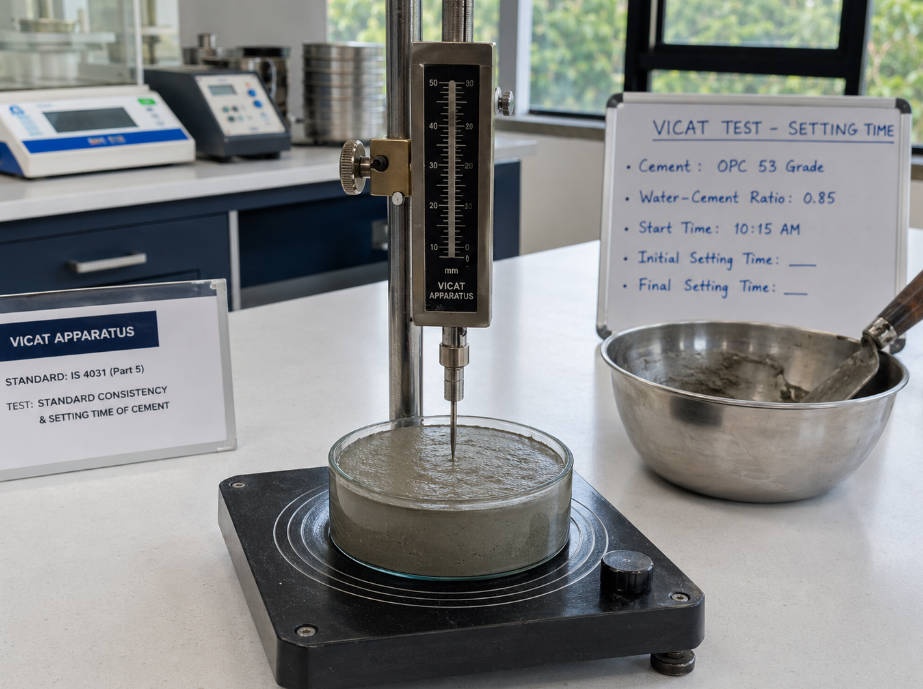
The consistency test determines the amount of water needed to produce a cement paste of standard consistency—the baseline for all subsequent tests including setting time and soundness.
Using a Vicat Apparatus, a 10 mm diameter plunger penetrates the cement paste. Standard consistency is reached when the plunger penetrates 33–35 mm within 3–5 minutes of mixing. The test is repeated with water content varying from 24% to 27% of cement weight until the target penetration is achieved.
Testing must be conducted at a controlled temperature of 25°C or 29°C and relative humidity of 20% to ensure reproducible results. The water percentage found in this test becomes the reference for preparing specimens in other tests.
Setting Time Test — Initial and Final Setting Explained
Cement must set within a workable time window—neither so fast that placement becomes impossible, nor so slow that construction schedules suffer. The Vicat Apparatus measures two critical points:
Initial Setting Time — A 1 mm square needle penetrates the cement paste (prepared at standard consistency). The time when penetration reaches 33–35 mm from the top is recorded as the initial set. This marks the point where the paste begins to lose plasticity.
Final Setting Time — After the paste has hardened, the needle penetrates no more than 0.5 mm. This time marks complete rigidity.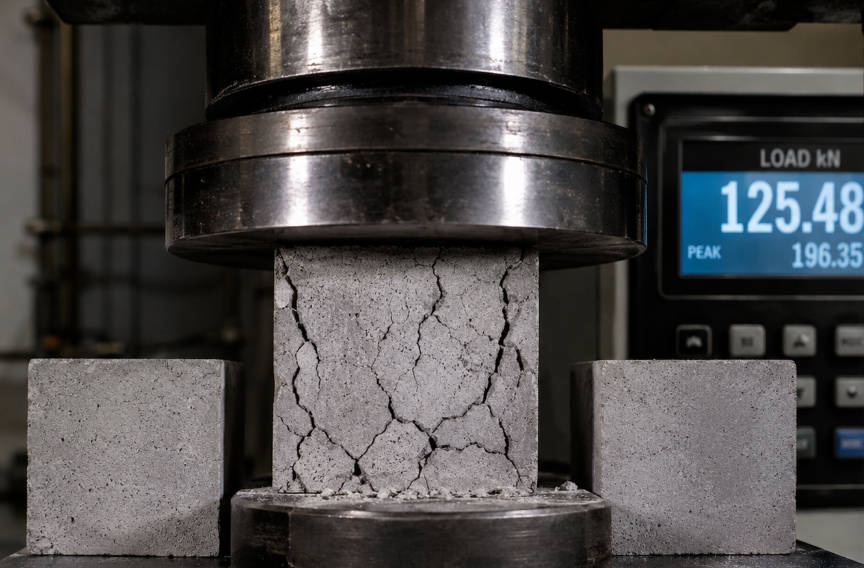
Two apparatus options exist:
-
Vicat Needle (ASTM C191 / AASHTO T 131) — The most common method
-
Gilmore Needles (ASTM C266 / AASHTO T 154) — An alternative using weighted needles
Proper setting times ensure that concrete remains workable during placement and gains strength at a predictable rate.
Soundness Test — Detecting Unstable Expansion
Unsound cement expands excessively after hardening, causing cracks and structural damage. The soundness test detects uncombined lime (calcium oxide) and magnesia—the primary culprits of delayed expansion.
The Le Chatelier method is the standard approach:
-
A cement paste ring is placed in a Le Chatelier mold with indicator needles
-
The assembly is immersed in water at boiling temperature for a specified period
-
The distance between needle tips is measured before and after boiling
-
Excessive expansion indicates unsound cement
The autoclave method provides an alternative, subjecting specimens to high-pressure steam to accelerate any potential expansion. Soundness testing is essential because the defects it reveals—unhydrated lime and magnesia—may not appear for months or years in actual structures.
Compressive Strength Test — Measuring Load-Bearing Capacity
Compressive strength is the single most important indicator of cement quality. Because cement alone cannot be tested for strength, the test uses cement mortar cubes (1:3 cement-to-sand ratio) prepared according to ASTM C109 / AASHTO T 106.
The process:
-
Mortar is mixed in a laboratory mixer and cast into 50 mm cube molds
-
Cubes are cured in a moist environment
-
Testing occurs at 2, 7, and 28 days using a compression testing machine
-
The average strength of multiple specimens must meet specification minimums
Equipment used includes laboratory mixers (also referenced in ASTM C227, C305), ASTM standard test sand (ASTM C778), and cube molds (also used in ASTM C87, C91, C311, C472, and others).
Compressive strength values directly determine whether cement is suitable for its intended application—from general-purpose Type I to high-early Type III.
Heat of Hydration Test — Controlling Thermal Cracking
Hydration of cement is an exothermic reaction—it releases heat. In mass concrete structures like dams and bridge abutments, excessive heat can cause thermal cracking as the interior expands while the surface cools and contracts.
The test is performed using a calorimeter that measures heat gain over time. Key limits for low-heat cement:
-
Must not exceed 65 calories per gram at 7 days
-
Must not exceed 75 calories per gram at 28 days
Type II and Type IV Portland cements, as well as many blended cements (Type IS, Type IP with MH suffix), are specifically formulated to reduce the heat of hydration. The fineness of the cement directly affects heat output—coarser particles hydrate more slowly and generate less heat.
Specific Gravity Test — Checking Cement Density and Purity
Specific gravity compares cement's density to water and typically ranges from 3.1 to 3.16. Deviations from this range signal potential adulteration or impurities.
Measurement methods include:
-
Le Chatelier flask — A graduated flask where kerosene displacement determines cement volume
-
Pycnometer — A precision vessel that measures the volume of a known cement mass
While not a daily field test, specific gravity is essential for mix design calculations and quality control. A lower-than-expected value may indicate contamination with lighter materials; a higher value may suggest heavy mineral adulterants.
Loss on Ignition (LOI) Test — Identifying Moisture and Volatiles
The LOI test measures weight loss when cement is heated to approximately 1000°C. This loss represents moisture, carbon dioxide from carbonates, and other volatile compounds.
High LOI values indicate problems:
-
Excess moisture from improper storage
-
Pre-hydration from exposure to humid air
-
Carbonation from prolonged atmospheric exposure
Cement with high LOI will have reduced strength and altered setting characteristics. Specifications set maximum LOI limits—typically not greater than 4%—to ensure the cement has not deteriorated during storage or transport.
Chemical Composition Test — Verifying Compound Proportions
Chemical analysis verifies that cement contains the correct proportions of silica, alumina, lime (calcium oxide), and iron oxide. Based on standards such as IS 269, key requirements include:
|
Parameter |
Requirement |
|---|---|
|
Alumina-to-iron oxide ratio |
Not less than 0.66 |
|
Lime Saturation Factor (LSF) |
0.66–1.02 |
|
Total loss on ignition |
Not greater than 4% |
|
Total sulphur content |
Not greater than 2.75% |
|
Insoluble residue |
Not greater than 1.50% |
|
Magnesia content |
Not greater than 5% |
These limits prevent alkali-aggregate reactions (detected through the alkali reactivity test), excessive expansion, and other long-term durability issues. Chemical composition testing is performed in a laboratory using X-ray fluorescence (XRF) or wet chemical methods.
What Are the Field Tests for Cement?
Before cement is mixed at a construction site, several simple field tests provide a quick quality check:
-
Colour Test — Cement should be a uniform grey with a light greenish shade. Uneven colour suggests contamination or inconsistent burning.
-
Lump Check — Hard lumps indicate moisture absorption. Cement bags with lumps should be rejected.
-
Adulteration Test — Cement rubbed between fingers should feel smooth. Grittiness suggests sand adulteration.
-
Float Test — Cement particles should float on water briefly before sinking. Immediate sinking indicates pre-hydration.
-
Manufacturing Date — Cement strength decreases with age. Use within 3 months of the manufacturing date for best results.
These tests take minutes but can prevent the use of compromised cement that would fail formal laboratory testing.
How Do Cement Test Methods Connect to Specifications?
Every cement specification references specific ASTM/AASHTO test methods as compliance requirements. The relationship is direct:
-
ASTM C150 (prescriptive) requires both chemical composition limits and passing physical tests
-
ASTM C595 (blended) mandates composition verification plus physical performance
-
ASTM C1157 (performance) requires only passing physical tests—chemistry is the manufacturer's choice
|
Test Method |
ASTM Standard |
Primary Spec |
|---|---|---|
|
Compressive Strength |
C109 / AASHTO T 106 |
C150, C595, C1157 |
|
Fineness (Sieve) |
C430 / AASHTO T 192 |
C150 |
|
Fineness (Blaine) |
C204 / AASHTO T 153 |
C150, C595 |
|
Setting Time (Vicat) |
C191 / AASHTO T 131 |
C150, C595, C1157 |
|
Setting Time (Gilmore) |
C266 / AASHTO T 154 |
C150 |
|
Soundness |
C151 / AASHTO T 107 |
C150, C595 |
|
Heat of Hydration |
C186 |
C150, C1157 |
Understanding which tests apply to which specification ensures that cement is evaluated against the correct criteria—whether the project specifies a prescriptive or performance-based approach. When all specified tests are passed, the cement is certified for use, and the structure built with it has a verified foundation of quality.