fire-resistant doors are one of the most critical passive fire protection elements in any building. They compartmentalize fire, protect escape routes, and prevent the spread of smoke and toxic gases between building zones. But a fire door is only as good as the test it has passed. This guide covers every major fire door testing standard worldwide, the classification criteria that determine ratings, and the technical methods used to evaluate whether a door assembly can survive real fire conditions.
Table of Contents
- What Is Fire-resistant door testing and Why Does It Matter
- Types of Fire-Resistant Doors
- North American Testing Standards: NFPA, UL, and ASTM
- European Testing Standards: EN 1634 and EN 13501
- International and Other Regional Standards
- Fire Resistance Classification Systems Compared
- Fire Door Test Procedure: Step by Step
- Critical Components: Seals, Hardware, and Hinges
- Smoke Control Testing
- Common Failure Modes in Fire door testing
- Industry Applications and Code Requirements
- How to Specify and Select a Fire-Resistant Door
- Summary
What Is Fire-Resistant Door Testing and Why Does It Matter
Fire-resistant door testing subjects a complete door assembly—door leaf, frame, hinges, latching hardware, seals, and any vision panels—to standardized fire exposure in a laboratory furnace. The test evaluates how long the assembly maintains three critical performance criteria:
- Integrity (E): No flames or hot gases pass through to the unexposed side. No cracks, holes, or sustained flaming.
- Insulation (I): The unexposed face temperature does not exceed 140°C above ambient (average) or 180°C at any single point.
- Radiation Control (W): Radiant heat flux on the unexposed side stays below 15 kW/m² at 1.0 meter distance.
Fire door testing matters because doors are the most frequently opened and closed fire-rated elements in a building. Unlike walls or floors, fire doors have moving parts, gaps around all four edges, and hardware that can degrade. A fire door that fails during a fire event—whether from seal failure, hinge distortion, leaf warping, or glass breakage—creates an immediate path for fire spread. Building codes worldwide mandate tested fire doors for stairwell enclosures, elevator lobbies, mechanical rooms, fire-rated corridors, hazardous material storage rooms, and any penetration of a fire-resistance-rated barrier.
Types of Fire-Resistant Doors
Fire doors are categorized by construction material and opening mechanism. Each type has distinct testing considerations: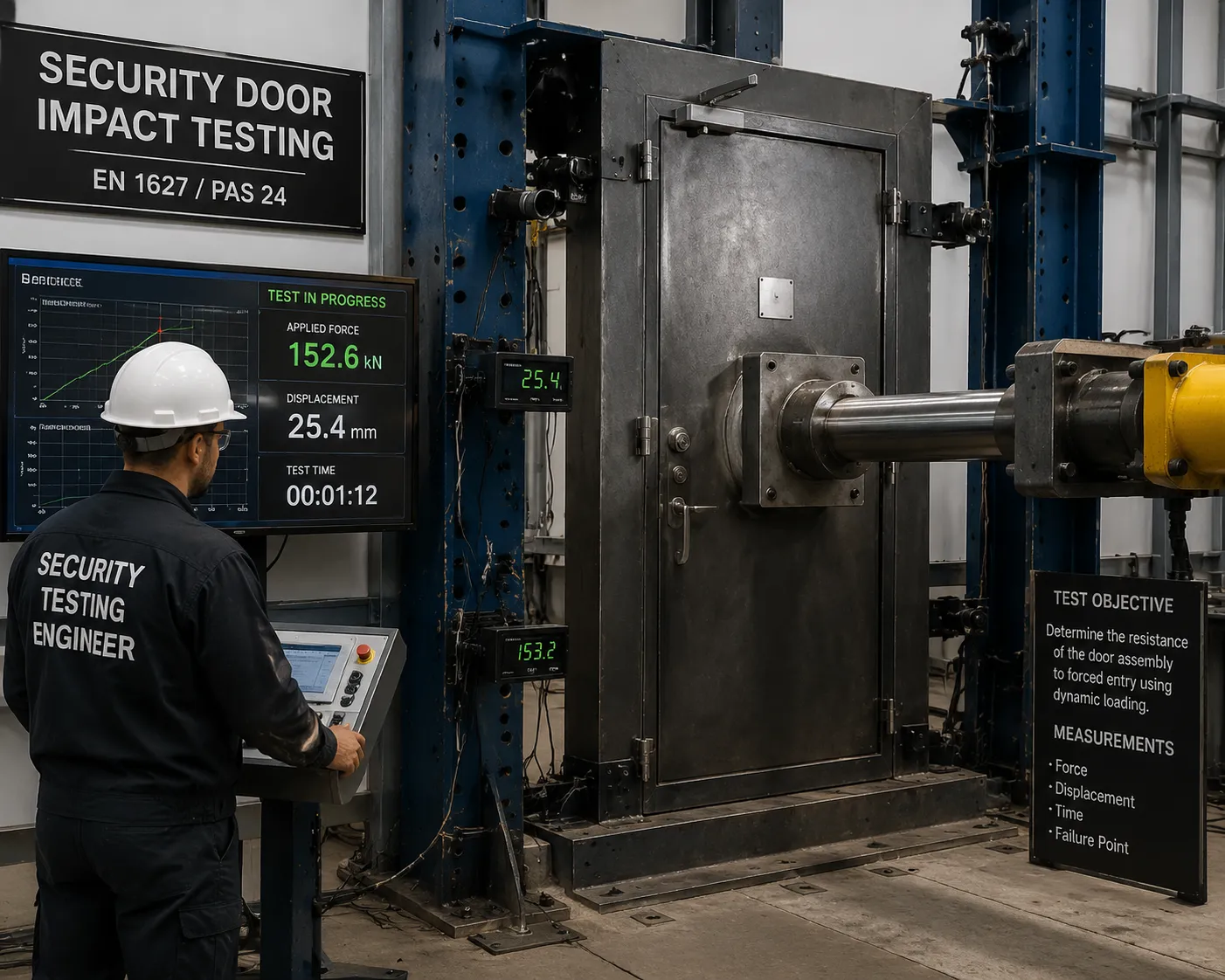
BHMA/ANSI A156
Grade Classification:
| Grade | Cycles | Security Features |
|---|---|---|
| Grade 1 | 1,000,000 | Highest security |
| Grade 2 | 400,000 | Medium security |
| Grade 3 | 200,000 | Basic security |
Test Parameters:
- Operational cycles: open/close
- Torque resistance: 100-300 in-lb
- Force resistance: 500-1500 lb
- Key cycle testing: 10,000-100,000
Lock Bump and Pick Resistance
Testing Methods:
- Bump key attack: 5-minute test
- Pick resistance: 10-minute test
- Impressioning: 60-minute test
- Drill resistance: 5-15 minute test
Performance Metrics:
- Time to defeat
- Skill level required
- Tools required
- Number of attempts
Environmental Durability Testing
Corrosion Resistance
ASTM B117 Salt Spray:
- 5% NaCl solution
- Temperature: 35°C
- Duration: 96-1000 hours
- Evaluate coating degradation
Cyclic Corrosion Tests:
- Alternate wet/dry cycles
- UV exposure periods
- Temperature cycling
- Real-world simulation
Temperature Cycling
Test Parameters:
- Low temperature: -40°C
- High temperature: +70°C
- Cycles: 20-100
- Dwell time: 4 hours each extreme
Evaluation:
- Dimensional stability
- Finish integrity
- Hardware function
- Seal condition
Humidity Resistance
Test Conditions:
- Relative humidity: 95% RH
- Temperature: 38°C
- Duration: 96-1000 hours
- Cyclic condensation
Acceptance Criteria:
- No corrosion of metal components
- No degradation of seals
- Hardware remains functional
- Finish intact
Wind Load Testing
ASTM E330:
- Uniform static air pressure
- Test pressures: ±20 to ±100 psf
- Measure deflection
- Verify operation after test
Performance Requirements:
- Maximum deflection: L/180 to L/60
- No permanent deformation
- Door operates freely after test
- Hardware intact
testing equipment and Facilities
Forced Entry Test Equipment
Test Fixtures:
- Rigid steel frame construction
- Adjustable mounting for various door sizes
- Instrumented for force measurement
- Video documentation capability
Tool Sets:
- Calibrated hand tools per standard
- Power tools with speed control
- Impact tools with energy measurement
- Specialized attack tools
Ballistic Test Equipment
Test Range:
- Controlled environment
- Velocity measurement system
- Target mounting fixture
- Backstop for safety
Instrumentation:
- Chronograph for velocity
- High-speed video
- Pressure transducers
- Spall collection system
Fire Test Furnace
Specifications:
- Temperature control: ±10°C
- Time-temperature curve programming
- Thermocouple array
- Hose stream capability
- Load application system
Acoustic Test Chambers
Requirements:
- Source room: 100-200 m³
- Receive room: 100-200 m³
- Background noise: <25 dB
- Reverberation time: 1-2 seconds
Quality Control Procedures
Incoming Material Testing
Visual Inspection:
- Dimensional verification
- Surface finish quality
- Hardware completeness
- Marking and labeling
Material Testing:
- Steel grade verification
- Coating thickness measurement
- Hardware material confirmation
- Seal material verification
In-Process Testing
Assembly Verification:
- Frame squareness
- Door panel alignment
- Hardware installation
- Seal application
Functional Testing:
- Operation cycles
- Lock function
- Latch engagement
- Hinge movement
Final Product Testing
Dimensional Inspection:
- Overall dimensions
- Frame opening size
- Door panel thickness
- Hardware placement
Performance Verification:
- Operation force
- Lock torque
- Seal compression
- Finish quality
Certification and Standards
US Certifications
UL Listings:
- UL 10B/10C: Fire resistance
- UL 752: Bullet resistance
- UL 325: Operator safety
BHMA Certification:
- ANSI/BHMA A156 series
- Grade 1/2/3 ratings
- Third-party testing
European Certifications
CE Marking:
- EN 16034: Fire and smoke
- EN 1627: Burglar resistance
- EN 1522: Bullet resistance
Additional Certifications:
- Secured by Design (UK)
- RC Mark (Netherlands)
- VdS (Germany)
International Standards
ISO Standards:
- ISO 9001: Quality management
- ISO 14001: Environmental
- ISO 45001: Safety
Regional Standards:
- AS/NZS (Australia/New Zealand)
- JIS (Japan)
- GB (China)
Frequently Asked Questions
How often should security doors be tested?
Initial certification testing is required for product qualification. Production testing should be performed on a statistical sampling basis, typically 1-5% of production. Field testing is recommended after installation and periodically throughout service life, especially after impact or attempted forced entry.
What is the difference between fire rating and fire resistance?
Fire rating is a classification indicating the duration of fire resistance (e.g., 60-minute). Fire resistance is the actual performance measured during testing. A 60-minute fire rating means the door assembly maintained integrity and insulation for 60 minutes during the standard fire test.
Can a door have multiple certifications?
Yes. Security doors can be tested and certified for multiple performance criteria including fire resistance, forced entry, ballistic resistance, and acoustic performance. However, combining features may require design compromises and should be verified through testing.
What is the difference between STC and Rw?
STC (Sound Transmission Class) is the North American rating based on ASTM E90 testing. Rw is the European equivalent based on ISO 10140. While both measure sound insulation, they use different frequency ranges and calculation methods, making direct conversion approximate.
How are blast ratings determined?
Blast ratings are determined by subjecting the door to a controlled explosive charge at a specified distance. The door must withstand the peak pressure and impulse without catastrophic failure. Ratings are expressed as charge weight and standoff distance or as pressure-impulse combinations.
What maintenance is required for certified security doors?
Regular maintenance includes lubricating hardware, checking seal condition, verifying lock operation, and inspecting for damage. Fire-rated doors require annual inspections per NFPA 80. Security-rated doors should be inspected after any impact or attempted entry.
Conclusion
Security door testing provides the essential foundation for ensuring life safety, property protection, and regulatory compliance across residential, commercial, and institutional applications. Comprehensive testing programs that include forced entry, ballistic, fire, and acoustic evaluation ensure that security doors will perform reliably when needed most.
Understanding testing methods, properly interpreting results, and applying this knowledge to product selection and specification enables architects, security professionals, and building owners to make informed decisions that protect people and property.
Key takeaways:
- Forced entry testing validates resistance to physical attacks
- Ballistic testing ensures protection against firearm threats
- Fire testing certifies life safety performance
- Acoustic testing measures sound insulation effectiveness
- Locking system testing verifies security hardware performance
- Environmental testing ensures long-term durability
- Certification provides independent verification of performance
- Quality control maintains consistency in production
The investment in proper testing and certification pays dividends through enhanced safety, reduced liability, lower insurance costs, and increased confidence in security door performance.
Note: This article provides general guidance on security door testing methods. Always consult applicable standards (ASTM, UL, EN, ISO), building codes, and manufacturer specifications for detailed testing procedures and acceptance criteria. Reference authoritative sources including ASTM International, Underwriters Laboratories, and European Committee for Standardization (CEN).
North American Testing Standards: NFPA, UL, and ASTM
North American fire door testing uses a distinct set of standards with mandatory hose stream testing—unlike European practice.
NFPA 252: Standard Methods of Fire Tests for Door Assemblies
NFPA 252 is the primary fire test standard for door assemblies in the United States and Canada:
- Scope: Fire tests for swinging door assemblies, including the door leaf, frame, hinges, latching hardware, and glazing if present
- Specimen size: Minimum 7 ft (2.13 m) high by 3 ft 4 in (1.02 m) wide—the largest practical single-leaf size to capture worst-case performance
- Fire exposure: Standard time-temperature curve (consistent with ASTM E119/ISO 834), reaching approximately 1,700°F (927°C) at 30 minutes
- Rating increments: 20, 30, 45, 60, 90, 120, and 180 minutes
- Hose stream test: Mandatory after fire exposure. A standard fire hose nozzle at approximately 30 psi water pressure is directed at the specimen. The assembly must not develop openings after this combined thermal shock and impact
- Temperature rise (optional): When an assembly also seeks a temperature rise rating, thermocouples on the unexposed face are monitored. Rating designations include "T" (250°F rise), "H" (450°F rise), or no letter (temperature rise not rated)
UL 10B: Fire Tests of Door Assemblies
UL 10B is Underwriters Laboratories' standard for fire door assemblies:
- Scope: Swinging door assemblies with or without vision panels
- Fire exposure: Standard time-temperature curve
- Hose stream: Required after fire endurance test
- Positive vs. neutral pressure: UL 10B originally used neutral pressure conditions. Positive pressure testing was introduced via UL 10C (see below)
- Classification: UL assigns ratings and lists assemblies in the UL Fire Resistance Directory. Ratings are designated with or without temperature rise limits
- Ambient temperature rise ratings:
- No temperature rise designation: integrity only
- 250°F (139°C) temperature rise: moderate insulation
- 450°F (232°C) temperature rise: basic temperature limitation
UL 10C: Positive Pressure Fire Tests of Door Assemblies
UL 10C represents a significant evolution in fire door testing by introducing positive pressure conditions:
- Key change: The furnace applies positive pressure on the fire side—specifically, the pressure at the neutral pressure plane is set such that the pressure differential across the specimen at the top is 0.01 inch water gauge (approximately 2.5 Pa)
- Why it matters: In a real building fire, hot gases create positive pressure at the top of a door opening and push through gaps around the top edge, lock stile, and hinge stile. Positive pressure testing is significantly more demanding than neutral pressure and reveals seal and gasket weaknesses that would otherwise go undetected
- Impact on fire door ratings: Many door assemblies that passed under UL 10B (neutral pressure) failed to maintain their ratings when retested under UL 10C. This led to widespread redesign of intumescent seals and frame geometry
- Adoption: Many building codes now require UL 10C-positive-pressure-rated fire doors, especially for stairwell and elevator lobby enclosures
UL 3059: Drop-Out Fire Shutters
UL 3059 covers a specialized category—fire shutters with fusible links that drop automatically:
- Scope: Fire shutter assemblies with fusible-link drop-out mechanisms
- Test method: Fire exposure until the fusible link activates, then evaluation of the closed assembly
- Application: Used to protect openings such as counter windows, conveyer openings, and ventilation grilles in fire-rated walls
ASTM E152: Fire Tests of Door Assemblies
ASTM E152 is the ASTM counterpart to NFPA 252/UL 10B:
- Scope: Fire tests of door assemblies to determine their fire resistance rating
- Procedure: Similar to NFPA 252, including furnace exposure and hose stream test
- Status: Largely superseded by NFPA 252 and UL standards in practice, but remains referenced in some specifications
European Testing Standards: EN 1634 and EN 13501
Europe uses a structured two-document system: EN 1634-1 defines the test method and EN 13501-2 defines the classification system.
EN 1634-1: Fire Resistance Tests for Door and Shutter Assemblies
EN 1634-1 is the primary European fire test standard for door assemblies:
- Scope: Fire resistance tests for door and shutter assemblies, including single-leaf and double-leaf doors, hinged and pivoting doors, and doors with vision panels
- Fire curve: ISO 834 standard time-temperature curve: T = 345 × log₁₀(8t + 1) + 20°C, reaching approximately 945°C at 60 minutes and 986°C at 90 minutes
- Pressure conditions: The furnace applies a pressure gradient—positive pressure at the top (approximately 20 Pa), neutral at mid-height, and negative at the bottom. This mimics real fire conditions where buoyancy drives hot gases upward
- Specimen installation: The complete door assembly is installed in a test frame exactly as it would be in practice, including all seals, hinges, closers, and latching hardware
- Optional tests: EN 1634-1 also includes provisions for testing door assemblies under mechanical cycling (repeated opening/closing before fire test), soft body and hard body impact, and wind load conditions
EN 13501-2: Fire Classification of Construction Products
EN 13501-2 assigns classifications based on EN 1634-1 test results. Fire doors are classified using letter codes:
| Classification | Integrity (E) | Radiation (W) | Insulation (I) | Common Door Rating |
|---|---|---|---|---|
| E | Required | Not measured | Not measured | E30, E60, E90, E120 |
| EW | Required | ≤15 kW/m² at 1m | Not measured | EW30, EW60, EW90 |
| EI | Required | Not measured | ≤140°C avg / 180°C max | EI30, EI60, EI90, EI120 |
Integrity (E) verification uses three methods:
- Cotton pad test: A cotton pad held near any crack or opening on the unexposed side must not ignite
- Gap gauge test: A 6mm gap gauge must not pass through any opening; a 25mm gap gauge must not penetrate more than 150mm into any crack
- Visual observation: No sustained flaming on the unexposed face
EN 16034: Product Standard for Fire-Resisting Doors
EN 16034 is the harmonized European product standard. Fire doors that pass EN 1634-1 testing and receive EN 13501-2 classification are marked with CE/UKCA under EN 16034. The manufacturer must declare fire resistance performance, and the product carries a label showing the classification (e.g., "EI60—S200—C5" indicating 60-minute EI rating with smoke control at 200°C and 5,000 cycle mechanical durability).
EN 1191: Mechanical Durability of Fire Doors
A supplementary standard that tests how many times a fire door can be opened and closed while still maintaining its fire resistance:
- Cycles: 100,000, 200,000, 500,000, or 1,000,000 operating cycles
- After cycling: The door must still pass the fire resistance test per EN 1634-1
- Classification: C0 (no cycling test), C1 (100,000 cycles), C2 (200,000 cycles), C3 (500,000 cycles), C4 (1,000,000 cycles)
International and Other Regional Standards
| Standard | Region | Scope | Key Feature |
|---|---|---|---|
| ISO 834 | International | Defines the standard fire curve used globally | T = 345×log₁₀(8t+1)+20 |
| ISO 3008 | International | Fire resistance of door and shutter assemblies | Closely aligned with EN 1634-1 |
| BS 476 Part 22 | UK (legacy) | Fire resistance of non-loadbearing elements | Superseded by EN standards |
| AS 1530.4 | Australia/NZ | Methods for fire tests on building elements | Similar to ISO 834 |
| CAN/ULC-S134 | Canada | Fire tests of door assemblies | Similar to NFPA 252 with hose stream |
| GB 12955 | China | Fire doors — requirements and test methods | Follows ISO 834; mandatory for Chinese building code |
| JIS A 1311 | Japan | Fire resistance test for door assemblies | Japanese fire curve |
GB 12955: Chinese Fire Door Standard
GB 12955 is a critical standard in the Chinese market. It classifies fire doors into five grades:
- Class A (甲级): 1.5 hours (90 minutes) fire resistance
- Class B (乙级): 1.0 hour (60 minutes) fire resistance
- Class C (丙级): 0.5 hour (30 minutes) fire resistance
- Class D: 0.25 hour (15 minutes) — less common
- Class E: 0.15 hour (9 minutes) — rarely used
GB 12955 mandates specific door construction: Class A doors must have steel frames, mineral cores, and steel-reinforced edges. The standard also specifies maximum door leaf dimensions, hardware requirements, and mandatory labeling with the fire resistance rating.
Fire Resistance Classification Systems Compared
| Criterion | North America (NFPA/UL) | Europe (EN 13501-2) | China (GB 12955) |
|---|---|---|---|
| Integrity | No openings; hose stream post-fire | E: cotton pad + gap gauge (6/25mm) | No flame penetration on unexposed side |
| Insulation | Optional: 250°F or 450°F rise | I: ≤140°C avg / 180°C max | Unexposed surface ≤140°C avg / 180°C max |
| Radiation | Not classified separately | W: ≤15 kW/m² at 1.0m | Not classified separately |
| Hose stream | Required by NFPA 252, UL 10B, 10C | Not required | Not required |
| Pressure | UL 10C: 2.5 Pa positive at top | EN 1634-1: ~20 Pa gradient at top | Not specified (neutral) |
| Rating format | 20/30/45/60/90/120/180 min (+ T/H) | E/EW/EI + minutes | 甲/乙/丙 (90/60/30 min) |
| Smoke control | UL 10C includes optional S rating | S200 (200°C cold smoke) | Required for all grades |
Fire Door Test Procedure: Step by Step
1. Specimen Preparation
The complete door assembly—leaf, frame, hinges, latching hardware, closer, seals, and any vision panels—is installed in a test frame exactly matching the manufacturer's installation instructions. Critical details include:
- Frame-to-wall anchorage method and spacing
- Intumescent seal placement and compression
- Door closer adjustment (if applicable)
- Latch engagement depth
- Vision panel glazing method and sealant
The specimen is conditioned at 23±2°C and 50±5% relative humidity for a minimum of 24 hours.
2. Instrumentation
- Thermocouples: Minimum 9 points on the unexposed face of the door leaf (center + 8 distributed points), plus additional on the frame and any hardware. Unexposed face thermocouples for insulation rating
- Furnace thermocouples: Verify standard time-temperature curve compliance
- Pressure taps: Monitor differential pressure at multiple heights
- Radiometers: 1.0m from the unexposed face (for EW classification)
- Deflection gauges: Measure leaf bowing and frame distortion
- Video recording: Continuous visual documentation of the unexposed side
3. Fire Exposure
The furnace follows the standard time-temperature curve. Key milestones:
| Time | Furnace Temperature (ISO 834) | Typical Observations |
|---|---|---|
| 5 min | ~576°C | Intumescent seals begin activating (~140–200°C at seal location) |
| 10 min | ~678°C | Seals fully expanded; door leaf surface charring begins |
| 20 min | ~784°C | Significant leaf deformation possible; hardware stress increasing |
| 30 min | ~842°C | Critical period; many door failures occur between 20–35 min |
| 60 min | ~945°C | Severe stress on all components; high-end ratings only |
| 90 min | ~986°C | Only specialized steel/industrial doors survive |
| 120 min | ~1,013°C | Premium industrial fire door territory |
| 180 min | ~1,090°C | Very rare; custom-engineered assemblies only |
4. Continuous Monitoring
Throughout the test, technicians monitor:
- Cotton pad testing at regular intervals (every 5 minutes initially, then every 10 minutes)
- Gap gauge insertion at any visible cracks
- Visual observation for sustained flaming
- Thermocouple temperature readings (recorded continuously)
- Door leaf deflection measurements
- Hardware functionality (does the latch stay engaged? Does the leaf separate from the frame?)
5. Hose Stream Test (North America)
After the fire endurance period, the assembly is immediately subjected to:
- Standard fire hose nozzle at 30 psi (207 kPa) water pressure
- Stream directed at the specimen from a specified distance
- Duration: typically 3 minutes of direct impact
- The assembly must not develop openings permitting fire passage after the hose stream
This uniquely North American requirement tests structural integrity under combined thermal shock and water impact—simulating real firefighting conditions. Many assemblies that survive the fire exposure fail the hose stream test.
Critical Components: Seals, Hardware, and Hinges
Intumescent Seals
Intumescent seals are the single most critical component for fire door integrity. They expand when heated to seal the gaps around the door leaf edges:
| Seal Location | Function | Activation Temp | Expansion |
|---|---|---|---|
| Leaf edge (all four sides) | Seal gap between leaf and frame | 140–200°C | 3:1 to 10:1 |
| Frame-to-wall junction | Seal gap between frame and structural opening | 140–250°C | 3:1 to 8:1 |
| Vision panel perimeter | Seal gap between glass and frame | 120–180°C | 3:1 to 6:1 |
| Letter plate / transom | Seal around penetrations | 140–200°C | 3:1 to 10:1 |
A fire door typically has three types of seals:
- Cold smoke seal: Prevents smoke leakage at ambient temperatures. Made of brush pile or elastomeric strip. Required for EN classifications (S200 designation)
- Intumescent seal: Expands when heated to maintain integrity. Mounted in grooves in the door leaf edge or frame rebate
- Combined intumescent + smoke seal: A single component that provides both cold smoke sealing and intumescent fire protection
Hardware
Fire door hardware must be rated for the same fire resistance as the door leaf. Critical hardware includes:
- Hinges: Minimum 3 hinges per leaf; ball bearing or continuous pin; must maintain leaf alignment under fire conditions. Steel or stainless steel required
- Latch/bolt: Must remain engaged throughout the fire exposure. Locking mechanisms that fail under thermal expansion can cause the door to swing open, creating a catastrophic failure mode
- Door closer: Must hold the door closed against fire-induced pressures. Listed fire door closers are required
- Vision panel hardware: Glazing beads, retention clips, and gaskets must maintain glass retention
Self-Closing Mechanisms
All fire doors in building code applications must be self-closing. This means:
- A listed door closer or spring hinges rated for the fire door assembly
- The closer must be capable of overcoming the resistance of intumescent seals and latches
- Positive latching is required—the door must latch automatically when closed, not merely remain in the closed position
Smoke Control Testing
Smoke kills more people in building fires than flames or heat. Fire door smoke control is increasingly important:
European system (EN 13501-2):
- S200: Cold smoke resistance at 200°C—measures air leakage rate at ambient temperature under a pressure differential of 20 Pa. Maximum leakage: 20 m³/h per meter of seal length for a closed door
- This is declared separately from the fire resistance classification, e.g., "EI60—S200"
UL/NFPA system:
- UL 10C includes an optional smoke control test
- The door assembly is pressurized to maintain a specific differential and leakage is measured
- Designated with an "S" suffix in the UL listing
Common Failure Modes in Fire Door Testing
| Failure Mode | Typical Time of Occurrence | Root Cause | Prevention |
|---|---|---|---|
| Leaf warping/bowing | 20–45 min | Uneven heating of leaf surfaces; thermal expansion mismatch between core and skin | Symmetric construction; reinforced edges; steel stiles |
| Intumescent seal failure | 30–90 min | Seal over-expansion, burnout, or erosion under furnace pressure | Match seal type and size to rating; proper groove depth |
| Hinge failure | 20–60 min | Hinge pin shear from leaf weight under distortion; thermal softening | Minimum 3 hinges; ball-bearing; heavy-duty rating |
| Latch disengagement | 15–45 min | Thermal expansion pushes latch bolt out of strike; latch material softens | Positive latching; extended throw bolts; steel components |
| Vision panel failure | 20–60 min | Glass breakage or softening; glazing bead failure | Use appropriate fire-rated glass; mechanical retention clips |
| Frame-to-wall gap | 30–90 min | Frame pulls away from surrounding structure; insufficient anchorage | Proper anchorage spacing; intumescent mastic at perimeter |
| Stile/edge failure | 30–60 min | Edge material burns through faster than face; glue-line failure | Steel edge channels; fire-resistant adhesive |
| Hose stream failure | Post-fire (NA only) | Thermal shock + water impact cracks charred or weakened sections | Adequate structural backing; reinforced core |
Industry Applications and Code Requirements
Fire doors are mandated in specific locations by virtually all building codes worldwide:
Stairwell enclosures: The most critical application. Fire doors must typically achieve a minimum 60-minute rating (EI60 in Europe, 1-hour in North America, Class B/乙级 in China). Self-closing and positive latching are mandatory.
Elevator lobby enclosures: Similar to stairwells, minimum 60-minute fire doors are required. In high-rise buildings, 90-minute or 120-minute ratings may be specified.
Mechanical/electrical rooms: Fire doors protect these areas from fire spread and protect the building from fires originating within equipment rooms. Ratings range from 60 to 120 minutes depending on occupancy.
Fire-rated corridors: Doors in corridor walls must match the wall's fire-resistance rating. A 2-hour corridor requires 120-minute fire doors.
Hazardous material storage: Rooms storing flammable liquids, compressed gases, or chemicals typically require the highest-rated fire doors—90 to 180 minutes with positive latching.
Industrial kitchens and boiler rooms: Fire doors separate these high-risk areas from occupied spaces. Minimum 60-minute ratings are typical.
Rolling shutters for counter openings: UL 3059-rated drop-out shutters protect service counters, conveyor openings, and ventilation openings in fire-rated walls.
How to Specify and Select a Fire-Resistant Door
- Determine code-required rating: Consult local building codes and fire codes for the minimum rating at each door location. Consider whether integrity only (E), integrity plus insulation (EI), or a specific temperature rise rating is required
- Verify third-party certification: Look for UL listing, Intertek (ETL) certification, FM Approval, certification, or CE/UKCA marking under EN 16034. Certification means the complete assembly was tested—not just individual components
- Check the test report scope: Fire door ratings apply to the specific tested configuration—leaf thickness, core material, frame type, seal system, and hardware. Substituting any component (e.g., a different hinge brand) may void the listing unless explicitly covered
- Match the usage classification: For doors in high-traffic areas (corridors, stairwells), verify mechanical durability (EN 1191 C-rating). A door rated EI60 but only tested for C0 (no cycling) may not be appropriate for a stairwell door opened 200+ times daily
- Confirm smoke control capability: If the application requires smoke resistance (which most stairwell and corridor doors do), verify the S200 designation (European) or UL S-rating
- Inspect installation quality: A perfectly rated fire door fails if poorly installed. Critical installation points include: frame plumb and square, proper anchorage, seal compression, latch engagement depth, closer adjustment, and adequate clearance (too much clearance = larger gaps to seal; too little = binding and premature wear)
Summary
Fire-resistant door testing is a rigorous, multi-standard discipline that evaluates complete door assemblies under extreme conditions. North America requires hose stream testing (NFPA 252, UL 10B/10C); Europe uses EN 1634-1 with the granular E/EW/EI classification system and optional smoke control (S200); China mandates GB 12955 with its 甲/乙/丙 grade system. The most common failure points—leaf warping, seal failure, hinge shear, and latch disengagement—occur between 20 and 60 minutes of fire exposure. Certification covers the complete tested assembly, not individual components. Always verify the test report matches your exact configuration, and ensure proper installation by qualified personnel. A fire door is only as good as its weakest component—and that includes the installation.