What Is Disinfecting Machine Testing and Why It Matters
Disinfecting machine testing is the systematic process of verifying that automated disinfection equipment — including washer-disinfectors, automated endoscope reprocessors (AERs), UV disinfection systems, and aerosolized hydrogen peroxide (aHP) foggers — consistently achieves the microbial log reduction required for patient safety. Unlike manual disinfection, which depends on operator technique, machine-based disinfection must be validated through quantitative microbiological methods before it is put into clinical service and monitored at regular intervals thereafter.
The stakes are high. Inadequately disinfected medical devices have been linked to some of the most serious healthcare-associated infection (HAI) outbreaks in recent history. Between 2013 and 2015, carbapenem-resistant Enterobacteriaceae (CRE) infections traced to contaminated duodenoscopes at multiple US hospitals resulted in patient deaths — even though hospital staff had followed the manufacturer's disinfection protocol. These incidents exposed a critical gap: protocols validated under laboratory conditions may fail in real-world use due to device design features (such as the elevator-wire channel in duodenoscopes) that prevent disinfectant contact.
Disinfecting machine testing answers one question: does the machine actually kill what it claims to kill, under the worst-case conditions it will encounter? The answer must be quantitative (log reduction), reproducible, and documented.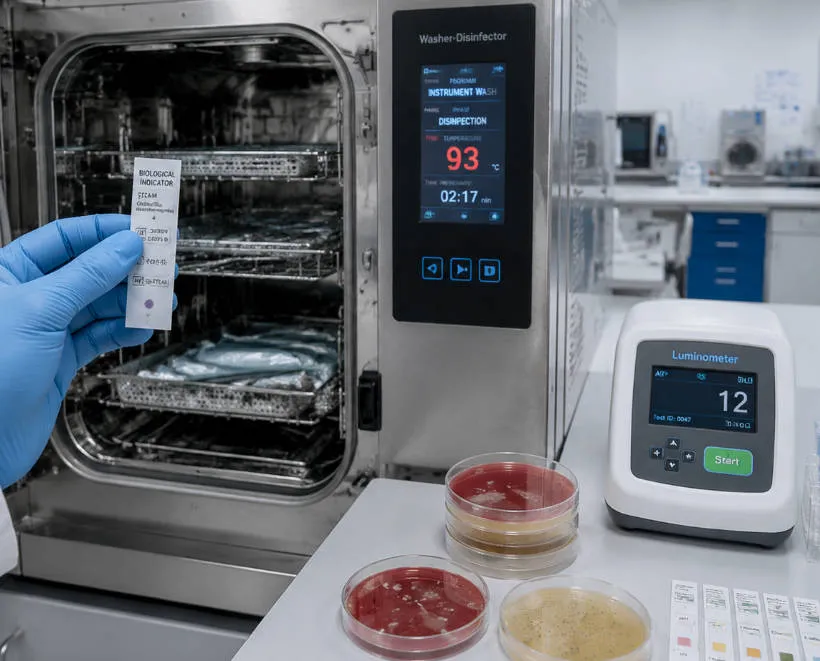
Key Standards for Disinfecting Machine Testing
Testing disinfection machines requires adherence to internationally recognized standards. The table below summarizes the most important standards governing machine-based disinfection validation.
|
Standard |
Scope |
Key Requirements |
|---|---|---|
|
ISO 15883-1 |
Washer-disinfectors — general requirements |
Defines performance tests, type tests, and routine tests for thermal disinfection |
|
ISO 15883-2 |
Washer-disinfectors — surgical instruments |
Specific test soils, temperature profiles, and log reduction criteria |
|
ISO 15883-4 |
Washer-disinfectors — thermolabile endoscopes |
Validation for AER-compatible machines processing flexible scopes |
|
ISO 15883-5 |
Washer-disinfectors — test soils and methods |
Standardized artificial test soils for reproducible validation |
|
ISO 17664 |
Medical device reprocessing — manufacturer's instructions |
Requires manufacturers to provide validated disinfection instructions |
|
AAMI TIR12 |
Designing, testing, and labeling reusable medical devices |
Guidance on selecting appropriate disinfection levels and test methods |
|
ANSI/AAMI ST58 |
Chemical sterilization and high-level disinfection |
Covers liquid chemical sterilants and HLD in automated systems |
|
ANSI/AAMI ST79 |
Steam sterilization in healthcare facilities |
Comprehensive guide for sterile processing departments |
|
EN ISO 14971 |
Medical device risk management |
Risk-based approach to selecting disinfection validation parameters |
|
EPA 810 Series |
Disinfectant product registration |
Test methods for registering disinfectant claims (sanitizer through sterilant) |
|
AOAC 960.09 / 955.15 |
Use-dilution and phenol coefficient tests |
Classic methods for evaluating disinfectant efficacy |
COre testing Methods Explained
Disk-Diffusion Method
The disk-diffusion method measures the effectiveness of a chemical disinfectant against a specific microorganism. Sterile filter paper disks impregnated with different disinfectant concentrations are placed on an agar plate inoculated with the target bacterium. As the chemical diffuses outward, clear zones of inhibition form. Larger zones correlate with greater antimicrobial effectiveness. This method is primarily used for screening and comparing disinfectant formulations rather than validating machine performance, but it remains a standard laboratory tool.
Use-Dilution Test (AOAC)
The AOAC use-dilution test evaluates disinfectant efficacy on contaminated surfaces. stainless steel cylinders are dipped in a culture of the target organism and dried, then immersed in disinfectant solutions at various concentrations for a specified contact time. The cylinders are transferred to sterile recovery medium, and bacterial survival is assessed by turbidity after incubation. The AOAC requires that a minimum of 59 out of 60 replicates show no growth for a passing result. This method directly informs the validation of disinfection cycles in automated machines.
In-Use Test
The in-use test monitors whether disinfectant solutions currently in clinical use remain free of microbial contamination. A 1 mL sample of the used disinfectant is diluted in sterile broth containing a disinfectant inactivator, and drops are inoculated onto agar plates. Growth of five or more colonies on either plate indicates contamination. This is a routine quality assurance test for healthcare facilities, not a machine validation method, but it is essential for ongoing monitoring of automated reprocessing systems.
Washer-Disinfector Validation (ISO 15883)
ISO 15883 is the primary international standard for washer-disinfector testing and validation. Validation follows a three-phase qualification process:
Installation Qualification (IQ): Verifies that the machine is correctly installed — water supply, drainage, electrical connections, and software configuration match the manufacturer's specifications.
Operational Qualification (OQ): Confirms that the machine operates within its design parameters across the full range of programmed cycles. Temperature sensors, flow meters, and dosing systems are calibrated and tested under empty-chamber and partial-load conditions.
Performance Qualification (PQ): Demonstrates that the machine achieves the required cleaning and disinfection outcomes with real or simulated instruments under worst-case loading conditions. This phase uses standardized test soils (blood, protein, carbohydrate, and lipid mixtures as defined in ISO 15883-5) and challenge organisms.
The table below shows the typical log reduction requirements by disinfection level:
|
Disinfection Level |
Target Organisms |
Required Log Reduction |
Typical Temperature |
|---|---|---|---|
|
Low-level disinfection |
Vegetative bacteria, enveloped viruses |
≥3 log |
20–40 °C |
|
Intermediate-level disinfection |
Vegetative bacteria, fungi, some viruses |
≥4 log |
40–60 °C |
|
High-level disinfection (HLD) |
All microorganisms except large numbers of spores |
≥6 log (bacteria), ≥4 log (viruses) |
20–25 °C (chemical) |
|
Thermal disinfection (A0 value) |
Vegetative bacteria, fungi, viruses |
A0 ≥ 60 (minimum), A0 ≥ 600 (enhanced) |
≥80 °C |
The A0 concept, defined in ISO 15883-1, expresses the disinfection effectiveness of a thermal process as the equivalent time in seconds at 80 °C. An A0 value of 600 means the thermal disinfection phase provides the same microbial kill as holding the load at 80 °C for 600 seconds with a z-value of 10 °C.
Automated Endoscope Reprocessor Testing
Endoscopes represent the most challenging category of semicritical medical devices for machine disinfection. Their long, narrow channels, intricate mechanisms (elevator-wire channels, auxiliary water channels), and heat-sensitive materials make complete disinfectant contact difficult to verify.
Why Endoscope Testing Is Critical
More healthcare-associated infection outbreaks have been linked to contaminated endoscopes than to any other medical device. A 1993 review identified 281 infections transmitted by gastrointestinal endoscopy and 96 by bronchoscopy. Salmonella species and Pseudomonas aeruginosa were the most common causative agents for GI endoscopy, while M. tuberculosis, atypical mycobacteria, and P. aeruginosa dominated bronchoscopy-related transmissions.
The bioburden on flexible GI endoscopes after use ranges from 10⁵ to 10¹⁰ CFU/mL, with the highest levels in suction channels. Cleaning reduces this by 4–6 log₁₀, and subsequent high-level disinfection adds another 4–6 log₁₀ reduction.
Validation Approach
AER validation testing involves:
-
Inoculation: Endoscope channels are inoculated with challenge organisms (typically Enterococcus faecalis and Bacillus subtilis spores) suspended in organic soil (horse blood or standardized test soil).
-
Drying: The inoculum is dried to simulate worst-case clinical conditions.
-
Processing: The endoscope is reprocessed through the AER using the manufacturer's standard cycle.
-
Recovery: Post-processing, each channel is flushed with recovery medium, and the eluate is cultured quantitatively.
-
Log Reduction Calculation: CFU counts before and after processing determine the log reduction achieved.
A passing result requires log reduction >5–6 for E. faecalis (disinfection) and >5–6 for B. subtilis spores (cleaning efficacy on surfaces with adequate water contact).
Five Methods of Testing Disinfection Efficacy
Five principal methods are used to evaluate disinfection machine performance, each with distinct strengths and limitations.
|
Method |
Measures |
Turnaround |
Sensitivity |
Best For |
|---|---|---|---|---|
|
ATP bioluminescence |
Organic residue (live + dead) |
~60 seconds |
Moderate |
Rapid cleaning verification |
|
Incubated ATP |
Live organisms only |
4–8 hours |
Moderate |
Same-day disinfection check |
|
Microbial culture |
Viable CFUs |
24–48 hours |
High (log quantifiable) |
Quantitative log reduction |
|
Chemical strips / sensors |
Disinfectant concentration |
Seconds (strips) / real-time (sensors) |
Chemical only |
Dosage verification |
|
Biological indicators (BI) |
Spore kill (worst case) |
7 days |
Gold standard |
Validation & annual requalification |
ATP Bioluminescence
ATP testing detects adenosine triphosphate from all organic matter — living and recently killed. A swab is immersed in luciferase reagent, and bioluminescence is measured in a luminometer. It provides immediate feedback on cleaning thoroughness but cannot distinguish between live pathogens and dead organic residue, making it unsuitable for validating disinfection kill claims.
Incubated ATP
An intermediate incubation step (4–8 hours in enrichment broth) allows only live organisms to multiply, minimizing the confounding effect of dead-cell ATP. This method provides same-day results for disinfection verification but has large measurement uncertainty due to sensitivity to incubation time and organism growth rates.
Microbial Culture
The gold standard for quantifying pathogen log reduction. Test surfaces are inoculated with a known concentration of challenge organisms, treated with the disinfection process, then swabbed and plated. After 24–48 hours of incubation, colony forming units (CFUs) are counted. The ratio of treated to untreated counts yields the log reduction. This method can characterize very high log reductions (limited only by initial inoculum size) and is scientifically verifiable and repeatable.
Chemical Strips and Electrochemical Sensors
Colorimetric test strips and amperometric sensors measure disinfectant chemical concentration (quats, chlorine, hydrogen peroxide). They provide rapid or real-time data but do not directly measure microbial kill — the chemical reading must be correlated with biological efficacy data from other tests.
Biological Indicator Testing
BI testing uses standardized spore strips (e.g., Bacillus atrophaeus as a surrogate for Clostridioides difficile) placed throughout the disinfection chamber. After exposure, strips are incubated in growth medium for seven days. If the medium remains clear (no growth), complete inactivation is confirmed. BI testing is recognized as the most reliable method for validating real-world disinfection performance and is used for initial validation and annual requalification.
Industry Applications
Hospitals and Surgical Centers
Hospital sterile processing departments (SPDs) use washer-disinfectors validated to ISO 15883 for reprocessing surgical instruments, and AERs for flexible endoscopes. Routine testing includes daily or weekly biological indicator tests, monthly ATP checks, and quarterly bacterial surveillance cultures of processed endoscopes and final rinse water.
Dental Clinics
Dental instruments classified as critical (extraction forceps, scalpel blades, surgical burs) require sterilization. Semicritical items (amalgam condensers, handpieces) are sterilized when heat-tolerant, or high-level disinfected when heat-sensitive. CDC guidelines specify that handpieces must be heat sterilized after each patient — handpieces that cannot be heat sterilized should not be used.
Pharmaceutical Manufacturing
Cleanroom disinfection machines (pass-through hatches, automated fogging systems) must be validated using biological indicators and chemical concentration mapping. EPA 810 series test methods and USP <1072> antimicrobial effectiveness testing apply.
Water Treatment
Municipal water treatment plants test disinfectant efficacy using DPD colorimetric methods for residual chlorine, amperometric sensors for continuous monitoring, and titration for regulatory audits. Testing verifies that disinfectant levels remain within the range that kills target pathogens (bacteria, viruses, protozoa) without excessive chemical waste or byproduct formation.
Laboratory and Research Facilities
Autoclaves, dry heat sterilizers, and vaporized hydrogen peroxide (VHP) chambers in research labs require routine BI testing (typically Geobacillus stearothermophilus spores for steam, Bacillus atrophaeus for dry heat and VHP).
Common Challenges in Disinfecting Machine Testing
Contact Time Discrepancy
Most EPA-registered disinfectants specify a 10-minute contact time on their labels. In practice, healthcare facilities apply a disinfectant and allow it to dry in approximately 1 minute. Multiple studies have demonstrated significant microbial reduction at 30–60 seconds of contact, but the label claim remains legally binding. This gap between validated and operational contact times complicates real-world testing.
Organic Load Interference
Blood, proteins, and other organic soils inactivate many disinfectants and create a physical barrier between the disinfectant and target microorganisms. Validation testing must incorporate realistic organic soil loads (typically 5% serum as specified by FDA test protocols) to account for worst-case clinical conditions.
Biofilm in Machine Plumbing
Washer-disinfectors and AERs can develop biofilm in internal plumbing, rinse-water lines, and filters. Pseudomonas aeruginosa is the most frequent contaminant, recovered from 80% of contaminated disinfectant products. Regular hot-water flushing of piping (60 °C for 60 minutes daily) has been shown to reduce positive cultures from 8.7% to approximately 2%.
Device Design Limitations
Some devices have features that prevent adequate disinfectant contact. Duodenoscope elevator-wire channels require manual flushing with a syringe because AERs cannot generate sufficient pressure. Until redesigned instruments become available, validation must include testing of these hard-to-reach areas with specific challenge organisms.
Emerging Trends in Disinfection Validation
Digital Monitoring and IoT Integration
Modern washer-disinfectors and AERs increasingly incorporate networked sensors that log temperature, pressure, flow rate, and disinfectant concentration in real time. These data streams enable continuous process verification and automated deviation alerts, reducing reliance on periodic manual testing.
Rapid Microbiological Methods
ATP bioluminescence with improved incubation protocols and emerging technologies like flow cytometry and qPCR are shortening the time-to-result for microbiological verification from 48 hours to under 8 hours, enabling same-day release of reprocessed instruments.
Sporicidal Disinfection for C. difficile
The rise of Clostridioides difficile as a major HAI pathogen has driven demand for validated sporicidal disinfection machines. EPA List K registered products, acidified bleach (5,000 ppm chlorine), and hydrogen peroxide-based fogging systems validated with B. atrophaeus spore BIs represent the current best practice. Some systems have demonstrated 4–6 log reduction of spores, equivalent to 99.99%–99.9999% kill rates.
Single-Use and Disposable Device Alternatives
The persistent challenge of validating disinfection for complex reusable devices (endoscopes, duodenoscopes) is driving the development of disposable components (protective barrier sheaths, single-use bronchoscope valves) and even single-use endoscopes. These alternatives eliminate the need for machine reprocessing validation but raise cost and environmental concerns.
AI-Assisted Cleaning Verification
Computer vision systems using fluorescent marker detection and machine learning algorithms are being developed to automate visual inspection of reprocessed instruments, providing objective pass/fail assessments that reduce operator-dependent variability.
Summary
Disinfecting machine testing is the quantitative validation that automated disinfection systems achieve the microbial kill they claim — under worst-case conditions, with documented evidence. The discipline is governed by ISO 15883 (washer-disinfectors), EPA 810 series (disinfectant registration), and FDA-cleared label claims. Five principal testing methods span the range from rapid ATP screening to the gold-standard biological indicator test requiring seven-day incubation. In healthcare, the margin between adequate disinfection and a CRE outbreak is measured in log reductions — and those numbers only count if the testing behind them is rigorous.