What Standard Governs Luminaire Safety in China?
Luminaire safety testing in China is anchored in GB 7000.1-2015 Luminaires — Part 1: General Requirements and Tests, which is identical to IEC 60598-1 — the international baseline for all luminaires using electric light sources on supplies up to 1000 V. GB 7000.1 is the umbrella safety standard; specific luminaire types are covered by the GB 7000.2 / .201 / .202 / .207 / .218 second-part series (fixed general-purpose, recessed, portable, stage/studio, special-purpose). A luminaire destined for the domestic market must clear GB 7000.1 plus the applicable second-part standard; a luminaire for international trade must clear the IEC 60598 equivalent or its country adoptions (EN 60598 in Europe, UL 1598 / CSA C22.2 in North America).
Three further standards layer onto the safety baseline. GB 17743 Limits and Methods of Measurement of Radio Disturbance Characteristics (= EN 55015 / CISPR 15) governs electromagnetic emissions — the EMC framework that prevents luminaires from interfering with radio reception and other electronics. GB 17625.1 governs harmonic current emissions into the mains. GB/T 20145 (= IEC 62471) Photobiological Safety of Lamps and Lamp Systems governs the blue-light and UV/IR hazard classification of the light output itself. A complete luminaire compliance report covers all four — safety, EMC, harmonics, and photobiological — because a luminaire can pass safety and still fail EMC (a switching-driver LED luminaire that radiates noise) or fail photobiological (a high-blue-content LED that exceeds the RG1 risk group for retinal hazard).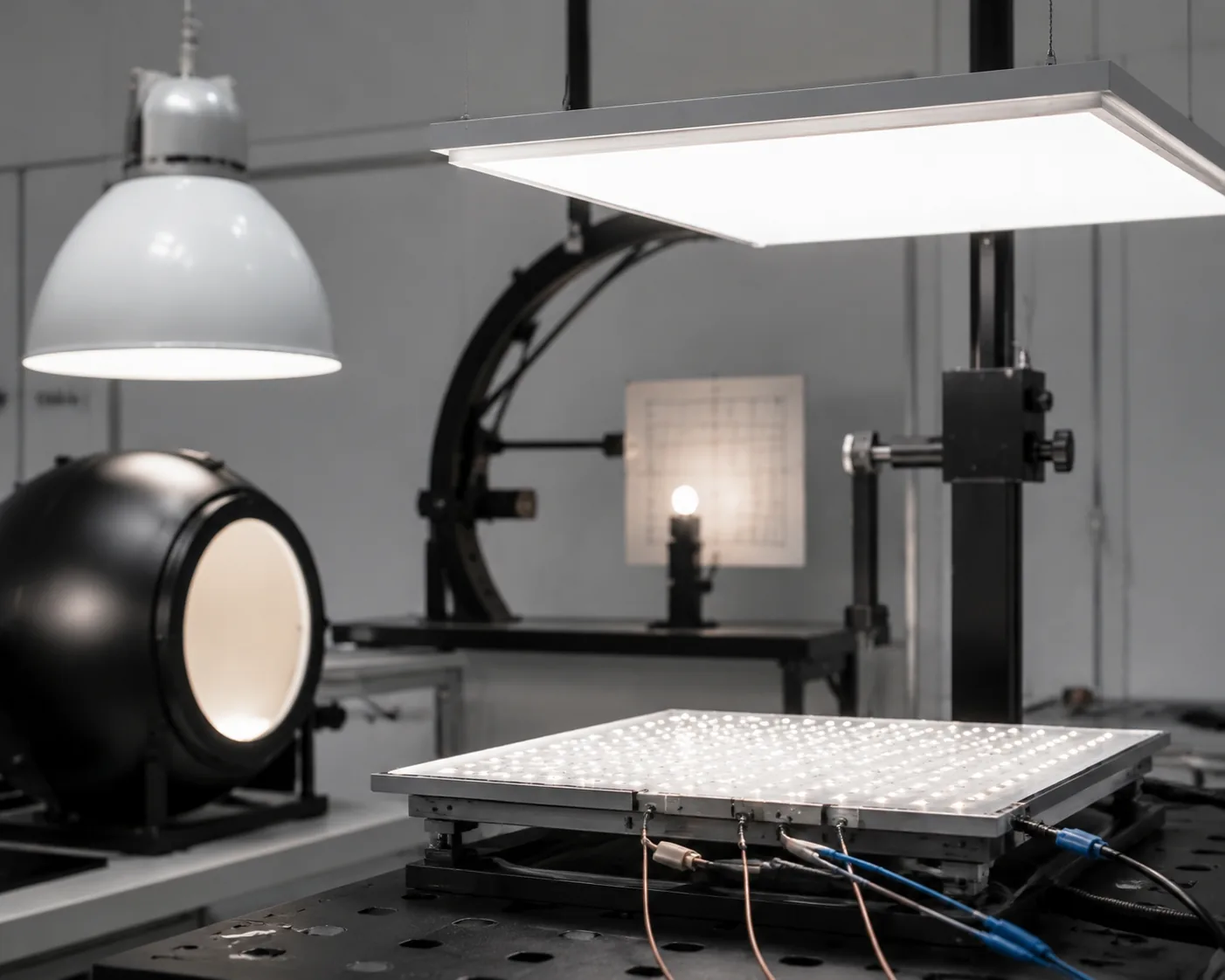
The luminaire is also classified by electric-shock protection class — Class I (protective earth), Class II (double/reinforced insulation, no earth), Class III (SELV, extra-low voltage) — and by IP (ingress protection) rating per GB/T 4208 (= IEC 60529). These classifications appear on the marking and dictate which clauses of GB 7000.1 apply: a Class II luminaire has no earthing test; an IP65 outdoor luminaire has the dust-and-water ingress tests that an IP20 indoor luminaire does not.
How Is Electrical Safety Tested Under GB 7000.1?
The electrical safety block of GB 7000.1 is the core test set that verifies the luminaire will not shock, burn, or catch fire in service. The four tests that drive pass/fail:
Protective earth continuity (第7章接地规定): for Class I luminaires, the resistance between the earth terminal and any accessible metal part must be low enough to ensure the protective device trips before a fault can deliver a dangerous shock. The test applies a defined current (typically 25 A or 10 A, depending on the standard version) between the earth terminal and accessible metalwork, and the resistance — typically required to be ≤ 0.5 Ω — confirms the earth path. A luminaire with a high-resistance earth path will not clear a fault and is a shock hazard.
Insulation resistance and electric strength (第10章): the insulation between live parts and accessible parts is tested by applying a DC voltage (typically 500 V or 1000 V) and measuring the insulation resistance — typically required to be ≥ 2 MΩ for Class I. The electric strength (dielectric withstand) test then applies a high AC voltage (typically 1500 V for basic insulation, 3000 V or 4000 V for reinforced insulation, depending on the class and working voltage) for 1 minute, and no breakdown or flashover may occur. This is the test that catches insufficient creepage and clearance in the internal wiring and PCB layout — if two circuits are too close together, the dielectric test breaks down between them.
Creepage and clearance distances (第11章): the minimum physical distances between conductive parts at different potentials. Creepage is the distance along the insulating surface; clearance is the distance through air. The minimums depend on the working voltage, the insulation category (basic / supplementary / reinforced), and the pollution degree. A luminaire with insufficient creepage/clearance may pass the dielectric test at the factory but fail in service when humidity or dust contaminates the surface — the creepage distance is what prevents tracking across a contaminated insulator.
Leakage current (泄漏电流): the current that flows from live parts through the insulation to accessible parts or to earth, measured under normal operating voltage. The acceptance ceiling is tight (typically ≤ 0.5 mA for portable, ≤ 1.0 mA for fixed Class I) because leakage current is what the user can actually feel as a tingling or shock. A luminaire with excessive leakage current is a touch hazard even without an insulation fault.
The diagnostic pattern in an electrical safety report: a failed earth continuity with passing insulation points to a mechanical earthing defect (loose terminal, corroded joint); a failed dielectric with passing creepage points to a defective insulating material; a failed creepage with passing dielectric points to a layout that will fail in humid service even though it passes at the factory.
How Is Temperature (Thermal) Testing Performed?
Temperature testing under GB 7000.1 (第12章) verifies that no component, wiring, or accessible surface in the luminaire exceeds its temperature rating in normal operation. This is the test that catches under-rated components and inadequate thermal management — the root causes of premature LED driver failure and, in the worst case, fire.
Measurement method: thermocouples (Type K or Type T) are attached to the critical points: the LED module case (the tc point specified by the LED manufacturer), the controlgear / driver case, the internal wiring insulation, the lamp-holder, and any accessible surface that the user could touch. The luminaire is operated at its rated voltage (typically at 0.92 / 1.0 / 1.06 × rated voltage to capture the worst case) in a defined ambient (typically 25 °C ± 5 °C, in a draught-free enclosure) until thermal equilibrium — the "ta" ambient rating of the luminaire is derived from this test.
The pass criterion is component-specific: the LED module case temperature must not exceed its rated tc; the driver must not exceed its rated tc; the internal wiring insulation must not exceed its rated operating temperature (e.g. 90 °C for common PVC, 180 °C for high-temperature silicone). An accessible surface (e.g. a metal housing or a plastic diffuser) must not exceed the burn-hazard temperature limit, which is tighter for surfaces that can be touched in normal use.
The thermal test is the one that most often forces a redesign — a luminaire that passes electrical safety can fail thermally because the LED driver is over-stressed or because the housing provides insufficient heatsinking. The diagnostic value of the thermal report is in where the temperature exceeds: a driver over-temperature points to driver undersizing or inadequate ventilation; an LED module over-temperature points to heatsink design; a wiring over-temperature points to wire routing too close to the light source.
What Are the Material Fire and Tracking Tests?
The plastic materials used in the luminaire — housings, diffusers, connectors, lampholders — are tested for their resistance to ignition and tracking, because these materials surround live parts and light/heat sources. GB 7000.1 invokes four material tests depending on the material's function:
Ball pressure test (球压试验): applies to all plastics that provide protection against electric shock or that hold current-carrying parts in place. A steel ball of defined diameter is pressed into the material at a defined force and temperature (typically 125 °C for parts providing electric-shock protection), and the impression diameter must not exceed 2 mm. This verifies the material does not soften excessively at service temperature — a softened housing can expose live parts.
Glow-wire test (灼热丝试验): for parts that provide protection against electric shock and parts near heat sources. A heated glow wire is applied to the material at a defined temperature (commonly 650 °C or 850 °C depending on the application), and the material must not ignite, or must self-extinguish within 30 s, with no flaming droplets that ignite the tissue paper below. This catches materials that can be ignited by a glowing connection fault.
Needle-flame test (针焰试验): for parts holding current-carrying parts in place. A small defined flame is applied for a defined time, and the material must self-extertinguish within 30 s.
Tracking test / proof tracking index (漏电起痕): for parts holding current-carrying parts in place in luminaires with an IP rating better than IP20. The material's resistance to surface tracking under moisture and contamination is measured (PTI 175 V is a common requirement). This is what catches materials that will track across their surface in a damp, dirty environment — the failure mode that causes arcing fires in outdoor and industrial luminaires.
The practical rule: a material with a valid certification (a UL Yellow Card or an IEC component certificate) does not need re-testing at the luminaire level, provided the certificate covers the requirements of the applicable IEC standard. This is why the critical-component and critical-material list is part of the luminaire certification documentation — it is the evidence that the materials have already been tested.
How Are LED Luminaire Performance and Energy Efficiency Tested?
The performance block for LED luminaires is governed by GB/T 31897.201-2016 Luminaires Performance — Part 2-1: LED Luminaires Particular Requirements and the energy-efficiency standards GB 30255-2019 (indoor LED products) and the outdoor LED equivalent. The key performance metrics:
Initial luminous flux (初始光通量): the total light output of the luminaire measured at the start of life, in lumens (lm). The measured value must fall within the declared tolerance of the rated value — a luminaire that under-delivers its rated lumens is mislabelled.
Luminous efficacy (光效): the light output per unit electrical power input, in lumens per watt (lm/W). This is the headline energy-efficiency number. GB 30255-2019 sets energy-efficiency grades by efficacy; for indoor LED products, the thresholds scale with colour rendering — a higher-CRI product (Ra ≥ 80) is allowed a slightly lower efficacy than a standard-CRI product (Ra ≥ 70), because high-CRI LEDs are inherently less efficient.
Colour rendering index (显色指数 Ra): how accurately the light renders the colours of illuminated objects, measured against the CIE Ra scale. For general indoor LED lighting, Ra ≥ 80 is the common requirement (the "8" in the 3-digit CRI/CCT code, e.g. "830" = Ra≥80, 3000 K). For higher-quality applications, Ra ≥ 90 is specified. The special R9 (saturated red) index is reported separately and for some indoor products must be > 0 — a negative R9 means the light cannot render red accurately.
Correlated colour temperature (相关色温 CCT): the apparent colour of the white light, in kelvin. Common values are 2700 K (warm white), 3000 K, 4000 K (neutral), 5000 K, 6500 K (daylight). The 3-digit code suffix (e.g. "830") encodes the CCT. The measured CCT must match the declared value within tolerance.
Lumen maintenance / luminous flux maintenance (光通维持率): the percentage of initial luminous flux retained after a defined operating period, typically measured at 3000 hours. This is the proxy for LED lifetime — an LED luminaire that loses too much light too fast will not reach its declared L70 or L80 life (the hours at which output drops to 70 % or 80 % of initial). The 3000-hour maintenance threshold is tied to the declared rated life.
Photometric distribution (配光): the angular distribution of light output, measured in a goniophotometer and reported as an IES or LDT photometric file. This is what the lighting designer uses to calculate illuminance, uniformity, and glare in a space. The photometric file is not a pass/fail test, but it is part of the performance documentation a serious buyer requires.
How Is Photobiological Safety Tested?
Photobiological safety, under GB/T 20145 (= IEC 62471), measures the hazard that the light output itself poses to the skin and eye — specifically the blue-light hazard, which is the retinal photochemical hazard from the blue content of LED spectra. The test measures the spectral radiance and irradiance of the source across the UV, visible, and IR bands and classifies the source into Risk Groups:
- Exempt (RG0): no hazard under any realistic exposure
- Risk Group 1 (RG1): no hazard under normal behavioural limitations
- Risk Group 2 (RG2): does not pose a hazard due to the aversion response to very bright light (do not stare at the source)
- Risk Group 3 (RG3): hazardous even for momentary exposure
For general-illumination LED luminaires, the requirement is typically RG1 or Exempt at the distance defined by the luminaire's application (often 200 mm for indoor, greater for high-bay and street). A luminaire with high blue content and a high-luminance LED source can exceed RG1 and require a hazard warning label, or a redesign with a diffuser that reduces source luminance.
The companion standard IEC/TR 62778 applies the blue-light hazard framework specifically to LED light sources used in luminaires, and provides the method for determining the threshold illuminance distance at which a source transitions from RG2 to RG1.
How Does the Chinese Framework Map to International Standards?
| Scope | China (GB) | International (IEC) | Europe (EN) | North America (UL / CSA) |
|---|---|---|---|---|
| Luminaire general safety | GB 7000.1-2015 | IEC 60598-1 | EN 60598-1 | UL 1598 / CSA C22.2 250 |
| LED luminaire performance | GB/T 31897.201 | IEC 62722-2-1 | EN 62722-2-1 | — |
| EMC emissions | GB 17743 | CISPR 15 | EN 55015 | FCC Part 15 |
| Harmonic current | GB 17625.1 | IEC 61000-3-2 | EN 61000-3-2 | — |
| Photobiological safety | GB/T 20145 | IEC 62471 | EN 62471 | — |
| IP rating | GB/T 4208 | IEC 60529 | EN 60529 | UL equivalent |
| Energy efficiency (LED) | GB 30255 | — | EU 2019/2020 ecodesign | DOE / Energy Star |
The safety framework (GB 7000.1 = IEC 60598-1) is closely aligned across China, IEC, and EN — the same luminaire tested to GB 7000.1 will generally pass EN 60598-1, and the test reports are often cross-accepted via the IECEE CB Scheme. The North American framework (UL 1598) is a separate national adoption with construction and material differences (it is not an IEC adoption), so a CB report does not directly substitute for a UL listing — additional testing is typically required for the UL ETL or cULus mark.
The energy-efficiency frameworks diverge more: China's GB 30255 indoor LED thresholds, the EU Ecodesign 2019/2020 requirements, and the US DOE / Energy Star requirements each set their own efficacy tiers, and a luminaire that passes one does not automatically pass another. For multi-market product, the energy-efficiency test must be reported against each destination's standard.
Our Testing Capabilities
Beijing ZKGX Research provides luminaire testing across the GB 7000.1 safety framework, the GB/T 31897 LED performance framework, the GB 17743 / GB 17625.1 EMC framework, and the GB/T 20145 photobiological safety framework, with cross-reference to IEC / EN / UL.
Electrical safety (GB 7000.1):
- Protective earth continuity (Class I, ≤ 0.5 Ω)
- Insulation resistance and electric strength (dielectric withstand, up to 4000 V)
- Creepage and clearance measurement
- Leakage current
- Temperature / thermal test (tc verification by thermocouple)
Material fire and tracking:
- Ball pressure test, glow-wire test, needle-flame test, tracking test (PTI)
LED performance (GB/T 31897.201):
- Initial luminous flux, luminous efficacy (lm/W)
- Colour rendering index Ra and R9
- Correlated colour temperature
- Lumen maintenance (3000 h)
- Photometric distribution (goniophotometer, IES/LDT file)
EMC and photobiological:
- Conducted and radiated emissions (GB 17743 / CISPR 15)
- Harmonic current (GB 17625.1)
- Photobiological safety / blue-light hazard (GB/T 20145 / IEC 62471, RG classification)
Ingress protection: IP rating testing per GB/T 4208 (IP20 through IP68).
Standards cross-reference: IEC 60598-1, EN 60598-1, UL 1598, EN 55015, IEC 62471, EU 2019/2020 ecodesign.
If you need a GB 7000.1 safety report for a domestic luminaire release, a GB/T 31897 LED performance test for an energy-efficiency filing, an IEC 62471 photobiological safety classification, an IP rating test for an outdoor luminaire, or a cross-reference report for an IEC CB / EN / UL export filing — contact our laboratory with the luminaire type (fixed / portable / recessed / outdoor), light source (LED / HID / fluorescent), protection class (Class I / II / III), IP rating claim, and destination market, and we will scope the test plan.
FAQ
What is the difference between GB 7000.1 and UL 1598?
GB 7000.1 is the Chinese adoption of IEC 60598-1, the international luminaire safety baseline. UL 1598 is the North American standard — it is a national standard, not an IEC adoption, and has construction and material requirements that differ from the IEC framework. A luminaire tested to GB 7000.1 / IEC 60598-1 will generally pass EN 60598-1 (Europe) via the CB Scheme, but will require additional testing for a UL listing. The two frameworks agree on the physics (insulation, earthing, thermal, IP) but differ on the construction details and the material certifications accepted.
Why is the LED module tc temperature so critical?
Because exceeding tc — the rated case temperature of the LED module — is the dominant failure mode for LED luminaires. Above tc, the LED junction runs hotter, the lumen maintenance drops faster, the colour shifts, and the driver (if mounted with the LED) is also over-stressed. A luminaire that passes electrical safety but fails the tc thermal test will pass at the factory and fail in service — the LEDs will dim, shift colour, and ultimately fail far earlier than their rated life. The thermal test is what catches this before the product ships.
How is the blue-light hazard (photobiological safety) relevant to a general-illumination luminaire?
Because LED spectra have a high blue content (the blue pump that excites the phosphor), and the blue-light hazard is a retinal photochemical risk. For most general-illumination LED luminaires with a diffused source, the classification is RG1 (no hazard under normal behavioural limitations) or Exempt. But a high-luminance LED source without a diffuser — a bare LED array, a narrow-beam spotlight, a high-bay luminaire viewed from below — can exceed RG1 and require a hazard warning or a redesign. The test is required because a luminaire can be electrically safe and still pose a photobiological hazard to the user.
What is the role of the IP rating test?
The IP (Ingress Protection) rating verifies the luminaire's resistance to dust and water ingress. An IP20 luminaire (indoor, dry) has no ingress protection; an IP65 outdoor luminaire must exclude dust (first digit 6) and water jets (second digit 5); an IP67 luminaire must survive temporary immersion. The test is physical — a dust chamber for the first digit, a water jet or immersion tank for the second. For outdoor, industrial, and cleanroom luminaires, the IP test is a primary acceptance gate, because a failed IP rating means water and dust will enter the housing, corrode the electronics, and cause field failures.
Can one test report cover multiple markets?
Partially. The GB 7000.1 / IEC 60598-1 safety framework is cross-accepted across China, IEC member states, and Europe via the IECEE CB Scheme — a CB Test Certificate from an NCB (National Certification Body) is accepted by the participating countries, reducing but not eliminating re-testing. The EMC framework (GB 17743 / EN 55015 / FCC) is largely aligned but has national differences. The energy-efficiency framework (GB 30255 / EU ecodesign / DOE) is not aligned — each destination has its own thresholds. For multi-market product, plan the test programme around the strictest framework and report against each destination's standard explicitly.