What Is Amusement Ride Safety Testing and Why Does It Matter?
Amusement ride safety testing is the systematic evaluation of fairground rides, theme park attractions, water slides, inflatables, go-karts, bungee jumping devices, aerial tramways, and other amusement devices to verify their structural integrity, mechanical reliability, electrical safety, and operational compliance before and during public use. It spans the full lifecycle — from design review and manufacturing inspection through installation verification, commissioning, and periodic re-inspection throughout the ride's operational life.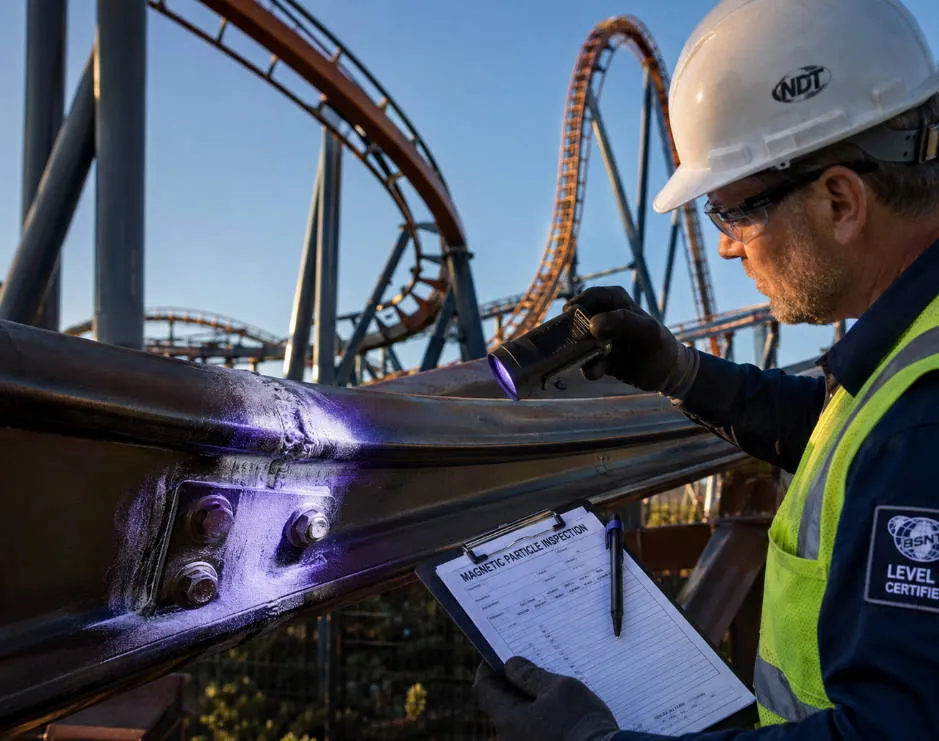
The scope is enormous. In the United States alone, the Consumer Product Safety Commission (CPSC) maintains a directory of amusement ride safety officials across all 50 states, each with different regulatory frameworks, inspection frequencies, and insurance requirements. Worldwide, the International Association of Amusement Parks and Attractions (IAAPA) has identified six essential elements of effective ride safety regulation, while ASTM International's F24 Committee has developed comprehensive standards covering design, testing, performance, maintenance, operations, and procedures for amusement rides and devices.
The stakes are self-evident. A single structural failure on a roller coaster, a malfunctioning restraint on a drop tower, or an electrical fault on a dark ride can result in catastrophic injury or death. Unlike most consumer products, amusement rides subject users to extreme forces — high G-loads, rapid acceleration and deceleration, significant heights, and moving parts with pinch points — all while the rider has little or no control. Rigorous testing is the last line of defense between a thrilling experience and a tragedy.
Key Standards and Regulations for Amusement Ride Testing
Amusement rides are regulated through a patchwork of national, regional, and industry standards:
|
Standard / Regulation |
Scope |
Key Requirements |
|---|---|---|
|
ASTM F2291 |
Standard Practice for Design of Amusement Rides and Devices |
Design criteria, load assumptions, acceleration limits, fatigue analysis |
|
ASTM F2374 |
Standard Practice for Design, Manufacture, Installation, Operation, and Maintenance of Inflatable Amusement Devices |
Inflatable-specific requirements, anchoring, blower systems |
|
ASTM F770 |
Standard Practice for Ownership, Operation, Maintenance, and Inspection of Amusement Rides and Devices |
Operational procedures, maintenance schedules, inspection protocols |
|
ASTM F893 |
Standard Guide for Inspection of Amusement Ride Brakes and Brake Systems |
Brake testing, redundancy, fail-safe requirements |
|
ASTM F1159 |
Standard Practice for Design and Manufacture of Amusement Rides and Devices for the Sponsor |
Manufacturer design and fabrication requirements |
|
EN 13814:2004 / EN 13814:2019 |
Fairground and amusement park machinery and structures — Safety |
European harmonized standard covering design, calculation, manufacturing, installation, operation |
|
ISO 17842 |
Amusement ride safety — Terminology and classification |
Global terminology framework |
|
CEN TC 254 |
European technical committee for amusement ride standards |
Suite of EN standards for specific ride types |
|
BS EN 14960 |
Inflatable play equipment — Safety requirements and test methods |
Bouncy castle and inflatable slide standards |
|
NAARSO Certification |
National Association of Amusement Ride Safety Officials |
Inspector certification (Level I, II, III), operator training, CEUs |
|
AIMS International Certification |
Amusement Industry Manufacturers & Suppliers |
Inspector certification, safety education |
|
UK HSE / ADIPS |
Amusement Device Inspection Procedures Scheme |
UK inspection scheme, Design Review, Initial Test, Annual inspection |
|
CPSC (US) |
Mobile amusement ride jurisdiction |
Federal oversight of mobile rides; state-by-state fixed-site regulation |
Design Review and Risk Assessment
Before any ride is manufactured, a comprehensive design review must be conducted per ASTM F2291 and EN 13814:
Structural Analysis
-
Static load analysis: Dead weight, live load (passengers), wind load, snow load, seismic load
-
Dynamic load analysis: Acceleration forces (G-forces), centrifugal forces on rotating rides, impact loads on coaster tracks
-
Fatigue analysis: Cyclic loading from repeated ride cycles — typically 10⁶ to 10⁷ cycles over design life
-
Finite Element Analysis (FEA): Computer simulation of stress distribution across critical joints, welds, and load-bearing members
Acceleration Limits
ASTM F2291 establishes maximum acceleration limits for ride design:
|
Body Region |
Maximum Acceleration (G) |
Duration |
|---|---|---|
|
Head (vertical, +Gz) |
Up to 6G (with duration limits) |
Per G-duration curve |
|
Head (vertical, -Gz) |
Up to -2G |
Per G-duration curve |
|
Head (front-to-back, +Gx) |
Per design category |
With restraint system |
|
Lateral (Gy) |
Per design category |
With appropriate restraints |
Risk Assessment
Per EN 13814 and ISO 12100:
-
Identify all hazards (mechanical, electrical, thermal, ergonomic)
-
Estimate risk severity and probability
-
Apply risk reduction measures (design elimination > safeguard > warning > PPE)
-
Document residual risks and rider responsibilities
Non-Destructive Testing (NDT) for Amusement Rides
NDT is the cornerstone of amusement ride structural integrity verification. Critical welds, pins, axles, track sections, and support columns must be inspected without disassembling the ride:
|
NDT Method |
Application |
Standard |
|---|---|---|
|
Magnetic Particle Testing (MT) |
Surface and near-surface cracks in ferromagnetic materials (track rails, chassis frames, wheel axles) |
ASTM E709, ASTM F2291 |
|
Liquid Penetrant Testing (PT) |
Surface-breaking defects on non-ferrous materials (aluminum gondolas, stainless steel components) |
ASTM E165 |
|
Ultrasonic Testing (UT) |
Subsurface defects in thick welds, axles, pins, and forged components |
ASTM E2375, ASTM A388 |
|
Radiographic Testing (RT) |
Internal weld defects in critical structural joints |
ASTM E94, ASTM E1032 |
|
Visual Testing (VT) |
Surface condition, weld appearance, corrosion, wear, cracking |
ASTM E709 (supplement) |
|
Eddy Current Testing (ET) |
Crack detection in conductive materials, especially tubing and bolt holes |
ASTM E2261 |
NDT Schedule
Per ASTM F770 and state regulations:
-
Initial NDT: Full baseline inspection during manufacturing and after installation
-
Periodic NDT: At intervals specified by the manufacturer or AHJ — typically annually for critical components, every 3-5 years for secondary structures
-
Event-driven NDT: After severe weather events, seismic activity, incident, or major modification
-
Pennsylvania (example): Certified inspector required every 28 days or every setup, whichever comes first
Structural and Mechanical Testing
Load Testing
-
Proof load test: Apply 1.0× to 1.25× design load (varies by standard) and verify no permanent deformation
-
Dynamic load test: Operate ride at full speed with test weights simulating maximum passenger load
-
Restraint system test: Verify lap bars, seat belts, harnesses, and over-the-shoulder restraints withstand specified forces without failure or unintended release
Fatigue Testing
-
Component-level: Cyclic testing of critical parts (axles, wheel assemblies, restraint latch mechanisms) to simulate 10+ years of operation
-
Full-ride: Accelerated cycle testing during commissioning to validate fatigue life predictions
Corrosion and Wear Assessment
-
Coating inspection: Measure paint/coating thickness on steel structures (per ISO 19840)
-
Corrosion mapping: Ultrasonic thickness measurement of steel columns, track sections, and tubular members to detect wall thinning
-
Wear measurement: Gauge wear on wheel assemblies, brake pads, guide rails, and chain dogs
Electrical Safety and Control System Testing
Modern amusement rides rely on complex PLC-based control systems, variable-frequency drives, and safety-rated circuits:
electrical testing
|
Test |
Requirement |
Reference |
|---|---|---|
|
Grounding and bonding |
Continuous ground path, < 1Ω resistance |
NEC Article 250, EN 13814 |
|
Insulation resistance |
> 1 MΩ at 500V DC megger test |
IEC 60204-1 |
|
Emergency stop |
All E-stop circuits functional, ride stops within specified time |
ASTM F770, EN 13814 |
|
Lockout/Tagout (LOTO) |
Verify energy isolation procedures for maintenance |
OSHA 1910.147 |
|
Safety-rated control |
PLC safety circuits meet SIL 2 or SIL 3 per IEC 62061 / ISO 13849 |
EN ISO 13849-1 |
Control System Validation
-
Functional safety assessment: Verify all safety interlocks (restraints locked, gates closed, clear-to-dispatch) function correctly
-
Fail-safe testing: Simulate sensor failures, power interruptions, and communication losses — ride must fail to a safe state
-
Redundancy verification: Critical systems (brakes, restraints) must have redundant controls
Commissioning and Pre-Opening Inspection
Before a ride opens to the public, it must pass a rigorous commissioning process:
Installation Verification
-
Foundation and anchor bolt inspection (torque verification, concrete strength testing)
-
Alignment checks (track gauge, level, plumb)
-
Utility connections (electrical, pneumatic, hydraulic) verified per design drawings
Initial Test and Adjustment
-
Dry runs: Operate ride empty through full cycle, verify all movements, brakes, and stops
-
Weighted tests: Test with water dummies or sandbags at full passenger capacity
-
Emergency evacuation drill: Verify evacuation procedures for all scenarios (mid-ride stop, power failure, restraint malfunction)
-
Noise and vibration measurement: Baseline recording for future comparison
-
Speed and acceleration measurement: Verify actual G-forces match design predictions using instrumented test dummies
Third-Party Certification
Per IAAPA guidelines, an independent qualified inspector (not the manufacturer or operator) should perform the initial certification. Organizations like TÜV SÜD employ dedicated amusement ride engineers who have inspected over 18,000 rides and certified more than 5,000 worldwide.
Periodic and Routine Inspections
Daily Pre-Opening Checks
-
Visual inspection of all accessible components
-
Functional test of restraints, gates, E-stops, brakes
-
Verification of safety signage and rider height markers
-
Weather condition assessment (wind speed, lightning proximity)
Annual / Periodic Comprehensive Inspection
Per ASTM F770 and EN 13814:
|
Item |
Inspection Method |
Frequency |
|---|---|---|
|
Structural steelwork |
VT, UT thickness, MT on critical welds |
Annual |
|
Foundation and anchors |
VT, torque check, concrete condition |
Annual |
|
Restraint systems |
Functional test, force measurement, NDT on latch mechanisms |
Annual or per manufacturer |
|
Brakes |
Lining wear measurement, hydraulic/pneumatic pressure, response time |
Annual (ASTM F893) |
|
Wire rope and chain |
Diameter measurement, broken wire count, lubrication |
Per ASTM A1023 / manufacturer |
|
Electrical systems |
Insulation resistance, grounding, control function |
Annual |
|
Hydraulic/pneumatic systems |
Pressure testing, hose inspection, cylinder seal check |
Annual |
|
Bearings and bushings |
Play measurement, lubrication, temperature monitoring |
Annual |
State-by-State Requirements (US Examples)
|
State |
Mobile Rides |
Fixed-Site Rides |
Insurance Minimum |
|---|---|---|---|
|
California |
Annual (OSHA Division) |
Annual (state + QSI, twice) |
Operating permit required |
|
Florida |
Every setup |
Exempt if 1000+ employees with full-time safety staff |
State law required |
|
New Jersey |
Every setup at each location |
Annual + random |
$1,000,000 |
|
New York |
Every stop, schedule submitted in advance |
Annual |
$1,000,000 |
|
Pennsylvania |
Every 28 days or every setup |
Frequent random state inspections |
Certificate required |
|
Texas |
Annual + posted signage |
Annual |
$1M Class B / $300K agg Class A |
|
Ohio |
Every location (depending on history) |
Annual |
License required |
Water Ride and Waterslide Testing
Water rides carry additional risks from chemical exposure, slip hazards, and drowning:
Structural Testing
-
FRP (fiberglass) inspection: Delamination detection via tap testing or thermography
-
Slide joint integrity: Verify all section connections are flush, no gaps or protruding edges
-
Support structure: Same NDT and load testing as dry rides, with added corrosion focus
Water Quality and Flow Testing
-
Flow rate verification: Adequate water volume for safe riding (per manufacturer specification)
-
Water chemistry: pH, chlorine/bromine levels, bacteria testing per local health codes
-
Splash pool depth: Verify minimum depth at slide exit per EN 1069 and manufacturer specs
Standards
-
EN 1069: Water slides — safety requirements and test methods (Parts 1 & 2)
-
ASTM F2376: Standard Practice for Design, Manufacture, Installation, Operation, and Maintenance of Aquatic Play Equipment
-
EN 13757: Fairground and amusement park machinery — Water rides — additional safety requirements
Incident Investigation and Post-Incident Testing
IAAPA mandates that post-incident reviews be conducted by qualified investigators. Testing after an incident includes:
-
Scene preservation: Lock out ride, secure all data logs (PLC event records, CCTV footage)
-
failure analysis: Metallurgical examination of failed components (fractography, hardness testing, chemical composition)
-
Control system forensics: Download and analyze PLC logs, verify sensor calibration
-
Witness documentation: Record operator and rider statements, environmental conditions
-
Root cause determination: Apply systematic methods (5-Why, fishbone diagram, fault tree analysis)
-
Corrective action verification: Test repair/modified components before return to service
Incident Reporting Requirements
-
Most US states require reporting to the AHJ if a rider requires overnight hospitalization
-
CPSC collects data on mobile ride incidents nationally
-
EN 13814 requires documentation of all incidents and near-misses
How to Choose an Amusement Ride Testing Provider
|
Criterion |
What to Look For |
|---|---|
|
Accreditation |
ISO 17025, NAARSO or AIMS certified inspectors, Notified Body status (EU) |
|
NDT capability |
In-house MT, PT, UT, RT, ET with certified technicians (ASNT Level II/III or ISO 9712) |
|
Engineering expertise |
Licensed Professional Engineers (PE) for design review and structural analysis |
|
Global standards knowledge |
ASTM F24, EN 13814, ISO 17842, local regulatory requirements |
|
Track record |
Experience with your ride type (coaster, flat ride, water slide, inflatable, tramway) |
|
Turnaround time |
Ability to meet operational schedules (pre-season, post-setup) |
|
Emergency response |
24/7 availability for incident investigation and post-incident testing |
|
Report quality |
Detailed, defensible reports accepted by AHJs and insurance companies |
Common Challenges in Amusement Ride Testing
-
Fragmented regulation: In the US, oversight is split between federal (CPSC for mobile rides) and state/local agencies (for fixed-site rides). Eight states have no state-administered inspection programs for mobile rides, and eight states plus DC lack programs for fixed-site rides. Testing requirements vary dramatically by jurisdiction.
-
Aging ride fleets: Many parks operate rides designed 30–50+ years ago to standards that have since been significantly updated. Applying current testing criteria to legacy rides requires engineering judgment and risk assessment.
-
NDT access constraints: Critical welds and structural connections on operating rides are often concealed by cladding, scenery, or other components. Access may require partial disassembly or specialized equipment (ropes access, scaffolding).
-
Custom and one-off designs: Many major attractions are unique prototypes with no sister rides for comparison. Testing protocols must be developed specifically for each installation, requiring deep engineering expertise.
-
Seasonal inspection bottlenecks: In regions with defined operating seasons, all rides must be inspected and certified before opening day. Testing providers face extreme demand in a compressed timeframe.
-
Inflatable device safety: Bouncy castles and inflatable slides are often operated by small businesses with limited technical knowledge. ASTM F2374 and EN 14960 requirements for anchoring, continuous airflow, and impact attenuation are frequently misunderstood or ignored.
-
Cybersecurity of control systems: Modern rides with networked PLCs, wireless diagnostics, and remote monitoring face potential cybersecurity threats. Testing must address network segmentation, authentication, and firmware integrity.
Frequently Asked Questions
Q: What standards govern amusement ride safety in the United States? A: ASTM International Committee F24 develops the primary technical standards, including F2291 (design), F770 (operation and maintenance), F893 (brakes), and F1159 (manufacture). Individual states adopt and enforce these through their own legislation.
Q: How often must amusement rides be inspected? A: It depends on the jurisdiction and ride type. Mobile rides are typically inspected at each setup location. Fixed-site rides require annual comprehensive inspections with daily pre-opening checks. Pennsylvania requires certified inspections every 28 days. Most states require $1 million minimum liability insurance.
Q: What is NAARSO certification? A: The National Association of Amusement Ride Safety Officials (NAARSO) provides inspector certification at Levels I, II, and III, plus operator training. NAARSO-certified inspectors are recognized across the industry and required by many states and insurance companies.
Q: What NDT methods are used on amusement rides? A: Magnetic particle testing (MT) for surface cracks in steel, ultrasonic testing (UT) for subsurface defects in axles and pins, liquid penetrant testing (PT) for non-ferrous components, radiographic testing (RT) for internal weld quality, and eddy current testing (ET) for tubing and bolt holes.
Q: Who has jurisdiction over amusement ride safety in the US? A: The CPSC has jurisdiction over mobile (traveling) rides. Fixed-site rides are regulated at the state or local level. Eight states and DC have no state inspection program for fixed-site rides, relying instead on insurance company inspections or local ordinances.
Q: How are roller coaster G-forces tested? A: During commissioning, instrumented test dummies equipped with triaxial accelerometers ride in each seat position through full ride cycles. Measured accelerations are compared against ASTM F2291 G-duration limits to verify they remain within safe levels for all passenger sizes.
Q: What testing is required for inflatable amusement devices? A: ASTM F2374 and EN 14960 require: anchor point pull testing, continuous blower system verification, impact attenuation testing (maximum fall height and surface firmness), material strength testing, and fire resistance classification.
Summary
Amusement ride safety testing is a multi-disciplinary, lifecycle-spanning process that combines structural engineering, non-destructive testing, electrical safety validation, control system verification, and regulatory compliance. Governed by a complex web of standards — ASTM F24 committee standards in the US, EN 13814 in Europe, and ISO globally — and enforced through fragmented jurisdictional frameworks that vary from state to state and country to country, the field demands specialized expertise from certified inspectors (NAARSO, AIMS) and accredited testing organizations. From the initial design review and FEA analysis through NDT of critical welds, commissioning tests with instrumented dummies, and periodic re-inspection of aging ride fleets, every test serves a single purpose: ensuring that the pursuit of thrills never compromises the safety of riders.