What Standard Governs Tea Bag Testing in China?
Tea bag testing in China sits at the intersection of two standard families — the tea product standard and the food-contact packaging standard — because a tea bag is simultaneously a tea product and a food-contact material. A complete test report covers both.
GB/T 24690-2018 Tea Bag (replacing the 2009 edition) is the product standard. It classifies tea bags by tea type (green, black, oolong, scented), sets sensory quality grades, defines the physical and chemical parameter limits (moisture, total ash, water extract, broken-tea-and-powder content), and requires that the filter bag material comply with food-contact-material standards. This is what makes tea bag testing distinct from tea testing — the filter bag is part of the product specification, not just a shipping container.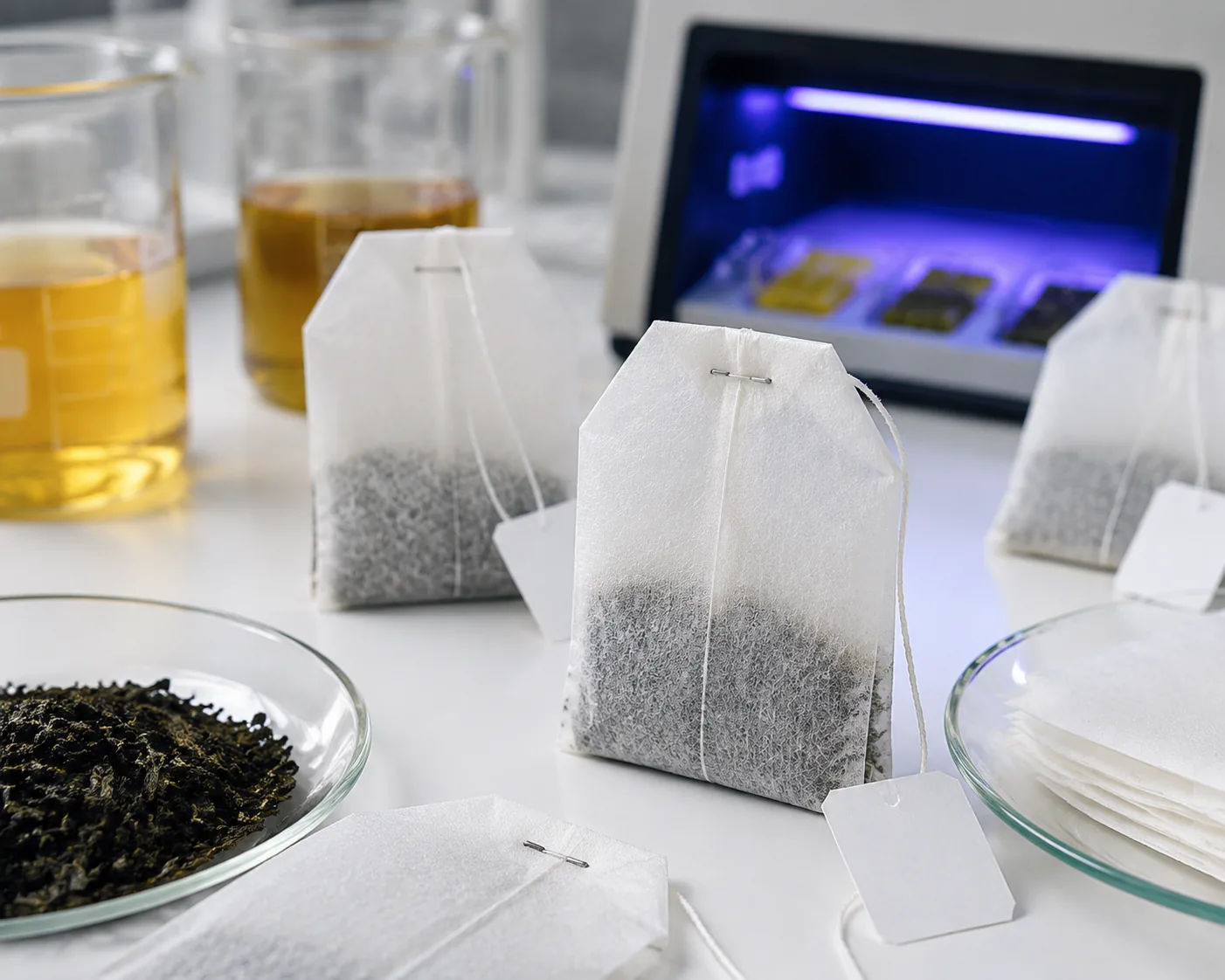
GB 4806.8-2022 Food Contact Paper and Board Materials and Articles (replacing the 2016 edition) is the mandatory food-safety standard for the filter bag material — paper, paperboard, or nonwoven fabric used to contain the tea during brewing. It sets the fluorescent-substance non-detectable requirement, the total migration limit (≤ 10 mg/dm²), the heavy-metal ceiling (lead ≤ 4.0 mg/kg in the 4 % acetic-acid simulant, arsenic), and the specific-migration limits for regulated substances in the paper or its coatings. This is the standard that catches filter bags that would leach optical brighteners, heavy metals, or coating chemicals into the brewed tea.
GB 2762-2022 Contaminant Limits in Foods and GB 2763 Pesticide Residue Limits apply to the tea content itself — lead, rare-earth elements, and the long list of pesticide active substances with tea-specific maximum residue limits (MRLs). These are the same parameters tested in loose-leaf tea, but for tea bags they apply to the tea content extracted through the filter bag into the brew.
For international trade, ISO 3103 (tea — preparation of liquor for sensory testing) and the EU 10/2011 plastic-food-contact regulation (for PLA or nylon tea bag meshes) may apply alongside the Chinese standards.
What Are the Tea Content Quality Requirements?
The tea-content block under GB/T 24690-2018 defines whether the tea inside the bag is of the declared type and grade. The key parameters:
Sensory quality (感官品质): assessed by trained panellists per GB/T 23776 Tea Sensory Evaluation Method. The tea liquor (brewed under defined conditions — water temperature, brewing time, tea-to-water ratio) is evaluated for appearance (colour, clarity), aroma, taste, and infused-leaf appearance. The sensory evaluation is the primary quality discriminator — it catches stale tea, off-flavours, flavouring adulteration, and grade mislabelling that the chemical parameters cannot.
Moisture (水分): measured per GB 5009.3. Tea is hygroscopic, and high moisture in the tea content shortens shelf life and promotes mould growth during storage. The GB/T 24690 moisture ceiling is tighter for higher grades.
Total ash (总灰分): measured per GB 5009.4. Total ash reflects the mineral content of the tea — high ash can indicate excessive stem/stalk content, sandy contamination, or adulteration with non-tea plant material.
Water extract (水浸出物): measured per GB/T 8305. This is the percentage of the tea that dissolves into hot water under defined brewing conditions — it is the measure of how much of the tea actually extracts into the cup. A low water-extract content means the tea bag delivers weak brews; a high value means strong brews. The GB/T 24690 floor ensures the tea content delivers adequate flavour and bioactive compounds.
Broken tea and powder (碎茶和粉末): measured per GB/T 8311. For loose-leaf tea this is a quality parameter (too much powder indicates rough handling); for tea bags it is less restrictive because tea bags are designed to contain small particles, but excessive powder can pass through the filter bag mesh and produce cloudy liquor. The test measures the percentage of particles below a defined sieve size.
What Are the Filter Bag Food-Contact Requirements?
The filter bag is the component unique to tea bags — it is a food-contact material because it is in contact with hot water (the brewing medium) throughout the tea-drinking event. The filter bag must not leach harmful substances into the brew, and it must contain the tea particles while allowing flavour and colour to extract.
Fluorescent substances (荧光性物质): tested per GB 4806.8 / GB 31604.47 at 254 nm and 365 nm UV — the requirement is non-detectable. This catches filter bags made from paper that has been bleached with optical brighteners — fluorescent whitening agents that improve visual whiteness but are not approved for food-contact paper. The fluorescent-substance test is the most commonly cited failure in tea bag packaging in Chinese market supervision sampling, because it is easy to detect and because some manufacturers use non-compliant bleached paper to lower cost.
Total migration (总迁移量): tested per GB 31604.8 into food simulants (water, 4 % acetic acid — the most relevant simulants for hot-water tea brewing) at defined time/temperature conditions. The total migration must not exceed 10 mg/dm². This catches filter bags that leach excessive soluble material into the brew — coating chemicals, sizing agents, or degraded fibre components.
Heavy metals (重金属): lead ≤ 4.0 mg/kg (in the 4 % acetic-acid simulant), arsenic — measured per GB 31604.49. Heavy metals in the filter bag can come from contaminated paper pulp, recycled fibre (if used — recycled fibre is restricted for food-contact paper), or from the coatings and adhesives used in the bag manufacture. The test is into the hot-water/acidic simulant because the brewing tea provides a hot, slightly acidic extraction medium.
Specific migration of regulated substances: for filter bags with coatings, laminations, or plastic components (PLA mesh, nylon mesh, heat-seal coatings), the specific migration of the regulated monomers and additives is tested per the GB 31604 series. For nylon (PA) meshes, the caprolactam SML applies; for PLA meshes, the lactic-acid migration applies.
How Are Filter Bag Physical Properties Tested?
The filter bag must contain the tea particles during brewing while allowing the flavour and colour to extract — the filter bag's physical properties are tested to verify this balance.
Filtration performance / permeability: the filter bag must allow hot water to penetrate and tea extract to diffuse out, while retaining the tea particles. Too tight a weave: the tea brews weakly and slowly; too loose: tea particles escape into the cup, producing cloudy liquor and visible sediment. The permeability is tested by defined flow-rate or extraction-rate methods, comparing the extraction performance against a standard reference.
Wet tensile strength: the filter bag must not rupture when wet — the brewing event saturates the paper with hot water, and the bag must withstand the hydrostatic pressure of the wet tea mass and the handling (lifting the bag out of the cup by its string). The wet tensile strength is tested per TAPPI T456 (wet tensile strength of paper) or equivalent — the specimen is saturated with water (typically using a Finch cup fixture) and pulled in tension. A filter bag with inadequate wet tensile strength splits during brewing, releasing tea particles into the cup.
Bag integrity / seal strength: for heat-sealed filter bags (the most common construction), the heat seal must withstand the wet brewing conditions without opening. The seal strength is tested by peeling or tensile methods, applying force to separate the sealed edges. A seal that opens during brewing releases the tea content — a complete product failure.
String, tag, and staple attachment: the string must remain attached to the bag and to the tag during the brewing and removal event. The attachment strength (staple pull-out or string-to-bag bond) is tested by tensile methods — a motorised tensile tester pulls the string from the bag or the tag from the string, and the force to detach is recorded. This is the test documented by Mecmesin and other packaging-test-equipment suppliers — it appears simple but is a daily quality-control parameter for tea bag production lines.
How Do Tea Bag Tests Differ from Loose-Leaf Tea Tests?
The tea-content parameters (sensory, moisture, ash, water extract, contaminants, pesticides) are shared with loose-leaf tea testing per GB/T 24690 and the GB 2762/2763 frameworks. But the tea bag adds three test dimensions that loose-leaf tea does not have:
| Test dimension | Loose-leaf tea | Tea bag |
|---|---|---|
| Filter bag food-contact safety | Not applicable | GB 4806.8 (fluorescent, migration, heavy metals) |
| Filter bag physical (permeability, wet strength, seal) | Not applicable | TAPPI T456, seal-strength, extraction-rate |
| String/tag/staple integrity | Not applicable | Attachment-strength tensile test |
The tea content inside a tea bag is typically lower grade than loose-leaf tea — it is the smaller-particle, broken-leaf material that brews faster in the confined filter-bag space. This is not a quality defect; it is the product design. But the broken-tea-and-powder parameter (GB/T 8311) is applied differently — for tea bags, some powder content is expected and acceptable (the bag contains it), while for loose-leaf tea it is a defect.
The sensory evaluation is also different — the GB/T 24690 brewing protocol for tea bags uses a defined tea-bag brewing method (water temperature, time, single or double bag), not the loose-leaf gaiwan or pot brewing used for GB/T 23776 sensory evaluation of loose tea. The tea-bag brewing method must produce a defined-strength, defined-clarity liquor — a tea bag that brews weakly or cloudily fails the sensory test even if the tea content is chemically compliant.
How Does the GB Framework Map to International Tea Bag Standards?
| Scope | China (GB/T) | International |
|---|---|---|
| Tea bag product | GB/T 24690-2018 | — (no single ISO product standard) |
| Tea sensory evaluation | GB/T 23776 | ISO 3103 (liquor preparation for sensory) |
| Tea moisture | GB 5009.3 | ISO 1573 |
| Tea water extract | GB/T 8305 | ISO 9768 |
| Filter bag (paper) food-contact | GB 4806.8-2022 | EU 1935/2004, EN 645/14338 |
| Filter bag (plastic mesh) food-contact | GB 4806.7 | EU 10/2011 |
| Filter bag wet tensile strength | — (TAPPI invoked) | TAPPI T456, ISO 3781 |
| Contaminants in tea | GB 2762-2022 | Codex GSCTFF, EU 1881 |
The Chinese tea bag standard (GB/T 24690) and the food-contact paper standard (GB 4806.8) together cover the same scope as the European framework (no single EU tea-bag product standard, but the food-contact regulations apply to the filter bag). The difference is that China has a dedicated tea-bag product standard (GB/T 24690) that ties the tea quality and the filter bag quality together in one product specification — most other countries do not have a single equivalent, treating the tea and the packaging under separate standards.
Our Testing Capabilities
Beijing ZKGX Research provides tea bag testing across the GB/T 24690 product standard, the GB 4806.8 filter-bag food-contact standard, and the GB 2762/2763 contaminant and pesticide framework.
Tea content quality (GB/T 24690):
- Sensory evaluation (GB/T 23776, tea-bag brewing protocol)
- Moisture (GB 5009.3), total ash (GB 5009.4)
- Water extract (GB/T 8305)
- Broken tea and powder (GB/T 8311)
Filter bag food-contact safety (GB 4806.8-2022):
- Fluorescent substances (254/365 nm, non-detectable)
- Total migration (water, 4 % acetic acid, ≤ 10 mg/dm²)
- Heavy metals — lead, arsenic (GB 31604.49)
- Specific migration (for coated/plastic filter bags)
Filter bag physical:
- Wet tensile strength (TAPPI T456 / Finch cup method)
- Seal strength (heat-seal peel)
- Filtration performance / extraction rate
- String-tag-staple attachment strength
Tea content food safety (GB 2762 / GB 2763):
- Lead, rare-earth elements (GB 2762)
- Pesticide residue panel (GB 2763, tea-specific MRLs)
If you need a GB/T 24690 tea bag product-release report, a GB 4806.8 filter-bag food-contact compliance test, a fluorescent-substance screening, a wet tensile / seal-strength physical qualification, or a contaminant/pesticide panel for the tea content — contact our laboratory with the tea-bag type (green / black / oolong / scented), the filter-bag material (paper / PLA / nylon), and the applicable standard, and we will scope the test plan.
FAQ
What is the difference between tea bag testing and tea testing?
Tea bag testing (GB/T 24690) covers everything tea testing covers — the tea content's sensory quality, moisture, ash, water extract, contaminants, and pesticides — plus three additional dimensions that tea testing does not: the filter bag's food-contact safety (fluorescent substances, migration, heavy metals), the filter bag's physical performance (wet tensile, seal strength, filtration), and the string/tag/staple integrity. A tea bag is a tea product and a food-contact package combined, and both must be tested.
Why is the fluorescent-substance test so important for tea bag filter bags?
Because optical brighteners (fluorescent whitening agents) are used in some paper manufacturing to improve visual whiteness, but they are not approved for food-contact paper under GB 4806.8. During brewing, hot water can extract the fluorescent agent from the paper into the tea liquor. The test is at 254 nm and 365 nm UV and requires non-detectable — any fluorescence fails. It is the most commonly cited failure in tea bag packaging in Chinese market supervision because some manufacturers use non-compliant bleached paper to lower cost.
What wet tensile strength does a tea bag filter need?
The filter bag must not rupture when saturated with hot water and handled (lifted by the string). The wet tensile strength is tested by saturating a specimen with water (using a Finch cup fixture) and pulling in tension per TAPPI T456. The acceptance threshold depends on the bag size and the tea mass, but the principle is that the wet bag must withstand the hydrostatic pressure of the wet tea and the lifting force without splitting. A bag that splits during brewing releases tea particles into the cup — a complete product failure.
Are PLA and nylon tea bag meshes tested differently from paper filter bags?
Yes. PLA (polylactic acid) and nylon (polyamide) meshes are plastic food-contact materials, tested under GB 4806.7 (plastic) rather than GB 4806.8 (paper). For PLA, the lactic-acid migration is tested; for nylon, the caprolactam SML applies. The fluorescent-substance test does not apply to plastic meshes (it is specific to paper). But the physical tests (wet tensile, seal strength, filtration) apply to all filter bag materials.
Can the tea inside a tea bag be lower grade than loose-leaf tea?
Yes — and this is by design. Tea bags are filled with broken-leaf or fannings-grade tea (small particles that brew quickly in the confined filter-bag space), while loose-leaf tea uses whole-leaf grades. The GB/T 24690 standard acknowledges this — the broken-tea-and-powder parameter is applied differently for tea bags (some powder is expected and acceptable because the bag contains it). The quality grade (special / grade 1 / etc.) is based on sensory evaluation and chemical parameters, not on leaf size.