Vegetable oil testing is the comprehensive laboratory analysis of edible oils derived from plant sources — including olive oil, soybean oil, sunflower oil, rapeseed oil, palm oil, coconut oil, and many others — to verify their quality, safety, authenticity, and compliance with food standards. It covers physical properties, chemical composition, contaminants, and nutritional parameters from raw material through processing to the finished product on the shelf.
Vegetable oil testing evaluates whether an oil is fit for human consumption, whether it has been adulterated with cheaper oils, whether it has degraded during storage or processing, and whether it contains harmful contaminants such as heavy metals, pesticide residues, or processing byproducts. The scope ranges from routine quality checks to forensic-level authenticity investigations.
Why Is Vegetable Oil Testing Important?
Vegetable oil is one of the primary dietary nutrients essential for human beings and the main source of essential fatty acids. Testing protects consumer health, ensures fair trade, and maintains product integrity across the supply chain.
Key reasons to test vegetable oil:
-
Consumer safety — Detects toxic contaminants (aflatoxins, PAHs, heavy metals, pesticide residues) that pose direct health risks
-
Quality assurance — Confirms that oil meets grade specifications (extra virgin, refined, cold-pressed) and has not degraded
-
Authenticity verification — Identifies adulteration with cheaper oils, a widespread fraud issue in the edible oil industry
-
Shelf-life determination — Oxidation markers (peroxide value, anisidine value) predict how long oil will remain acceptable
-
Regulatory compliance — Meets mandatory requirements under food safety laws (EU regulations, GB standards, FDA, Codex Alimentarius)
-
Process control — Monitors refining, deodorization, and storage conditions to prevent quality loss
Without systematic testing, rancid, contaminated, or adulterated oils can reach consumers undetected — causing both health risks and economic fraud.
What Are the Key Quality Parameters Tested in Vegetable Oil?
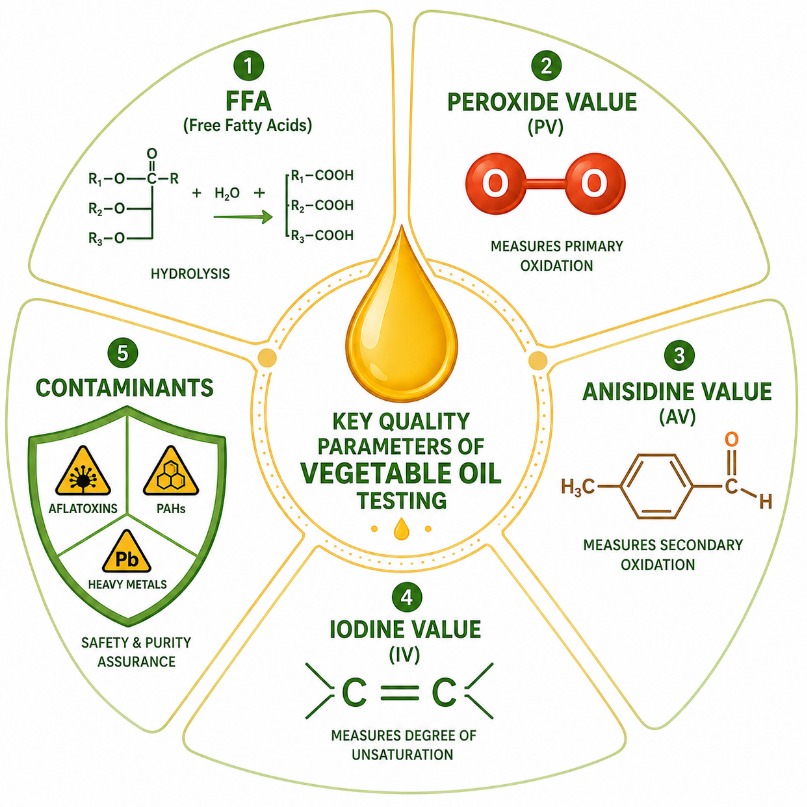
Vegetable oil quality is assessed through a combination of chemical, physical, and safety parameters. Each parameter addresses a specific aspect of oil quality.
|
Parameter |
What It Measures |
Why It Matters |
|---|---|---|
|
Free Fatty Acids (FFA) / Acid Value |
Hydrolytic rancidity |
Indicates oil degradation and quality grade |
|
Peroxide Value (PV) |
Primary oxidation products |
Measures how fresh the oil is |
|
Anisidine Value (AV) |
Secondary oxidation products |
Reveals historical oxidation damage |
|
Iodine Value (IV) |
Degree of unsaturation |
Classifies oil type and predicts stability |
|
Saponification Value |
Average molecular weight of fatty acids |
Verifies oil identity |
|
Moisture Content |
Water present in oil |
Water accelerates hydrolysis and spoilage |
|
Fatty Acid Composition |
Profile of individual fatty acids |
Confirms authenticity and nutritional value |
|
Trans Fatty Acids |
Trans fat content |
Health hazard; regulated in many countries |
|
Unsaponifiable Matter |
Non-glyceride components |
Detects additives and contaminants |
|
Insoluble Impurities |
Solid foreign matter |
Indicates poor refining or contamination |
How Is Free Fatty Acid (FFA) Content Measured?
Free fatty acids (FFA) are the single most important quality indicator for vegetable oil. They are produced by the hydrolysis of triglycerides — the breaking apart of fat molecules — which occurs when oil is exposed to moisture, heat, and enzymes over time. Higher FFA means lower quality.
FFA levels depend on time, temperature, and moisture content because oils are exposed to various environments during storage, processing, heating, or frying. Since free fatty acids are less stable than neutral oil, they are more prone to oxidation and to turning rancid.
Traditional titration method:
AOCS, AOAC, and EU regulations have established nearly identical standard methods based on titration. Oil or fat is dissolved in hot neutralized ethanol or ethanol/diethyl ether, and titrated with sodium hydroxide using phenolphthalein as an endpoint indicator. Results are expressed as:
-
% Free Fatty Acids (typically as % oleic acid)
-
Acid Value (mg KOH per gram of oil)
Limitations of titration:
-
Laborious and requires large amounts of chemicals and solvents
-
Cost of chemicals and environmental concerns limit the procedure
-
Accurate endpoint detection is difficult for highly colored crude oils using colorimetric indicators
-
Despite these drawbacks, titration remains the most widely used method in the edible oil industry
Modern instrumental alternatives offer higher sensitivity, accuracy, and speed, including NIR spectroscopy, colorimetric sensors, and automated titration systems.
What Does Peroxide Value Indicate About Oil Freshness?
Peroxide value (PV) measures the concentration of primary oxidation products — hydroperoxides — in vegetable oil. It is the primary indicator of oil freshness and the earliest sign that oxidation has begun.
When oil is exposed to oxygen, light, or heat, unsaturated fatty acids react with oxygen to form hydroperoxides. These are the first products of lipid oxidation, making PV a real-time freshness marker.
-
Low PV (< 10 meq O₂/kg) — Fresh oil, minimal oxidation
-
Moderate PV (10–20 meq O₂/kg) — Oxidation has started; oil may be approaching the end of acceptable quality
-
High PV (> 20 meq O₂/kg) — Significant oxidation; oil is likely rancid or unfit for consumption
Important limitation: Hydroperoxides are unstable and break down into secondary oxidation products (aldehydes, ketones). Therefore, PV alone can be misleading — an oil that was heavily oxidized and then stored may show a low PV because the peroxides have already decomposed. This is why the anisidine value must be measured alongside PV.
What Is the Anisidine Value and Why Does It Matter?
Anisidine value (AV) measures secondary oxidation products — specifically aldehydes, particularly 2-alkenals — that form when hydroperoxides decompose. While peroxide value only captures the current state of oxidation, anisidine value reveals the oxidation history of the oil.
This matters because an oil can have a low peroxide value but a high anisidine value — meaning it was heavily oxidized in the past, the peroxides broke down, but the damaging aldehydes remain. These secondary products are responsible for the off-flavors and odors associated with rancid oil.
Totox value combines both measurements for a complete oxidation picture:
Totox = 2 × PV + AV
A low Totox value indicates that the oil has experienced minimal oxidation throughout its entire life. Most quality specifications set Totox limits for refined and virgin oils.
How Is Iodine Value Used to Classify Vegetable Oils?
Iodine value (IV) measures the degree of unsaturation in a vegetable oil — how many double bonds are present in the fatty acid chains. It is expressed as grams of iodine absorbed per 100 grams of oil.
Oils with higher iodine values contain more unsaturated (and polyunsaturated) fatty acids, which makes them:
-
More nutritionally beneficial (higher in heart-healthy fatty acids)
-
Less stable (more prone to oxidation and rancidity)
-
Liquid at room temperature
Typical iodine values for common oils:
|
Oil |
Iodine Value |
Classification |
|---|---|---|
|
Coconut oil |
6–11 |
Non-drying (highly saturated) |
|
Palm oil |
44–58 |
Non-drying |
|
Olive oil |
75–94 |
Non-drying |
|
Rapeseed oil |
94–120 |
Semi-drying |
|
Soybean oil |
118–139 |
Semi-drying |
|
Sunflower oil |
125–144 |
Drying |
|
Linseed oil |
170–205 |
Drying (highly unsaturated) |
Iodine value is essential for verifying oil identity and detecting adulteration — if a sample labeled as olive oil shows an iodine value outside the expected range, it may have been blended with a cheaper oil.
What Does Saponification Value Reveal?
Saponification value indicates the average molecular weight (chain length) of the fatty acids in a vegetable oil. It is measured as milligrams of KOH required to saponify one gram of oil.
-
Higher saponification value = shorter chain fatty acids (e.g., coconut oil, palm kernel oil)
-
Lower saponification value = longer chain fatty acids (e.g., rapeseed oil, fish oil)
Like iodine value, saponification value is used to verify oil identity and detect adulteration. Each vegetable oil has a characteristic saponification range; deviations suggest contamination or mixing with other oils.
How Is Moisture Content Determined in Vegetable Oil?
Moisture in vegetable oil accelerates hydrolysis, promotes microbial growth, and reduces shelf life. Even small amounts of water can trigger the breakdown of triglycerides into free fatty acids, initiating a chain reaction of quality degradation.
Primary test methods:
-
Karl Fischer titration — The most accurate method, detecting water down to ppm levels
-
Loss on drying — Simpler but less precise; measures weight loss after heating
-
Distillation methods — Azeotropic distillation separates water from the oil sample
For refined oils, moisture content should typically be below 0.1%. Higher levels indicate inadequate processing or poor storage conditions.
What Contaminants and Safety Hazards Are Tested in Vegetable Oil?
Aflatoxins
Aflatoxins are carcinogenic mycotoxins produced by Aspergillus molds that can contaminate oilseeds before or after harvest. Testing per GB 2761 and other standards is mandatory, especially for peanut oil, corn oil, and other oils from mold-susceptible crops.
Polycyclic Aromatic Hydrocarbons (PAHs)
PAHs such as benzo[a]pyrene are formed during high-temperature processing (drying, roasting, smoking) of oilseeds. They are potent carcinogens and strictly regulated in the EU and other jurisdictions.
Pesticide Residues
Oilseed crops may carry pesticide residues that concentrate during oil extraction. Testing per GB 2763 and equivalent standards screens for a wide panel of pesticide compounds.
Heavy Metals
Lead, cadmium, arsenic, and mercury can contaminate oils through soil, water, or processing equipment. Testing is required under GB 2762 and equivalent food safety regulations.
Phthalate Esters (Plasticisers)
Phthalates can leach into oil from plastic packaging and processing equipment. They are endocrine disruptors and are increasingly monitored, particularly in bottled oils.
Residual Solvents
Oils extracted with chemical solvents (typically hexane) must be tested for residual solvent content. Per food safety standards, hexane residues must be below strict limits.
Trans Fatty Acids
Trans fats are formed during partial hydrogenation and are strongly linked to cardiovascular disease. Many countries now mandate trans fat labeling or set maximum content limits.
Mineral Oil Saturated Hydrocarbons (MOSH/MOAH)
Mineral oil contamination from processing aids, lubricants, or packaging can introduce MOSH and MOAH fractions into vegetable oils — an emerging safety concern in the EU.
How Is Fatty Acid Composition Analyzed?
Fatty acid composition is the most definitive test for vegetable oil authenticity. It provides a detailed profile of all fatty acids present, expressed as a percentage of total fatty acids, and is the gold standard for detecting adulteration.
Method: gas chromatography with flame ionization detection (GC-FID) per ISO 12966 or equivalent methods. The oil is first converted to fatty acid methyl esters (FAMEs), which are then separated and quantified by GC.
Key fatty acid markers for common oils:
|
Oil |
Characteristic Fatty Acids |
|---|---|
|
Olive oil |
High oleic acid (55–83%) |
|
Sunflower oil |
High linoleic acid (48–74%) |
|
Rapeseed oil |
High erucic acid (varies) and oleic acid |
|
Coconut oil |
High lauric acid (45–53%) |
|
Palm oil |
Roughly equal palmitic and oleic acids |
|
Soybean oil |
Moderate linoleic, oleic, and linolenic acids |
Deviations from the expected fatty acid profile are strong evidence of adulteration with cheaper oils — for example, adding sunflower oil to olive oil would increase the linoleic acid percentage beyond the normal range.
What Physical Tests Are Performed on Vegetable Oil?
Relative Density
Relative density (specific gravity) is measured per ISO 6883 or equivalent. Each oil has a characteristic density range at a given temperature. Abnormal density values suggest adulteration or contamination.
Refractive Index
The refractive index, measured with a refractometer, correlates with the degree of unsaturation and is a rapid screening tool for oil identity. Each vegetable oil type has a defined refractive index range at specified temperatures.
Optical Rotation
Some oils contain optically active compounds. Measuring optical rotation can help verify the identity and purity of certain specialty oils.
Color
Color measurement (often by Lovibond tintometer) indicates refining quality. Darker color in refined oils suggests inadequate processing or degradation.
Viscosity
Viscosity affects processing behavior and mouthfeel. It varies with fatty acid composition and temperature, and can be another indicator of oil identity.
What Standards and Regulations Govern Vegetable Oil Testing?
International Standards
|
Organization |
Key Standards |
|---|---|
|
ISO |
6883 (density), 660 (acid value), 3960 (peroxide value), 6885 (anisidine value), 12966 (fatty acid composition), 3657 (saponification value), 3947 (iodine value) |
|
AOCS |
Cd 3d-63 (acid value), Cd 8b-90 (peroxide value), Cd 18-93 (anisidine value), Cd 1d-92 (iodine value), Ce 1h-05 (fatty acid composition) |
|
AOAC |
940.28 (FFA), 965.33 (peroxide value), 996.06 (fat composition) |
|
Codex Alimentarius |
Standard for Named Vegetable Oils (CXS 210) |
Regional and National Standards
-
EU Regulations — EC regulations on limits for contaminants (PAHs, mycotoxins, heavy metals), labeling requirements, and quality standards
-
GB Standards (China) — GB 2716-2018 (edible vegetable oil safety), GB 2761 (aflatoxins), GB 2762 (heavy metals), GB 2763 (pesticides), plus product-specific standards (GB/T 1534 for peanut oil, GB/T 1535 for soybean oil, etc.)
-
FDA (USA) — Food additive regulations, labeling requirements, GRAS status
-
Food Safety and Standards Authority (India) — FSSAI standards for edible oils
Laboratory Accreditation
Testing laboratories should be accredited to ISO/IEC 17025 to ensure competence and reliability of results. Accreditation by recognized bodies (such as CNAS in China, ANAB in the US) provides confidence in test data across the food supply chain.
How Does Vegetable Oil Testing Differ by Oil Type?
Different oils require specific testing programs because their chemical compositions, risk profiles, and quality grade definitions vary significantly.
Olive Oil
Olive oil has the most complex testing regime of any vegetable oil due to widespread adulteration and premium pricing. Key tests include FFA (acidity), peroxide value, UV spectrophotometry (K232, K270, ΔK), fatty acid composition, sterol composition, and diglyceride content to distinguish extra virgin from lower grades and detect blending with refined or cheaper oils.
Refined Seed Oils (Soybean, Sunflower, Rapeseed)
Refined oils are tested primarily for residual solvents, trans fatty acids, polar compounds, and oxidation parameters. The refining process itself must be monitored to ensure it has adequately removed impurities without creating harmful byproducts.
Tropical Oils (Coconut, Palm, Palm Kernel)
These highly saturated oils require testing focused on moisture, FFA, iodine value (to confirm identity), and contaminants from tropical agriculture (aflatoxins in coconut, pesticide residues in palm).
Specialty Oils (Walnut, Flaxseed, Sesame, Camellia)
Premium and cold-pressed specialty oils need testing for authenticity markers, oxidation stability (they are often high in polyunsaturates), and pesticide residues. Sesame oil testing includes specific tests for sesamol and sesamin as identity markers.
Used Frying Oils
Oils that have been used for frying must be tested for total polar compounds (TPC), acid value, and polymer content to determine whether they are still safe for continued use. Many jurisdictions set TPC limits (typically 24–25%) beyond which frying oil must be discarded.