What Is Rust Preventive Oil Testing and Why Does It Matter
Rust preventive oil testing is the systematic evaluation of temporary protective coatings — oils, greases, and solvent-deposited films — applied to ferrous and non-ferrous metal surfaces to prevent corrosion during storage, transport, and interim manufacturing stages. It determines whether a rust preventive product can protect metal components for the specified duration under defined environmental conditions.
Corrosion is a serious threat to the integrity of industrial equipment and components. The World Corrosion Organization (WCO) estimates that annual maintenance and shutdown costs related to corrosion amount to $2.5 billion worldwide. In the oil and gas sector alone, pipeline and equipment corrosion drives a significant share of this figure. For manufacturers, rust on in-process parts, stored components, or finished goods destined for export translates directly into scrap, rework, warranty claims, and lost customer confidence.
Rust preventive oils serve as the first line of defense. They form barrier films on metal surfaces that block moisture, oxygen, and corrosive agents such as chlorides and sulfur compounds. But not all rust preventives perform equally — performance varies by formulation, application method, film thickness, substrate preparation, and environmental severity. Testing provides the data needed to select the right product, verify that it performs as claimed, and monitor its effectiveness over time.
The stakes are concrete. An automotive supplier shipping machined engine blocks from Southeast Asia to North America faces 4–8 weeks of ocean transit through salt-laden marine atmospheres. If the rust preventive oil fails at week 3, the customer receives corroded parts and the supplier faces a six-figure rejection. Testing the oil's salt spray resistance before shipment prevents this scenario.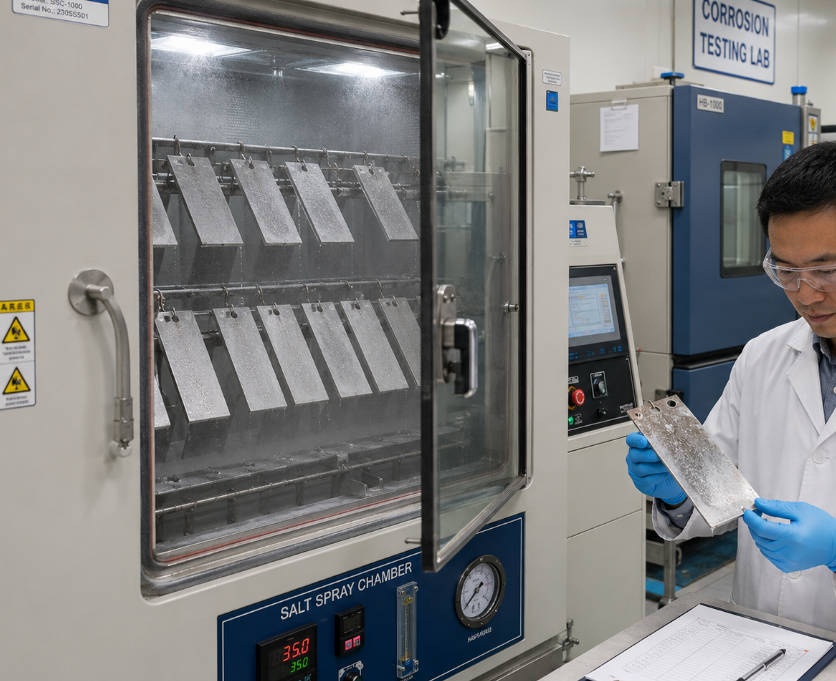
Key Rust Preventive Oil Testing Standards
|
Standard |
Title |
Scope |
|---|---|---|
|
ASTM B117 |
Standard Practice for Operating Salt Spray (Fog) Apparatus |
Accelerated corrosion testing in 5% NaCl fog at 35 °C |
|
ISO 9227 |
Corrosion Tests in Artificial Atmospheres — Salt spray tests |
Neutral (NSS), acetic acid (AASS), and copper-accelerated (CASS) spray |
|
ASTM D665 |
Rust-Preventing Characteristics of Inhibited Mineral Oil in the Presence of Water |
Steel specimen in oil/water mixture at 60 °C for 4 hours |
|
ASTM D3603 |
Rust-Preventing Characteristics of Steam Turbine Oil (Horizontal Disc Method) |
Horizontal and vertical steel surfaces in oil/water |
|
ASTM D1748 |
Rust Protection by Metal Preservatives in the Humidity Cabinet |
Steel panels at 49 °C and 95–100% relative humidity |
|
ASTM D2247 |
Testing Water Resistance of Coatings in 100% Relative Humidity |
Humidity cabinet exposure for organic coatings |
|
DIN 50017 |
Condensation Water Test Atmospheres |
Humidity cabinet with condensation cycles |
|
ASTM D130 |
Detection of Copper Corrosion from Petroleum Products by Copper Strip |
Corrosiveness toward yellow metals |
|
ASTM D3703 |
Peroxide Number of Aviation Turbine Fuels |
Oxidation state of protective films |
|
JIS K2246 |
Rust Preventive Oils |
Japanese standard covering all rust preventive oil test methods |
|
ASTM D7548 |
Standard Practice for Evaluating the Compatibility of Additives with lubricating oil |
Additive performance verification |
Types of Rust Preventive Oils
|
Type |
Film Type |
Typical Duration |
Application Method |
Best For |
|---|---|---|---|---|
|
Solvent-deposited (soft film) |
Thin oily or waxy residue after solvent evaporation |
3–12 months indoor |
Dip, spray, brush |
Machined parts, stampings, fasteners |
|
Oil-based (thin film) |
Persistent oily film |
6–24 months indoor, 3–6 months outdoor |
Dip, spray, roller coat |
Engine components, bearings, gears |
|
Wax-based (hard film) |
Dry-to-touch wax or grease film |
12–36 months indoor/outdoor |
Dip, spray (heated) |
Heavy machinery, structural steel, export |
|
Water-based emulsion |
Thin film, easy to remove |
1–6 months indoor |
Dip, spray |
Inter-stage protection, environmentally sensitive |
|
Oil-based (thick film) |
Heavy grease or slushing compound |
24+ months outdoor |
Brush, trowel, dip |
Marine storage, long-term outdoor exposure |
|
Vapor corrosion inhibitor (VCI) oil |
Molecular adsorption + oil film |
6–24 months enclosed |
Spray, inject into packaging |
Enclosed systems, export packaging, internal cavities |
Core Rust Preventive Oil Test Methods
Salt Spray Test (ASTM B117 / ISO 9227)
The salt spray test is the most widely used accelerated corrosion test for evaluating rust preventive oil performance. It simulates a marine or industrial salt-laden atmosphere inside a controlled chamber using a 5% sodium chloride (NaCl) fog at 35 °C.
Why salt spray instead of natural exposure? Under natural conditions, verifying the rust resistance of a preventive oil can take one year or more — an impractical timeline for product development and quality control. The salt spray test creates an environment where the NaCl concentration is several times to dozens of times higher than natural salt spray, dramatically accelerating corrosion. A widely cited industrial correlation:
Neutral Salt Spray Test 24 hours ≈ 1 year in natural environment
This correlation is approximate and depends on the specific environment, but it provides a practical benchmark for product qualification.
Test procedure: Polished steel panels are coated with the rust preventive oil at the specified film weight, allowed to dry/cure, then suspended in the salt spray cabinet. Panels are inspected at regular intervals for the first sign of rust. The result is reported as the number of hours until rust appears on the test specimen.
Three salt spray variants:
|
Variant |
Solution |
Temperature |
Corrosion Rate |
Typical Application |
|---|---|---|---|---|
|
NSS (Neutral Salt Spray) |
5% NaCl, pH 6.5–7.2 |
35 °C |
Baseline |
Most rust preventive oils |
|
AASS (Acetic Acid Salt Spray) |
5% NaCl + acetic acid, pH 3.1–3.3 |
35 °C |
~3× NSS |
Decorative coatings, aggressive environments |
|
CASS (Copper-Accelerated) |
5% NaCl + acetic acid + CuCl₂ |
50 °C |
~8× NSS |
Automotive, aerospace, high-performance coatings |
Typical performance benchmarks for rust preventive oils:
|
Product Type |
Salt Spray Hours (NSS) |
Equivalent Natural Exposure |
|---|---|---|
|
Light oil film, indoor storage |
24–48 hours |
1–2 years indoor |
|
Medium oil film, general purpose |
48–120 hours |
2–5 years indoor |
|
Heavy wax/grease film, export grade |
120–360+ hours |
5+ years outdoor |
|
VCI oil, enclosed packaging |
48–96 hours |
2–4 years enclosed |
Rust Preventing Characteristics Test (ASTM D665)
ASTM D665 evaluates the rust-preventing ability of inhibited mineral oils (particularly steam turbine oils, gear oils, and hydraulic oils) when they come into contact with water. It is the most fundamental test for rust prevention in lubricating oils.
Test procedure: 300 mL of the test oil is mixed with 30 mL of distilled water (Procedure A) or synthetic seawater (Procedure B) in a beaker at 60 ± 1 °C. A polished cylindrical steel test rod (made from #1018 cold-finished carbon steel) is completely immersed in the stirred mixture for 4 hours. After the test period, the rod is removed, washed with solvent, and inspected for rust.
Rating:
|
Result |
Appearance |
Interpretation |
|---|---|---|
|
Pass |
No rust on any part of the specimen |
Adequate rust inhibition |
|
Fail |
Any visible rust on the specimen |
Insufficient rust inhibition |
The test is run in duplicate — both specimens must be rust-free to pass. This method is widely used for specification of new oils and for monitoring in-service oils.
Significance: Lubricants in normal operation can contact steam and water, affecting both lubricity and inherent corrosion resistance. Rust inhibitors added to the formulation must be verified by this test. For in-service oils, declining performance signals inhibitor depletion and the need for oil replacement.
Humidity Cabinet Test (ASTM D1748 / ASTM D2247)
The humidity cabinet test evaluates rust preventive oils under conditions of high moisture — simulating warehouse storage, tropical climates, or condensation-prone environments.
ASTM D1748 procedure: Steel panels are dipped in the rust preventive oil, allowed to drain and dry, then suspended in a humidity cabinet maintained at 49 °C (120 °F) and 95–100% relative humidity. Panels are inspected daily for the first sign of rust or corrosion.
DIN 50017 variant: Uses cyclic condensation — panels are exposed to alternating periods of high humidity and mild drying to simulate real-world day/night condensation cycles.
|
Test |
Conditions |
Typical Duration |
Simulates |
|---|---|---|---|
|
ASTM D1748 |
49 °C, 95–100% RH, static |
30–360 days equivalent |
Tropical storage, warehouse |
|
DIN 50017 (condensation) |
40 °C, 100% RH with cycles |
8–240 hours |
Day/night condensation |
|
ASTM D2247 |
38 °C, 100% RH |
24–1000+ hours |
General moisture resistance |
Copper Strip Corrosion Test (ASTM D130)
When rust preventive oils are used on assemblies containing yellow metals (copper, brass, bronze) — common in valves, fittings, and electrical connectors — the ASTM D130 test determines whether the oil itself causes corrosion of these non-ferrous components.
A polished copper strip is immersed in the oil at a specified temperature (typically 100 °C for 3 hours for most products), then removed and compared against the ASTM Copper Strip Corrosion Standard.
|
Rating |
Description |
Assessment |
|---|---|---|
|
1a |
Light tarnish, nearly the same as fresh polish |
Excellent — no corrosion concern |
|
1b |
Light tarnish, slight orange or red |
Good — acceptable for most applications |
|
2a–2c |
Moderate tarnish (purple, multi-color) |
Caution — may not suit sensitive yellow metals |
|
3a–3b |
Dark tarnish |
Poor — likely to corrode copper alloys |
|
4a–4c |
Corrosion (black, pitted) |
Fail — product is corrosive to copper |
Water Displacement Test (ASTM D3703 / IP 54)
Water displacement ability is critical for rust preventive oils used on parts that are wet after machining, washing, or rain exposure. The test evaluates whether the oil can displace water from the metal surface and establish a protective film.
A steel panel is wetted with water, then immersed in the rust preventive oil. After removal, the panel is inspected to verify that water has been displaced (no water breaks or uncovered spots) and that a continuous protective film has formed. Panels are then subjected to humidity or salt spray exposure to verify that the displaced-water film still provides adequate protection.
Film Properties and Residue Testing
The physical characteristics of the protective film directly affect handling, stacking, packaging, and eventual removal.
|
Property |
Test Method |
Why It Matters |
|---|---|---|
|
Film thickness |
Gravimetric (weigh before/after coating) |
Determines protection level and material cost |
|
Drying time |
Touch test per product specification |
Affects production throughput |
|
Tack/fingerprint resistance |
Finger press test, visual |
Worker handling, packaging adhesion |
|
Removal ease |
Solvent wipe, alkaline wash test |
Downstream processing, assembly |
|
Non-volatile residue |
ASTM D381 (existent gum) |
Film consistency, cleanliness |
|
Pour point / low-temperature behavior |
ASTM D97 |
Cold climate storage and application |
Accelerated Weathering and Outdoor Exposure
For products claiming long-term outdoor protection (12+ months), manufacturers and testing laboratories supplement salt spray and humidity tests with:
-
QUV accelerated weathering (ASTM G154): UV light exposure combined with condensation cycles simulates sunlight and rain degradation of the protective film.
-
Natural outdoor exposure: Test panels mounted at 45° facing south (in the Northern Hemisphere) at coastal or industrial test sites provide real-world performance data — but require 6–24 months of patience.
-
Cyclic corrosion tests (SAE J2334, CCT-I/II/III): Combine salt spray, humidity, and drying cycles to better simulate real atmospheric conditions than continuous salt spray alone.
Digital Detection Imaging (FeDDI) for Automated Rating
Traditional rust assessment relies on visual inspection by an operator — a subjective process with considerable bias. The VISAYA Iron Digital Detection Imaging (FeDDI) system addresses this by performing ASTM D665 and D7548 tests with automated digital image analysis.
FeDDI uses a high-resolution CMOS camera and a 4-step automated vision algorithm to capture 360° images of the test specimen, integrating the total corroded area and producing a quantitative corrosion rating. This eliminates operator bias, improves repeatability, and provides numerical data for trending and specification compliance.
Interpreting Rust Preventive Oil Test Results
|
Scenario |
Likely Cause |
Action |
|---|---|---|
|
Salt spray failure at <24 hours |
Insufficient film thickness, wrong product for severity |
Increase film weight, select higher-performance product |
|
Salt spray failure at 24–48 hours |
Marginal formulation, surface contamination |
Improve surface preparation (cleaning, degreasing) |
|
ASTM D665 failure (distilled water) |
Inhibitor depletion, wrong oil formulation |
Reformulate or increase inhibitor concentration |
|
ASTM D665 failure (seawater only) |
Inhibitor not effective against chloride attack |
Use seawater-resistant inhibitor chemistry |
|
Humidity cabinet early failure |
Thin film, incomplete coverage, water in oil |
Verify application method, check oil quality |
|
Copper strip corrosion |
Active sulfur or acid compounds in oil |
Switch to non-staining formulation |
|
Film too thick / tacky |
Over-application, wrong solvent balance |
Adjust application parameters or product selection |
|
Film too thin / uneven |
Under-application, poor surface wetting |
Verify viscosity, surface cleanliness |
Rust Preventive Oil Testing by Industry Application
|
Industry |
Typical Protection Need |
Key Tests |
Protection Duration |
|---|---|---|---|
|
Automotive parts |
In-process and export shipping |
Salt spray, humidity, copper strip |
3–12 months |
|
Bearings |
Storage and transit |
Salt spray, humidity, film removal |
6–24 months |
|
Steel coils / sheets |
Warehouse and outdoor storage |
Humidity cabinet, salt spray |
3–12 months |
|
Fasteners |
Export, long-term storage |
Salt spray (often 48–96 hour spec) |
6–24 months |
|
Heavy machinery |
Outdoor storage, construction site |
Salt spray, outdoor exposure, wax film |
12–36 months |
|
Aerospace components |
Controlled storage, transit |
Salt spray, humidity, non-volatile residue |
Per OEM specification |
|
Oil & gas equipment |
Pipeline, offshore, marine |
ASTM D665 seawater, salt spray, humidity |
6–24 months |
|
Electronics / connectors |
Yellow metal compatibility |
Copper strip (ASTM D130), humidity |
3–12 months |
|
Marine / shipbuilding |
Severe marine atmosphere |
Cyclic corrosion, salt spray, outdoor |
12–60 months |
Factors Affecting Rust Preventive Performance
Multiple variables influence how well a rust preventive oil protects metal surfaces. Understanding these factors is essential for both product formulation and end-use application.
|
Factor |
Effect on Performance |
Optimization |
|---|---|---|
|
Surface cleanliness |
Oil, grease, machining residue, and fingerprints under the film create corrosion initiation sites |
Thorough cleaning (alkaline wash, solvent degreasing, or vapor degreasing) before application |
|
Surface roughness |
Rough surfaces trap contaminants and reduce film uniformity |
Polished or smooth surfaces receive more uniform films |
|
Film thickness |
Too thin = inadequate barrier; too thick = waste, slow drying, handling issues |
Apply per product data sheet; verify by gravimetric measurement |
|
Application method |
Dip provides most uniform coverage; spray may miss recessed areas |
Select method appropriate for part geometry |
|
Water quality (for water-displacing oils) |
Hard water or contaminated rinse water leaves residues |
Use clean, preferably deionized water for final rinse |
|
Storage conditions |
Temperature cycling causes condensation; stacking pressure damages films |
Store in controlled environments; use interleaving paper |
|
Substrate metallurgy |
Different alloys corrode at different rates; galvanized surfaces may react with certain inhibitors |
Match product to substrate; test on actual production material |
|
Time between cleaning and coating |
Exposed bare metal begins oxidizing within minutes in humid environments |
Apply rust preventive immediately after cleaning |
Benefits of Regular Rust Preventive Oil Testing
-
Verified product selection: Salt spray and humidity data confirm that the chosen rust preventive oil matches the actual storage and transit conditions — preventing costly surprises.
-
Batch-to-batch consistency: Incoming quality testing of rust preventive oil ensures that each batch meets the same performance specification, avoiding variability in protection quality.
-
In-service monitoring: For long-term applications (e.g., oil in turbine systems), periodic ASTM D665 testing detects inhibitor depletion before corrosion damage occurs.
-
Cost optimization: Over-specifying rust prevention wastes money; under-specifying risks corrosion losses. Testing data enables right-sizing of protection level to actual need.
-
Regulatory and customer compliance: Many OEMs specify minimum salt spray hours (e.g., "48 hours per ASTM B117") for supplied components. Documented test results satisfy these requirements.
-
Warranty and liability protection: Test records demonstrate due diligence in corrosion prevention, supporting warranty claims and limiting liability for corrosion-related failures.
Summary
Rust preventive oil testing provides the objective data needed to protect metal components from corrosion during storage, transit, and interim manufacturing. Salt spray testing (ASTM B117) delivers accelerated results in hours that correlate to years of natural exposure. ASTM D665 verifies rust inhibition in lubricating oils exposed to water contamination. Humidity cabinet tests simulate storage conditions. Together, these methods enable manufacturers to select the right product, verify batch quality, and monitor in-service performance. The key to effective corrosion prevention is matching the test method and performance level to the actual environmental severity — and maintaining the discipline of regular testing rather than assuming a product will perform indefinitely without verification.