What Does a Salt Spray Test Actually Measure?
A salt spray test (also called a salt fog test) exposes metal or coated samples to a continuous, controlled mist of saline solution to accelerate corrosion, then records how the surface responds over time. It is governed above all by ASTM B117 (the first internationally recognized salt-spray standard, published in 1939) and ISO 9227, with JIS Z 2371 as the Japanese equivalent. The single most important thing to understand before commissioning one is that a salt spray test is a comparative quality-control tool, not a field-life predictor. The chamber does not reproduce the wet/dry cycling, UV, pollutants and temperature swings of real service, so hours-to-rust in the cabinet do not translate into months or years outdoors. Its real value is detecting drift in a coating process, qualifying a supplier, or ranking two finishes against each other. This distinction — established repeatedly in ASTM B117 practice and in ISO 9227 guidance — determines how a test report should be written and read.
What Are the Operating Conditions for an ISO 9227 Neutral Salt Spray (NSS) Test?
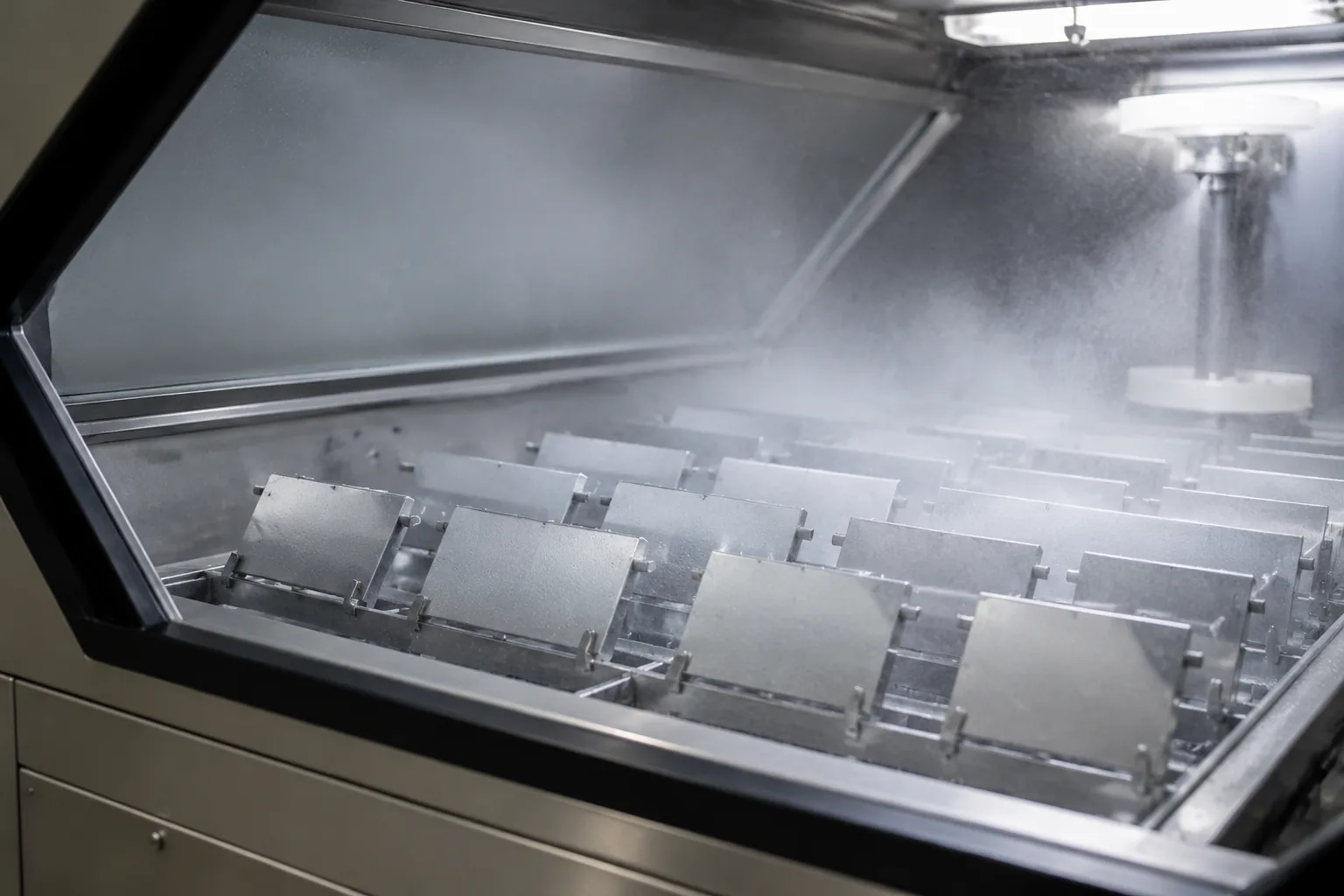
The Neutral Salt Spray (NSS) variant is by far the most common, and its boundary conditions are tightly defined. ISO 9227 (and the parallel DIN EN ISO 9227) fixes five parameters that must be held within tolerance for the whole test, with daily checking and records:
| Parameter | ISO 9227 NSS specification |
|---|---|
| Chamber temperature | 35 °C ± 2 °C |
| NaCl solution concentration | 50 ± 5 g/L (≈ 5%), high-purity NaCl in deionized water |
| Solution pH | 6.5 to 7.2 (neutral; adjusted with HCl or NaOH) |
| Spray nozzle overpressure | 0.7 to 1.4 bar |
| Solution collection rate | 1.0 to 2.0 mL/h per 80 cm² of collection area (100 mm-diameter funnel) |
Specimens are mounted in the cabinet at 15° to 25° (or up to 30°) from vertical, resting at only a few contact points so that condensate cannot drip from an upper sample onto one below. Standard test panels are 75 × 150 mm, but other sizes are accepted if specified. The reason these tolerances matter mechanically: a pH drift outside 6.5–7.2, a spray rate below 1 mL/h, or an angle error all change the chloride delivery and produce non-comparable results — which is why ISO 9227 mandates daily parameter logging.
How Do the NSS, AASS and CASS Variants Differ?
ISO 9227 defines three main variants plus OEM marine-climate tests, distinguished by solution chemistry and temperature. Choosing the wrong variant is a common cause of rejected reports.
- NSS — Neutral Salt Spray. 5% NaCl, pH 6.5–7.2, 35 °C. The workhorse for painted/coated metals, phosphated steel, and zinc flake coatings. Most salt-spray hours quoted in specifications are NSS hours.
- AASS — Acetic Acid Salt Spray. The NaCl solution is acidified with acetic acid to pH 3.1–3.3, 35 °C. Roughly accelerates corrosion relative to NSS; used for decorative chromium plating on steel and zinc die-castings, and in galvanizing work.
- CASS — Copper-Accelerated Acetic Acid Salt Spray. Adds copper(II) chloride dihydrate at ~0.26 g/L to the acidified solution and runs at ≈ 50 °C. The most aggressive variant, used for decorative Cu–Ni–Cr and Ni–Cr systems and anodized aluminium.
- Marine climate (OEM) tests. Synthetic seawater approximating 0.9% NaCl + 0.1% CaCl₂ + 0.075% NaHCO₃, simulating seawater rather than pure chloride.
A practical contamination rule worth knowing: ISO 9227 does not recommend running NSS in a cabinet previously used for CASS, because residual copper is extremely difficult to remove and skews later neutral results.
What Does Each ASTM G85 Annex Test?
When a specification calls for something beyond steady NSS — wet/dry cycles, SO₂, or alloy-specific conditions — the route is ASTM G85, which contains five modified-salt-spray annexes. Several arose within specific industries to mimic natural corrosion that continuous fog cannot reproduce:
- Annex A1 — ASS (Acetic Acid Salt Spray), non-cyclic. Acidified fog (pH 3.1–3.3), 35 °C, continuous. Essentially the AASS variant above; decorative chromium on steel/zinc die-cast.
- Annex A2 — MASTMAASIS (cyclic). For aluminium alloys. A repeating 6-hour cycle: 0.75 h acidified spray (pH 2.8–3.0) → 2 h air-dry purge → 3.25 h humidity ramping to 65–95% RH, all at 49 °C.
- Annex A3 — SWAAT (Seawater Acidified Test), cyclic. For coated/uncoated aluminium and other metals. 30 min acidified synthetic-seawater spray (pH 2.8–3.0) → 90 min high humidity (>98% RH), at 49 °C (24–35 °C for organically coated samples).
- Annex A4 — SO₂ Salt Spray, cyclic. For environments combining SO₂, salt spray and acid rain. Two cycle options; SO₂ dosed at 35 cm³/min/m³ of chamber volume during the salt-spray phase, at 35 °C. Models industrial-pollution corrosion.
- Annex A5 — Prohesion (Dilute Electrolyte Fog/Dry), cyclic. For paints on steel. 1 h dilute acidified spray (pH 3.1–3.3) at ambient (21–27 °C) → 1 h air-dry at 35 °C. Popular in the surface-coatings industry because the dry phase better mimics outdoor film behaviour.
What Are Realistic Salt-Spray Durations for Common Coatings?
Neither ASTM B117 nor ISO 9227 prescribes test durations or pass criteria — those are agreed between client and manufacturer, or set in material specifications. The figures below are widely used industry references for hours-to-defined-failure, useful for setting a test plan:
| Coating system | Typical salt-spray milestone |
|---|---|
| Phosphated steel (no topcoat) | 8–24 h before corrosion |
| Electroplated zinc + yellow passivate | 96 h without white rust |
| Zinc–nickel electroplating | > 720 h in NSS without red rust (or 48 h in CASS) |
| High-grade zinc flake (ISO 10683) | up to 1000 h |
| Automotive e-coat / paint systems | 500–1000+ h |
| Pre-treated + painted component (process-control gate) | 96 h must pass before production release |
The 96-hour NSS gate on pre-treated painted parts is the textbook process-control application: a failure there means the pre-treatment chemistry or paint line is out of control, and the longer the line runs uncorrected the larger the non-conforming batch — so the test is run specifically to catch process drift fast. For a deeper look at how corrosion performance fits into coating evaluation, see our coating testing and Steel structure testing capabilities.
Why Is Salt Spray the Wrong Test for Hot-Dip Galvanizing?
This is the most common misuse of the method, and it produces misleadingly poor results. Hot-dip galvanized surfaces should generally not be evaluated by salt spray (ISO 1461 / ISO 10684 context). In natural outdoor exposure, galvanized zinc reacts with atmospheric CO₂ and moisture to form stable, protective zinc carbonate layers that slow further corrosion. A salt-spray cabinet supplies continuous chloride fog with no CO₂ cycling, so those protective carbonates never form — the test therefore attacks the zinc faster than real weather would and reports a result that understates actual performance. ISO 9223 is the appropriate route for assessing hot-dip galvanized corrosion resistance. (Painted systems over a hot-dip galvanized substrate are different, and may be tested under ISO 12944-6.) Knowing when not to run salt spray is as much part of competent testing as running it correctly.
How Are Salt Spray Results Actually Evaluated?
Because the standard fixes the environment but not the acceptance criteria, evaluation is where the client's specification takes over. A compliant report typically documents several of the following:
- Time to first corrosion onset — e.g. hours to first red rust (iron oxide on steel) or white rust (zinc oxide on zinc coatings).
- Scribe creepback — for a sample with an intentional scribe, how far corrosion creeps from the cut (mm), per ASTM-defined methods.
- Blistering and rust rating — size and density of blisters/corrosion points, graded against rating systems such as GB/T 1766 (paint film defect ratings) or the ISO 4628 series.
- Percentage area corroded — image-based quantification of affected surface.
- Mass change — specimen weighed before and after to compute material loss.
- Adhesion after exposure — coating adhesion re-tested post-corrosion to detect degradation.
Modern laboratories augment visual rating with 3D macroscope image processing for objective depth-of-attack and creepback measurement, and can use multi-electrode sensor arrays to log corrosion rate as a function of wet/dry cycles inside the chamber.
Salt Spray vs Cyclic corrosion testing — When to Use Which?
The choice comes down to what question you are answering. Salt spray (continuous fog) is fast, cheap, well-standardized and repeatable — ideal for lot-to-lot process control, supplier qualification, and comparative ranking of coatings. Cyclic Corrosion Testing (CCT) alternates salt spray with drying, high humidity and temperature steps (e.g. ISO 11997, ISO 14993, SAE J2334, VDA 233-102, GM9540/GMW 17872), and because it reproduces the wet/dry transitions that drive real atmospheric corrosion, it correlates far better with field performance. A reasonable rule: use salt spray for process control and go/no-go gates; use CCT when you need to predict actual outdoor durability, especially for automotive, aerospace and marine applications where the stakes justify the longer cycle times.
FAQ
Can salt spray hours be converted to years of outdoor service?
No. This is the most persistent misconception. The chamber is a steady chloride-fog environment without UV, temperature cycling, or pollutants, so it has weak correlation with field life for most coatings. It is a comparative and process-control tool — it tells you whether lot B is as good as lot A, not how many years either will last outside.
What is the difference between ASTM B117 and ISO 9227?
Both specify how to run a continuous salt-fog test (temperature, concentration, pH, collection rate), and their NSS conditions are closely aligned. ASTM B117 is the original 1939 US practice; ISO 9227 (with its DIN EN equivalent) is the European/international counterpart that also formally defines the NSS, AASS and CASS variants. A specification usually names one or the other; results are generally accepted cross-referenced, but the chamber must be set to the named standard's tolerances.
Why does my salt spray result vary between labs?
Most variability traces to parameters drifting outside tolerance: pH outside 6.5–7.2, spray collection below 1 mL/h, nozzle pressure outside 0.7–1.4 bar, specimen angle outside 15–30°, or cross-contamination from prior CASS runs. ISO 9227 requires daily parameter checks and records precisely to control these. Insufficient cleaning/degreasing of samples and poor-quality salt also distort results.
Should I test my hot-dip galvanized part in salt spray?
Generally no. Salt spray cannot form the protective zinc carbonate layer that galvanizing develops outdoors, so it overstates corrosion and understates real performance. Use ISO 9223 atmospheric-corrosion guidance instead. Painted systems over hot-dip galvanizing are a separate case and may be tested under ISO 12944-6.
How long should my salt spray test run?
The duration is set by your material specification or by agreement with the client — the standards do not fix it. Typical references: phosphated steel 8–24 h, zinc + yellow passivate 96 h to white rust, zinc–nickel 720 h to red rust, zinc flake up to 1000 h. State the coating system and the acceptance sign (white rust / red rust / creep / blistering) on the test request so the lab stops and evaluates at the right point.
Our Testing Capabilities
As an ISO/IEC 17025-accredited third-party laboratory, Beijing ZKGX Research provides salt spray and cyclic corrosion testing aligned to the ASTM, ISO and JIS framework:
- Standard salt fog tests: ASTM B117 and ISO 9227 NSS, AASS and CASS, JIS Z 2371, with daily parameter logging to tolerance.
- Modified and cyclic tests: ASTM G85 Annexes A1–A5 (ASS, MASTMAASIS, SWAAT, SO₂, Prohesion), ASTM D1735 water fog, and cyclic corrosion to ISO 11997, ISO 14993, SAE J2334 and VDA 233-102.
- Evaluation and rating: time-to-corrosion, scribe creepback, blistering/rust rating (GB/T 1766, ISO 4628), percentage-area-corroded image analysis, and mass change.
- Coating systems routinely tested: phosphated steel, electroplated zinc/zinc–nickel, zinc flake (ISO 10683), chromium/nickel decorative plating, anodized aluminium, paint and e-coat systems, conformal coatings — see also our conformal coating testing and Fire-resistant coating testing services.
If you have a specific coating system, material specification, or pass criterion, contact the laboratory to confirm the correct standard, variant and duration befOre testing — particularly for hot-dip galvanized samples, where an alternative method is usually more appropriate.