What Is Steel Structure Testing and Why Is It Essential?
Steel structure testing encompasses a comprehensive range of evaluation procedures designed to verify the mechanical properties, structural integrity, and safety compliance of steel components used in construction projects. These tests determine whether steel materials meet required specifications for strength, ductility, hardness, and corrosion resistance before integration into buildings, bridges, and infrastructure.
Steel remains the backbone of modern construction, with over 3,500 grades available for engineering applications. Each grade possesses unique characteristics that must be verified through rigorous testing protocols to ensure long-term structural performance and public safety.
Critical Importance of Testing
Quality Assurance Benefits
- Identifies manufacturing defects, impurities, and handling damage
- Verifies compliance with design specifications and building codes
- Prevents use of substandard or scrap materials at construction sites
- Supports accurate structural design and reinforcement detailing
- Ensures traceability through mill test reports
Safety and Performance Outcomes
- Confirms load-bearing capacity meets project requirements
- Validates performance under expected environmental conditions
- Determines corrosion resistance and treatment needs
- Establishes fatigue life for cyclic loading applications
- Provides data for structural analysis and modeling
Economic Impact
- Reduces risk of structural failures and associated costs
- Minimizes warranty claims and liability exposure
- Optimizes material selection for cost-effective designs
- Supports maintenance planning and life-cycle assessment
- Enables informed decisions about material substitution
Types of Steel Used in Construction Projects
Different steel types serve specific construction applications, each requiring tailored testing approaches to verify suitability for intended use.
Structural Steel
Characteristics and Applications
- High strength, elasticity, and durability properties
- Moulded into I-beams, L-beams, Z-beams, and custom shapes
- Supports design flexibility in commercial and industrial buildings
- Primary material for bridge girders and long-span structures
- Subject to tensile, compression, and bending tests
Common Grades
- ASTM A36: Mild steel with 36,000 psi yield strength
- ASTM A572-50: High-strength low-alloy with 50,000 psi yield
- ASTM A992: Wide-flange shapes for building construction
- European grades S235, S355, S450 for Eurocode applications
Reinforcing Steel (Rebar)
Purpose and Properties
- Provides tensile strength in reinforced concrete structures
- Improves stability and durability of concrete elements
- Essential for earthquake-resistant construction
- Available in various grades (Fe 415, Fe 500, Fe 550, Fe 600)
- Requires bend, rebend, and chemical composition tests
Grade Specifications
| Grade | Yield Strength (N/mm²) | Tensile Strength (N/mm²) | Elongation (%) |
|-------|------------------------|-------------------------|----------------|
| Fe 415 | 415 | 485 | 20 |
| Fe 500 | 500 | 545 | 16 |
| Fe 500D | 500 | 565 | 18 |
| Fe 550 | 550 | 585 | 14 |
| Fe 600 | 600 | 660 | 10-12 |
Alloy Steel
Enhanced Properties
- Combines chromium, nickel, molybdenum with carbon steel
- Superior strength, hardness, and corrosion resistance
- Common in pipeline construction and pressure vessels
- Requires chemical composition and specialized mechanical testing
- Performance varies significantly with alloy content
Light Gauge Steel
Construction Applications
- Thin steel sheets formed into framing members
- Expedited construction speed for residential projects
- Maximum design flexibility with cold-formed shapes
- Resistant to pests and fire damage
- Testing focuses on connection strength and stability
Mild Steel
General Purpose Material
- Low carbon content (0.03% to 0.25%)
- Excellent malleability and weldability
- Less brittle than higher carbon grades
- Suitable for diverse construction applications
- Lower strength but higher ductility than alloy steels
Key Steel Structure Testing Methods Explained
Comprehensive testing programs employ multiple methods to fully characterize steel material properties and structural performance.
Destructive Testing Methods
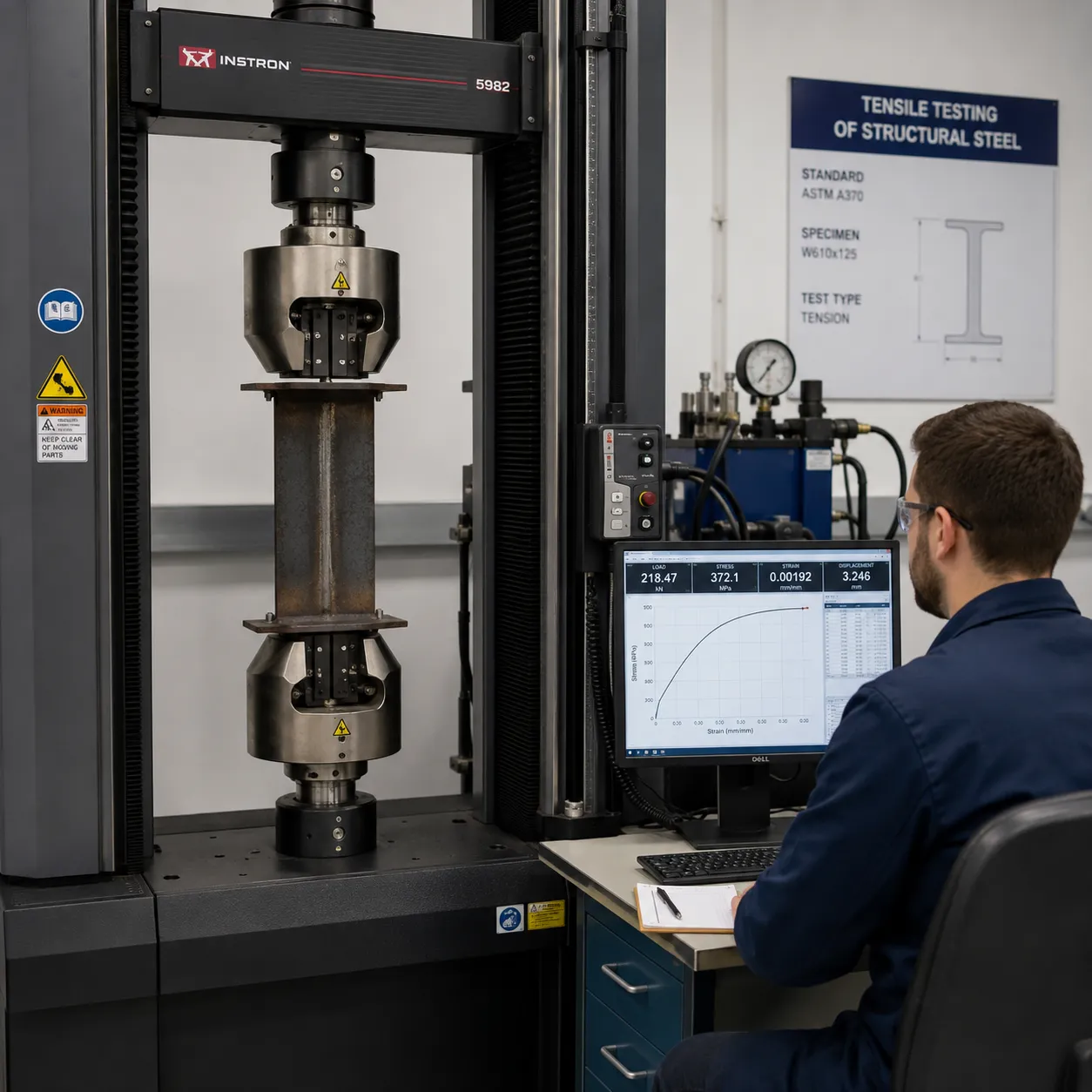
Tensile Testing
- Determines yield strength, ultimate tensile strength, and elongation
- Uses Universal Testing Machine with extensometer
- Produces stress-strain curve for material characterization
- Identifies proportional limit, elastic limit, and plastic region
- Critical for verifying load-bearing capacity
Compression Testing
- Evaluates behavior under compressive loads
- Tests columns, braces, and compression members
- Identifies buckling resistance and crushing strength
- Essential for seismic isolation devices and concrete members
- Can handle ultra-large loads up to 10MN with specialized equipment
Bend and Rebend Testing
- Assesses ductility and resistance to cracking
- Bend test: 180° bend at midpoint
- Rebend test: 135° bend followed by aging simulation
- Verifies strain ageing resistance
- Critical for reinforcing steel applications
Impact Testing
- Charpy V-Notch test for toughness evaluation
- Izod test for alternative impact measurement
- Determines energy absorption before fracture
- Temperature-dependent results for cold service applications
- Essential for structures in seismic zones
Non-Destructive Testing Methods
Ultrasonic Testing (UT)
- Uses high-frequency sound waves to detect internal defects
- Identifies laminations, cracks, and inclusions
- Accuracy between ±0.025mm and ±0.001mm
- No damage to tested material
- Suitable for in-service inspection
Radiographic Testing (RT)
- X-ray or gamma ray examination
- Reveals internal weld defects and porosity
- Creates permanent record of inspection
- Requires radiation safety protocols
- Effective for complex geometries
Magnetic Particle Testing (MT)
- Detects surface and near-surface discontinuities
- Limited to ferromagnetic materials
- Quick and economical method
- Requires clean surface preparation
- Shows crack indications clearly
Penetrant Testing (PT)
- Reveals surface-breaking defects
- Applicable to all metals
- Uses visible or fluorescent dyes
- Requires thorough cleaning before application
- Cost-effective for small components
Tensile Strength Testing of Structural Steel Members
Tensile testing remains the most fundamental steel evaluation method, providing essential data for structural design and material certification.
Test Procedure Overview
Specimen Preparation
- Coupon samples cut from master plate or forging
- Longitudinal coupons (LCVN) aligned with rolling direction
- Transverse coupons (TCVN) perpendicular to rolling direction
- Standard dimensions per IS 1608 or ASTM E8
- Representative of actual material conditions
- Universal Testing Machine (UTM) with calibrated load cell
- Extensometer for accurate strain measurement
- Hydraulic or electromechanical drive systems
- Data acquisition system for continuous recording
- Temperature control for elevated temperature tests
Test Execution Steps
- Mount specimen in machine grips
- Attach extensometer to gauge length
- Apply gradually increasing axial load
- Record load and elongation continuously
- Continue until specimen fracture
- Generate stress-strain curve from data
Interpreting Test Results
Key Parameters from Stress-Strain Curve
- Proportional Limit: End of linear stress-strain relationship
- Elastic Limit: Maximum stress with full recovery
- Yield Point: Onset of permanent plastic deformation
- Ultimate Tensile Strength: Maximum stress before necking
- Fracture Point: Complete material separation
- Elongation: Percentage strain at fracture
Comparison of Common Grades
| Property | ASTM A36 | ASTM A572-50 |
|----------|----------|--------------|
| Yield Point (psi) | 36,000 | 50,000 |
| Tensile Strength (psi) | 58,000-80,000 | 65,000 |
| Elongation % (200mm) | 18% | 20% |
Large-Scale Tensile Testing
Specialized Applications
- Steel pipe pile joint verification
- Bolted connection performance testing
- Lifeline water pipeline member evaluation
- Carbon fiber reinforced steel members
- Ultra-long material testing
Equipment Capabilities
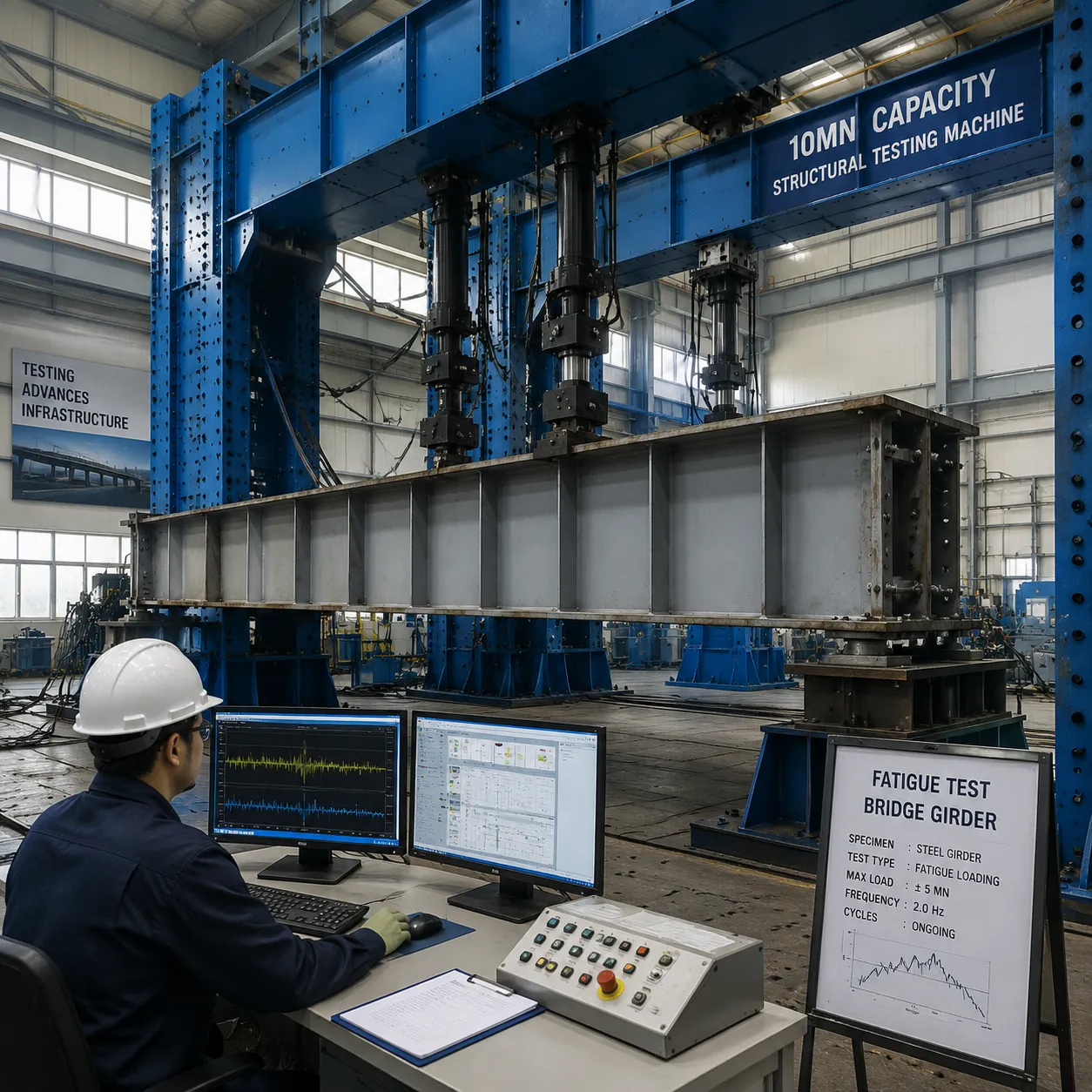
- 10MN large-scale testing machines available
- Maximum chuck spacing up to 3000mm
- Accommodates full-size structural members
- Realistic loading conditions simulation
- Supports public examination verification
Compression Testing for Load-Bearing Capacity
Compression testing evaluates structural members under axial compressive loads, critical for columns, braces, and bearing elements.
Test Applications
Common Test Subjects
- Automobile roof structures
- Seismic bracing members
- Concrete compression members
- CFRP composite members
- Seismic isolation devices
- Bearing plates and connections
Testing Equipment Specifications
Large-Scale Facilities
| Equipment | Capacity | Location |
|-----------|----------|----------|
| 10MN Structure Testing Machine | Compression: 10MN, Tension: 10MN, Bending: 25MNm | Chiba |
| 3MN Structural Testing Machine | Compression: 3MN, Tension: 2MN, Bending: 5MNm | Kawasaki |
| 2MN Material Testing Machine | Max. load 2MN | Chiba |
Test Setup Considerations
- Proper alignment to prevent eccentric loading
- End conditions matching service situation
- Lateral support to prevent premature buckling
- Instrumentation for lateral deflection
- Safety provisions for sudden failure modes
Results Interpretation
Key Measurements
- Ultimate compressive strength
- Buckling load and mode shape
- Load-deformation relationship
- Post-buckling behavior
- Energy absorption capacity
Bending and Flexural Testing Procedures
Bending tests characterize flexural behavior of beams, girders, slabs, and other members subjected to transverse loading.
Test Specimens and Applications
Common Test Subjects
- Bridge girders and deck slabs
- Steel and concrete piping
- Valves and pressure components
- Steel pipe piles and concrete piles
- Floor and roof decking systems
- Composite beam sections
Testing Methods
Three-Point Bending
- Simple support at two ends
- Single load applied at midspan
- Maximum moment at center
- Suitable for brittle materials
- Simple calculation procedures
Four-Point Bending
- Two loads applied symmetrically
- Constant moment region between loads
- More uniform stress distribution
- Preferred for ductile materials
- Better representation of beam behavior
Cantilever Bending
- Fixed support at one end
- Load applied at free end
- Maximum moment at support
- Tests connection strength
- Simulates cantilever conditions
Large-Scale Bending Tests
Specialized Test Applications
- Steel pipe pile joint performance verification
- Large deformation load test method development
- Lifeline water pipeline member testing
- Free-standing column alternative loading
- Carbon fiber strengthened member evaluation
Equipment Requirements
- Strong floor or reaction frame
- Hydraulic jacks or actuators
- Load cells and displacement transducers
- Data acquisition systems
- Safety containment for sudden failures
Fatigue Testing for Long-Term Structural Integrity
Fatigue testing evaluates structural performance under repeated cyclic loading, essential for bridges, cranes, and dynamically loaded structures.
Fatigue Fundamentals
Why Fatigue Matters
- Most common cause of structural failures
- Occurs at stress levels below static strength
- Progressive crack growth over many cycles
- Critical for bridges and crane structures
- Determines remaining service life
Fatigue Life Factors
- Stress range magnitude
- Number of loading cycles
- Material toughness properties
- Detail geometry and stress concentrations
- Environmental conditions
Testing Approaches
Constant Amplitude Testing
- Fixed stress range throughout test
- Determines S-N curve parameters
- Identifies fatigue limit for steel
- Run-out criteria at 2-5 million cycles
- Basis for design curve development
Variable Amplitude Testing
- Spectrum loading simulating service conditions
- Rainflow counting for cycle identification
- Damage accumulation per Miner's rule
- More representative of actual service
- Requires extensive test duration
Large-Scale Fatigue Testing Equipment
Available Facilities
| Equipment | Dynamic Capacity | Max Speed |
|-----------|------------------|-----------|
| 750kN High Speed Fatigue Machine | ±750kN | 180 cm/s |
| 1MN Dynamic Actuator | ±1.0MN | Variable |
| 500kN Dynamic Actuator | ±500kN | 6.4 cm/s |
| 100kN Dynamic Actuator | ±100kN | Variable |
Fatigue Test Applications
Common Test Subjects
- New lightweight material evaluation
- Anchor bolt endurance testing
- Large-scale automotive members
- Welded connection details
- Carbon fiber reinforced members
Impact and Dynamic Load Testing Methods
Impact testing assesses material toughness and energy absorption capacity, critical for structures subjected to sudden loads or seismic events.
Charpy V-Notch Test
Test Procedure
- Standard specimen with V-notch machined at center
- Pendulum hammer strikes fractured specimen
- Energy absorbed measured from hammer swing
- Test conducted at specified temperature
- Results reported in Joules
Temperature Considerations
- Lower temperatures increase brittleness
- Transition temperature identifies ductile-to-brittle shift
- Service temperature must exceed transition
- Multiple temperatures define transition curve
- Critical for cold climate applications
Typical Results for Mild Steel
| Test Type | Standard Energy Range |
|-----------|----------------------|
| Charpy (horizontal) | 30-200 J |
| Izod (vertical) | 25-160 J |
Drop Weight Testing
Test Configuration
- Weight dropped from specified height
- Impact velocity controlled by drop height
- Specimen supported on anvil
- Maximum drop height: 8 meters
- Maximum drop weight: 100 kg
Applications
- Impact resistance of body structures
- Crashworthiness verification
- On-site impact testing
- Automobile structural testing
- Safety barrier evaluation
Pendulum Impact Testing
Izod Test Method
- Specimen clamped vertically as cantilever
- Pendulum strikes near free end
- Energy absorbed recorded
- Alternative to Charpy configuration
- Used for specific material comparisons
Non-Destructive Testing Techniques for Steel Structures
NDT methods enable inspection without damaging the structure, essential for quality control and in-service evaluation.
Ultrasonic Testing Applications
Defect Detection Capabilities
- Internal laminations from rolling
- Weld discontinuities and lack of fusion
- Crack depth and orientation
- Inclusions and porosity
- Thickness verification
Advantages
- High accuracy (±0.025mm to ±0.001mm)
- Single-sided access sufficient
- Immediate results available
- No radiation hazards
- Portable equipment available
Radiographic Testing Benefits
When RT Is Preferred
- Complex weld geometries
- Permanent record required
- Internal defect characterization
- Castings and forgings inspection
- Critical joint evaluation
Limitations
- Radiation safety requirements
- Two-sided access needed
- Slower than other methods
- Higher cost per inspection
- Skill-intensive interpretation
Magnetic Particle Testing
Surface Defect Detection
- Cracks and seams
- Laps and folds
- Incomplete penetration
- Undercut and porosity
- Stress corrosion cracking
Procedure Steps
- Clean surface thoroughly
- Apply magnetic field
- Apply magnetic particles (dry or wet)
- Inspect for particle accumulations
- Document indications
- Demagnetize if required
Penetrant Testing Process
Application Steps
- Clean and dry surface
- Apply penetrant liquid
- Allow dwell time for penetration
- Remove excess penetrant
- Apply developer
- Inspect for indications
- Clean after inspection
Suitable Applications
- Non-ferromagnetic materials
- Small component inspection
- Field inspection situations
- Leak detection in welds
- Surface crack mapping
Steel Structure Inspection Standards and Codes
International standards ensure consistent testing procedures and acceptance criteria across projects and jurisdictions.
Indian Standards
Key Testing Standards
- IS 1786: High-strength deformed steel bars and wires
- IS 1608: Tensile testing of steel products
- IS 1599: Bend test methods and procedures
- IS 2062: Structural steel specifications
- IS 1499: Charpy impact testing
- IS 1598: Izod impact testing
American Standards
ASTM Testing Standards
- ASTM A36: Structural steel specification
- ASTM A572: High-strength low-alloy structural steel
- ASTM A992: Steel for structural framing
- ASTM E8: Tensile testing of metallic materials
- ASTM E23: Notched bar impact testing
- ASTM A370: Mechanical testing of steel products
European Standards
Eurocode Framework
- EN 1993: Design of steel structures
- EN 10025: Hot rolled products of structural steels
- EN 10219: Cold formed welded structural hollow sections
- EN 1993-1-9: Fatigue strength assessment
- EN 10204: Inspection documents types
Acceptance Criteria
Chemical Composition Limits
| Constituent | Fe 415 Max % | Fe 500 Max % | Fe 550/600 Max % |
|-------------|--------------|--------------|------------------|
| Carbon (C) | 0.30 | 0.30 | 0.30 |
| Sulphur (S) | 0.060 | 0.055 | 0.055 |
| Phosphorus (P) | 0.060 | 0.055 | 0.050 |
| S + P | 0.110 | 0.105 | 0.100 |
Quality Control Checklist for steel testing
Systematic quality control ensures comprehensive material verification throughout the construction process.
Pre-Construction Testing
Material Certification Review
- Mill test reports for all steel deliveries
- Heat number traceability verification
- Chemical composition confirmation
- Mechanical property validation
- Coating certification review
Visual Inspection
- Surface condition assessment
- Rust and mill scale evaluation
- Mechanical damage identification
- Dimension verification
- Marking and identification check
Testing Protocol
Required Tests by Application
- Tensile test: All structural applications
- Bend test: Reinforcing steel
- Chemical analysis: Welding applications
- Impact test: Dynamic loading situations
- Hardness test: Wear-resistant applications
- Fatigue test: Cyclic loading service
Documentation Requirements
Test Report Contents
- Material identification and heat number
- Test specimen location and orientation
- Testing equipment and calibration status
- Test procedure and standard reference
- Complete test results with curves
- Acceptance criteria and pass/fail determination
- Technician and laboratory certification
Choosing the Right Testing Equipment and Facilities
Appropriate equipment selection ensures accurate and efficient testing for diverse project requirements.
Equipment Selection Factors
Load Capacity Requirements
- Match machine capacity to expected loads
- Consider safety margin for ultimate loads
- Account for dynamic load factors
- Allow for specimen size variations
- Plan for future testing needs
Specimen Considerations
- Maximum specimen dimensions
- Grip type and capacity
- Chuck spacing for long specimens
- Fixture requirements
- Environmental chamber needs
Laboratory Capabilities
Accreditation Requirements
- ISO 17025 laboratory accreditation
- Certified testing personnel
- Calibrated equipment with traceability
- Documented procedures
- Quality management system
Support Services
- Specimen preparation facilities
- Machine shop for fixtures
- Data analysis capabilities
- Report generation systems
- Consultation services
Cost Considerations
Testing Cost Factors
- Number of tests required
- Specimen preparation complexity
- Equipment time charges
- Personnel requirements
- Report preparation time
Optimization Strategies
- Group similar tests together
- Use statistical sampling plans
- Consider in-house vs. external testing
- Balance cost with risk reduction
- Plan for potential retesting
Common Questions About Steel Structure Testing
Addressing common concerns helps stakeholders understand testing requirements and make informed decisions.
Frequently Asked Questions
How often should steel testing be performed?
- Every heat or lot of delivered material
- Periodically during long projects
- When material source changes
- Before critical structural applications
- After storage periods exceeding one year
What tests are required for reinforcing steel?
- Tensile test for strength verification
- Bend test for ductility
- Rebend test for strain ageing resistance
- Chemical analysis for weldability
- All tests per IS 1786 requirements
Can existing structures be tested non-destructively?
- Yes, multiple NDT methods available
- Ultrasonic testing for internal defects
- Magnetic particle for surface cracks
- Hardness testing for strength estimation
- Visual inspection for obvious damage
What is a mill test report?
- Quality assurance document from steel producer
- Shows material origin and composition
- Documents test results from production
- Provides traceability to heat number
- Required for all structural steel purchases
How are test specimens selected?
- Coupons cut from master plate
- Longitudinal and transverse orientations
- Locations specified by standards
- Representative of material condition
- Avoid end effects and edge zones
What causes test failures?
- Material not meeting specification
- Improper specimen preparation
- Equipment calibration issues
- Testing procedure errors
- Environmental condition variations
How is remaining fatigue life estimated?
- Historical loading records analysis
- Current inspection findings
- S-N curve data for detail category
- Damage accumulation calculations
- Safety factors for uncertainty
What is the difference between yield and tensile strength?
- Yield: Stress where permanent deformation begins
- Tensile: Maximum stress before fracture
- Yield used for service load design
- Tensile indicates reserve capacity
- Both needed for complete characterization
Bottom Line
Steel structure testing provides the foundation for safe and reliable construction, enabling engineers to verify material properties, ensure compliance with specifications, and predict long-term structural performance. Comprehensive testing programs combining destructive and non-destructive methods deliver the data needed for informed engineering decisions.
Understanding testing methods, standards, and equipment requirements helps project stakeholders implement effective quality control programs. Whether evaluating new construction materials or assessing existing structures, proper testing procedures protect public safety and optimize construction investments. Partnering with accredited testing laboratories and following established standards ensures consistent, reliable results that support structural integrity throughout the service life of steel structures.