Why Is Stainless Steel Testing Important?
Stainless steel testing protects your projects from failure and saves money over time. Without proper testing, you risk using the wrong grade — and that can lead to structural failure, corrosion damage, or even legal trouble. Testing tells you exactly what you are working with, so you can match the right material to the right job.
Consider the consequences of skipping tests:
-
Structural failure — Using a weaker grade for heavy loads can cause catastrophic breaks.
-
Corrosion damage — Grades without molybdenum rust rapidly in salty or chemical environments.
-
Legal and compliance issues — Wrong materials on certified projects can trigger regulatory penalties.
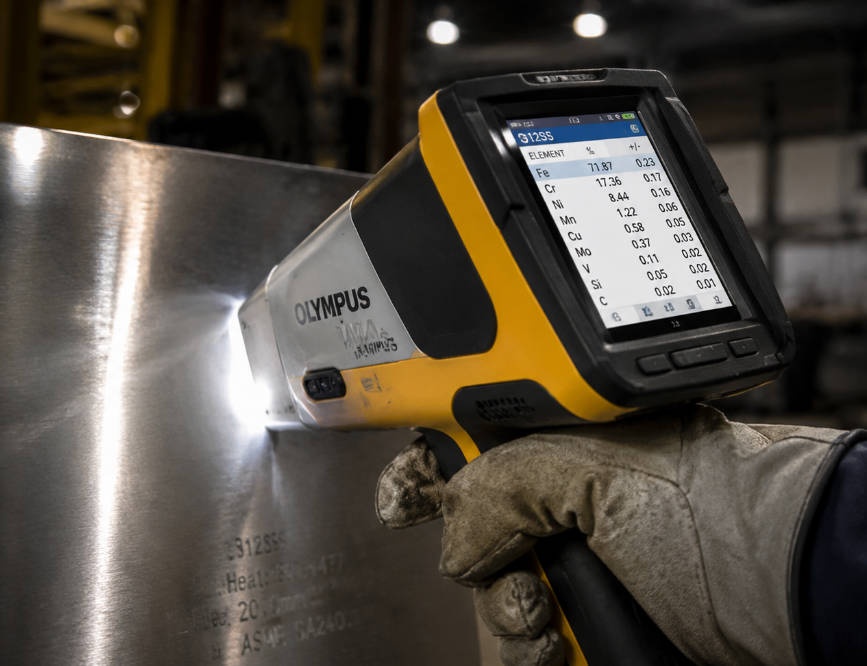
Testing is not optional for safety-critical applications. LPG valves, medical instruments, food processing equipment — all demand positive material identification (PMI) to confirm every item meets specification.
What Are the Main Types of Stainless Steel?
Stainless steel falls into four primary families, each with distinct properties that determine how you test and use them.
Austenitic Stainless Steel
Austenitic grades (304, 316, 321) are the most widely used. They offer excellent corrosion resistance and are generally non-magnetic when annealed. Cold working can introduce partial magnetic response, which actually helps confirm the grade during field testing.
Ferritic Stainless Steel
Ferritic grades (430, 409, 439) contain little or no nickel, making them more cost-effective. They are strongly magnetic and resist stress corrosion well. Common applications include automotive components and household appliances.
Martensitic Stainless Steel
Martensitic grades (410, 420) are very hard and strong after heat treatment. They are strongly magnetic and are typically used for cutting tools, surgical instruments, and turbine blades.
Duplex Stainless Steel
Duplex grades (2205, 2304) combine austenitic and ferritic structures, delivering higher strength and superior chloride resistance. They are moderately magnetic, which distinguishes them from annealed austenitic grades.
|
Family |
Magnetic Response |
Relative Permeability |
Example Grades |
|---|---|---|---|
|
Austenitic |
Non-magnetic |
1.003–1.005 |
304, 316, 321 |
|
Ferritic |
Strongly magnetic |
500–1,000 |
430, 409, 439 |
|
Martensitic |
Strongly magnetic |
N/A |
410, 420 |
|
Duplex |
Moderately magnetic |
20–100 |
2205, 2304 |
Why grades matter for testing: Each grade has a unique chemical makeup and mechanical profile. The testing approach changes depending on the grade. You need different tests for duplex versus austenitic steel, and confusing a 304 with a 316 in a marine environment can cause rapid failure.
How Do You Test the Chemical Composition of Stainless Steel?
Chemical composition analysis is the only conclusive way to identify a stainless steel grade. The key elements — chromium, nickel, molybdenum, and carbon — determine the grade and its performance. Three main instrument-based methods deliver quantitative results.
XRF (X-Ray Fluorescence) Analysis
XRF analyzers are fast, portable, and non-destructive. Handheld units deliver results in seconds and work well for sorting and grade identification in the field. For stainless steel 304, accuracy for chromium, manganese, nickel, copper, and molybdenum ranges between 94.5% and 99.5%.
-
Speed: Seconds per reading
-
Field use: Yes — handheld models available
-
Limitation: Cannot detect light elements like carbon or nitrogen
-
Best for: Fast sorting, grade ID, scrap yard checks
OES (Optical Emission Spectroscopy)
OES uses an electrical spark to excite atoms in the metal, measuring the emitted light spectrum to determine elemental percentages. It provides very high accuracy and can detect carbon — critical for distinguishing L-grade (low carbon) variants like 304L from standard 304.
-
Speed: Minutes per reading
-
Field use: Limited — requires a flat surface ~20mm diameter
-
Limitation: Leaves a spark mark on the surface; cannot measure nitrogen in air
-
Best for: Full grade confirmation, trace element analysis
ICP-OES (inductively coupled plasma Optical Emission Spectroscopy)
ICP-OES is a laboratory-only method that dissolves a sample in acid and uses plasma to excite atoms. It can detect over 30 elements with extreme precision, including trace impurities. It meets the Chinese standard GB/T 20125-2006 for stainless steel analysis.
-
Speed: Minutes per sample (after digestion)
-
Field use: No — lab only
-
Best for: Impurity checking, certified lab analysis, research
Quick Field Chemical Tests
When instruments are not available, simple chemical spot tests provide qualitative results:
-
Molybdenum spot test ("Moly Drop") — A single drop of solution darkens if molybdenum is present, distinguishing 304 from 316. Accuracy up to 95%.
-
Manganese spot test — Identifies 200-series (high manganese) grades from 300-series austenitics.
-
Sulphur test — Photographic paper soaked in dilute sulphuric acid pressed onto the surface reveals high-sulphur free-machining grades (303) as brown marks.
-
Acidified copper sulphate test — Copper deposits within minutes indicate ferritic or martensitic grades; no deposit suggests austenitic or duplex.
Note: Spot tests mark the surface. Always test in an inconspicuous area on items intended for service, and wash chemicals away immediately after testing.
How Do You Test the Mechanical Properties of Stainless Steel?
Mechanical property testing confirms whether stainless steel can handle the loads, impacts, and wear your application demands. The three core tests are hardness, tensile, and impact.
Hardness Testing
Hardness tests measure resistance to surface indentation or scratching. Two common methods:
-
Brinell test — A carbide ball is pressed into the surface; the diameter of the resulting dent indicates hardness.
-
Rockwell test — A diamond indenter is driven into the surface under load; the depth of penetration measures hardness.
Hardness testing confirms heat treatment effectiveness and evaluates wear resistance. It is especially important for martensitic grades used in cutting tools and shafts.
Tensile Testing
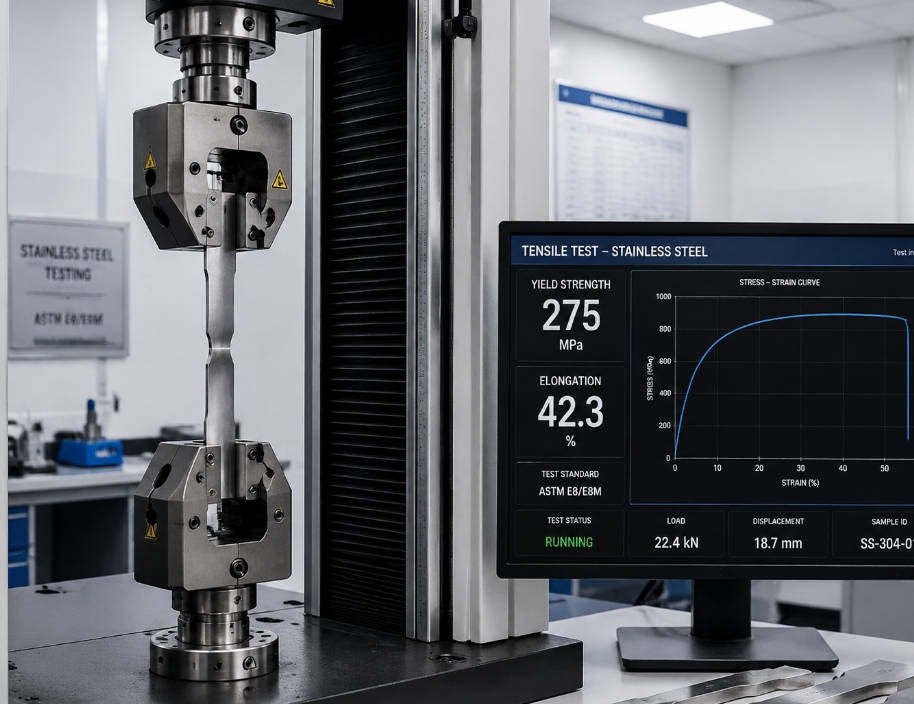
Tensile tests measure yield strength, tensile strength, and elongation — the three numbers that tell you how much force the steel can take before bending or breaking. Standards ISO 6892-1 and ASTM A370 govern these procedures.
-
Yield strength — The stress at which permanent deformation begins
-
Tensile strength — The maximum stress before fracture
-
Elongation — How much the steel stretches before breaking (critical for safety)
|
Standard |
Test Type |
Key Properties Measured |
|---|---|---|
|
ISO 6892-1 |
Tensile |
Yield strength, tensile strength, elongation |
|
ASTM A370 |
Mechanical |
Tensile strength, yield strength, hardness |
Impact Testing
Impact testing measures the energy a material absorbs before fracturing under sudden load. Standards ISO 148-1 and ASTM E23 define the procedures. This test is essential for stainless steel used in construction, bridges, and cold environments where brittle fracture is a risk.
How Do You Test the Corrosion Resistance of Stainless Steel?
Corrosion resistance is the defining property of stainless steel — and testing it is non-negotiable for harsh environments. The three most common corrosion test types simulate real-world attack.
Salt spray testing (ASTM B117 / ISO 9227)
Salt spray tests expose samples to a fog of sodium chloride solution. ISO 9227 defines three variants:
-
NSS (Neutral Salt Spray) — General corrosion comparison
-
AASS (Acetic Acid Salt Spray) — More aggressive, for decorative coatings
-
CASS (Copper-Accelerated Salt Spray) — Accelerated test for severe environments
These tests help you compare how fast different grades rust under controlled conditions.
Immersion Testing (NACE TM0169/G31)
Immersion tests submerge samples in specific chemicals or solutions for extended periods. They reveal how stainless steel performs in real liquid environments — chemical plants, seawater systems, or food processing lines.
Electrochemical Testing
Electrochemical methods like potentiodynamic polarization give quantitative numbers for corrosion resistance. They measure parameters such as pitting potential and critical current density, providing data that salt spray tests cannot.
Understanding Corrosion Types
|
Corrosion Type |
Description |
Recommended Material |
|---|---|---|
|
Uniform corrosion |
Metal thins evenly across the surface |
Highly alloyed stainless or Ni-based alloys |
|
Pitting corrosion |
Tiny holes form in the surface |
Higher Cr, Mo, and N content |
|
Crevice corrosion |
Attack in shielded areas (under clamps, deposits) |
Higher Cr, Mo, and N content |
|
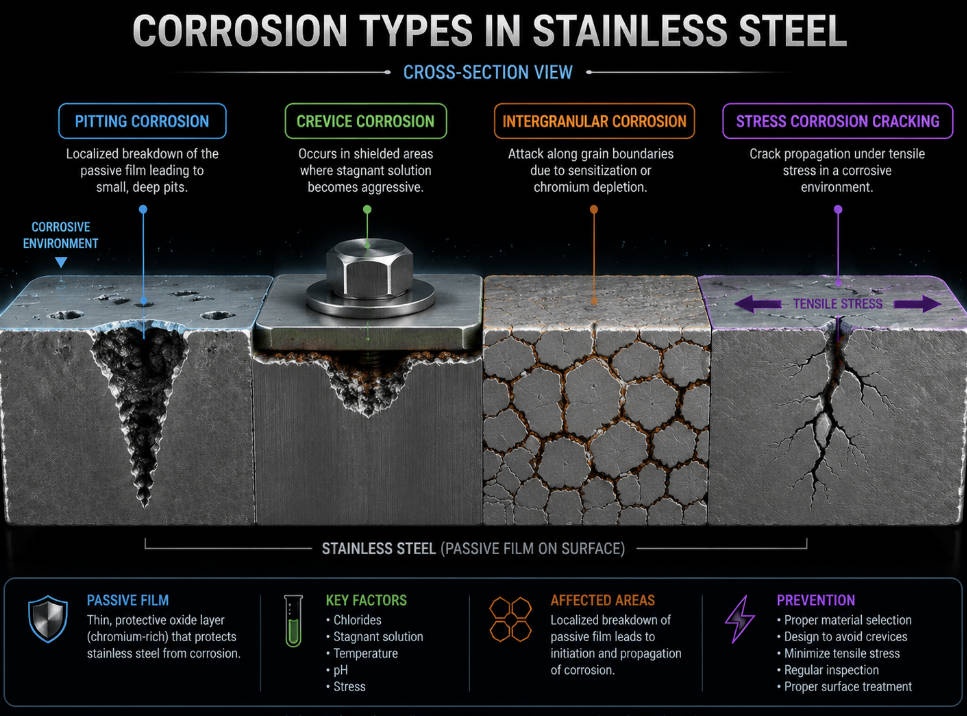
Intergranular corrosion |
Attack along grain boundaries |
Low-carbon (L) grades or stabilized grades |
|
Stress corrosion cracking (SCC) |
Cracking under tensile stress in corrosive environments |
Increased Ni content in austenitic grades |
Key statistic: Stress corrosion cracking accounts for 49% of stainless steel corrosion failures in industrial settings — more than any other type.
What Nondestructive Testing Methods Work for Stainless Steel?
Nondestructive testing (NDT) finds flaws without damaging the material, so the part remains usable after inspection. This is critical for expensive components and in-service equipment.
Common NDT Techniques
|
Technique |
What It Detects |
Limitations |
|---|---|---|
|
Visual Inspection |
Surface defects, discoloration |
Cannot see below the surface |
|
Ultrasonic Testing (UT) |
Subsurface cracks, voids, inclusions |
Requires coupling medium; trained operator needed |
|
Radiographic Testing (RT) |
Internal flaws, cracks, porosity |
Radiation safety requirements; slower process |
|
Eddy Current Testing (ET) |
Surface and near-surface defects |
Only works on conductive materials |
|
Magnetic Particle Testing (MT) |
Surface and near-surface cracks |
Only works on magnetic (ferritic, martensitic) steels |
When to Use NDT
-
Weld inspection — Check stainless steel car body welds, pipeline joints
-
In-service monitoring — Regular checks on aircraft, hospital, and rail components
-
Quality control — Verify incoming material without destroying samples
-
Safety-critical applications — High-speed rail, pressure vessels, structural steel
Benefits for Stainless Steel Grades
NDT preserves the material while providing reliable defect detection. Eddy current and ultrasonic methods together can find both surface and subsurface problems in austenitic stainless steel — the family most commonly used in critical applications.
How Do You Identify Stainless Steel Grades in the Field?
When you lack laboratory equipment, a systematic step-by-step approach using simple tests can narrow down the grade. Here is a practical field identification procedure:
Step 1: Check the Appearance
-
Painted or oiled surfaces — Stainless steel is rarely painted. Carbon steel sections are often primed or oiled.
-
Rust stains — Stainless steel does not rust unless contaminated. General light rusting indicates carbon steel.
-
Mill scale — Stainless steel is supplied descaled; heavy grey scale suggests carbon steel.
Step 2: Water Drop or Copper Sulphate Test
Place a drop of water or 5% copper sulphate solution on the clean surface and leave it overnight:
-
Copper colour develops quickly → Carbon or low-alloy steel
-
No copper deposit → Likely stainless steel
Step 3: Magnet Test
Bring a hand magnet near the surface:
-
Not attracted (or weakly attracted at formed corners) → Austenitic stainless steel (304, 316, 321)
-
Strongly attracted → Ferritic, martensitic, or duplex stainless steel, or carbon steel
Step 4: Molybdenum Spot Test
Apply a moly drop test to distinguish austenitic grades:
-
Drop darkens → Molybdenum present → Likely 316, 317, 904L, or duplex
-
No change → No molybdenum → Likely 304 or similar
Step 5: Sulphur Test
Photographic paper soaked in dilute sulphuric acid pressed onto the surface:
-
Brown marks appear → Free-machining grade (303, 430F)
-
No marks → Standard grade
Step 6: Heating Test (If Sample Available)
Heat a small piece to ~1,000°C (light orange glow) and quench in water:
-
Becomes harder → Martensitic steel
-
Becomes softer with reduced magnetism → Austenitic steel
-
Softened, no change in magnetism → Ferritic or duplex steel
|
Test |
200 Series |
300 Series |
400 Ferritic |
Duplex |
|---|---|---|---|---|
|
Magnet |
Not attracted* |
Not attracted* |
Attracted |
Attracted |
|
Mo Spot |
Some positive |
316/317/904L positive |
444+ positive |
2205+ positive |
|
Mn Spot |
Positive |
No colour |
No colour |
Lean duplex positive |
*Cold-worked austenitic grades may show slight magnetic attraction.
How Do You Choose the Right Test Method for Your Application?
The right test depends on what you need to know, where you are testing, and what is at stake. Use this decision framework:
Match the Test to Your Goal
|
Your Goal |
Recommended Test |
Why |
|---|---|---|
|
Quick grade sorting on site |
XRF analyzer or magnet + spot tests |
Fast, portable, non-destructive |
|
Full grade confirmation |
OES or ICP-OES lab analysis |
Detects all elements including carbon |
|
Corrosion resistance validation |
Salt spray (ASTM B117) or electrochemical |
Simulates real environment |
|
Structural integrity check |
Tensile + impact testing |
Confirms load-bearing capacity |
|
In-service flaw detection |
Ultrasonic or eddy current NDT |
Finds defects without removing the part |
|
Surface treatment verification |
XPS or depth profiling |
Reveals coating composition and thickness |
Consider the Consequences
-
Low stakes — Sorting mixed stock in a warehouse: magnet test and spot tests are sufficient.
-
Medium stakes — Confirming incoming material matches purchase orders: handheld XRF gives reliable results.
-
High stakes — Safety-critical applications (pressure vessels, medical devices): full laboratory analysis with certified results.
Practical Tips
-
Start with chemical composition analysis — Confirm the grade before anything else.
-
Use visual inspection for a quick first look — Catch obvious defects early.
-
Add mechanical testing for structural applications — Hardness, tensile, and impact tests as needed.
-
Apply NDT for in-service equipment — Detect problems without shutting down operations.
-
Always follow safety protocols — Wear gloves, goggles, and work in well-ventilated areas when using acids or grinders.
What Standards Govern Stainless Steel Testing?
Adherence to recognized standards ensures your test results are reliable, comparable, and accepted by regulators. Key standards include:
Chemical Analysis Standards
-
ASTM E572 — XRF analysis of stainless steel
-
GB/T 20125-2006 — ICP-OES analysis of stainless steel (Chinese standard)
Mechanical Testing Standards
-
ISO 6892-1 — Tensile testing of metallic materials
-
ASTM A370 — Mechanical testing of steel products
-
ISO 148-1 / ASTM E23 — Impact testing (Charpy)
Corrosion Testing Standards
-
ASTM B117 — Salt spray testing
-
ISO 9227 — Corrosion tests in artificial atmospheres
-
ASTM G48 — Pitting and crevice corrosion resistance (ferric chloride test)
-
NACE TM0169/G31 — Laboratory immersion testing
Product-Specific Standards
-
ASTM A269 — Seamless and welded austenitic stainless steel tubes
-
ASTM A213 — Seamless ferritic and austenitic alloy-steel tubes
-
ASTM A249 — Welded austenitic steel tubes
-
ASTM A908 — Austenitic stainless steel needle tubing
Certification Standards
-
ISO 9001 — Quality management system certification
-
EN 10204 — Inspection documents for steel products (material test reports)
Following these standards is not just about compliance — it is about ensuring your stainless steel performs as expected and protecting the people who rely on it.