What Is Electronic Switch Testing?
Electronic switch testing is the safety, performance, and endurance verification of switches used in electrical appliances and equipment — mechanical switches (rotary, push-button, rocker, slide, cord, foot) and electronic switches (semiconductor-switched, touch-controlled, sensor-actuated) — against IEC 61058-1 (general requirements) with its particular-requirements parts IEC 61058-1-1 (mechanical) and IEC 61058-1-2 (electronic), plus the national equivalents UL 61058-1 / CSA C22.2 No. 61058-1 (North America) and GB/T 15092 (China, identical adoption of IEC 61058). For household fixed wiring switches the relevant standard is IEC 60669-1, and for low-voltage switchgear and control switches it is IEC 60947-3. A complete program confirms electrical safety, mechanical and electrical endurance, making/breaking capacity, and EMC compatibility in one coordinated test package.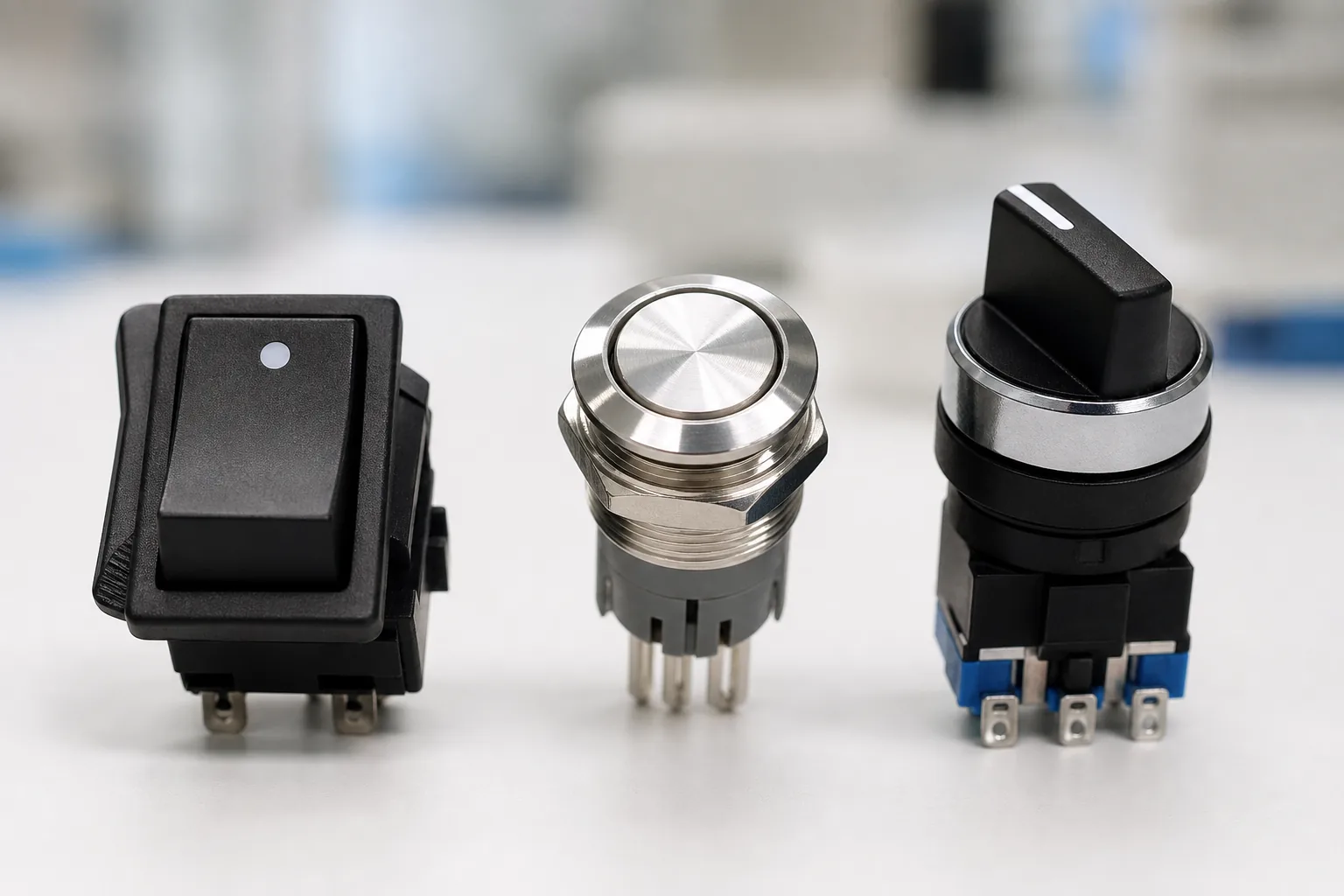
A switch is the single point in a circuit where user actuation translates directly into a current-making or current-breaking event — and that event is where arcs form, contacts erode, and insulation is stressed. Beijing ZKGX Research Institute structures its electronic switch programs around the IEC 61058 clause matrix, with each measurement traceable to the exact clause being verified.
Why Electronic Switch Testing Matters
A switch is simultaneously an electromechanical component (the contact system) and, increasingly, a semiconductor circuit (the electronic switch). Three classes of failure drive the test program:
- Contact erosion and welding — every making event bounces the contacts, every breaking event draws an arc; after thousands of cycles contacts erode, pit, and eventually weld shut or fail to make
- Insulation failure — dielectric breakdown between live parts and accessible metal, between poles, or across the contact gap causes electric shock, fire, or nuisance tripping
- Electronic-switch-specific faults — semiconductor failure modes (short circuit, loss of control), EMC emissions and immunity, thermal runaway under load
For these reasons, IEC 61058 is mandatory for switches used in virtually every household and similar appliance — sale without certification means rejection at customs, withdrawal from retail, or, worse, a fire or shock incident that triggers product recall and liability.
Which Standards Govern Electronic Switch Testing?
There is no single global switch standard; the framework is layered across appliance-switch, fixed-installation, and low-voltage-switchgear standards:
| Standard | Scope | What it answers |
|---|---|---|
| IEC 61058-1:2016 (Ed 4.0) | Appliance switches — general requirements | The baseline safety and test framework for all appliance switches |
| IEC 61058-1-1:2016 | Particular requirements for mechanical switches | The mechanical-specific additions: contact force, travel, actuator strength |
| IEC 61058-1-2:2016 | Particular requirements for electronic switches | The electronic-specific additions: semiconductor faults, EMC, category classification |
| IEC 61058-2-x series | Particular requirements for specific switch types | Cord switches (2-1), rotary (2-4), push-button (2-5), etc. |
| UL 61058-1 / CSA C22.2 No. 61058-1 | North American harmonized adoption | Same content as IEC 61058-1 with national deviations |
| GB/T 15092.1-2010 and sub-parts | China adoption of IEC 61058 (IDT) | The Chinese CCC mandatory framework |
| IEC 60669-1 | Household and similar fixed electrical installations — switches | Wall switches, fixed wiring switches — a separate but parallel framework |
| IEC 60947-3 | Low-voltage switchgear — switches, disconnectors, switch-fuses | Industrial-rated switches and disconnectors |
Beijing ZKGX structures every electronic switch test report against this matrix so the client can see which clause of which standard each measurement satisfies — not just a pass/fail verdict.
What Are the Core Electronic Switch Test Items?
The IEC 61058 program divides into six blocks. Each item maps to a clause, and each has a measurable acceptance threshold.
1. Electrical Safety Tests (IEC 61058-1 §10, §13, §15)
- Protection against electric shock — jointed and unjointed test finger probes (IEC 61032 Probe B and Probe 11) must not touch live parts; verifying the enclosure and actuator design
- Insulation resistance — apply 500 V DC between live parts and accessible metal, between poles, and across the open contact; minimum ≥ 2 MΩ for basic insulation, ≥ 5 MΩ for reinforced (per typical IEC 61058 acceptance)
- Dielectric strength (electric strength) — apply 1,000 V + 2 × rated voltage for 1 minute between live parts and accessible metal (basic), or 1,500 V for reinforced insulation; no breakdown or flashover
- Leakage current — at 1.06× rated voltage, ≤ 0.25 mA for portable Class II appliances and ≤ 0.75 mA for Class I (per the parent appliance standard)
2. Temperature Rise Test (IEC 61058-1 §16)
Run the switch at 1.25× rated current (or 1.0× for electronic switches under steady state) until thermal equilibrium, with thermocouples on terminals, contacts, and accessible surfaces. Acceptance per IEC 61058-1 Table 3: terminal temperature rise must not exceed ≤ 45 K for external copper conductors, and accessible-surface temperatures stay within the limits for the applicable T-rating (T55 = 55 °C, T85 = 85 °C, T105 = 105 °C, T130 = 130 °C, T150 = 150 °C). Excessive temperature rise is the leading indicator of contact degradation — high contact resistance from wear produces heat.
3. Mechanical Endurance Test (IEC 61058-1 §17)
Actuate the switch through the declared number of mechanical operating cycles with no electrical load. The standard endurance code (e.g. 1E4 = 10,000 cycles, 1E5 = 100,000, 1E6 = 1 million) is the headline durability claim. After the test, the switch must still meet the dielectric strength and operating-force requirements. The actuation rate is defined by the standard (typically 6–30 cycles/minute depending on switch type).
4. Electrical Endurance and Making/Breaking Capacity (IEC 61058-1 §17, §18)
The most demanding tests. The switch is operated under load at defined test circuits for the same number of cycles as the mechanical endurance:
- Making capacity — the switch must close against inrush current (e.g. 10× rated current for capacitive loads, 6× for lamp loads) without contacts welding
- Breaking capacity — at least 1,500 A for general appliance switches unless fault current is fuse-limited; the switch must break rated current at 0.95–1.05 power factor without sustained arcing
- Normal-operation electrical endurance — typically 10,000 cycles at rated current with a resistive or specified inductive/capacitive load; contacts must not weld, and the switch must still pass dielectric strength afterward
For the making/breaking sequence, IEC 61058 defines specific test circuits (capacitive load circuit, lamp load circuit) to reproduce the worst-case stress for each switch application.
5. Construction and Material Tests (IEC 61058-1 §19–§25)
- Clearances and creepage distances — measured against the switch's rated impulse voltage and pollution degree; typical minimum clearance 1.5 mm for 250 V appliances
- Contact gap (full-disconnection) — ≥ 1.5 mm between open contacts to qualify as full-disconnection; micro-disconnection allows smaller gaps but with restricted application
- Actuator pull/push force — the actuator must withstand specified force without breaking or permanently deforming
- Screwed terminal torque — terminals must withstand defined tightening torque without damage or loosening
- Tracking index of insulating materials — PTI (proof tracking index) per IEC 60112
6. Environmental and IP Tests
- Moisture resistance — 48 hours at 93 ± 3% RH per IEC 61058-1 §14; immediately followed by insulation resistance and dielectric strength re-test
- Dust and water ingress (IP code) — for switches with declared IP rating per IEC 60529 (IP54, IP65, IP67 etc.)
- Cold and heat resistance — storage at declared T-minimum and T-maximum ambient followed by functional verification
- Vibration — for switches used in transport, industrial, or vehicle applications
Electronic Switch-Specific Tests (IEC 61058-1-2)
Electronic switches — those that use semiconductors to perform or support the switching function — add a separate clause set on top of IEC 61058-1:
- EMC emissions — conducted and radiated per CISPR 14-1; the semiconductor switching generates high-frequency noise
- EMC immunity — ESD, EFT, surge, conducted disturbances per IEC 61032 family
- Fault-condition tests — single-fault conditions on the electronic circuit must not cause fire, electric shock, or failure of the disconnection function; semiconductor short-circuit is a mandatory fault case
- Category classification — electronic switches are classified by their behavior under fault and by whether they provide full or electronic-only disconnection; this affects whether they can be used in safety-relevant positions
- Standby power — for electronic switches with sensing or always-on circuitry; declared and verified per the relevant eco-design regulation
Type Approval vs. Production Conformity vs. Field Failure — Don't Confuse Them
Three regimes apply to a switch over its life cycle:
- Type approval — done once per switch design to earn the certification mark (CCC, UL, ENEC, VDE). The full IEC 61058 sequence lives here, including the 10,000–1,000,000 cycle endurance test.
- Production conformity — periodic re-verification of production lots before shipment, typically a shortened set (dielectric strength, contact resistance, mechanical travel, sample endurance on a subset)
- Field failure / OOS investigation — when a switch-related complaint arrives (premature failure, overheating, intermittent operation), the same tests on the failed unit and a reference lot isolate the root cause
A common error is treating a production-conformity pass as evidence of IEC 61058 type approval. It is not — the regimes have different purposes, different acceptance thresholds, and different regulatory weight. Beijing ZKGX labels every report with which regime the result serves.
How Long Does Electronic Switch Testing Take?
A complete IEC 61058 type-approval program on a single switch model takes 4 to 8 weeks, dominated by:
- Electrical endurance — 10,000 cycles at 6–30 cycles/minute = 6–28 days continuous running
- Mechanical endurance — 100,000 to 1,000,000 cycles, depending on the declared class
- Environmental conditioning — 48 hours moisture plus thermal cycles, several days
- Dielectric, temperature rise, contact resistance — 1–3 days each
Production-conformity runs much faster — 1 to 3 days per lot for the shortened sequence. EMC testing for electronic switches adds 1 to 2 weeks at an accredited EMC lab.
Sample requirements: typically 15 to 25 production samples of the same model for the full IEC 61058 program, because electrical and mechanical endurance are destructive (samples cannot be reused after welding tests). EMC samples typically 3 to 5 dedicated units.
A formal test report is delivered within 5 to 7 working days after completion of each testing block, including raw data, endurance cycle logs, oscilloscopic captures of making/breaking events, thermocouple logs, and a clear statement of which clauses were met.
What Makes an Electronic Switch Test Report Usable?
A report that only says "PASS" is useless when a regulator, retailer, or insurer challenges the certification. A defensible report — accepted by NMPA in China, UL/CSA in North America, TÜV/VDE in Europe, and retailer compliance reviews — must contain:
- Switch identification — model, rated voltage, rated current, ambient T-rating, endurance code, IP rating, switching category (mechanical vs electronic, full vs micro-disconnection)
- Measured values with units and tolerance — not "compliant," but "contact resistance 28 mΩ (limit 50 mΩ, voltage-drop method, IEC 61058-1 §15)"
- Standard-clause traceability — which paragraph of IEC 61058-1, IEC 61058-1-1/-2, or GB/T 15092 each result is judged against
- Endurance cycle log — actuations completed, rate, any failures or anomalies during the run
- Oscilloscopic evidence for making/breaking — actual voltage and current waveforms showing arc duration and peak
- Thermocouple and dielectric traces — actual temperature rise and leakage current records
- Signed conclusion — accredited laboratory stamp and ISO/IEC 17025 reference
Beijing ZKGX electronic switch reports follow this structure as standard and are issued under the laboratory's ISO/IEC 17025 accreditation framework, with each measurement traceable to a recognized national or international standard.
Frequently Asked Questions
Is electronic switch testing mandatory?
Yes, in every major market. Switches used in appliances sold in China require GB/T 15092 / CCC certification; in the EU and IEC-signatory markets, EN IEC 61058 type approval; in North America, UL 61058-1 / CSA C22.2 No. 61058-1 certification. Household fixed-wiring switches additionally require IEC 60669-1, and industrial low-voltage switches require IEC 60947-3.
What's the difference between a mechanical switch and an electronic switch under IEC 61058?
A mechanical switch opens and closes the circuit through physical contact motion; it is tested to IEC 61058-1 plus IEC 61058-1-1. An electronic switch uses semiconductors to perform or support the switching function (touch dimmers, sensor switches, smart switches); it is tested to IEC 61058-1 plus IEC 61058-1-2, which adds EMC, fault-condition, and standby-power tests. Electronic switches are also category-classified by whether their disconnection qualifies as "full" or "electronic-only," which determines where they may be installed. See our electric motor testing page for the same mechanical-vs-electronic distinction applied to motor controllers.
Why does the test specify both mechanical and electrical endurance?
Because they fail differently. Mechanical endurance (no load) catches purely mechanical wear — actuator fatigue, spring set, contact hammering. Electrical endurance (under load) catches the interaction of mechanical wear with arc erosion — the two together produce contact pitting, material transfer, and eventual welding. A switch that passes mechanical endurance but fails electrical endurance has a contact-material problem; the inverse has an actuator problem.
What is the difference between IEC 61058 and IEC 60669?
IEC 61058 covers switches that are part of an appliance (built into or supplied with the appliance). IEC 60669 covers switches for fixed electrical installations (wall switches, ceiling-pull switches). The two share many test methods but have different installation contexts, different ambient temperature assumptions, and different installation requirements. IEC 60947-3 covers the industrial-grade switchgear category. Our Electric blanket testing page illustrates IEC 61058 switch testing in the context of a specific appliance.
Does a switch with an IP65 rating need additional testing?
Yes — IP rating is tested separately per IEC 60529, and the switch must additionally pass the IEC 61058 moisture-resistance test after IP exposure to verify that the sealed enclosure has not compromised electrical safety. See our IP water resistance testing program for the IEC 60529 framework, and our Damp Heat Test for the longer-duration humidity exposure that catches long-term moisture ingress.
References & Further Reading
- IEC 61058-1:2016 (Ed 4.0) — Switches for appliances — Part 1: General requirements (iec.ch)
- IEC 61058-1-1:2016 — Particular requirements for mechanical switches (iec.ch)
- IEC 61058-1-2:2016 — Particular requirements for electronic switches (iec.ch)
- IEC 61058-2-x series — Particular requirements for cord, rotary, push-button, and other specific switch types (iec.ch)
- UL 61058-1 / CSA C22.2 No. 61058-1 — North American harmonized standard (ul.com)
- GB/T 15092.1-2010 — China adoption of IEC 61058-1 (openstd.samr.gov.cn)
- IEC 60669-1 — Switches for household and similar fixed electrical installations (iec.ch)
- IEC 60947-3 — Low-voltage switchgear and controlgear — Switches, disconnectors, switch-fuses (iec.ch)
- IEC 60529 — Degrees of protection provided by enclosures (IP code) (iec.ch)
- IEC 60112 — Method for determining the comparative and proof tracking indices of solid insulating materials (iec.ch)