What standards govern electric blanket testing?
Electric blanket testing is governed by a Part 2 particular standard that sits on top of a general household-appliance safety standard. The Part 2 standard adds the requirements specific to flexible heating appliances — the heating-element durability, the temperature limits that prevent burns, the mechanical-flexure tests that address the wear mode that actually kills blankets in service — while the general standard supplies the electrical-safety framework that every household appliance must meet. A test report that quotes only the general standard, or only the Part 2 standard, is incomplete; the two work as a set.
The principal reference standards our laboratory works to are:
- IEC 60335-2-17, Household and similar electrical appliances — Safety — Part 2-17: Particular requirements for blankets, pads, clothing and similar flexible heating appliances (IEC Webstore) — the international Part 2 standard. The current published edition is IEC 60335-2-17:2022 (4th edition), and a European harmonized edition (FprEN IEC 60335-2-17:2026) is in the late stages of adoption. The standard covers electric blankets, heating pads, heated clothing and similar flexible heaters rated at not more than 250 V, used in the household and similar environments.
- IEC 60335-1, General requirements — the foundation standard that every Part 2 particular standard builds on. It supplies the electrical-safety framework: protection against access to live parts, input power and current, leakage current and dielectric strength, moisture resistance, internal wiring, supply connection and external cords, creepage distances and clearances.
- GB 4706.8, Safety of household and similar electrical appliances — Particular requirements for electric blankets, warming pads and similar flexible heating appliances (openstd.samr.gov.cn) — the Chinese national adoption, used with the general standard GB 4706.1. It is the standard Chinese quality-supervision authorities cite in electric-blanket product sampling and the one a Chinese-market conformity report must address.
- AS/NZS 60335.2.17:2012 — the Australia/New Zealand adoption of IEC 60335-2-17, the standard cited in regional in-service testing programmes.
- AS/NZS 3760:2022, In-service safety inspection and testing of electrical equipment and RCDs — the regional standard for in-service portable-appliance testing (PAT), relevant to the recurring inspection of blankets already in service rather than type approval of new blankets.
A common misconception in specifications we receive is that "electric blanket testing" is a single test. It is not. It is a programme that spans the heating test (Clause 11 in the IEC 60335-2-17 structure), the leakage-current and dielectric-strength tests at working temperature (Clause 13), the mechanical-strength flexure tests for the heating element and the supply cord (Clause 21), the moisture-resistance tests (Clause 15), and the construction and marking requirements that round out the standard. A complete project covers all of these; a project that tests only the heating behaviour misses the electrical and mechanical failures that are the actual causes of field incidents.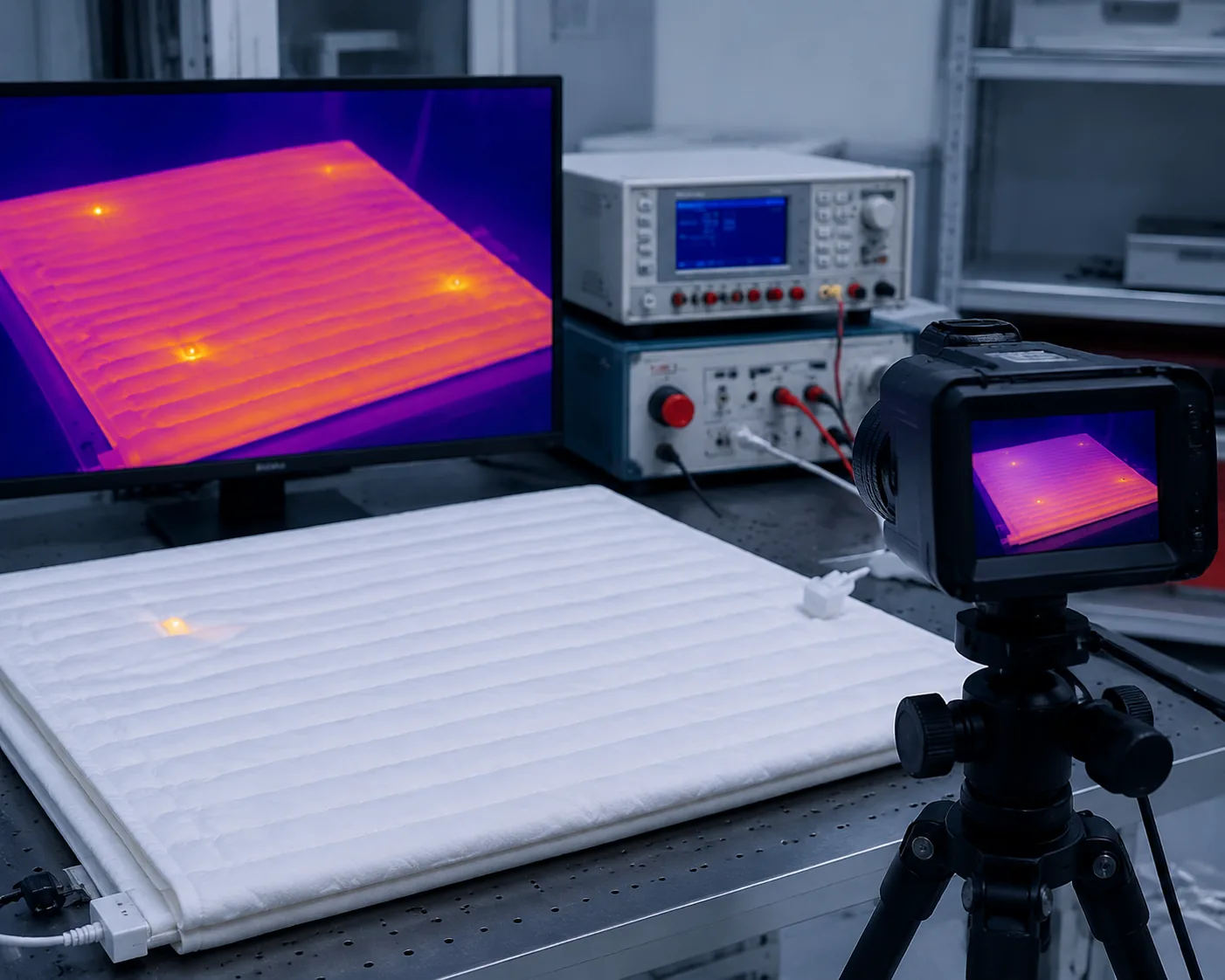
What does the heating test actually verify?
The heating test (Clause 11) verifies that the blanket, operated under defined conditions, does not produce temperatures that exceed the safety limits the standard sets for accessible surfaces and for the materials of the blanket itself. The test is run with the blanket on a defined test bed — for an under-blanket, on a mattress-like support with specified thermal properties; for an over-blanket or heated throw, draped over a defined form — supplied at rated voltage, in a defined ambient temperature, until thermal steady state is reached. Temperature is measured at multiple points across the blanket surface with thermocouples or thermal imaging, and the measured temperatures are compared to the standard limits.
Two properties of the heating test matter for interpreting its result.
Surface temperature uniformity. A properly functioning blanket heats evenly across its surface. A blanket with a damaged heating element — a partially broken wire, a bunched section, a shorted segment — develops hot spots: localized regions where the temperature rises well above the surrounding area. These hot spots are the direct precursors of the scorch marks, the melted insulation, and the ignitions that fire-safety authorities find in their post-incident inspections. Thermal imaging across the full blanket surface is the most revealing measurement in the heating test, because a hot spot that would be missed by a small number of point thermocouples shows up immediately as a bright region in the thermal image. This is why competent in-service testing programmes pair the point measurements with a full-surface thermographic scan.
Compliance with the temperature-rise limits. The standard sets maximum temperature-rise values for the accessible surfaces of the blanket and for the internal materials — the heating-element insulation, the controller housing, the supply-cord entry — that must not be exceeded. The numerical limits depend on the material class and the contact condition (skin contact, possible contact, no contact) and are specified in the standard's table of limits. A blanket that heats evenly but to an excessive temperature, or that allows a controller housing to exceed its material limit, fails the test even without a hot spot.
The heating test is also where the distinction between a type test and an in-service test shows up most clearly. A type test on a new blanket confirms that the design meets the temperature limits as manufactured. An in-service test on an aged blanket is looking for the departure from the as-manufactured behaviour — the hot spot that was not there when the blanket was new, indicating that the heating element has degraded in service. Same test method, different question, and the two cannot be substituted for each other.
How is mechanical strength tested for a flexible heater?
The defining mechanical failure mode of an electric blanket is the progressive damage to the heating element and the supply cord from the flexing, folding and pulling the blanket experiences in normal use. Unlike a rigid appliance, a blanket is bent, rolled, tucked, pulled by the cord and folded (against the manufacturer's instructions) throughout its service life, and the heating wire and the cord-to-controller junction are where that stress concentrates. The mechanical-strength tests in IEC 60335-2-17 (Clause 21) address this directly.
The mechanical-strength test set for flexible heating appliances typically includes:
Heating-element flexure. The flexible heating element is subjected to repeated bending cycles that simulate the folding and rolling the blanket experiences in service. The test confirms that the heating conductor does not fracture and that the insulation does not crack or wear through after the defined number of cycles. A heating element that fractures in this test produces either an open circuit (the blanket stops heating in that section) or a partial short (the surviving section overheats) — both of which are field-failure modes the test is designed to catch before the blanket reaches the consumer.
Cord flexure and anchorage. The supply cord and the cord-to-controller junction are the most stressed mechanical points on the blanket, because the cord is pulled every time the blanket is moved or the controller is handled. The flexure test simulates repeated cord movement under a defined force — a representative published test runs 5000 flexure cycles under a 10 newton cord load, followed by a leakage-current check to confirm that no internal damage has occurred. The cord-anchorage test then pulls the cord with a much larger force — a representative published value is 25 pulls at 100 newtons, with a small rotational torque applied — to confirm that the cord remains securely anchored to the blanket and that the internal connections do not shift or break under the pull loads a consumer will impose. The published flexure and anchorage test parameters cited here are drawn from the consumer-product test methodology used by the Australian consumer organization CHOICE, which bases its test rig on the relevant clause of the household safety standard; the IEC 60335-2-17 normative test parameters are defined in the standard and are the authoritative reference for a conformity project.
Mechanical abuse of the controller and housing. The controller, the switches, the indicator lights and the housing that carries them are subjected to impact and drop tests that confirm they survive the handling a blanket receives in service. A cracked controller housing that exposes live parts is a fail, even if the heating element is intact.
The mechanical-strength tests are where the cord-to-controller wear that drives the majority of consumer-product recalls shows up. The product-safety authorities in several jurisdictions have coordinated recalls of electric blankets across major retailers specifically because of wear between the cord and the controller — a defect that the flexure and anchorage tests are designed to detect before the blanket ships. A laboratory that runs the mechanical-strength programme rigorously is testing the failure mode that the recall data says is the dominant one.
What electrical safety tests are required?
The electrical safety tests are the core of the household-appliance safety framework and apply to electric blankets as they do to every appliance in the IEC 60335 family. They are organized into tests at working temperature and tests under moisture and cold conditions.
Leakage current and dielectric strength at working temperature (Clause 13). With the blanket operating at thermal steady state, the leakage current between the live parts and the accessible surfaces is measured and must remain below the standard limit. The dielectric-strength test then applies a defined high voltage between the live parts and the accessible surfaces for a defined duration, confirming that the insulation can withstand the overvoltage without breaking down. A blanket with degraded heating-element insulation — the kind of degradation that flexing, age and thermal cycling produce — fails the dielectric-strength test because the degraded insulation breaks down under the test voltage.
Protection against access to live parts (Clause 8). The test confirms that no live part is accessible to the user under normal use, using the standardized test finger and test probe defined in the general standard. A controller housing with a gap, or a damaged connector, can fail this test by exposing a live terminal.
Input power and current (Clause 10). The blanket's measured input power at rated voltage must fall within the standard tolerance of the marked rated power. A blanket whose heating element has been modified, or whose production varies from the qualified design, can produce an input power outside the tolerance — an indicator that the blanket as built does not match the blanket as qualified.
Moisture resistance (Clause 15). Flexible heating appliances are tested for their resistance to the moisture they may encounter in service — spillage, damp bedding, washing for blankets marked washable. The test exposes the blanket to defined moisture conditions and then repeats the dielectric-strength test to confirm that the insulation still holds after the moisture exposure. This is the test that catches the design or manufacturing defect that turns a minor spill into an electrical hazard.
Internal wiring, supply connection and external cords (Clauses 23–25). The routing, securing and insulation of the internal wiring, the strain relief at the cord entry, and the specification of the external supply cord are all inspected and tested. A blanket whose internal wiring is inadequately secured can develop a short where a wire chafes against the heating element or the frame, and the construction tests are designed to prevent that.
These tests are not optional and they are not redundant. Each addresses a distinct failure mode, and a blanket that passes the heating test can still fail the dielectric-strength test, the moisture test, or the construction inspection — failures that the heating test alone would not detect.
How is in-service electric blanket testing different from type testing?
There are two distinct kinds of electric blanket testing, and they answer different questions. Type testing (to IEC 60335-2-17, GB 4706.8 or their regional adoptions) qualifies a new blanket design before it goes to market. In-service testing inspects a blanket that has been in use, to decide whether it is still safe to use. The two are not interchangeable, and conflating them is a common error.
Type testing is a comprehensive programme run on a representative sample of a new product, in a laboratory, against the full standard. It includes the heating test, the mechanical-strength flexure and anchorage tests, the leakage-current and dielectric-strength tests, the moisture tests, the construction inspection and the marking review. A type test takes days and consumes or fatigues the sample. Its purpose is to confirm that the design meets the standard, so that the design can be put into production and the production units can be presumed to conform.
In-service testing is a much shorter programme run on a blanket that has been in use, to catch the failures that type testing cannot predict. It is governed regionally by standards such as AS/NZS 3760:2022 for portable-appliance testing. The in-service programme typically combines:
- Visual inspection for the physical damage that predicts electrical failure — frayed fabric, scorch marks, wires poking through, damaged cords or connectors, buzzing or smell from the controller.
- Insulation and leakage-current testing (the PAT test) to confirm that the insulation has not degraded in service.
- Thermographic inspection — running the blanket on high for a defined period, then imaging the surface with a thermal camera to detect hot spots that indicate damaged or bunched heating elements. This is the test that catches the heating-element degradation that a PAT test alone cannot detect.
The reason in-service testing exists, and the reason it is run periodically rather than once, is that the failure modes that cause electric-blanket fires — the broken wire, the bunched element, the degraded insulation — develop over time and use, and are not present when the blanket is new. A blanket that passed its type test cleanly can become hazardous after years of folding, tucking and thermal cycling. The in-service programme is the check that catches this before the blanket ignites.
The fire-service data on in-service blanket testing is striking. In a recent regional testing initiative, over a third of the electric blankets presented for inspection failed the safety check and were withdrawn from service — a finding consistent with similar campaigns in other jurisdictions, which typically report failure rates in the range of a third to nearly forty percent of blankets tested. These are blankets that had been in normal household use and that their owners believed were functional. The failures are predominantly the hidden-heating-element and insulation-degradation modes that only thermographic and electrical testing can detect, not the visible damage that an owner would notice and act on. This is the evidence base for the recommendation that electric blankets be professionally tested periodically and be replaced after a defined service life, regardless of visible condition.
How does the Chinese GB 4706.8 standard compare?
GB 4706.8, Safety of household and similar electrical appliances — Particular requirements for electric blankets, warming pads and similar flexible heating appliances, is the Chinese national adoption of IEC 60335-2-17. It is structurally aligned with the IEC standard — same Part 2 structure, same general-standard pairing with GB 4706.1, same test philosophy — and is the standard that Chinese quality-supervision authorities cite in their electric-blanket product sampling and conformity enforcement.
Three points matter for a Chinese-market project.
GB 4706.8-2008 remains the current mandatory edition. It is the standard cited in provincial and municipal electric-blanket quality-supervision sampling rules across multiple jurisdictions, and it is the standard a conformity report for the Chinese market must address. The standard is used as a set with GB 4706.1-2005 (the general requirements), and the two together define the complete electric-blanket safety framework.
A new edition, GB/T 4706.8-2024, has been published and is in transition. The 2024 edition extends the scope to cover heated clothing (电热衣) alongside blankets, pads and similar flexible heaters, reflecting the growth of wearable heating products that the 2008 edition did not explicitly address. A regulatory point that affects specifications we receive: the 2024 edition carries the GB/T prefix, denoting a recommended standard, where the 2008 edition carried the GB prefix denoting a mandatory one. A project whose report will be submitted to Chinese quality-supervision inspection should confirm which edition the receiving authority expects, because the mandatory-status transition affects which document the conformity argument must cite.
The test programme parallels the IEC 60335-2-17 set. The GB 4706.8 clauses cover the same territory: marking and instructions, protection against access to live parts, input power and current, the heating test (Clause 11), leakage current and dielectric strength at working temperature (Clause 13), moisture resistance, mechanical strength, internal wiring, supply connection and external cords, creepage distances and clearances. A laboratory qualified to run the IEC programme can run the GB programme on the same instrumentation and the same test rigs, with the report issued against the GB standard rather than the IEC.
The cross-regime consideration for a blanket intended for both Chinese and international markets is that a single test run can often be reported against multiple standards, but only if the standards are confirmed equivalent at scoping and the report explicitly states which edition of each standard it addresses. We confirm the target market and the receiving authority's expected edition before quoting.
What failure modes does testing actually catch?
The failure modes that electric-blanket testing addresses are not theoretical. They are the modes that fire-service investigations, product-recall campaigns and hospital burn-unit data identify as the causes of real incidents. Understanding the modes makes the testing defensible rather than rote, because each test in the programme maps to a specific mode that the test is designed to catch.
Hot spots from damaged or bunched heating elements. A heating wire that has been partially fractured by folding, or a section that has bunched so that the element density is locally higher than designed, produces a localized region of excessive temperature. The hot spot scorches the fabric, melts the element insulation, and in the worst case ignites the blanket or the bedding. The heating test with full-surface thermal imaging catches this mode, and thermographic in-service inspection is the primary tool for detecting it in blankets already in use.
Insulation breakdown from flexing and age. The insulation on the heating element and on the internal wiring degrades over years of flexing and thermal cycling. Degraded insulation breaks down under overvoltage or moisture, producing a leakage current or a short. The dielectric-strength and leakage-current tests catch this mode, and the moisture test catches the interaction between degraded insulation and the damp conditions a blanket may encounter.
Cord-to-controller wear. The supply cord and its junction to the controller are the most mechanically stressed points on the blanket. Cord wear produces the frayed, exposed or partially severed cord that is both an electrical hazard and the most common reason for product recall. The cord flexure and anchorage tests catch this mode, and the visual inspection in an in-service programme catches the cord wear that has progressed far enough to be visible.
Mechanical damage exposing live parts. A cracked controller housing, a damaged connector, or a torn blanket that exposes the heating element all create the possibility of direct contact with live parts. The protection-against-access-to-live-parts test and the construction inspection catch this mode at type testing; visual inspection catches it in service.
Thermal abuse from misuse. A blanket folded while operating, covered by other bedding, or used with a hot-water bottle traps heat and can reach temperatures the design never intended. These are not design defects — they are misuse modes — but the heating test and the marking requirements address them by ensuring that the blanket, used as marked, does not reach unsafe temperatures, and by requiring the manufacturer to warn against the misuse patterns that cause incidents.
The value of framing the testing in terms of failure modes is that it explains why no single test suffices. A blanket that passes the heating test can still fail the dielectric-strength test; a blanket that passes the mechanical-strength test can still develop a hot spot in service that only thermography catches. A complete programme covers all the modes, and a competent laboratory reports the result of each test against the mode it addresses, not as a single pass/fail.
FAQ
Which standard should my electric blanket be tested to?
It depends on the target market and the life-cycle stage. For type approval of a new product, IEC 60335-2-17 (current edition 2022) is the international reference; GB 4706.8-2008 is the Chinese adoption; AS/NZS 60335.2.17 is the Australia/New Zealand adoption. For in-service inspection of a blanket already in use, the regional portable-appliance-testing standard applies (AS/NZS 3760 in the Australia/New Zealand case). We confirm the standard and the life-cycle stage before quoting.
Can you test an electric blanket that has been in use, or only new ones?
Both. New blankets are type-tested against IEC 60335-2-17 / GB 4706.8 for product conformity. In-service blankets are inspected under the regional PAT standard, combining visual inspection, insulation and leakage-current testing, and thermographic hot-spot detection. The two programmes answer different questions and are not interchangeable.
What sample do you need for a type test?
A representative sample of the production unit, plus the controller and supply cord as shipped. The mechanical-strength and heating tests consume or fatigue the sample, so a complete type-test programme typically requires multiple samples. We confirm the sample count after scoping the test list.
Why is thermographic inspection part of in-service testing?
Because the most dangerous in-service failure mode — the hot spot from a damaged or bunched heating element — is not detectable by electrical testing alone. The heating element can be intact electrically while producing localized excessive temperature, and only a thermal image of the operating blanket will reveal it. The fire-service testing initiatives that report high blanket failure rates rely on thermographic inspection to catch the modes that PAT testing misses.
Do you test to GB 4706.8-2008 or the new GB/T 4706.8-2024?
We confirm the edition at scoping. The 2008 edition remains the mandatory standard for Chinese quality-supervision purposes; the 2024 edition extends the scope to heated clothing and is transitioning from mandatory to recommended status. For projects whose report will be submitted to Chinese inspection, we recommend confirming which edition the receiving authority expects befOre testing begins.
Our electric blanket testing service
Our laboratory provides electric blanket testing across the full applicable standard stack — IEC 60335-2-17 for international type approval, GB 4706.8 (2008 mandatory edition, with the GB/T 4706.8-2024 transition available on request) for the Chinese market, AS/NZS 60335.2.17 for the Australia/New Zealand market, and the regional in-service PAT standard for inspection of blankets already in service. Each project begins with a scoping step that confirms whether the project is type approval of a new design or in-service inspection of aged stock, and maps the test programme to the corresponding standard and life-cycle stage.
We perform the Clause 11 heating test with full-surface thermographic imaging, the Clause 13 leakage-current and dielectric-strength tests at working temperature, the Clause 21 mechanical-strength flexure and cord-anchorage tests, the Clause 15 moisture-resistance tests, the construction and marking inspection, and the in-service visual-plus-electrical-plus-thermographic programme. Reports are issued with the standard, the test method, the measured value, the limit and the conformity conclusion explicitly stated, with thermographic images included where the heating-test result depends on a hot-spot finding, in a format suitable for regulatory submission, quality-supervision sampling response, customer qualification or internal safety audit.
To start a project, send us the blanket type (under-blanket, over-blanket, heated throw, heating pad, heated clothing), the rated voltage and power, the target market, the life-cycle stage (new product type approval or in-service inspection), and any washability or heated-clothing scope requirements. We will return a project scope, sample requirement, schedule and quotation, and begin testing on your confirmation.