Ore testing is the laboratory determination of the grade (the concentration of the target metal) and the multi-element composition of an ore, to the commodity-specific Chinese national standards that govern trade settlement, smelter acceptance, and customs classification. Unlike most materials, ore has no single governing standard — testing is commodity-segmented: each ore type (iron, gold, copper-lead-zinc, tungsten-molybdenum, rare earth) is analyzed under its own GB standard series, and the further split between raw ore and beneficiated concentrate changes the standard set again. Getting the commodity — and therefore the standard — right is the first step of any ore test.
Why Ore Testing Is Commodity-Segmented
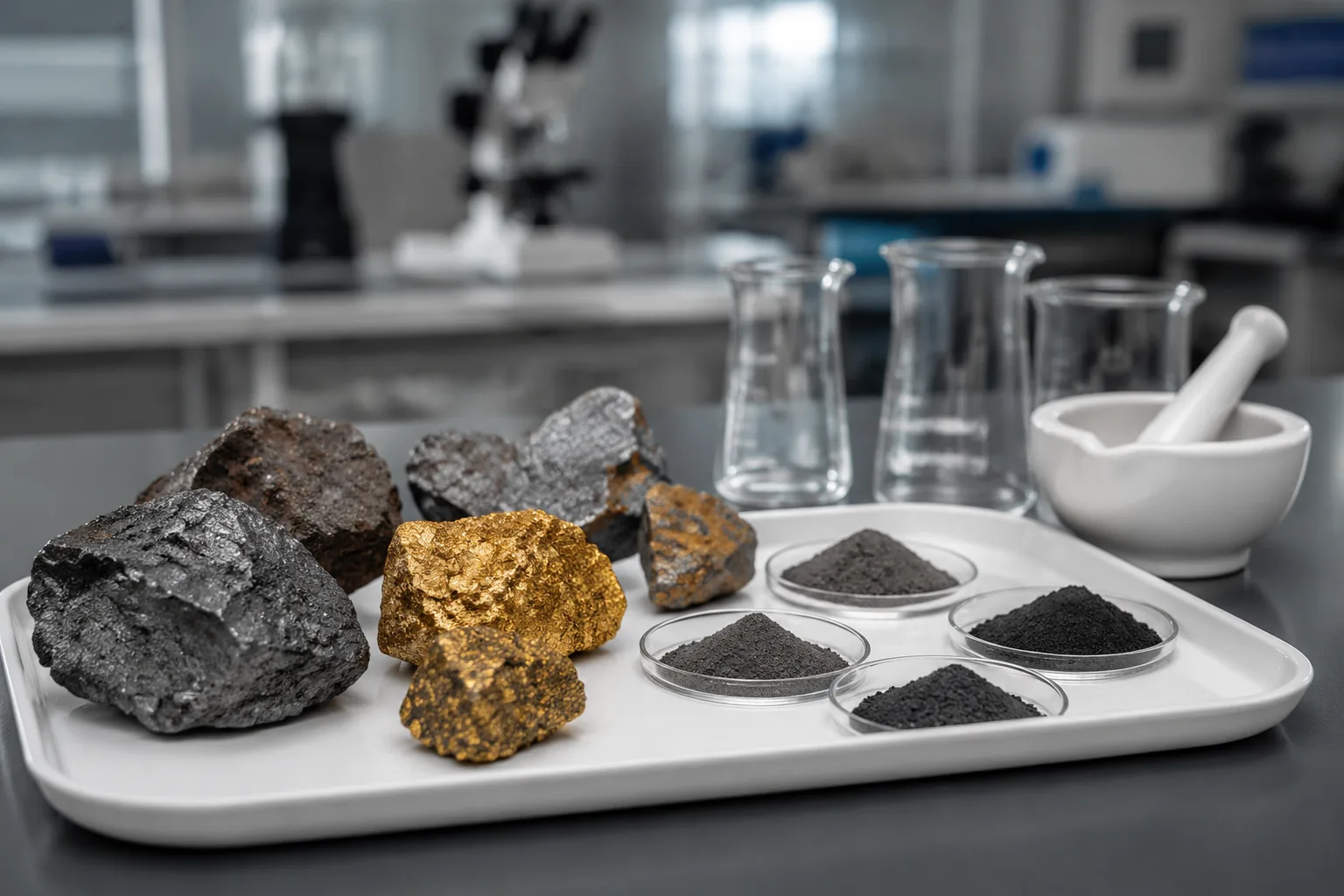
The single most important framing fact, and one the search results routinely miss, is that "ore testing" is not one test under one standard. The governing standard depends on the commodity, because each metal has its own chemistries, interferences, and economic-grade thresholds. A representative mapping:
| Ore commodity | Standard series | What is determined |
|---|---|---|
| Iron ore | GB/T 6730 series | Total iron (grade), silica, alumina, phosphorus, sulfur, moisture — the trade-settlement basis |
| Gold ore | GB/T 20899 series (14 parts); GB/T 13449-2021 (sampling) | Gold (by fire assay), silver, and associated elements |
| Copper / lead / zinc ore | GB/T 14353 series | Cu, Pb, Zn grades and associated elements |
| Tungsten / molybdenum ore | GB/T 14352 series (24 parts) | W, Mo, and associated elements (Zn, Te, Re, Ge, etc.) |
| Rare-earth ore | GB/T 17417.1/.2 | 15 rare-earth element fractions and scandium — the customs classification basis |
A gold ore assayed under the iron-ore standard (or vice versa) is a category error that produces a meaningless result, because the digestion, the interferences, and the detection method are commodity-specific. The commodity is identified first, and the standard follows.
Ore vs Concentrate: Different Material, Different Standard
The second split, within each commodity, is between raw ore (the mined rock) and concentrate (the beneficiated product after milling and flotation). These are different materials at different stages of the value chain, and they are tested under different standards:
| Material | Copper | Lead | Zinc |
|---|---|---|---|
| Ore | GB/T 14353 series (Cu/Pb/Zn ore) | GB/T 14353 series | GB/T 14353 series |
| Concentrate | GB/T 3884 series (copper concentrate) | GB/T 8152 series (lead concentrate) | GB/T 8151 series (zinc concentrate) |
Concentrate is a processed, enriched product destined for the smelter, and its standard set includes the deleterious-element limits (arsenic, fluorine, mercury, cadmium) that the smelter penalizes or refuses. The smelter and trader therefore specify the concentrate standards, while the mine and explorer specify the ore standards. The standard quoted on the report must match the material actually sampled.
The Three Test Categories
Within each commodity, the laboratory work falls into three categories that answer different questions:
Grade assay — the concentration of the target metal, the number trade settlement and smelter acceptance turn on. For iron ore it is total iron (TFe); for gold it is the gold grade in g/t; for copper ore it is the copper percentage. The grade-assay method is commodity-specific and is the headline result of the report.
Multi-element / associated-element analysis — the full chemical profile: the value elements (e.g., silver and copper in a gold ore) and the deleterious elements (arsenic, fluorine, mercury, antimony) that attract smelter penalties or trigger environmental controls. A concentrate report without the deleterious-element panel is incomplete for smelter acceptance.
Sampling representativeness — the precondition that the assay result represents the lot, not just the lab specimen. Ore is heterogeneous, so sampling and sample preparation (crushing, coning-and-quartering, riffling to the assay pulp) are governed by their own standards (e.g., GB/T 13449-2021 for gold lump ore). A grade number from a non-representative sample is worthless regardless of the precision of the assay itself — a fact often stated but rarely enforced in the sampling specification.
The Analytical Methods: Fire Assay, AAS, ICP
The actual measurement techniques, and when each is used:
- Fire assay (lead collection / cupellation) — the classical gold (and other precious-metal) grade method. The sample is fused with lead oxide and fluxes; the lead collects the precious metal, the lead button is cupelled to leave a precious-metal bead, and the bead is weighed or further analyzed. Fire assay is preferred for gold because of its large sample charge (10–30 g, sometimes up to 100 g for low-grade ore), which averages out the nugget effect that would otherwise dominate a small-charge instrumental measurement. It is the reference method for gold grade.
- Flame atomic absorption spectroscopy (AAS) — the workhorse for the base-metal and many associated elements; the sample is dissolved in acid and aspirated into a flame, with element-specific absorbance measured. Widely used after fire-assay collection or acid digestion for Cu, Pb, Zn, Ag, and others.
- ICP-OES / ICP-MS — inductively coupled plasma (optical emission or mass spectrometry) is the modern multi-element method, capable of determining dozens of elements in one run from a single digestion. ICP-MS, with its low detection limits, is the method of choice for trace and rare-earth elements (e.g., the 15 rare-earth fractions of GB/T 17417.1) and for the deleterious trace elements in concentrate.
- X-ray fluorescence (XRF) — used for the major-oxide composition of iron ore and similar (Fe, SiO₂, Al₂O₃, CaO, MgO), often pressed-powder or fused-bead, providing a fast multi-oxide screen.
The method chosen depends on the element, the grade range, and the standard: fire assay for gold, AAS for routine base metals, ICP for multi-element and trace, XRF for the bulk oxides.
Why the SERP Is Off the Compliance Intent
The search results for "ore testing" are dominated by content that answers different questions:
- Mining-equipment-company lab services (e.g., Metso's ore-characterization offering) sell comminution and mineralogical tests — SMC, JK drop-weight, bond work index — that optimize how the ore is processed. That is process metallurgy, not grade compliance.
- Historic extraction-process literature (e.g., the detailed 1920s gold-chlorination study) documents how metal was extracted, a process question.
- General gold-assay explainers cover fire assay but rarely connect it to the GB standard framework or the ore-vs-concentrate split.
Each is legitimate, but none maps ore testing as a commodity-segmented grade-compliance discipline — which is the question a mine, a trader, a smelter, or a customs broker actually asks. That is the gap this article fills.
Our Testing Capabilities
Beijing ZKGX Research conducts ore and concentrate testing across the principal commodities:
- Iron ore — total iron (TFe) grade, the major oxides (SiO₂, Al₂O₃, CaO, MgO), and the penalty elements (P, S), per the GB/T 6730 series (IDT the corresponding ISO methods for trade settlement).
- Gold ore — gold grade by fire assay (GB/T 20899.1) with sampling and preparation per GB/T 13449-2021; silver and associated elements across the GB/T 20899 series.
- Copper / lead / zinc ore — Cu, Pb, Zn grades and the associated-element panel, per GB/T 14353.
- Tungsten / molybdenum ore — W and Mo grades and the associated elements (Zn, Te, Re, Ge), per the GB/T 14352 series.
- Rare-earth ore — the 15 rare-earth element fractions and scandium, per GB/T 17417.1/.2 (the customs-classification basis for exports).
- Concentrates — copper concentrate (GB/T 3884), lead concentrate (GB/T 8152), zinc concentrate (GB/T 8151), including the deleterious-element panels (As, F, Hg, Cd) required for smelter acceptance.
- Methods: fire assay, AAS, ICP-OES/MS, and XRF, each applied per the standard's method specification.
- Deliverable: a test report identifying the commodity and the material (ore vs concentrate), the standard series applied, each element with its method citation, and the grade against the trade-settlement or smelter-acceptance basis.
If you have an ore or concentrate sample requiring grade determination, contact our testing team to scope the commodity, the material form (ore vs concentrate), and the applicable standard series.
Frequently Asked Questions
What standard governs ore testing?
There is no single standard — ore testing is commodity-segmented. Iron ore is tested under GB/T 6730, gold ore under GB/T 20899 (with sampling per GB/T 13449), copper/lead/zinc ore under GB/T 14353, tungsten/molybdenum under GB/T 14352, and rare-earth ore under GB/T 17417. The commodity is identified first, then the standard.
What is the difference between ore testing and concentrate testing?
Ore is the raw mined rock; concentrate is the beneficiated, enriched product after milling and flotation. They are different materials tested under different standards — for example, copper ore under GB/T 14353 but copper concentrate under GB/T 3884. Concentrate standards additionally include the deleterious-element limits (As, F, Hg, Cd) required for smelter acceptance.
Why is fire assay used for gold?
Fire assay (lead collection and cupellation) uses a large sample charge (10–100 g), which averages out the "nugget effect" — the high variance that would dominate a small-charge measurement of gold's irregular distribution. It is the reference method for gold grade because it is accurate, representative, and reproducible.
Is ore testing the same as the comminution / mineralogical tests sold by mining labs?
No. Comminution tests (SMC, JK drop-weight, Bond work index) and mineralogical characterization optimize how the ore is processed — a process-metallurgy question. Ore laboratory testing determines the grade and composition for trade settlement, smelter acceptance, and customs — a compliance question. They answer different questions.
How is ore grade reported?
Grade is reported as the concentration of the target metal: total iron (TFe) as a percentage for iron ore; gold in grams per tonne (g/t) for gold ore; copper/lead/zinc as percentages for the base-metal ores. The grade is the headline trade-settlement and smelter-acceptance number, and it must be paired with a representative sampling basis to be meaningful.