What Is Knitted Cotton Testing?
Knitted cotton testing is the laboratory verification of cotton knitted fabrics — jersey, rib, interlock, pique, French terry, and blends — against the international, national, and buyer-specific standards that govern their quality, safety, and labeling in apparel, home textile, and industrial applications. The core framework combines GB/T 22848 / FZ/T 72001 (China, knitted finished fabric and knit-face fabric standards), GB 18401 (China, general textile safety), ISO 6348 / ISO 3801 / ISO 5077 / ISO 6330 / ISO 105 series (international, fiber content, mass, shrinkage, wash, color fastness), AATCC 135 / ASTM D5034 / ASTM D3786 (US dimensional stability and strength), and JIS L 1096 (Japan, woven and knitted fabric physical properties). A complete program confirms fiber authenticity, dimensional stability, mechanical performance, color fastness, comfort properties, and chemical safety in one coordinated test package.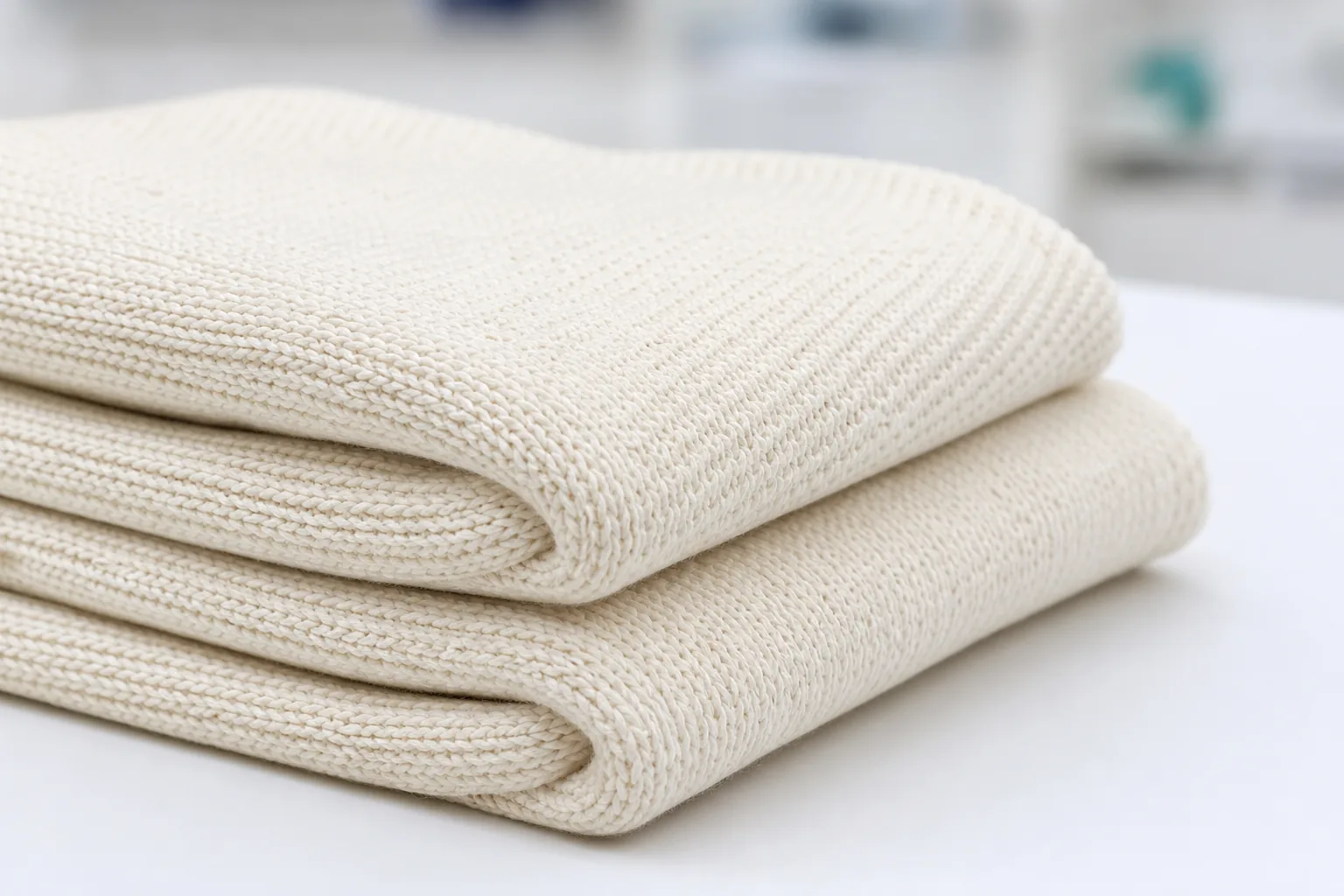
Cotton knits are the dominant substrate in casual apparel — China's National Textile and Apparel Council data puts knitted apparel above 68% of total apparel production. That scale, combined with cotton's natural sensitivity to moisture and shrinkage, makes the test program non-trivial. Beijing ZKGX Research Institute structures its knitted cotton programs around the GB/T and ISO clause matrix, with each measurement traceable to the exact clause being verified.
Why Knitted Cotton Testing Matters
A knitted cotton fabric is chosen specifically for softness, stretch, and breathability — three properties that come from the looped knit structure, and three properties that each drive failure modes the test program targets:
- Dimensional instability (shrinkage) — cotton fibers absorb water and swell, and the knit geometry that gives stretch also lets the fabric deform in the laundry; untested knits shrink 8–15% in five washes
- Mechanical failure — knit structures fail by bursting (not by the warp/weft tensile failure of woven fabric), so burst strength is the critical strength index, not strip tensile
- Color fastness loss — reactive dyes on cotton can bleed, rub off, fade in light, or migrate in perspiration; the test program must verify each mode separately
- Chemical safety non-compliance — formaldehyde, pH, aromatic amines from azo dyes, heavy metals, and (for children) flammability must meet regulated ceilings
For these reasons, the textile safety and quality framework in every major market treats knitted cotton as a regulated article — sale without a supporting test dossier means rejection at customs, retail withdrawal, or, worse, a consumer incident (allergic dermatitis, infant formaldehyde exposure) that triggers recall and liability.
Which Standards Govern Knitted Cotton Testing?
There is no single global knitted cotton standard; the framework is layered across safety, product, and test-method standards:
| Standard | Scope | What it answers |
|---|---|---|
| GB 18401-2010 | China — General safety technical code for textile products | The mandatory safety floor in China: formaldehyde, pH, color fastness, aromatic amines, odor |
| GB 31701-2015 | China — Safety technical code for infants and children textile products | Stricter limits for infant/children knits (formaldehyde ≤ 20 mg/kg, no aromatic amines) |
| GB/T 22848-2022 | China — Knitted finished fabric | The product specification: classification, intrinsic quality, appearance grading, sampling |
| FZ/T 72001-2009 | China — Knitted face fabric (warp and weft) | Industry-level specification for knit face fabric |
| GB/T 22849-2014 | China — Knitted T-shirt | Product standard for the most common knitted cotton apparel |
| GB/T 8878-2014 | China — Knitted underwear | Product standard for knitted cotton underwear |
| ISO 6348:2004 | Textiles — Quantitative analysis of binary fiber mixtures | Verifies "100% cotton" or blend-ratio claim |
| ISO 3801:1977 | Woven/knit fabric — Mass per unit area (GSM) | Verifies declared g/m² |
| ISO 5077:2007 | Textiles — Dimensional change in washing | The wash-shrinkage test |
| ISO 6330:2021 | Domestic washing and drying procedures for textile testing | The reference wash procedure used by 5077 and AATCC 135 |
| ISO 105 series | Textiles — Tests for color fastness | Color fastness to wash, rub, perspiration, light, etc. |
| ISO 13938-1/-2 | Textiles — Bursting properties of fabrics (hydraulic/pneumatic) | The strength test specific to knits |
| JIS L 1096:2020 | Japan — Woven and knitted fabric physical properties | The unified Japanese standard (merged former JIS L 1018 for knits); letter methods A/B/C/D/H/E |
| AATCC 135 / 150 | US — Dimensional changes after wash (home/commercial laundry) | US shrinkage test |
| ASTM D3786/D3787 | US — Bursting strength (ball burst) | US strength test for knits |
Beijing ZKGX structures every knitted cotton test report against this matrix so the client can see which clause of which standard each measurement satisfies — not just a pass/fail verdict.
What Are the Core Knitted Cotton Test Items?
A complete program divides into five blocks. Each item maps to a clause, and each has a measurable acceptance threshold.
1. Fiber Content Verification (ISO 6348 / GB/T 2910)
Verify the declared fiber composition. For "100% cotton" knit fabric, manual or instrumental analysis (burn test, microscope, or solvent dissolution for blends) must confirm the cotton content to within the tolerance allowed by the labeling regulation. Acceptance per GB 5296.4 and EU Textile Labeling Regulation 1007/2011: ±3% absolute tolerance on each declared component (e.g., 95% cotton / 5% spandex must test within 92–98% cotton / 2–8% spandex). Mis-declared fiber content is the most common labeling violation in imported knits.
2. Mass Per Unit Area — GSM (ISO 3801 / GB/T 4669)
Cut a specimen of known area, condition at standard atmosphere (20 ± 2 °C, 65 ± 4% RH), weigh on a calibrated balance, and compute g/m². Acceptance: the measured GSM must fall within the tolerance band declared in the product specification. For GB/T 22848 knit fabric grades (Superior / First-class / Qualified), typical GSM tolerance is ±5% of the nominal value for Superior, broader for lower grades. GSM is the single most-used procurement spec — a buyer orders "200 g/m² jersey" and rejects anything outside ±5%.
3. Dimensional Stability / Wash Shrinkage (ISO 5077 / GB/T 8628 / AATCC 135)
Wash specimens under a specified cycle (e.g. ISO 6330 cycle 5N — wash at 40 °C, line dry), then re-measure length and width against pre-wash benchmarks. Compute dimensional change as a percentage. Acceptance for knitted cotton apparel: typically within −5% to +1% (i.e. shrinkage up to 5%) after the specified number of washes per the product standard; infant products have stricter limits. The dominant variable, per the published research, is stitch length — the longer the loop, the more the fabric can distort under washing, so stitch length is both a process variable and a quality-control target.
4. Bursting Strength (ISO 13938 / ASTM D3786 / JIS L 1096 Method A)
Unlike woven fabrics, which fail by strip tensile in the warp or weft direction, knitted fabrics fail by bursting — the simultaneous stress on every loop when pressure is applied normal to the fabric surface. Measure on a hydraulic or pneumatic ball-burst tester; record the maximum bursting strength in kPa and the bursting distension in mm.
Indicative ranges (clear, finished knit fabric):
- Lightweight jersey (≤ 160 g/m²): typically 200–400 kPa
- Mid-weight interlock (180–260 g/m²): typically 400–700 kPa
- Heavy French terry (> 260 g/m²): typically 700–1100 kPa
Buyer specs typically set the bursting floor based on the garment's end-use (active wear higher than loungewear).
5. Color Fastness (ISO 105 series / GB/T 3920 / 3921 / 3922 / 8427)
Knitted cotton is dyed with reactive, direct, or sulfur dyes, each with a different fastness profile. Five fastness modes are routinely tested:
- Color fastness to rubbing (GB/T 3920, ISO 105-X12) — dry and wet crocking; grade 1–5
- Color fastness to washing (GB/T 3921, ISO 105-C06) — typically at 40 °C or 60 °C; grade 1–5
- Color fastness to perspiration (GB/T 3922, ISO 105-E04) — acid and alkaline simulated perspiration; grade 1–5
- Color fastness to light (GB/T 8427, ISO 105-B02) — xenon arc exposure; grade 1–8
- Color fastness to water (ISO 105-E01) — relevant for swimwear and towels
Acceptance per GB 18401 general products (Class B, direct skin contact): color fastness ≥ 3 for rubbing, washing, perspiration, and water; ≥ 3 for light (light is graded 1–8, so 3 is the floor for general apparel). Infants (Class A) require ≥ 4 for most modes.
Chemical Safety Tests (GB 18401 / CPSIA / REACH Annex XVII)
Knitted cotton must also meet the chemical safety ceiling of the destination market:
| Test | Method | Typical limit (general apparel) |
|---|---|---|
| Formaldehyde | GB/T 2912.1 / ISO 14184-1 | ≤ 75 mg/kg (Class B); ≤ 20 mg/kg (infants Class A) |
| pH | GB/T 7573 / ISO 3071 | 4.0–8.5 (general); 4.0–7.5 (infants) |
| Aromatic amines (from azo dyes) | GB/T 17592 / ISO 14362-1 | ≤ 20 mg/kg per amine (24 listed amines) |
| Heavy metals (Pb, Cd, etc.) | ICP-MS / CPSIA §108 | Lead ≤ 100 mg/kg total in children's product surfaces (CPSIA) |
| Phthalates (on prints/coatings) | CPSC-CH-C1001 | ≤ 0.1% each in children's toys and care articles |
For children's knit apparel, GB 31701-2015 adds flammability, cord-and-drawstring safety, and stricter chemical limits on top of GB 18401. The US equivalent is 16 CFR Part 1610 (clothing textile flammability) and CPSIA lead/phthalate limits.
Type vs. Production vs. Surveillance Testing — Don't Confuse Them
Three regimes apply to a knitted cotton fabric over its life cycle:
- Type / sample approval — done once per fabric construction when a buyer approves the fabric for production; the basis of the purchase contract spec
- Production lot testing — verified on each production lot before shipment, typically a shortened set (GSM, wash shrinkage, color fastness to rub and wash, formaldehyde, pH, and fiber content)
- Market surveillance testing — conducted by regulators (customs, market supervision bureaus in China and the EU) on garments pulled from retail; commonly catches undeclared azo-dye amines, formaldehyde overage, and false fiber-content labels
A common error is treating a single sample-approval pass as proof of ongoing compliance. It is not — the production-lot regime exists precisely because dyeing, finishing, and knitting parameters drift. Beijing ZKGX labels every report with which regime the result serves.
How Long Does Knitted Cotton Testing Take?
A complete GB 18401 + GB/T 22848 compliance program on a single fabric sample takes 5 to 8 working days, dominated by the wash-shrinkage test sequence (multi-cycle wash plus conditioning). Fiber content by manual analysis takes 1 to 2 days, by instrumental dissolution 1 day. Color fastness tests typically return within 3 to 5 working days; chemical safety (formaldehyde, aromatic amines) within 3 to 5 working days. Bursting strength returns the same day it is scheduled.
Sample requirements: typically 1 to 2 linear meters of full-width fabric of the same construction and color, or 3 to 5 finished garments for garment-level testing. Aqueous-wash items require additional material for replicate measurements.
A formal test report is delivered within 5 to 7 working days after completion of each testing block, including raw data, fastness-grade grey-scale readings, wash-cycle records, chromatograms for chemical tests, and a clear statement of which clauses were met.
What Makes a Knitted Cotton Test Report Usable?
A report that only says "PASS" is useless when a regulator, retailer, or consumer challenges the quality claim. A defensible report — accepted by GB 18401 / 31701 authorities in China, REACH authorities in the EU, CPSIA authorities in the US, and major retailer compliance reviews (UNIQLO, H&M, Target, Walmart) — must contain:
- Sample identification — fabric construction, GSM, color, supplier, batch, the dyeing-finishing route
- Measured values with units and tolerance — not "compliant," but "GSM 198 g/m² (declared 200 ±5%, ISO 3801)"
- Standard-clause traceability — which paragraph of GB 18401, GB/T 22848, or ISO 5077 each result is judged against
- Wash cycle and condition records — ISO 6330 cycle number, temperature, detergent, drying method
- Grey-scale and instrumental fastness readings — actual grade plus the supporting evidence
- Signed conclusion — accredited laboratory stamp and ISO/IEC 17025 reference
Beijing ZKGX knitted cotton reports follow this structure as standard and are issued under the laboratory's ISO/IEC 17025 accreditation framework, with each measurement traceable to a recognized national or international standard.
Frequently Asked Questions
Is knitted cotton testing mandatory?
Yes, in every major market for apparel and home textile sale. Sale in China requires GB 18401 (and GB 31701 for infant/children products); in the EU, REACH Annex XVII and the Textile Labeling Regulation 1007/2011; in the US, CPSIA lead/phthalate limits and 16 CFR Part 1610 flammability. Retailer-specific standards (UNIQLO JIS L 1096, H&M RSL) layer on top of these regulatory floors.
How is knitted cotton testing different from general Fabric testing?
General fabric testing covers all textile substrates (woven, nonwoven, knit) for generic physical properties. Knitted cotton testing adds three knit-specific items: bursting strength (replacing strip tensile as the strength index), wash-shrinkage on knit geometries (where dimensional change is larger and less predictable than woven), and knit-loop structural checks (course/wale density, stitch length). The two share methods for color fastness, GSM, and chemical safety. Anti-static clothing testing is a separate functional textile category addressing surface resistivity.
Why is bursting strength used for knits and not tensile strength?
Knit geometry distributes stress in all directions simultaneously; there is no single "warp" or "weft" line to pull. A ball-burst tester applies normal pressure and measures the resistance of the entire knit grid at once — closer to how the garment actually fails in service (a knee pressing through, an elbow stretching). Strip tensile on knits gives direction-dependent data that does not predict real-world performance.
Does organic cotton need different testing?
Same test methods, additional certification. Organic cotton must be verified to the GOTS (Global Organic Textile Standard) or OCS (Organic Content Standard), which add GMO testing, restricted-substance limits stricter than GB 18401 / REACH, and traceability back to the farm. The physical and color-fastness tests are identical.
What about flammability of children's knitted cotton?
Children's sleepwear is held to a stricter flammability standard than adult apparel — 16 CFR Parts 1615 and 1616 in the US require specific burn performance for children's sleepwear sizes 0–14. Plain cotton jersey typically does not pass without flame-retardant treatment or a tight-fitting design exemption; most children's sleepwear uses polyester or treated fabrics. For general apparel, see our fire resistance and Flame Retardant Testing program covering the 16 CFR 1610 and related frameworks.
References & Further Reading
- GB 18401-2010 — General safety technical code for textile products (openstd.samr.gov.cn)
- GB 31701-2015 — Safety technical code for infants and children textile products (openstd.samr.gov.cn)
- GB/T 22848-2022 — Knitted finished fabric (openstd.samr.gov.cn)
- GB/T 22849-2014 — Knitted T-shirt (openstd.samr.gov.cn)
- GB/T 8878-2014 — Knitted underwear (openstd.samr.gov.cn)
- ISO 6330:2021 — Domestic washing and drying procedures for textile testing (iso.org)
- ISO 5077:2007 — Textiles — Dimensional change in washing (iso.org)
- ISO 13938-1/-2 — Textiles — Bursting properties of fabrics (iso.org)
- ISO 105 series — Textiles — Tests for color fastness (iso.org)
- JIS L 1096:2020 — General physical properties of woven and knitted fabrics (jis.or.jp)
- 16 CFR Part 1610 — Standard for the flammability of clothing textiles (cpsc.gov)
- Regulation (EU) No 1007/2011 — Textile fiber names and related labeling (eur-lex.europa.eu)