Table of Contents
- What standards govern fabric testing?
- How is physical and mechanical performance tested?
- How is colorfastness evaluated?
- What chemical safety tests are required?
- How is flammability regulated?
- How do the Chinese GB 18401 and GB 31701 classify textiles?
- What does OEKO-TEX Standard 100 add?
- FAQ
- Our fabric testing service
What standards govern fabric testing?
Fabric testing is governed by four parallel standard families — the ISO methods used internationally and in Europe, the AATCC and ASTM methods used in North America, the 16 CFR federal regulations that govern the U.S. market, and the Chinese GB standards that govern the Chinese market — plus the OEKO-TEX and REACH frameworks that govern chemical safety across markets. A fabric destined for multiple markets must be tested against each market's standard set, because the methods, the limits and the classifications are not interchangeable across the families.
The principal reference standards our laboratory works to are:
- ISO 13934 / ISO 13937 / ISO 13936 / ISO 12945 / ISO 105 — the international method standards for tensile strength, tear strength, seam properties, pilling and colorfastness respectively. The ISO 105 colorfastness family alone has dozens of parts, each covering a specific exposure (washing, rubbing, light, perspiration, water, chlorinated water, bleach).
- AATCC 8 / 15 / 16 / 61 / 107 / 135 / 162 / 112 — the American chemical-textile standards for colorfastness to crocking, perspiration, light, washing, water, dimensional change, chlorinated water, and formaldehyde release.
- ASTM D5034 / D1424 / D4966 / D3512 / D1230 / D6413 / D737 — the American material-test standards for tensile strength, tear strength, abrasion (Martindale), pilling, flammability, flame resistance and air permeability.
- 16 CFR 1610 / 1611 / 1615 / 1616 / 423 / 303 — the U.S. federal regulations for clothing-textile flammability, vinyl-film flammability, children's sleepwear flammability (both ranges), care labeling and fiber-content labeling.
- GB 18401-2010, National general safety technical code for textile products (std.samr.gov.cn) — China's mandatory general safety code, classifying all textile products into the A / B / C categories by skin-contact exposure.
- GB 31701-2015 (and the incoming GB 31701-2023), Safety technical specification for infant and children textile products — China's mandatory infant-and-children textile code, adding the burning-performance, phthalate, heavy-metal and physical-safety requirements on top of the GB 18401 baseline.
- REACH (EC 1907/2006) and the SVHC list — the European chemical-safety framework governing restricted substances in textiles placed on the EU market, including the Annex XVII restrictions on specific azo dyes, phthalates, PAHs and flame retardants.
- OEKO-TEX Standard 100 (oeko-tex.com) — the global voluntary harmful-substance certification, with the four product classes (I infant / II skin contact / III no skin contact / IV decoration material) and the limit catalogue that goes beyond most national requirements.
- California Proposition 65, California AB 1817 (PFAS in textiles), EU POP Regulation, TSCA-PBT — the state-level and product-specific chemical regulations that apply to textiles in the respective jurisdictions.
A common misconception in specifications we receive is that a single test report covers a fabric for all markets. It does not. The AATCC colorfastness methods and the ISO 105 colorfastness methods are similar but not identical (the specimen geometry, the apparatus and the grading can differ), and a report issued against AATCC will not be accepted by a buyer who specified ISO. The GB 18401 classification has no direct equivalent in the U.S. or the EU regulatory frameworks, and an OEKO-TEX certificate does not substitute for the GB 18401 mandatory classification in the Chinese market. We confirm the target market and the buyer's specified method standard before quoting, because the test scope and the cost are driven by the combined requirement set.
How is physical and mechanical performance tested?
The physical and mechanical tests measure the fabric's strength, durability and structural behaviour — the properties that determine whether the fabric will hold up in use, resist tearing and abrasion, and retain its shape after laundering. These are the tests that the brand's quality specification and the buyer's purchase order are built around, and a fabric that fails them is a fabric that produces customer returns regardless of its chemical safety.
Six tests form the core of the mechanical evaluation: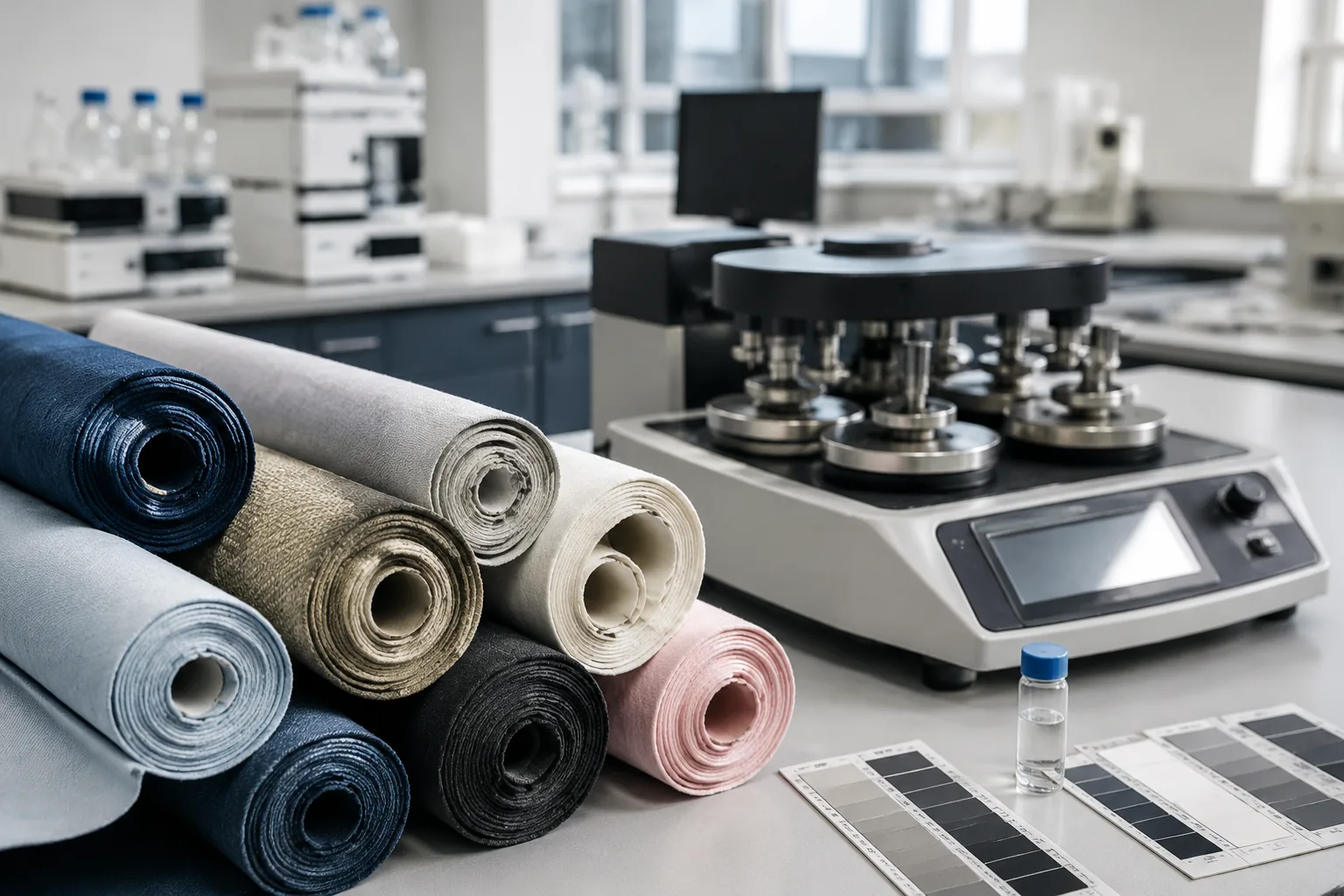
Tensile strength (ISO 13934-1 / -2, ASTM D5034). The fabric specimen is pulled to rupture on a constant-rate-of-extension machine, and the maximum breaking force in newtons and the percentage elongation at break are recorded. The ISO standard offers the strip method (13934-1) and the grab method (13934-2); the choice depends on the fabric type and the buyer's specification. The tensile strength is governed by the yarn strength, the thread count and the fabric composition, and once the fabric is woven it cannot be improved — the failures point back to the yarn selection and the construction.
Tear strength (ISO 13937-1 to -4, ASTM D1424). A defined cut is started in the fabric and a sudden force is applied to propagate a single-rip tear of defined length, and the tearing force in newtons is recorded. The tear strength is sensitive to the yarn strength, the fibre length and the yarn twist, and — unlike tensile — it can be marginally improved by finishing treatments. The tear failure is the one a consumer experiences when a fabric catches on a sharp edge and propagates a rip.
Seam strength (ISO 13936-1 to -3). A sewn seam is loaded until it fails, and the maximum force in newtons and the seam opening in millimetres at a given force are recorded. The seam failure mode matters: the seam can fail by stitch rupture, by yarn slippage (the fabric yarns slide out of the seam), or by fabric rupture at the seam line. The ISO 13936 family covers the three modes, and the failure mode identifies the corrective action (change the stitch type or density, reinforce the seam, or change the fabric).
Pilling (ISO 12945-1 / -2, ASTM D3512). The fabric specimen is mounted on a pilling tester (the ICI-type or the Martindale-type, with the random-tumble pilling tester as the ASTM equivalent) and rubbed under defined conditions to simulate the wear that produces pills — the small fibre balls that form on the surface. The pilling is rated on the 1-to-5 scale (5 = no change; 4 = slight fuzzing with partially formed pills; 3 = moderate; 2 = distinct; 1 = severe). The pilling behaviour is governed by the fabric construction, the composition and the yarn twist, and the improvement routes are singeing, increased twist or a polymer-coating finish.
Abrasion resistance (ASTM D4966 Martindale, ISO 12947). The fabric specimen is rubbed against a standard abrasive under defined load and motion, and the number of cycles to a defined endpoint (the breakdown of the specimen, or the mass loss) is recorded. The Martindale is the most widely specified abrasion method for apparel and upholstery, and the cycle count to breakdown is the figure the buyer's specification sets (for example, 20,000 cycles for a residential upholstery, 40,000 for a contract upholstery). The abrasion resistance is governed by the fibre type, the yarn structure and the fabric density.
Dimensional stability (AATCC 135, ISO 5077). The fabric specimen is laundered under defined conditions and the dimensional change (the shrinkage or the growth) is measured in the warp and the weft directions. The result is reported as a percentage, and the buyer's specification sets the maximum allowable change. The dimensional stability is governed by the fabric construction, the relaxation of the yarns and any finishing tension, and it is the test that predicts whether the garment will fit after the consumer launders it.
These six tests are the mechanical baseline, and a fabric that passes all six meets the quality threshold for most apparel and home-textile applications. The specialised applications — the water resistance, the air permeability, the moisture management, the UV protection — are added on top of the mechanical baseline, not instead of it, and we scope them against the application.
How is colorfastness evaluated?
The colorfastness tests measure the fabric's ability to retain its colour under the exposures it will experience in service — washing, rubbing, light, perspiration, chlorinated water, sea water, bleach — and the colour transfer to adjacent materials. The colorfastness is governed by the dye selection, the dyeing and finishing process, and the fibre material, and the failures are the ones the consumer sees as fading, staining and bleeding.
The colorfastness test family covers:
Colorfastness to washing (AATCC 61, ISO 105-C06). The specimen is laundered under defined conditions with adjacent fabrics, and the colour change of the specimen and the staining of the adjacent fabrics are graded on the 1-to-5 grey scale.
Colorfastness to rubbing / crocking (AATCC 8 / 116, ISO 105-X12). A white cotton cloth is rubbed against the specimen under defined load, dry and wet, and the staining of the cotton cloth is graded. The dry and the wet crocking measure different things — the dry crocking simulates the colour transfer from rubbing against another surface in wear, and the wet crocking simulates the transfer from rain, sweating or wet contact.
Colorfastness to light (AATCC 16, ISO 105-B02). The specimen is exposed to a defined light source (a xenon-arc lamp that simulates daylight) for a defined duration, and the colour change is graded against the blue-wool reference scale. The light fastness is the test that predicts whether a garment's colour will survive a season of sun exposure, and it is the test most often failed by fabrics dyed with low-light-fastness dyes.
Colorfastness to perspiration (AATCC 15, ISO 105-E04). The specimen is immersed in an artificial perspiration solution (acidic and alkaline), placed under pressure between adjacent fabrics, and the colour change and the staining are graded. The perspiration fastness is the test that predicts whether a garment's colour will bleed under sweat, and it is particularly critical for activewear.
Colorfastness to water (AATCC 107, ISO 105-E01), to chlorinated (pool) water (AATCC 162, ISO 105-E03) and to sea water (AATCC 106). The specimen is immersed in the relevant aqueous medium and the colour change and staining are graded. The chlorinated-water fastness is the test that predicts whether a swimsuit's colour will survive pool exposure, and the sea-water fastness predicts the beach performance.
The colorfastness grading uses the grey scale for colour change (the ISO 105-A02 scale) and the grey scale for staining (ISO 105-A03), both running 1 to 5 with half-grade steps, where 5 is the best (no change, no staining). The buyer's specification sets the minimum grade for each fastness property — typically 3-4 or 4 for the skin-contact applications, 3 for the less critical — and the report grades each property against the minimum. A fabric that fades or bleeds in service is a fabric that fails the consumer's expectation, and the colorfastness tests are the ones that predict this most directly.
What chemical safety tests are required?
The chemical safety tests measure the restricted and the harmful substances in the fabric — the substances that the regulatory frameworks and the voluntary certifications limit because they are toxic, allergenic, carcinogenic or environmentally persistent. The chemical safety is governed by the chemical inputs the fabric has received (the dyes, the finishes, the coatings, the auxiliaries), and the failures are the ones that trigger recalls, regulatory action and reputational damage.
The chemical safety test programme typically covers:
Formaldehyde (AATCC 112, ISO 14184, GB/T 2912). The formaldehyde released from the fabric is measured by the sealed-jar method, and the result in mg/kg is compared to the regulatory limit. Formaldehyde is used in the easy-care and the wrinkle-resistant finishes, and it is a skin irritant and a human carcinogen. The GB 18401 limits are 20 mg/kg (Class A, infant), 75 mg/kg (Class B, skin contact), 300 mg/kg (Class C, no skin contact); the OEKO-TEX Standard 100 limits are 16, 75, 300 and 300 mg/kg for the four product classes. The differences reflect the framework — the GB limits are regulatory floors, the OEKO-TEX limits are the certification thresholds — and a fabric that meets GB 18401 Class A is essentially at the OEKO-TEX Class I threshold.
pH (ISO 3071, GB/T 7573). The pH of the fabric's aqueous extract is measured, and the result is compared to the regulatory range. The GB 18401 ranges are 4.0-7.5 (Class A), 4.0-8.5 (Class B), 4.0-9.0 (Class C); the OEKO-TEX Class II range is 4.0-7.5. A fabric outside the range can cause skin irritation, and the pH test catches the residual alkali from inadequate rinsing after dyeing.
Banned azo dyes (EN 14362, ISO 14362, GB/T 17592). Certain azo dyes can reductively cleave to release the carcinogenic aromatic amines (the 24 restricted amines under REACH Annex XVII and the GB 18401 ban), and the test detects the amines by HPLC or GC-MS. The limit is 30 mg/kg per amine, and a positive result is an outright ban — the fabric cannot be sold. The azo-dye test is the one most directly tied to the carcinogenic-substance risk in textiles, and it is mandatory under GB 18401, REACH and the OEKO-TEX framework.
Heavy metals (ISO 17294, ICP-MS). The extractable heavy metals (lead, cadmium, mercury, arsenic, chromium, antimony and others) are measured by ICP-MS, and the results are compared to the regulatory limits. The heavy metals enter the fabric from the dyes, the mordants and the coatings, and the CPSIA sets the lead limits (90 ppm paint / 100 ppm substrate for children's products) and the GB 31701 sets the children's-textile extractable-metal limits.
Phthalates (CPSC-CH-C1001, ISO 14389). The six regulated phthalates (DEHP, DBP, BBP, DINP, DIDP, DnOP) are measured by GC-MS, and the total content is compared to the 0.1 % limit under CPSIA, GB 31701 and the REACH restrictions. The phthalates enter the fabric from the plastic prints, the coatings and the plastic components (buttons, zippers).
PFAS — per- and poly-fluoroalkyl substances (LC-MS, GC-MS). The PFAS used in water-repellent and stain-resistant finishes are measured by LC-MS and GC-MS, and the results are compared to the emerging regulatory limits. California AB 1817 sets the limits for textile articles (100 ppm total organic fluorine from January 2025, 50 ppm from January 2027), and the EU REACH Annex XVII entry 79 restricts the PFHxA subfamily. The PFAS regulation is the most rapidly evolving area of textile chemical safety, and a project that tests PFAS should confirm the current limit for the destination market.
Restricted-substances screening (REACH SVHC, CPSIA, GB 31701, OEKO-TEX). The full restricted-substances list for the destination market is screened by the appropriate analytical methods (LC-MS, GC-MS, ICP-MS, HPLC), and the results are compared to the market-specific limits. The restricted-substances screening is the test that catches the substances the individual-property tests do not cover, and it is the test that the buyer's chemical-management specification typically requires.
How is flammability regulated?
The flammability of textiles is regulated because textile ignition is a leading cause of residential fire injury, and the regulatory frameworks set the flammability classes and the test methods that the fabric must meet to be sold for the regulated applications. The flammability regulation is application-specific — the requirements differ for clothing, for children's sleepwear, for bedding, for upholstery and for camping tents — and a fabric that passes one application's flammability test does not automatically pass another's.
The U.S. flammability regulations under 16 CFR are:
- 16 CFR 1610, Flammability of clothing textiles — the baseline clothing-textile flammability standard, classifying fabrics into Class 1 (normal flammability, acceptable for clothing), Class 2 (intermediate, restricted) and Class 3 (rapid and intense burning, unacceptable for clothing). Most apparel fabrics pass at Class 1; the regulation exists to keep the dangerously flammable fabrics off the market.
- 16 CFR 1615 / 1616, Flammability of children's sleepwear — the more stringent standard for children's sleepwear (sizes 0-6X and 7-14), requiring the fabric to self-extinguish and limiting the char length after ignition. The children's sleepwear standard is the reason most children's sleepwear is made from flame-resistant-treated polyester rather than from cotton.
- 16 CFR 1630 / 1631, Flammability of carpets and rugs — the carpet-flammability standard, requiring the carpet to resist ignition from a small flame source.
The corresponding standards for the other markets include:
- Canada SOR/2016-194, Textile Flammability Regulations — the Canadian regulations covering bedding and non-bedding textiles.
- CPAI-84, Flammability of camping tents — the U.S. standard for the tent fabric, specifying the after-flame time and the flame-spread requirements.
- EN 1102 / ISO 6940 / ISO 6941 — the European and international flammability-test methods for curtains and drapes and for the ignition and flame spread of fabrics.
The flammability test measures the fabric's response to a defined ignition source under defined conditions — the time to ignition, the flame-spread rate, the char length, the after-flame time — and the result is graded against the application-specific pass criterion. The flammability is governed by the fibre type (the cellulosics like cotton are more flammable than the synthetics like polyester, but the synthetics melt), the fabric construction, and any flame-retardant finish. The flame-retardant finish is itself a chemical input that the chemical-safety testing must address, because the regulated flame retardants (the PBDEs, the TCEP and others) are restricted under REACH, the POP Regulation and the OEKO-TEX framework.
How do the Chinese GB 18401 and GB 31701 classify textiles?
The Chinese fabric-testing framework is built around the two GB standards that classify textiles by the skin-contact exposure, with the chemical-safety limits set per class. The classification is mandatory — every textile product sold in China must carry the GB 18401 class declaration on its label — and the class determines which chemical limits apply.
GB 18401-2010, National general safety technical code for textile products, classifies textile products into three categories:
- Class A — infant textiles (age 36 months and below). The strictest category. The formaldehyde limit is 20 mg/kg, the pH range is 4.0-7.5, the colorfastness to water, perspiration and dry friction must be at least grade 3-4, the colorfastness to saliva must be at least grade 4, no odour is permitted, and the banned azo dyes are prohibited.
- Class B — textiles in direct contact with the skin. The intermediate category, covering the underwear, the bed linen, the T-shirts and similar products whose surface is in direct contact with the skin during wear. The formaldehyde limit is 75 mg/kg, the pH range is 4.0-8.5, the colorfastness minimums are grade 3, and the banned azo dyes are prohibited.
- Class C — textiles without direct skin contact. The least strict category, covering the outerwear, the jackets, the linings and the products worn over a base layer. The formaldehyde limit is 300 mg/kg, the pH range is 4.0-9.0, the colorfastness minimums are grade 3, and the banned azo dyes are prohibited.
The three-class structure parallels the OEKO-TEX Standard 100 product-class structure (I infant / II skin contact / III no skin contact), and the limits are close but not identical — a fabric that meets GB 18401 Class A is essentially at the OEKO-TEX Class I threshold, but the certification frameworks are separate and one does not substitute for the other.
GB 31701-2015 (with the incoming GB 31701-2023), Safety technical specification for infant and children textile products, adds requirements specific to infant (≤36 months) and children (≤14 years) textiles, on top of the GB 18401 baseline:
- Burning performance. The infant and children's textiles must meet the defined burning-performance class.
- Phthalates. The six regulated phthalates must total no more than 0.1 % by mass, with no intentional addition.
- Extractable heavy metals. The extractable heavy metals (lead, cadmium, mercury, arsenic and others) must meet the GB 31701 limits.
- Physical safety. The attachment strength (the pull strength of buttons, snaps, decorations), the sharp points and the sharp edges are tested, because the small attachments are choking hazards for the young children.
- Filler restrictions. The infant textiles must not use recycled or reclaimed filler material.
A regulatory point that affects specifications we receive: GB 31701-2015 is being superseded by GB 31701-2023, and the 2023 edition may revise the test scope and the limits. A conformity project for a Chinese-market infant or children's textile product should confirm with the receiving authority whether the report is to be issued against the 2015 edition or the incoming 2023 edition, because the test scope and the pass criteria may differ. The GB 18401 classification and the GB 31701 specification apply together for infant and children's products, not alternatively — GB 31701 sits on top of GB 18401 and adds the infant-and-children-specific requirements.
What does OEKO-TEX Standard 100 add?
OEKO-TEX Standard 100 is the global voluntary harmful-substance certification that goes beyond most national regulatory requirements. A fabric that carries the OEKO-TEX label has been tested against a catalogue of up to 1,000 regulated substances (including the formaldehyde, the heavy metals, the pesticides, the banned azo dyes, the flame retardants, the phthalates and many others), and the certification is valid for one year and is specific to the certified article.
The certification is organized into four product classes by the intended end-use and the degree of skin contact, mirroring the GB 18401 structure:
- Product Class I — articles for babies and toddlers (up to 3 years). The strictest class. The formaldehyde limit is 16 mg/kg (effectively not detectable), and the full limit catalogue applies at the most stringent thresholds.
- Product Class II — articles with direct skin contact. The formaldehyde limit is 75 mg/kg, the pH range is 4.0-7.5, and the limit catalogue applies at the skin-contact thresholds.
- Product Class III — articles without direct skin contact. The formaldehyde limit is 300 mg/kg, and the limit catalogue applies at the no-skin-contact thresholds.
- Product Class IV — decoration materials. The least strict class, covering the curtains, the tablecloths, the upholstery and the carpets. The formaldehyde limit is 300 mg/kg.
Three features of OEKO-TEX Standard 100 distinguish it from the mandatory regulatory frameworks and explain why brands seek the certification on top of their regulatory compliance:
The limit catalogue is broader than any single regulation. OEKO-TEX tests against the union of REACH, the CPSIA, the GB 18401 / GB 31701 limits and its own additional substances, so a single certification provides evidence of compliance across multiple jurisdictions — a marketing advantage for brands selling internationally.
The limits are updated annually. The OEKO-TEX limit catalogue is reviewed every year and updated to reflect the new scientific findings and the new regulatory additions. A certification carries the year's limit catalogue, and the renewal applies the next year's catalogue, which keeps the certified products at the leading edge of the chemical-safety expectations.
The certification is article-specific and chain-of-custody. The certification covers a specific article (a specific fabric, in a specific composition, from a specific production), and the certified article is traceable through the OEKO-TEX system. This is a stronger claim than a test report on a generic fabric type, because it ties the certification to the article the consumer actually buys.
A fabric destined for the Chinese market still needs the GB 18401 / GB 31701 mandatory classification regardless of any OEKO-TEX certification, because the OEKO-TEX is a voluntary certification and the GB is the regulatory requirement. The two are complementary, not substitutive, and a complete project for a brand selling in China and internationally addresses both.
FAQ
Which standard should my fabric be tested to?
It depends on the target market, the application and the buyer's specification. For the European market, the ISO methods and the REACH framework apply. For the U.S. market, the AATCC and ASTM methods and the 16 CFR regulations apply. For the Chinese market, GB 18401 and (for infant / children products) GB 31701 apply. For the international voluntary certification, OEKO-TEX Standard 100 applies. We confirm the target market, the application and the buyer's specified methods before quoting.
What is the difference between GB 18401 Class A, B and C?
Class A is for infant textiles (≤36 months) with the strictest limits (formaldehyde ≤20 mg/kg, pH 4.0-7.5). Class B is for direct-skin-contact textiles (formaldehyde ≤75 mg/kg, pH 4.0-8.5). Class C is for non-skin-contact textiles (formaldehyde ≤300 mg/kg, pH 4.0-9.0). Every textile sold in China must carry the class declaration, and the class determines the chemical limits that apply.
Does an OEKO-TEX certificate replace the GB 18401 testing?
No. OEKO-TEX Standard 100 is a voluntary international certification; GB 18401 is the Chinese mandatory regulation. A fabric destined for the Chinese market must carry the GB 18401 classification regardless of any OEKO-TEX certification. The two are complementary — OEKO-TEX provides the international harmful-substance evidence, GB 18401 provides the Chinese regulatory classification — and a complete project for a brand selling in both addresses both.
Why does the colorfastness matter as much as the chemical safety?
Because the colorfastness failures are the ones the consumer sees directly. A fabric that meets every chemical-safety limit but fades after one wash, bleeds onto adjacent garments, or stains the wearer's skin from perspiration, fails the consumer's expectation and generates returns. The colorfastness tests predict the in-service colour behaviour, and the buyer's specification sets the minimum grades for each property alongside the chemical-safety limits.
How often should fabric testing be conducted?
At minimum, at every production lot that ships to a regulated market (the lot-acceptance testing), at every change of the material or the process (the type testing), and whenever the regulation changes (the compliance verification). For the OEKO-TEX certification, the article-specific certificate is valid for one year and must be renewed. We confirm the testing frequency with the client based on the production rhythm, the market requirements and the buyer's specification.
Our fabric testing service
Our laboratory provides fabric testing across the full standard stack — the ISO methods for the international market, the AATCC and ASTM methods for the North American market, the 16 CFR regulations for the U.S. market, the GB 18401 and GB 31701 classifications for the Chinese market, the REACH framework for the EU market, and the OEKO-TEX Standard 100 certification for the international voluntary certification. Each project begins with a scoping step that confirms the target market, the application (apparel, home textile, infant / children, upholstery, technical textile), the buyer's specified methods, and the corresponding standard set, so the report you receive answers the question your regulator, your buyer or your quality system will actually ask.
We run the physical and mechanical tests (tensile, tear, seam, pilling, abrasion, dimensional stability), the colorfastness tests (washing, crocking, light, perspiration, water, chlorinated water, sea water, bleach), the chemical-safety tests (formaldehyde, pH, banned azo dyes, heavy metals, phthalates, PFAS, restricted-substances screening), the flammability tests (16 CFR 1610 / 1615 / 1616 for the U.S., SOR/2016-194 for Canada, EN 1102 for the EU), and the GB 18401 / GB 31701 classification testing with the A/B/C class determination. Reports are issued with the standard, the method, the measured value, the limit, the grade and the conformity conclusion explicitly stated, with the grey-scale gradings and the chromatograms included where the result depends on them, in a format suitable for regulatory submission, buyer qualification, lot acceptance or OEKO-TEX certification application.
To start a project, send us the fabric composition, the application, the target market, the buyer's specified methods if any, and whether the project is regulatory conformity, buyer qualification, lot acceptance or OEKO-TEX certification. We will return a project scope, sample requirement, schedule and quotation, and begin testing on your confirmation.