What Is Lubricating oil testing?
Lubricating oil testing is the laboratory analysis of a lubricant's physical and chemical properties, suspended contaminants, and wear debris to determine whether the oil remains fit for use and whether the machinery it serves is operating normally. It is performed during routine preventive maintenance to provide meaningful, accurate information on both lubricant condition and machine health.
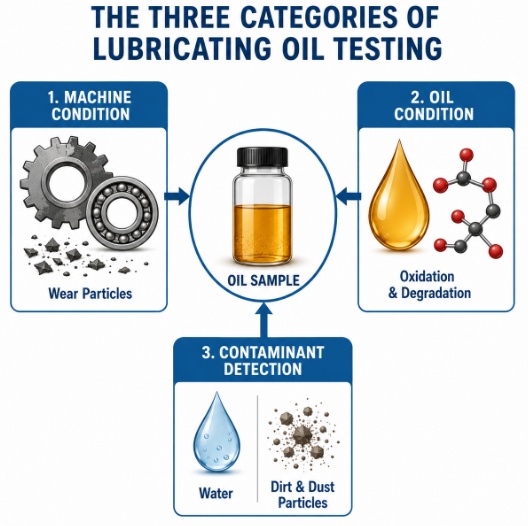
Lubricating oil testing evaluates three core aspects: oil condition (whether the lubricant itself has degraded), machine condition (whether wear particles indicate component damage), and contaminant detection (whether foreign substances have entered the lubrication system). By tracking oil analysis results over the life of a particular machine, trends can be established that help eliminate costly repairs and unexpected downtime.
Why Is Lubricating Oil Testing Important?
Lubricating oil testing matters because it catches problems before they become failures. The early detection of unusual mechanical wear and lubricant deterioration can prevent costly disasters that basic maintenance programs cannot.
Key benefits include: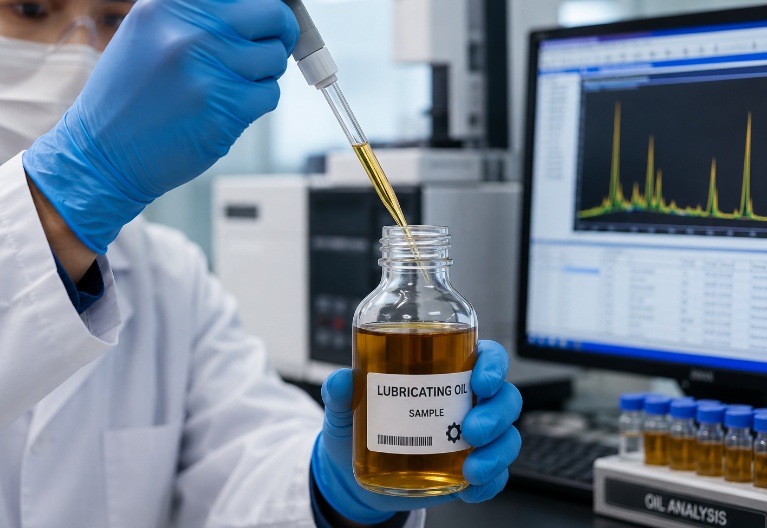
-
Eliminates breakdowns — Identifies wear modes and contamination before equipment fails
-
Improves equipment reliability — Ensures lubricants maintain protective properties under operating conditions
-
Saves spare and replacement costs — Extends oil drain intervals when analysis confirms oil is still serviceable
-
Boosts productivity — Reduces unplanned downtime by enabling condition-based maintenance instead of time-based schedules
-
Optimizes drain intervals — By analyzing additive remaining useful life, maintenance costs can be reduced by avoiding premature oil changes
Without regular oil analysis, the only alternative is to replace oil on a fixed schedule — which may be too early (wasting oil and money) or too late (risking catastrophic equipment damage).
What Are the Three Categories of Lubricating Oil Tests?
Every lubricating oil test falls into one of three categories, and together they paint a comprehensive picture of machine and lubricant health.
Machine Condition Tests
Machine condition tests reveal the wear and tear on a machine's parts. They look for the presence of wear metals in the oil that may have been generated by components, then determine whether a normal or severe wear mode is occurring.
-
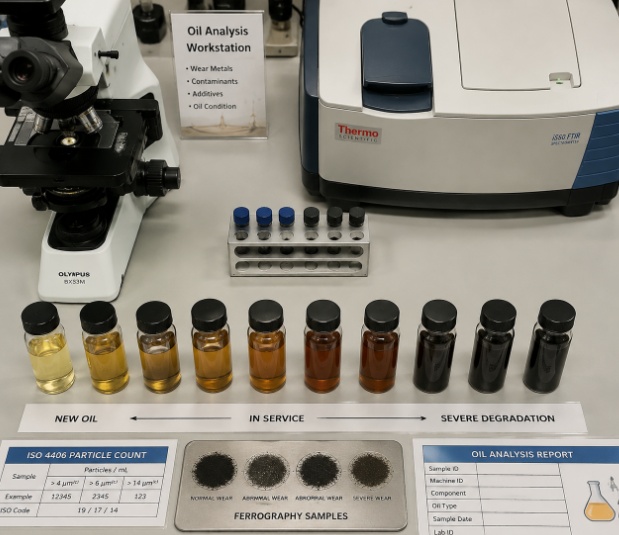
Analytical Ferrography — Microscopic examination of wear particles to identify wear mechanism and severity
-
Ferrous Wear Concentration — Quantifies the amount of iron-based wear debris
Oil Condition Tests
Oil condition tests reveal the health of the lubricant itself — whether it is still fit for use and the extent of degradation.
-
FTIR (Fourier Transform Infrared Spectroscopy) — Detects oxidation, nitration, sulfation, and soot contamination
-
Acid Number (TAN) — Measures the level of acidic byproducts from oil oxidation
-
Viscosity — Confirms the oil maintains its required flow characteristics
Contaminant Detection Tests
Contaminant detection tests identify foreign substances that may have entered the lubrication system.
-
Particle Count — Quantifies solid particles by size range (reported as ISO 4406 or NAS cleanliness codes)
-
Water Content — Measures dissolved or free water contamination
The Cross-Category Test: Elemental Spectroscopy
Elemental Spectroscopy (ASTM D5185) is unique because it fits all three categories simultaneously:
-
Machine condition — Identifies wear metals (Fe, Cu, Pb, Al, Cr, Sn, Ni)
-
Oil condition — Monitors additive elements (Ca, Zn, P, Mg, B, Na, Ba)
-
Contaminant detection — Detects contaminant elements (Si, Na, V)
How Is Viscosity Tested in Lubricating Oil?
Viscosity is the single most important physical property of a lubricating oil. It determines whether the oil can form and maintain an adequate lubricating film between moving surfaces. If viscosity is too low, the film breaks down and metal-to-metal contact occurs. If viscosity is too high, the oil cannot flow properly, leading to inadequate lubrication and increased energy consumption.
Kinematic Viscosity is measured using ASTM D445 / ISO 3104. The test measures the time required for a fixed volume of oil to flow under gravity through a calibrated glass capillary viscometer at a controlled temperature (typically 40°C and 100°C). Results are reported in centistokes (cSt or mm²/s).
Viscosity Index (VI) is calculated per ASTM D2270 from the kinematic viscosities at 40°C and 100°C. A higher VI indicates that the oil's viscosity changes less with temperature — a desirable property for lubricants that must perform across wide temperature ranges.
Common viscosity deviations and their causes:
|
Deviation |
Likely Cause |
|---|---|
|
Viscosity increase |
Oxidation, contamination with solids, wrong oil grade, evaporation of light ends |
|
Viscosity decrease |
Fuel dilution, shearing of VI improvers, contamination with lower-viscosity fluid |
What Does Acid Number Testing Reveal About Oil Health?
Acid Number (AN), also called Total Acid Number (TAN), measures the concentration of acidic compounds in the oil. As lubricating oil oxidizes over time, it produces acidic byproducts. A rising TAN indicates ongoing oxidation and potential corrosive attack on machine components.
TAN is determined by ASTM D974 (color-indicator titration), ASTM D664 (potentiometric titration), or ASTM D3339. The result is expressed in mg KOH per gram of oil — the amount of potassium hydroxide required to neutralize the acidic components in one gram of sample.
What TAN values tell you:
-
Stable TAN — Oil oxidation is under control; the lubricant is performing within specification
-
Gradually increasing TAN — Normal oxidation in progress; monitor the trend rate
-
Sharp TAN increase — Severe oxidation or contamination; immediate investigation required
Total Base Number (TBN) is the complementary test, measured by ASTM D2896 or ASTM D4739. TBN indicates the reserve alkalinity of engine oils — their remaining ability to neutralize acidic combustion byproducts. When TBN drops too low, the oil can no longer protect against corrosive wear, and an oil change is necessary.
How Is Water Contamination Detected in Lubricating Oil?
Water is one of the most destructive contaminants in lubricating oil. Even small amounts (as low as 0.1%) can cause oil degradation, promote rust, reduce film strength, and accelerate component wear. Water exists in oil in three states: dissolved, emulsified, and free.
Primary test methods:
-
ASTM D6304 — Coulometric Karl Fischer titration; the most precise method, detecting water down to ppm levels
-
ASTM D95 — Distillation method; water is distilled from the sample and measured volumetrically
-
ASTM D1533 — Another Karl Fischer approach for electrical insulating oils
Water contamination thresholds:
|
Water Level |
Condition |
Action |
|---|---|---|
|
< 0.05% (500 ppm) |
Normal |
Continue monitoring |
|
0.05% – 0.1% |
Caution |
Investigate source; consider dehydration |
|
> 0.1% |
Critical |
Immediate action — drain, flush, or purify |
What Is FTIR Analysis and Why Does It Matter?
FTIR (Fourier Transform Infrared Spectroscopy) is the primary screening tool for lubricating oil degradation. It measures how the oil absorbs infrared light at specific wavelengths, producing a spectral "fingerprint" that reveals chemical changes in the lubricant.
FTIR per ASTM E2412 detects four critical degradation parameters simultaneously:
-
Oxidation — Measures the buildup of carbonyl compounds from oil reacting with oxygen; high oxidation means the oil is losing its protective properties
-
Nitration — Indicates nitrogen oxide absorption, common in natural gas engines; excessive nitration leads to sludge and varnish
-
Sulfation — Measures sulfur oxide byproducts; relevant for engine oils exposed to high-sulfur fuels
-
Soot — Quantifies carbonaceous particles from incomplete combustion; high soot loading increases viscosity and abrasive wear
ASTM D7844 provides the specific FTIR procedure for monitoring soot, oxidation, and sulfation in-service lubricants. ASTM D7415 covers sulfation measurement specifically.
How Does Elemental Spectroscopy Detect Wear and Contamination?
Elemental spectroscopy (ICP-OES or ICP-AES per ASTM D5185) identifies and quantifies up to 22+ elements in a single oil sample. This makes it one of the most powerful and versatile tests in the oil analysis toolkit.
Element categories and their significance:
|
Category |
Elements |
What They Indicate |
|---|---|---|
|
Wear metals |
Fe, Cu, Pb, Al, Cr, Sn, Ni, Mn |
Component wear — bearings, gears, cylinders, pistons |
|
Additive elements |
Ca, Zn, P, Mg, B, Na, Ba, Mo |
Lubricant additive package health |
|
Contaminant elements |
Si, V, Cd, As |
Dirt ingestion, external contamination, corrosive environments |
By tracking element concentrations over multiple samples, analysts can identify trending increases that signal developing wear problems long before they cause equipment failure. A sudden spike in iron (Fe), for example, may indicate severe gear or cylinder wear, while rising copper (Cu) often points to bearing distress.
What Is Analytical Ferrography?
Analytical ferrography provides the most detailed information about wear particles in lubricating oil. While elemental spectroscopy tells you what elements are present, ferrography tells you what the particles look like — their size, shape, color, and texture — which reveals the wear mechanism generating them.
Per ASTM D7690, the procedure involves:
-
Preparing a ferrogram — Oil flows over a glass slide in a magnetic field; ferrous particles deposit along the field lines, sorted by size
-
Microscopic examination — A trained analyst examines the ferrogram under bichromatic and polarized light at magnifications up to 1000×
-
Particle classification — Particles are categorized as normal rubbing wear, cutting wear, severe sliding wear, fatigue spalls, or corrosive wear particles
What ferrography reveals that other tests cannot:
-
Wear mechanism — Distinguishes between abrasive, adhesive, fatigue, and corrosive wear
-
Wear severity — Large, abnormally shaped particles indicate severe wear
-
Source identification — Particle morphology helps trace which component is failing
What Other Key Tests Are Performed on Lubricating Oil?
Flash Point
Flash point (ASTM D92 / ASTM D93 / ISO 2592 / ISO 2719) is the lowest temperature at which oil vapors will ignite. A depressed flash point indicates fuel dilution — a critical safety concern, especially in engine oils.
Pour Point
Pour point (ASTM D97 / ISO 3016) is the lowest temperature at which the oil will flow. This matters for equipment operating in cold environments. A rising pour point may indicate oil thickening from oxidation or contamination.
Demulsibility (Water Separability)
ASTM D1401 measures how quickly and completely water separates from the oil. Poor demulsibility means the oil tends to form stable emulsions, preventing effective water removal.
Foam Tendency and Stability
Foam tests (IS 1448 Part-67) evaluate the oil's tendency to foam and the stability of any foam formed. Excessive foam can lead to inadequate lubrication, cavitation, and overflow.
Oxidation Stability
Oxidation stability (IP 280 / IS 1448 Part-106) measures how resistant the oil is to oxidative degradation. Higher oxidation stability means longer oil life, especially in high-temperature applications.
Copper Strip Corrosion
ASTM D130 / IS 1448 Part-15 evaluates the oil's corrosiveness toward copper alloys, which are common in bearings and bushings.
Carbon Residue
Conradson carbon residue (ASTM D189), Ramsbottom carbon (IP 14), and micro carbon residue (ASTM D4530) measure the tendency of the oil to form carbonaceous deposits when heated — a key concern for engine and compressor oils.
Sulphated Ash
ASTM D874 measures the ash remaining after the oil is burned and treated with sulfuric acid. This indicates the metallic additive content and is important for compatibility with emission control systems.
Particle Count and Cleanliness
Particle count per ISO 4406 or NAS 1638 classifies solid particles by size ranges, providing a cleanliness code for the oil. This is critical for hydraulic systems and other applications where particulate contamination directly affects component life.
Glycol Content
ASTM D4291 detects glycol contamination, which indicates coolant leakage into the lubrication system — a serious condition that can cause rapid oil degradation and component damage.
What Standards Govern Lubricating Oil Testing?
Lubricating oil testing follows internationally recognized standards to ensure consistency, accuracy, and comparability of results.
Major standards organizations and their relevant methods:
|
Organization |
Key Standards |
|---|---|
|
ASTM International |
D445 (viscosity), D974/D664 (TAN), D6304 (water), D5185 (elements), D7690 (ferrography), D92/D93 (flash point), D97 (pour point), D1401 (demulsibility), E2412 (FTIR) |
|
ISO |
3104 (viscosity), 2592/2719 (flash point), 3016 (pour point), 4406 (cleanliness) |
|
IS (Indian Standard) |
1448 series — covers viscosity, density, flash point, pour point, acidity, TAN, TBN, foam, copper corrosion, and more |
|
IP (Institute of Petroleum) |
IP 14 (Ramsbottom carbon), IP 139 (TBN), IP 280 (oxidation stability), IP 510 (chlorine) |
|
API / ILSAC |
Service categories and performance specifications for engine oils |
|
CEC |
Coordinating European Council test methods for European lubricant specifications |
|
ACEA |
European automobile manufacturers' lubricant sequences |
How Does Lubricating Oil Testing Benefit Different Industries?
Maritime Industry
Ships rely on lubricating oil testing to monitor main propulsion engines, auxiliary engines, deck equipment, and hydraulic systems. On-board testing combined with shore laboratory analysis helps prevent failures at sea where emergency repairs are extremely costly.
Power Generation
Turbine oil analysis monitors oxidation, water contamination, and particle cleanliness in gas and steam turbines. Transformer oil testing (per ASTM D1533 and other methods) ensures electrical insulation integrity.
Mining and Construction
Heavy equipment in mining and construction operates under extreme loads and contaminated environments. Regular oil analysis detects wear and contamination early, preventing expensive equipment downtime.
Oil and Gas
Compressors, pumps, and engines in the oil and gas industry require rigorous lubricant monitoring. Gas engine oils, in particular, need frequent analysis because service life can be shortened depending on fuel and gas composition.
Automotive and Transportation
Engine oil analysis evaluates sludge, oxidation, component wear, oil consumption, piston deposits, and fuel economy for both gasoline and diesel engines.
Industrial Manufacturing
Gearboxes, hydraulics, compressors, and pumps across manufacturing facilities benefit from oil analysis programs that extend equipment life and reduce maintenance costs.
When Should Lubricating Oil Be Tested?
The best time to start lubricating oil testing is now — before a problem develops. Effective oil analysis programs begin with baseline testing of new oil, then establish regular sampling intervals based on equipment criticality and operating conditions.
General sampling guidelines:
-
Critical equipment — Every 1–3 months or 250–500 operating hours
-
Moderate criticality — Every 3–6 months or 500–1000 operating hours
-
Non-critical equipment — Every 6–12 months or at oil change intervals
Always test immediately if you notice:
-
Unusual noises, vibration, or temperature increases
-
Oil that appears dark, milky, or has an unusual odor
-
Filter plugging occurring more frequently than normal
-
Any indication of coolant or fuel leakage into the oil system
Proper oil sampling technique is critical. Samples must be drawn into clean bottles, sealed immediately, and sent to the laboratory with minimal disturbance. A poorly taken sample produces misleading results that can lead to incorrect maintenance decisions.