Hexavalent chromium (Cr(VI)) testing is the laboratory determination of the concentration of chromium in its +6 oxidation state — the toxic, carcinogenic form — in a product or material, against the Chinese national standards that govern it by product category. Unlike occupational-exposure testing (which measures Cr(VI) in workplace air in μg/m³ per OSHA/NIOSH), product-compliance Cr(VI) testing measures Cr(VI) in the material in mg/kg, and it is governed by a matrix-specific GB framework: coatings under GB 30981.2-2025 (just published, Cr(VI) limit with an 8 mg/kg detection limit) and electrical/electronic products under GB 26572-2025 (the China RoHS, Cr(VI) ≤ 1000 mg/kg, just expanded from 6 to 10 restricted substances). The defining analytical principle is that the test must be specific to Cr(VI) — not total chromium — because Cr(III) is an essential trace element while Cr(VI) is a Group 1 carcinogen, and a total-chromium result would conflate the two.
Cr(VI) vs Cr(III) vs Total Chromium — the Analytical Principle
The single most important concept, and one the search results routinely conflate, is that Cr(VI) is not the same as total chromium. Chromium exists in two stable oxidation states in products:
- Cr(III) — trivalent chromium, an essential trace element, low toxicity, the form in stainless steel and nutritional supplements.
- Cr(VI) — hexavalent chromium, IARC Group 1 (carcinogenic to humans), readily crosses biological membranes, causes lung cancer, nasal cancer, and allergic contact dermatitis. The form in chromate pigments, anti-corrosion coatings, chrome plating, and leather tanning.
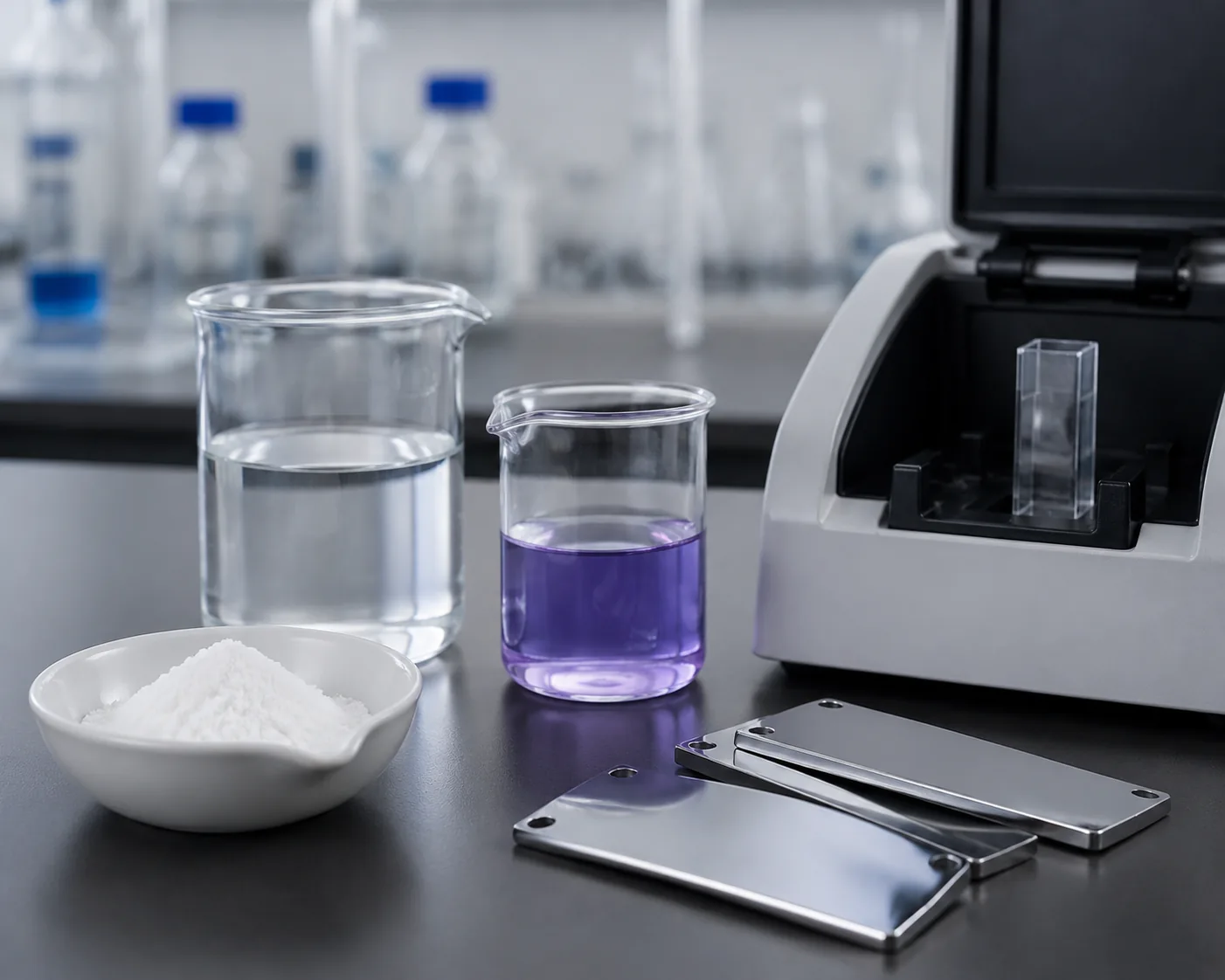
Because the two have opposite toxicity, a total-chromium result is meaningless for Cr(VI) compliance — it would count the benign Cr(III) with the carcinogenic Cr(VI). The test must be speciation-specific: it must selectively extract and measure Cr(VI) in the presence of Cr(III) without interference. This is achieved by an alkaline extraction (pH 9–11 carbonate/bicarbonate buffer, where Cr(VI) is stable and Cr(III) does not oxidize to Cr(VI)), followed by a Cr(VI)-specific detection (diphenylcarbazide colorimetry or ion chromatography). The method must not allow the interconversion between Cr(III) and Cr(VI) during extraction — that interconversion is the analytical trap that produces false results.
Product Compliance vs Occupational Exposure — Two Different Worlds
The search results are dominated by OSHA/NIOSH occupational-exposure content, and the first job of any explanation is to separate it from product-compliance testing:
| Occupational exposure (OSHA/NIOSH) | Product compliance (GB) | |
|---|---|---|
| What is measured | Cr(VI) in workplace air (dust, mist, fume) | Cr(VI) in the product/material |
| Unit | μg/m³ (air concentration) | mg/kg (material concentration) |
| Limit | OSHA PEL 5 μg/m³ (8-h TWA), NIOSH 1 μg/m³ | Coatings 8 mg/kg; RoHS ≤1000 mg/kg |
| Question | "Is the worker's exposure safe?" | "Does this product contain too much Cr(VI)?" |
| Standard | OSHA 1910.1026, NIOSH 7605/7600 | GB 30981.2 (coatings), GB/T 26572 (RoHS) |
The two tests share the same target analyte (Cr(VI)) and the same underlying chemistry (alkaline extraction + Cr(VI)-specific detection), but they answer fundamentally different questions and are governed by different standard families. This article addresses product-compliance Cr(VI) testing under the GB framework.
The Matrix-Specific GB Framework
Cr(VI) in products is governed by different GB standards depending on the product category, and the limits differ sharply:
| Product category | Standard | Cr(VI) limit |
|---|---|---|
| Industrial / protective coatings | GB 30981.2-2025 (replaces GB 30981-2020 + GB 24613-2009) | 8 mg/kg detection limit (total Cr(VI) limit newly added) |
| Electrical & electronic products (RoHS) | GB 26572-2025 (China RoHS, expanded 6→10 substances) | ≤ 1000 mg/kg (0.1 %) |
| Leather | QB/T (industry standards) | Category-specific |
The 125× difference between the coatings limit (8 mg/kg) and the RoHS limit (1000 mg/kg) reflects the different exposure routes and risk tolerances: a coating can release Cr(VI) by hand contact and degradation, so the limit is low; an electronic component's Cr(VI) is embedded in a metal surface treatment, so the limit is higher.
Coatings: GB 30981.2-2025
GB 30981.2-2025 (涂料中有害物质限量 第2部分:工业涂料, Limit of Harmful Substances in Coatings — Part 2: Industrial Coatings) is the brand-new coatings standard that replaces both GB 30981-2020 (工业防护涂料中有害物质限量) and GB 24613-2009 (玩具用涂料中有害物质限量). The 2025 edition made a significant addition: it newly introduced a total Cr(VI) limit requirement, with a defined test method and an 8 mg/kg detection limit. The prior editions managed soluble total chromium but did not set a Cr(VI)-specific limit; the 2025 edition closes that gap.
The Cr(VI) test method for coatings is the diphenylcarbazide (DPC) spectrophotometric method specified in the standard's normative appendix: the coating sample is extracted in the alkaline buffer, the Cr(VI) in the extract reacts with DPC to form a purple-violet complex, and the absorbance at 540 nm gives the Cr(VI) concentration. A current coatings Cr(VI) report cites GB 30981.2-2025.
Electrical/Electronic Products: GB 26572-2025 (China RoHS)
For electrical and electronic products, Cr(VI) is governed as one of the restricted substances under the China RoHS, GB 26572-2025 (电器电子产品有害物质限制使用要求, Requirements for Restricting the Use of Hazardous Substances in Electrical and Electronic Products). The 2025 edition expanded the restricted-substance list from 6 to 10 (adding the four phthalates DEHP, BBP, DBP, DIBP), with Cr(VI) retaining its ≤ 1000 mg/kg (0.1 %) limit. The test method is in the GB/T 39560 series (IDT IEC 62321 series), specifically:
- GB/T 39560.702-2021 — Cr(VI) in polymers and electronic components by the boiling-water-extraction colorimetric (DPC) method for metal surfaces, and the alkaline-digestion method for polymers.
The RoHS test article covers the full multi-substance RoHS framework; this article covers the Cr(VI)-specific compliance test within and beyond RoHS.
The Analytical Methods
Two Cr(VI)-specific methods dominate product-compliance testing:
- Diphenylcarbazide (DPC) spectrophotometry — the reference method. Cr(VI) reacts with 1,5-diphenylcarbazide in acidic solution to form a purple-violet complex measured at 540 nm. It is Cr(VI)-specific (Cr(III) does not react), fast, and widely used for coatings and leather.
- Ion chromatography (IC) with post-column derivatization — the higher-precision method (the Dionex IC the SAI competitor describes for occupational work). Cr(VI) is separated chromatographically as the chromate ion, then detected by post-column DPC derivatization with UV-Vis detection. IC provides lower detection limits and better matrix tolerance for complex samples.
Both methods are preceded by an alkaline extraction that selectively dissolves Cr(VI) while keeping Cr(III) in its benign state — the critical sample-preparation step that prevents Cr(III)→Cr(VI) oxidation or Cr(VI)→Cr(III) reduction during analysis.
Why the Search Results Are Off the Compliance Intent
The search results for "hexavalent chromium testing" are dominated by content that does not frame the GB product-compliance framework:
- SAI laboratory service — Cr(VI) analysis by Dionex ion chromatography, modified NIOSH 7605, IHLAP accreditation, for occupational exposure assessment. US occupational-hygiene lab, zero GB.
- OSHA / NIOSH occupational-exposure regulation — PEL 5 μg/m³, methods 7605/7600/7604/9101, OSHA standards 1910.1026 (general industry), 1915.1026 (shipyards), 1926.1126 (construction). US occupational regulation, measures air not product, zero GB.
- Occupational-exposure-control guidance — engineering controls, respiratory protection, PPE, hygiene practices, medical surveillance. US worker-protection content.
None tells a coatings manufacturer, an electronics producer, a leather tanner, or a product-quality lab which GB standard governs their product's Cr(VI), what the 8 mg/kg or 1000 mg/kg limit is, or how the DPC method works. That compliance question is what this article addresses.
Our Testing Capabilities
Beijing ZKGX Research conducts hexavalent chromium (Cr(VI)) product-compliance testing across the matrix-specific GB framework:
- Coatings (GB 30981.2-2025): Cr(VI) by the DPC spectrophotometric method against the 8 mg/kg detection limit, for industrial and protective coatings (replacing the GB 30981-2020 and GB 24613-2009 framework).
- Electrical/electronic products (GB 26572-2025 / GB/T 39560.702): Cr(VI) in polymers, metals, and electronic components by the boiling-water-extraction DPC method and the alkaline-digestion method, against the ≤1000 mg/kg RoHS limit, as part of the full RoHS test panel.
- Methods: DPC spectrophotometry (reference) and ion chromatography with post-column DPC derivatization (high precision), both preceded by the Cr(VI)-specific alkaline extraction.
- Sample types: industrial and protective coatings, toy coatings, plastic and polymer components, metal surface treatments (chrome plating, passivation), electronic components, leather, and pigments.
- Deliverable: a test report stating the matrix, the applicable standard (GB 30981.2-2025 for coatings, GB 26572-2025 for electronics), the Cr(VI)-specific method, the measured value (mg/kg), and pass/fail against the matrix-specific limit.
If you have a coating, electronic product, or material requiring Cr(VI) compliance verification, contact our testing team to scope the matrix, the applicable standard, and the Cr(VI)-specific detection method.
Frequently Asked Questions
What standard governns Cr(VI) in products?
It depends on the product category. Industrial coatings are under GB 30981.2-2025 (Cr(VI) limit, 8 mg/kg detection limit). Electrical/electronic products are under GB 26572-2025 (China RoHS, Cr(VI) ≤ 1000 mg/kg). The two limits differ by 125× because the exposure routes and risk tolerances differ.
What replaced GB 30981-2020?
GB 30981-2020 (工业防护涂料中有害物质限量) and GB 24613-2009 (玩具用涂料中有害物质限量) were both replaced by GB 30981.2-2025 (涂料中有害物质限量 第2部分:工业涂料). The 2025 edition newly added a total Cr(VI) limit requirement with an 8 mg/kg detection limit, where the prior editions managed soluble total chromium without a Cr(VI)-specific limit.
Is Cr(VI) testing the same as total chromium testing?
No. Cr(VI) is the toxic, carcinogenic form (IARC Group 1); Cr(III) is an essential trace element. A total-chromium result counts both and is meaningless for Cr(VI) compliance. The test must be speciation-specific — selectively extracting and measuring Cr(VI) in the presence of Cr(III), by alkaline extraction followed by diphenylcarbazide colorimetry or ion chromatography.
Is product Cr(VI) testing the same as occupational-exposure testing?
No. Occupational-exposure testing (OSHA 1910.1026, NIOSH 7605) measures Cr(VI) in workplace air in μg/m³ to protect workers; product-compliance testing (GB 30981.2, GB 26572) measures Cr(VI) in the material in mg/kg to verify the product meets its regulatory limit. They share the same analyte and chemistry but answer different questions under different standards.
What is the Cr(VI) limit under China RoHS?
Under GB 26572-2025 (China RoHS), Cr(VI) is limited to ≤ 1000 mg/kg (0.1 %), the same as lead, mercury, PBB, and PBDE (cadmium is 100 mg/kg). The 2025 edition expanded the restricted substances from 6 to 10 by adding four phthalates. The Cr(VI) test method is GB/T 39560.702-2021 (DPC colorimetric, IDT IEC 62321-7-2).