Table of Contents
- What is medical ultrasound coupling gel testing?
- The standard stack: YY 0299, GB/T 15214, USP, IEC 61157, ISO 10993
- Acoustic properties: impedance, speed of sound, attenuation
- Viscosity and rheology: the non-Newtonian flow requirement
- Physicochemical properties: pH, conductivity, clarity, density
- Microbial limits and preservative efficacy
- Biocompatibility: cytotoxicity, skin irritation, sensitisation
- Stability testing and shelf-life
- FAQ
- Our ultrasound coupling gel testing capabilities
What is medical ultrasound coupling gel testing?
Medical ultrasound coupling gel testing is the measurement and validation of the acoustic, physicochemical, microbiological, and biocompatibility properties of the ultrasound coupling gel (also called ultrasound couplant, ultrasound transmission gel, or acoustic coupling gel) — the water-based gel applied between the ultrasound transducer and the patient's skin to eliminate the air gap (which has a very low acoustic impedance of 0.0004 MRayl and reflects > 99 % of the ultrasound energy) and to provide an acoustic-impedance match between the transducer and the soft tissue (both ~1.5-1.6 MRayl) for efficient ultrasound transmission. The output of a coupling gel test is a dossier covering the acoustic impedance (Z = ρv, the product of the density and the speed of sound; should be ~1.5-1.6 MRayl, matching soft tissue), the speed of sound in the gel (~1540 m/s, matching water and soft tissue), the acoustic attenuation (≤ 0.5 dB/cm/MHz, the frequency-dependent loss of ultrasound energy as it passes through the gel layer), the viscosity (typically 10,000-100,000 mPa·s, non-Newtonian shear-thinning, thick enough to stay on the skin but thin enough to allow the transducer to glide), the pH (5.0-7.0, skin-compatible), the conductivity (5-15 mS/cm, sufficient for the electrocardiography electrodes on the ultrasound transducer), the microbial limits (sterile for sterile gel; bioburden-limited for non-sterile gel), and the biocompatibility (cytotoxicity, skin irritation, sensitisation per ISO 10993).
The ultrasound coupling gel is the single most-used consumable in diagnostic ultrasound — every ultrasound examination (abdominal, obstetric, cardiac, vascular, musculoskeletal) applies the gel between the transducer and the skin. The gel has three functions: (1) acoustic coupling — replace the air gap (which reflects > 99 % of the ultrasound at 1-20 MHz) with a medium that matches the acoustic impedance of the soft tissue (~1.5 MRayl), transmitting > 99 % of the ultrasound energy into the body; (2) lubrication — allow the transducer to glide smoothly across the skin without friction; and (3) skin protection — the gel is in contact with the patient's skin for the duration of the examination (minutes to hours), and must be non-irritating, non-sensitising, and pH-compatible. The gel is typically formulated from purified water (~90 %), a thickener (carbomer/carbopol, polyacrylic acid, hydroxyethyl cellulose, or propylene glycol), a preservative (methylparaben, propylparaben, phenoxyethanol), a humectant (glycerin, propylene glycol), a pH adjuster (triethanolamine), and a colourant/fragrance (optional). Some formulations incorporate aloe vera for its anti-inflammatory and skin-conditioning properties, and EDTA as a chelating agent.
The standards governing ultrasound coupling gel testing span the Chinese YY 0299 Medical Ultrasound Coupling Agent (the Chinese industry standard for the product), the GB/T 15214 (the related Chinese national standard), the USP (the US pharmacopeial framework for the gel as a medical-device accessory), the IEC 61157 Standard Means for the Reporting of the Acoustic Output of Medical Diagnostic Ultrasonic Equipment (the international standard that defines the coupling-medium requirements for the acoustic-output measurement of ultrasound equipment), and the ISO 10993 / GB/T 16886 biocompatibility series (for the patient-contact testing). A coupling gel placed on the Chinese market must satisfy YY 0299 and be registered with the NMPA as a Class I or Class II medical device.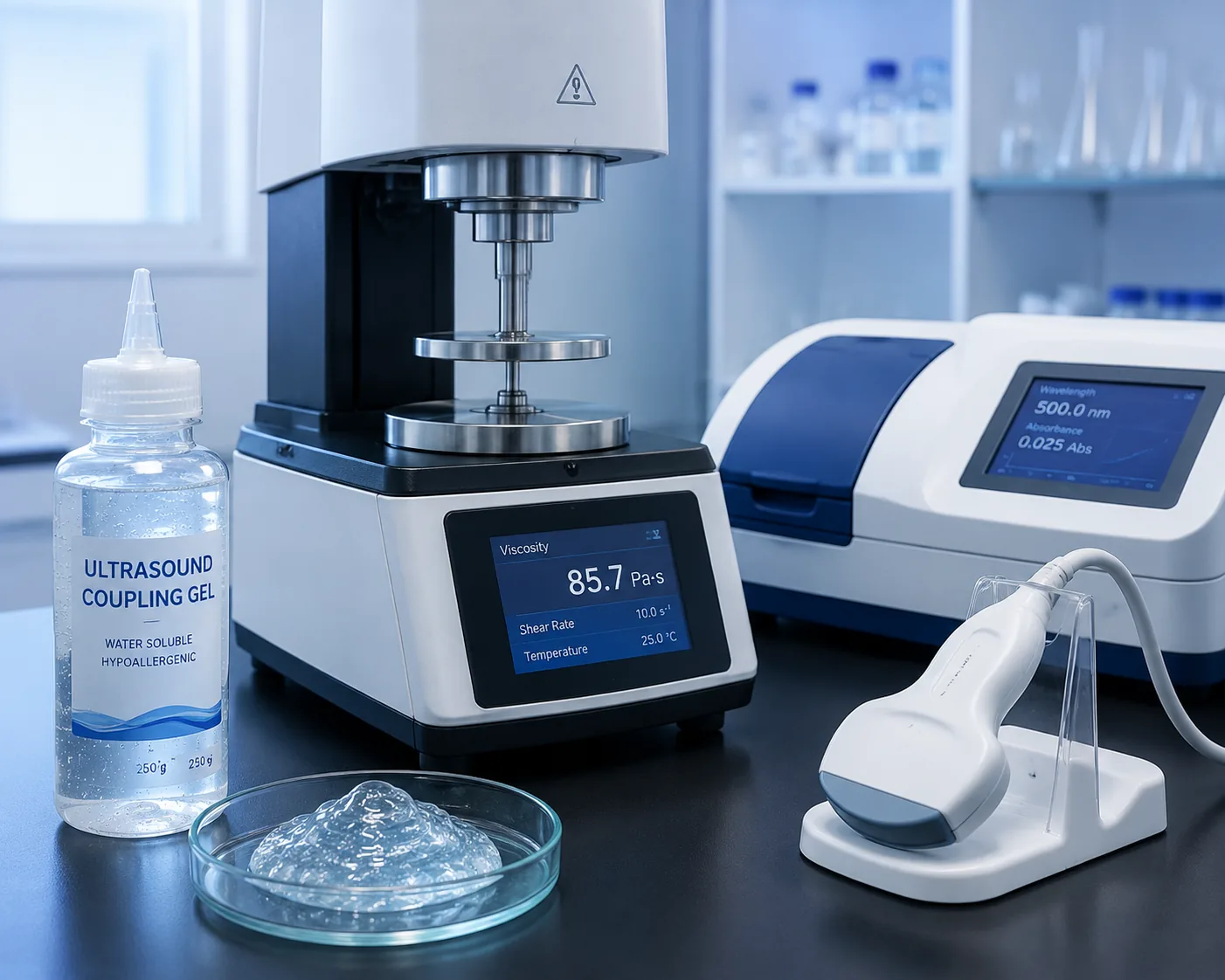
The standard stack: YY 0299, GB/T 15214, USP, IEC 61157, ISO 10993
A complete ultrasound coupling gel testing project draws on a stack of Chinese, international, US, and biocompatibility standards.
| Family | Standard | Scope |
|---|---|---|
| YY 0299 | Medical Ultrasound Coupling Agent (医用超声耦合剂) | The Chinese industry standard for the ultrasound coupling gel; acoustic properties (impedance, speed of sound, attenuation), viscosity, pH, microbial limits, biocompatibility, stability |
| GB/T 15214 | Medical diagnostic ultrasonic equipment — related national standard (cross-reference) | The Chinese national standard that may invoke the coupling-medium requirements |
| IEC 61157:2007 | Standard Means for the Reporting of the Acoustic Output of Medical Diagnostic Ultrasonic Equipment | The international standard defining the coupling-medium properties for the acoustic-output measurement (the gel used in the IEC 61157 measurement must have defined acoustic properties) |
| IEC 62359:2010 | Ultrasonics — Field characterization — Test methods for the determination of thermal and mechanical indices | The international standard for the thermal and mechanical safety indices (which use the coupling medium) |
| ISO 10993-5:2009 (≡ GB/T 16886.5) | Tests for in vitro cytotoxicity | The Cytotoxicity test for the gel in contact with cells |
| ISO 10993-10:2010 (≡ GB/T 16886.10) | Tests for irritation and skin sensitisation | The skin irritation and sensitisation tests for the patient-contact gel |
| ISO 10993-23:2021 (≡ GB/T 16886.23) | Tests for irritation (in vitro RhE) | The in vitro RhE irritation test |
| USP <61> / <62> | Microbial Examination of Nonsterile Products | The USP microbial-limits test (for the non-sterile gel) |
| USP <51> | Antimicrobial Effectiveness Testing | The preservative-efficacy test |
| GB 15979-2002 | Hygienic Standard for Disposable Sanitary Products | The Chinese microbial-limits framework for the non-sterile gel (sometimes invoked) |
| ICH Q1A(R2) | Stability Testing of New Drug Substances and Products | The stability-test framework (adapted for the gel's shelf-life) |
| FDA 21 CFR 880.5600 | Acoustic Coupler (the FDA classification of the coupling gel as a Class I medical device, 510(k)-exempt) | The US regulatory classification |
The single most consequential fact for a Chinese manufacturer is that YY 0299 is the NMPA-mandated standard for the ultrasound coupling agent and the product must be registered with the NMPA (as a Class I or Class II medical device, depending on the sterile/non-sterile claim and the intended use). The sterile gel (used for invasive ultrasound, biopsy guidance, and surgical ultrasound) is typically a Class II device requiring the sterility validation; the non-sterile gel (used for external diagnostic ultrasound) is typically a Class I device with the microbial-limits control.
Acoustic properties: impedance, speed of sound, attenuation
The acoustic properties are the defining performance characteristics of the coupling gel — the three parameters that determine whether the gel efficiently transmits the ultrasound energy from the transducer to the tissue.
| Parameter | Target value | Why it matters | Method |
|---|---|---|---|
| Acoustic impedance (Z) | ~1.5-1.6 MRayl (matching soft tissue) | The impedance match between the gel and the tissue determines the fraction of the ultrasound energy transmitted at the gel-tissue interface; a mismatch causes reflection and reduces the imaging quality | The pulse-echo method — a transducer sends an ultrasound pulse through the gel to a reflector and measures the reflected echo; the echo height is proportional to the impedance (per the Afzal 2022 method) |
| Speed of sound (c) | ~1540 m/s (matching water and soft tissue) | The speed of sound in the gel determines the ultrasound-beam geometry and the timing of the echoes; a gel with a significantly different speed of sound distorts the image | The pulse-echo time-of-flight method (the known distance and the measured travel time give the speed) |
| Acoustic attenuation (α) | ≤ 0.5 dB/cm/MHz (the frequency-dependent loss) | The attenuation in the gel layer (typically 1-5 mm thick) reduces the ultrasound energy reaching the tissue; a high-attenuation gel reduces the image quality, especially at the higher diagnostic frequencies (10-20 MHz) | The insertion-loss method (measure the transmitted signal with and without the gel layer; the difference is the attenuation) |
The acoustic impedance Z = ρv (the product of the density ρ and the speed of sound v) is the parameter most closely tied to the gel's imaging performance. For a gel with density 1.05 g/cm³ and speed of sound 1540 m/s, Z = 1.05 × 1540 = 1.617 MRayl — very close to the soft-tissue value of ~1.6 MRayl and the transducer-face value of ~1.5 MRayl. The impedance match means that > 99 % of the ultrasound energy is transmitted at each interface (transducer → gel → tissue), and the imaging quality is maximised.
The Afzal et al. 2022 study (Polymers 14:175) provides the detailed method for the impedance measurement — the pulse-echo apparatus with a 2 MHz probe and a digital storage oscilloscope, the derivation of Z_gel from the echo-height ratios of water, air, and gel (the full derivation is in the paper's Equations 5-17). This method is the practical reference for a coupling-gel laboratory.
Viscosity and rheology: the non-Newtonian flow requirement
The viscosity of the coupling gel is the property that balances two opposing requirements: the gel must be thick enough to stay on the skin (not run off during the examination) and thin enough to allow the transducer to glide smoothly. The typical commercial gel has a viscosity of 10,000-100,000 mPa·s (measured at a defined shear rate), but the gel is non-Newtonian (shear-thinning / pseudoplastic) — it is thick at rest (stays on the skin) and thins under the shear of the transducer motion (allows the gliding).
| Parameter | Target | Method |
|---|---|---|
| Apparent viscosity (at a defined shear rate, e.g. 10 s⁻¹) | 10,000-100,000 mPa·s | Rotational rheometer (e.g. TA Instruments AR 1500ex, Anton Paar MCR); the 40 mm plate, 2 mm gap, 30 °C, the shear-rate sweep 0.05-200 rad/s (per the Afzal 2022 method) |
| Shear-thinning index (the ratio of the viscosity at low shear to the viscosity at high shear) | > 2 (a pseudoplastic gel thins significantly under shear) | The same rheometer sweep |
| Yield stress (the minimum stress to initiate flow) | Low (the gel flows under the transducer's weight) | The rheometer stress sweep |
| Thixotropy (the time-dependent recovery of viscosity after the shear is removed) | The gel should recover its viscosity within seconds after the transducer passes | The rheometer thixotropy loop |
The viscosity is measured on a rotational rheometer (a controlled-stress or controlled-rate instrument with a cone-and-plate or parallel-plate geometry), not on a simple Brookfield rotational viscometer — the rheometer provides the shear-rate sweep that reveals the non-Newtonian behaviour. The Afzal 2022 method (TA Instruments AR 1500ex, 40 mm plate, 2 mm gap, 30 °C, 0.05-200 rad/s sweep) is the practical reference.
Physicochemical properties: pH, conductivity, clarity, density
| Parameter | Target value | Why it matters | Method |
|---|---|---|---|
| pH | 5.0-7.0 (skin-compatible; slightly acidic to match the skin's acid mantle) | A pH outside this range irritates the skin and destabilises the gel (the carbopol gels gel only in the pH 4-6 range) | pH meter (in the gel diluted 1:10 in purified water); or pH paper |
| Conductivity | 5-15 mS/cm (sufficient for the ECG electrodes on the transducer) | Some ultrasound transducers have integrated ECG electrodes that need electrical contact through the gel; a low-conductivity gel breaks the contact | Conductivity meter (e.g. Bante 950, the two-cell probe) |
| Visual clarity / transparency | Clear, colourless (or slightly tinted); no visible particles, no haze | The gel's clarity does not affect the acoustic performance but affects the user experience and the visual inspection during the examination | Visual inspection against a white and black background; UV-Vis-NIR spectrophotometry for the transmittance (400-600 nm) |
| Density | 1.00-1.10 g/cm³ (close to water and soft tissue) | The density is one of the two factors in the acoustic impedance (Z = ρv); a significantly different density would shift the impedance | Pycnometer or densitometer |
| Homogeneity | No aggregates, no lumps, no phase separation | The gel must be homogeneous for the consistent acoustic performance | Visual and tactile examination |
The pH is the most critical physicochemical parameter because it affects both the skin compatibility and the gel stability — the carbopol-based gels (the most common thickener) gel only in the pH 4-6 range; below pH 4 the gel is too thin (the carbopol does not swell); above pH 7 the gel loses viscosity (the carbopol de-gels). The pH is typically adjusted with triethanolamine (TEA), the neutralising agent that converts the acidic carbopol to the salt form and triggers the gel formation.
Microbial limits and preservative efficacy
The ultrasound coupling gel is a water-based, nutrient-rich product (the carbopol, the glycerin, and the aloe vera are all microbially metabolisable) — without an effective preservative, the gel supports the growth of bacteria and fungi within days. The microbial control is therefore a critical safety parameter.
| Parameter | Non-sterile gel | Sterile gel | Method |
|---|---|---|---|
| Bioburden (total aerobic microbial count) | ≤ 100 CFU/g | Sterile (SAL 10⁻⁶) | USP <61> / GB 15979 |
| Yeasts and moulds | ≤ 100 CFU/g | Absent | USP <61> |
| Specified microorganisms (E. coli, P. aeruginosa, S. aureus, Candida albicans) | Absent in 1 g | Absent | USP <62> |
| Preservative efficacy (the antimicrobial effectiveness test) | Passes USP <51> criteria (the log reductions for bacteria, yeasts, moulds at 7, 14, 28 days) | — (sterile product; no preservative needed if single-use) | USP <51> / Ph. Eur. 5.1.3 |
| Sterility (sterile gel only) | — | Sterile per USP <71> / ISO 11137 (EtO or gamma sterilisation) | USP <71> sterility test |
The 2014 Klebsiella pneumoniae outbreak in a US hospital — traced to non-sterile ultrasound gel used for intra-cavity ultrasound — is the historical driver of the sterile-gel requirement for invasive ultrasound. The non-sterile gel may be used for external (transcutaneous) ultrasound, but the sterile gel (single-use) is required for any procedure where the gel contacts mucous membranes, sterile tissue, or the biopsy needle track.
Biocompatibility: cytotoxicity, skin irritation, sensitisation
The coupling gel is in contact with the patient's skin (or mucous membrane) for the duration of the examination — it is a medical-device material subject to the ISO 10993 / GB/T 16886 biocompatibility framework.
| Endpoint | Standard | Acceptance |
|---|---|---|
| Cytotoxicity | ISO 10993-5 / GB/T 16886.5 | Cell viability ≥ 70 % of the control (L929 fibroblast, MTT) |
| Skin irritation | ISO 10993-10 / GB/T 16886.10 (or ISO 10993-23 RhE) | No significant erythema or oedema; the RhE cell viability ≥ 50 % |
| Skin sensitisation | ISO 10993-10 / GB/T 16886.10 | No sensitisation in the GPMT or LLNA |
| Intracutaneous reactivity | ISO 10993-10 / USP <88> | No significant difference from the control |
The skin irritation is the most commonly failed biocompatibility endpoint for coupling gels — the preservatives (methylparaben, propylparaben, phenoxyethanol) and the thickener (Carbopol 940, isothiazolinones) can cause contact dermatitis in sensitive patients. The 2014-2018 literature reports multiple cases of allergic contact dermatitis from ultrasound gels containing isothiazolinones — driving the shift to the paraben-preserved or preservative-free formulations with the aloe vera skin-conditioning.
Stability testing and shelf-life
The coupling gel's shelf life is determined by the stability of the viscosity (the gel thins over time as the carbopol network degrades), the pH (the TEA-neutralised gel drifts), the microbial control (the preservative depletes), and the acoustic properties (the impedance shifts if the gel separates or degrades).
| Test | Condition | Duration | Endpoint |
|---|---|---|---|
| Accelerated stability | 40 ± 2 °C / 75 ± 5 % RH | 6 months | Viscosity, pH, conductivity, colour, microbial, acoustic impedance at 0, 1, 2, 3, 6 months |
| Real-time stability | 25 ± 2 °C / 60 ± 5 % RH | 24-36 months | Same endpoints at 0, 3, 6, 12, 18, 24, 36 months |
| Freeze-thaw cycling | -10 °C → 25 °C, 5 cycles | — | No phase separation, no viscosity loss |
| Photostability | UV / visible exposure | Per ICH Q1B | No colour change, no degradation |
The typical commercial shelf life is 2-3 years at room temperature (15-25 °C). The Afzal 2022 study used a 7-day accelerated stability test at 70 °C / 75 % RH (the "stress test") as a rapid screening method — the gel that passes the 70 °C stress test is likely to pass the real-time 25 °C shelf life.
FAQ
What is the acoustic impedance of an ultrasound coupling gel and why does it matter?
The acoustic impedance Z = ρv (the product of the density and the speed of sound) is ~1.5-1.6 MRayl for a coupling gel, matching the soft-tissue value. The impedance match ensures that > 99 % of the ultrasound energy is transmitted at the gel-tissue interface, and the imaging quality is maximised. A gel with a significantly different impedance (e.g. air at 0.0004 MRayl) would reflect > 99 % of the ultrasound and the imaging would fail.
Why is the coupling gel non-Newtonian (shear-thinning)?
The gel must be thick at rest (to stay on the skin during the examination) and thin under shear (to allow the transducer to glide smoothly). A Newtonian gel would either be too thin (runs off the skin) or too thick (the transducer does not glide). The shear-thinning (pseudoplastic) behaviour is achieved with the carbopol thickener — the polymer network breaks under shear and re-forms when the shear is removed.
What is the difference between sterile and non-sterile coupling gel?
The non-sterile gel (bioburden-limited, preserved with methylparaben or phenoxyethanol) is used for external (transcutaneous) ultrasound. The sterile gel (single-use, SAL 10⁻⁶, sterilised by EtO or gamma) is required for any procedure where the gel contacts mucous membranes, sterile tissue, or the biopsy needle track — driven by the 2014 Klebsiella outbreak from non-sterile gel used intra-cavity.
What preservatives are used in ultrasound gel and why are some being phased out?
The traditional preservatives are methylparaben, propylparaben, and phenoxyethanol. The isothiazolinones (methylisothiazolinone, MIT) were used historically but are being phased out because of the contact-deratitis cases. Some newer formulations use the aloe vera's natural antimicrobial activity and the EDTA chelation as the preservative system.
What standard applies to ultrasound coupling gel in China?
The Chinese industry standard YY 0299 Medical Ultrasound Coupling Agent (医用超声耦合剂) is the NMPA-mandated standard. The product must be registered with the NMPA (Class I for non-sterile external gel; Class II for sterile gel). The acoustic properties, viscosity, pH, microbial limits, biocompatibility, and stability per YY 0299 are the regulatory requirements.
Our ultrasound coupling gel testing capabilities
Beijing ZKGX Research (ISO/IEC 17025 accredited, CMA- and CNAS-accredited testing laboratory) provides complete ultrasound coupling gel testing across the YY, GB/T, USP, IEC, and ISO 10993 standard stack:
- YY 0299 Medical Ultrasound Coupling Agent — full conformance: acoustic impedance, speed of sound, attenuation, viscosity, pH, conductivity, clarity, microbial limits, biocompatibility, stability.
- Acoustic properties — acoustic impedance Z (pulse-echo method, 2 MHz probe, digital oscilloscope, per the Afzal 2022 derivation); speed of sound (time-of-flight); attenuation (insertion-loss method, ≤ 0.5 dB/cm/MHz).
- Viscosity and rheology — rotational rheometer (TA Instruments / Anton Paar); the 40 mm parallel plate, 2 mm gap, 30 °C; shear-rate sweep 0.05-200 rad/s; the non-Newtonian shear-thinning curve.
- Physicochemical — pH meter (5.0-7.0); conductivity meter (5-15 mS/cm); UV-Vis-NIR spectrophotometry for clarity (400-600 nm transmittance); density (pycnometer); visual inspection for homogeneity.
- Microbial limits — USP <61>/<62> / GB 15979; total aerobic count ≤ 100 CFU/g; yeasts/moulds ≤ 100 CFU/g; E. coli / P. aeruginosa / S. aureus / C. albicans absent.
- Preservative efficacy — USP <51> / Ph. Eur. 5.1.3; the antimicrobial effectiveness test at 7, 14, 28 days.
- Sterility (sterile gel) — USP <71>; SAL 10⁻⁶; EtO or gamma sterilisation validation.
- Biocompatibility — ISO 10993-5 / GB/T 16886.5 cytotoxicity (L929, MTT, ≥ 70 % viability); ISO 10993-10 / GB/T 16886.10 skin irritation (in vivo rabbit or in vitro RhE per ISO 10993-23); sensitisation (GPMT or LLNA).
- Stability — accelerated (40 °C / 75 % RH, 6 months) and real-time (25 °C / 60 % RH, 24-36 months); viscosity, pH, conductivity, colour, microbial, acoustic impedance at each time point; freeze-thaw cycling; photostability per ICH Q1B.
- NMPA registration support — YY 0299 + GB/T 16886 biocompatibility + stability + product technical requirements (PTR).
Suitable product categories include: non-sterile external ultrasound coupling gel (bottles, pouches, dispenser pumps); sterile single-use ultrasound gel (sachets, tubes); electrocardiography electrode gel; defibrillator gel; surgical ultrasound gel; lubricating gel for catheter insertion; esophageal-probe ultrasound gel; lotion-type coupling (lower viscosity). Each project is delivered with a full data report (test protocol, instrument calibration, raw acoustic / rheometer / pH / conductivity / microbial data, statistical analysis, identification-test evidence, classification conclusion per YY 0299) in English and/or Chinese, with CMA/CNAS stamping. Contact Beijing ZKGX Research to scope the ultrasound coupling gel test applicable to your product and target market.