Jet fuel testing is the comprehensive analytical process of evaluating aviation turbine fuel against strict quality, safety, and performance specifications before it ever reaches an aircraft wing. Every batch of jet fuel must pass a defined slate of laboratory tests to prove it is fit-for-use in jet engines operating at altitudes of 40,000 feet and temperatures as low as −60°C.
Why is jet fuel testing non-negotiable?
-
Engine protection: Contaminated jet fuel causes engine flameouts, fuel gauge malfunctions, and fuel system failures. In May 2019, a Cessna C550 air ambulance lost power in both engines because diesel exhaust fluid (DEF) was confused with de-icing fluid — they look identical.
-
Flight safety: What contaminates fuel is often invisible to the naked eye. Water, microbes, particulates, and surfactants can exist at dangerous levels with no visual signs.
-
Regulatory compliance: Jet fuel must conform to ASTM D1655 (US and international) or DefStan 91-91 (UK) before commercial distribution. No conformance certificate means no fuel on the plane.
-
Supply chain integrity: From refinery to pipeline terminal to airport hydrant system, fuel changes hands multiple times. Testing at each transition point catches problems early.
The enTire testing cycle — from sampling to issuing a Certificate of Analysis (COA) — typically takes four hours in a well-equipped laboratory. Speed matters because airports rely on a constant, uninterrupted fuel supply.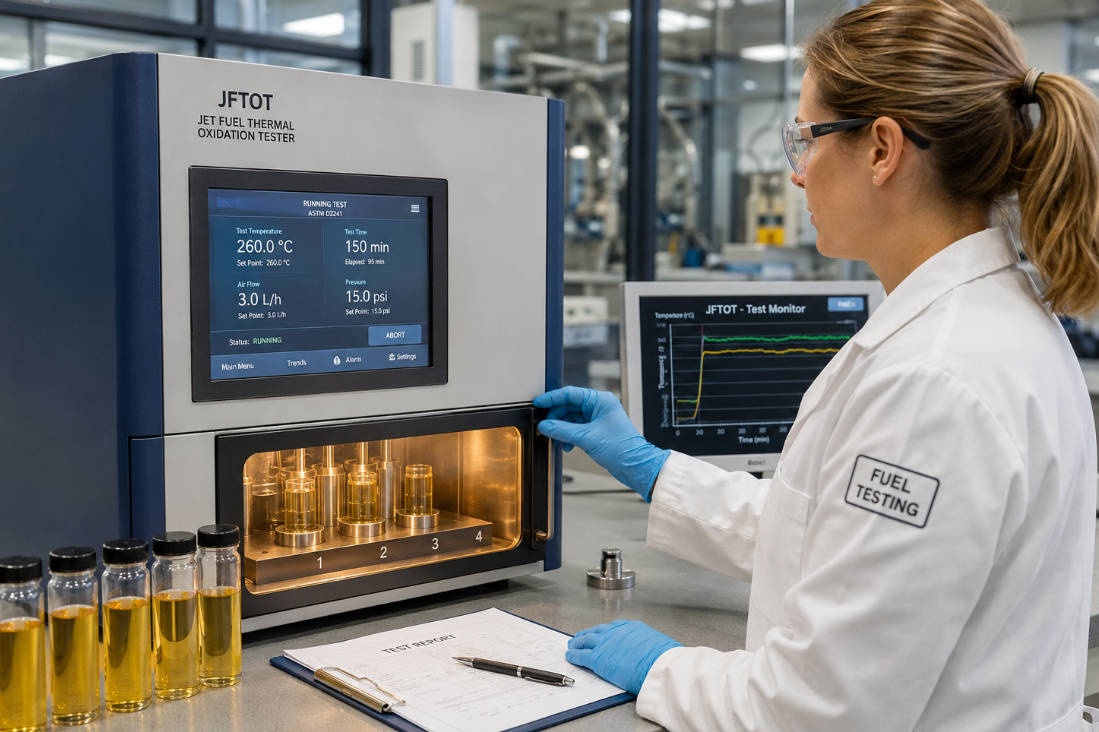
Jet Fuel Types: What Gets Tested
Jet A and Jet A-1 (Commercial Turbine Fuels)
Jet A is the dominant commercial jet fuel in North America. Jet A-1 is the international equivalent with a lower freeze point (−47°C vs. −40°C). Both are kerosene-range hydrocarbons (C8–C16) with flash points above 38°C. They are refined directly from crude oil and must meet ASTM D1655 requirements.
Jet A-1 with Synthetic Components
Semi-synthetic and fully synthetic fuels (such as those produced by SASOL) are now included in DefStan 91-91 and AFQRJOS specifications. Emerging sources include:
-
Gas-to-liquid (GTL) fuels
-
Coal-to-liquid (CTL) fuels
-
Biomass-to-liquid (BTL) fuels
-
Algal-derived fuels
JP-8 and JP-5 (Military Turbine Fuels)
JP-8 is the NATO standard military jet fuel — equivalent to Jet A-1 with a military additive package (corrosion inhibitor, antistatic additive, thermal stability improver). Specification: MIL-DTL-83133.
JP-5 is a high flash point (>60°C) naval jet fuel designed for carrier operations, where reduced fire risk during ship fuel handling is critical.
Avgas 100LL (Piston Engine Fuel)
Aviation gasoline grade 100LL (100 octane, low lead — 0.56 g Pb/L tetraethyl lead) remains the only leaded fuel in widespread commercial use. Specification: ASTM D910. The industry is transitioning to unleaded alternatives (G100UL) under FAA authorization.
Sustainable Aviation Fuel (SAF)
SAF covers a growing category of bio-derived and synthetic fuels tested under ASTM D7566. These fuels must demonstrate they are chemically equivalent to conventional jet fuel when blended at approved ratios.
Key Jet Fuel Testing Standards and Specifications
|
Standard |
Scope |
Region |
|---|---|---|
|
ASTM D1655 |
Aviation turbine fuel specification |
US / International |
|
DefStan 91-91 |
Jet A-1 specification |
UK / International |
|
AFQRJOS |
Joint checklist (strictest of ASTM + DefStan) |
International |
|
ASTM D910 |
Aviation gasoline (Avgas) specification |
US / International |
|
ASTM D7566 |
Synthetic / SAF aviation fuel |
International |
|
MIL-DTL-83133 |
JP-8 military turbine fuel |
US / NATO |
|
GOSST 10227 TS-1 |
Jet fuel specification |
Russia / CIS |
|
Number 3 Jet Fuel |
Jet fuel specification |
China |
|
EI/JIG 1530 |
Fuel quality and handling practices |
International |
The AFQRJOS checklist is widely used because it incorporates the strictest elements of both ASTM D1655 and DefStan 91-91, providing a single compliance standard for internationally traded fuel.
Core Jet Fuel Test Methods Explained
Thermal Stability Testing (ASTM D3241 — JFTOT)
The Jet Fuel Thermal Oxidation Tester (JFTOT) is one of the most critical tests for jet fuel. It simulates the high-temperature conditions fuel experiences inside aircraft fuel systems.
How it works:
-
Fuel circulates over a heated aluminum alloy tube at 260°C
-
The test measures deposit formation on the tube (visual scale 0–4)
-
It also measures pressure drop across a filter downstream
Acceptance criteria:
-
Maximum tube deposit rating: 3 (on a 0–4 scale)
-
Maximum pressure differential: 25 mmHg
Failing thermal stability can indicate the need for more metal deactivator additive (MDA). Deposits in real fuel systems can clog nozzles, block filters, and reduce engine performance.
Flash Point Testing (ASTM D56 / D93)
Flash point is the lowest temperature at which fuel vapor above the liquid can be ignited. This directly measures flammability hazard during refueling and ground handling.
Requirements:
-
Jet A / Jet A-1: minimum flash point of 38°C
-
JP-5: minimum flash point of 60°C (for shipboard safety)
A flash point that is too low indicates contamination with lighter fractions (e.g., gasoline or naphtha) and makes the fuel unsafe for aviation use.
Freeze Point Testing (ASTM D2386 / D7153)
At cruising altitude, fuel temperatures can drop to −47°C or lower. If the fuel begins to freeze, wax crystals can block fuel lines and filters — a potentially catastrophic failure.
How it works:
-
A fuel sample is gradually cooled
-
The temperature at which wax crystals appear (and disappear on re-warming) is recorded as the freeze point
Requirements:
-
Jet A: maximum freeze point −40°C
-
Jet A-1: maximum freeze point −47°C
Density and Viscosity Testing
Density (ASTM D4052):
-
Measured at 15°C
-
Determines the mass-to-volume relationship critical for fuel quantity gauging and combustor atomization
-
Typical Jet A-1 density range: 775–840 kg/m³
Kinematic Viscosity (ASTM D445):
-
Measured at −20°C
-
Ensures adequate fuel atomization at cold conditions
-
Maximum: 8 mm²/s at −20°C per ASTM D1655
-
Fuel that is too viscous at cold temperatures cannot be properly atomized by fuel injectors
Contamination Analysis: Water, Particulates, and Microbes
This is where most fuel quality problems originate. The primary contaminants:
Water:
-
Even low water content is dangerous because temperature changes cause condensation inside tanks
-
Measured by Karl Fischer titration (ASTM D6304) and water separation rating (WSIM, ASTM D3948)
-
Free water can cause filter icing at altitude and promote microbial growth
Particulates:
-
Dust, dirt, rust, rubber from damaged hoses
-
Measured by gravimetric filter analysis (ASTM D5452)
-
Particulates plug fuel filters and damage fuel control systems
Microbial contamination:
-
Bacteria, yeasts, and fungi thrive at the fuel-water interface
-
They form solid debris that plugs fuel filters
-
Detected using fuel test kits and microbial analysis
Sulfur Content Testing
Sulfur in jet fuel causes corrosion of engine components and contributes to particulate emissions. Modern specifications require total sulfur below 0.3% mass (3,000 ppm), with many refiners producing ultra-low-sulfur fuel well below this limit.
Testing methods include:
-
ASTM D4294: X-ray fluorescence (energy dispersive)
-
ASTM D5453: Ultraviolet fluorescence
Lubricity Testing (BOCLE)
Jet fuel serves as a lubricant for fuel system components such as pumps and control valves. The Ball-on-Cylinder Lubricity Evaluator (BOCLE) test (ASTM D5001) measures the wear scar diameter produced when a steel ball rubs against a cylinder lubricated by the fuel sample.
-
Maximum wear scar diameter: 0.85 mm (for Jet A-1)
-
Poor lubricity causes premature pump wear and fuel system failure
-
Highly refined fuels (especially hydrotreated) often have poor lubricity and require lubricity improver additives
Conductivity Testing
Static electricity builds up during fuel transfer (pumping, filtering). Without adequate conductivity, static discharge can ignite fuel vapors.
-
Measured per ASTM D2624
-
Minimum conductivity: 50 pS/m (with static dissipator additive)
-
Stadis 450 is the standard antistatic additive used
FAME Contamination in Jet Fuel
Fatty Acid Methyl Ester (FAME) — commonly known as biodiesel — is a serious contaminant in jet fuel. It enters the supply chain when biodiesel passes through shared distribution systems (pipelines, tanks).
-
Even trace amounts of FAME (as low as 5 mg/kg) can affect fuel properties
-
Detected by IP 585 or ASTM D8271
-
FAME causes poor water separation, filter plugging, and thermal stability issues
Jet Fuel Contamination: Sources and Prevention
Understanding contamination sources is essential for preventing fuel quality failures:
|
Contaminant |
Source |
Risk |
|---|---|---|
|
Water |
Condensation, rainwater leaks, humid air |
Filter icing, microbial growth, corrosion |
|
Particulates |
Dust, dirt, rust, hose rubber |
Filter plugging, fuel system damage |
|
Surfactants |
Residual chemicals, cleaning agents |
Poor water separation, filter malfunction |
|
DEF (Diesel Exhaust Fluid) |
Accidental cross-contamination at airports |
Engine flameout (complete power loss) |
|
FAME (biodiesel) |
Shared pipeline/tank systems |
Water separation failure, filter plugging |
|
Microbes |
Air and water ingress |
Solid debris, filter plugging, fuel degradation |
Prevention best practices:
-
Regular tank sampling and testing at each supply chain point
-
Proper tank maintenance including soak tests for new or repaired tanks
-
Dedicated fuel systems where possible to avoid cross-contamination
-
Routine microbial monitoring programs
-
Correct additive dosing (antioxidants, antistatic agents, corrosion inhibitors, FSII)
Jet Fuel Storage and Degradation Testing
Jet fuel does not last forever in storage. Over time, several degradation processes occur:
Gum Formation (ASTM D381):
-
Oxidation of fuel components forms sticky deposits (gum)
-
Existent gum above specification indicates fuel is degrading
-
Antioxidant additives (e.g., AO-37) are dosed to prevent gum formation
Thermal Oxidation Stability:
-
Even in storage, slow oxidation reactions occur
-
JFTOT testing (ASTM D3241) monitors whether stored fuel still meets thermal stability requirements
Microbial Growth:
-
Microorganisms thrive in stored fuel, especially where water is present
-
Biocide treatment and monitoring programs are essential for long-term storage
Soak Tests:
-
Required when commissioning a new tank or returning a repaired tank to service
-
Verify that the tank interior surfaces do not contaminate the fuel
Sustainable Aviation Fuel (SAF) Testing
Sustainable Aviation Fuel is the fastest-growing segment of aviation fuel testing. SAF must demonstrate drop-in compatibility — meaning it performs identically to conventional jet fuel when blended at approved ratios.
Key SAF testing requirements:
-
ASTM D7566 governs synthetic aviation fuel specifications
-
Blended SAF must still meet all ASTM D1655 requirements for Jet A-1
-
Additional tests verify that the synthetic components do not introduce:
-
Unusual contaminants
-
Poor thermal stability
-
Inadequate lubricity
-
Off-spec freeze point or flash point
-
SAF pathways currently approved under ASTM D7566:
-
Fischer-Tropsch (FT) synthesis
-
HEFA (Hydroprocessed Esters and Fatty Acids)
-
SIP (Synthesized Iso-Paraffins)
-
Alcohol-to-Jet (ATJ)
-
CHJ (Catalytic Hydrothermolysis Jet)
Each pathway has specific blend ratio limits (up to 50% for most pathways) and unique testing requirements.
Military Jet Fuel Testing: JP-8 and JP-5
Military jet fuels have additional requirements beyond commercial specifications:
JP-8 (MIL-DTL-83133):
-
Based on Jet A-1 with mandatory additive package:
-
Corrosion inhibitor (NATO S-1737)
-
Antistatic additive (Stadis 450)
-
Thermal stability improver
-
Fuel system icing inhibitor (FSII, e.g., DiEGME)
-
-
Used by all NATO military aircraft
JP-5 (MIL-DTL-5624):
-
High flash point (>60°C) for shipboard safety
-
Lower volatility reduces fire risk during carrier deck operations
-
Higher freeze point tolerance acceptable for naval operations
Testing must verify all additive concentrations are within specification and that the base fuel meets commercial grade requirements before additive dosing.
How to Choose a Jet Fuel Testing Laboratory
Selecting the right testing partner is as important as the tests themselves:
|
Criteria |
Why It Matters |
|---|---|
|
ISO 17025 accreditation |
Demonstrates technical competence and international acceptance of results |
|
24/7 availability |
Aviation never stops — fuel emergencies happen on holidays and weekends |
|
ASTM proficiency testing participation |
Round-robin testing proves the lab's results are accurate and consistent |
|
Full test slate capability |
Can perform all ASTM D1655 tests in-house (no subcontracting delays) |
|
Fast turnaround |
4-hour COA delivery keeps fuel flowing through the supply chain |
|
On-site sampling |
Proper sample collection is as important as the analysis itself |
|
SAF and synthetic fuel experience |
Growing demand requires labs that keep pace with evolving specifications |
Red flags to avoid:
-
Labs without ISO 17025 accreditation — your results may not be internationally accepted
-
Labs that cannot explain what to do when results fail — a good lab provides actionable recommendations
-
The cheapest option — compromised quality in fuel testing can have catastrophic consequences
Jet Fuel Testing FAQ
How often should jet fuel be tested?
Jet fuel must be tested at every custody transfer point: refinery discharge, pipeline receipt, terminal storage, and airport delivery. Stored fuel should be retested periodically (typically every 3–6 months) to monitor degradation.
What happens if fuel fails a test?
Depending on the failure, corrective actions include: additive re-dosing (antioxidants, MDA, FSII), filtration to remove contaminants, biocide treatment for microbial growth, or in severe cases, rejection of the entire batch.
How long does jet fuel testing take?
A full specification test slate typically takes 4–6 hours from sampling to Certificate of Analysis. Recertification testing (shorter slate) can be faster.
Can SAF be used without testing?
No. All SAF must be tested to ASTM D7566 requirements and the blended fuel must meet ASTM D1655 specification before it can be used in aircraft.
What is the difference between Jet A and Jet A-1?
The primary difference is the freeze point: Jet A must meet −40°C maximum, while Jet A-1 must meet −47°C maximum. Jet A-1 is used internationally; Jet A is primarily a North American product.
Why is FAME contamination such a concern?
Even trace amounts of FAME (5 mg/kg) can degrade water separation performance, cause filter plugging, and reduce thermal stability. Because FAME comes from biodiesel passing through shared pipelines, it is an ongoing supply chain risk.
Summary
Jet fuel testing is the foundation of aviation safety. From verifying thermal stability and flash point to detecting trace contamination that is invisible to the naked eye, every test protects lives and aircraft. Whether you are testing conventional Jet A-1, military JP-8, or next-generation SAF, the principle is the same: if it hasn't been tested, it doesn't go on the plane.
Choose an ISO 17025 accredited laboratory, follow the correct standards, test at every supply chain point, and never cut corners on fuel quality. The cost of comprehensive testing is always less than the cost of an engine failure at 40,000 feet.