Table of Contents
- What is silica testing?
- The standard stack: OSHA, NIOSH, GBZ, ISO, EN, MDHS, AS, MSHA
- The three crystalline polymorphs and the amorphous / crystalline distinction
- The international RCS exposure limits: a six-jurisdiction comparison
- The respirable fraction and the ISO 7708 D50 = 4 µm definition
- Three analytical methods: XRD, FTIR, and visible spectrophotometry
- Gravimetric sampling: cyclone, PVC filter, 2.7 L/min, 8-hour TWA
- Real-time monitoring: light-scattering and the end-of-shift method
- Health surveillance: spirometry, DLCO, ILO chest X-ray, B reader
- FAQ
- Our silica testing capabilities
What is silica testing?
Silica testing — in the context of occupational health and industrial hygiene — is the measurement of the concentration of respirable crystalline silica (RCS) in the workplace air, performed to verify compliance with the regulatory exposure limits and to protect workers from silicosis, lung cancer, and chronic obstructive pulmonary disease. The test distinguishes three analyses: the gravimetric sampling of the respirable fraction (the air-particle-size fraction small enough to reach the deep lung, defined as D50 = 4 µm aerodynamic diameter per ISO 7708), the laboratory analysis of the filter (X-ray diffraction for crystalline-phase identification and quantification, or Fourier-transform infrared for the Si-O bond absorption), and the real-time monitoring (a light-scattering photometric instrument calibrated to the gravimetric reference, used for the end-of-shift and the engineering-control verification). The output is a time-weighted average (TWA) concentration in mg/m³ or µg/m³, reported against the applicable exposure limit.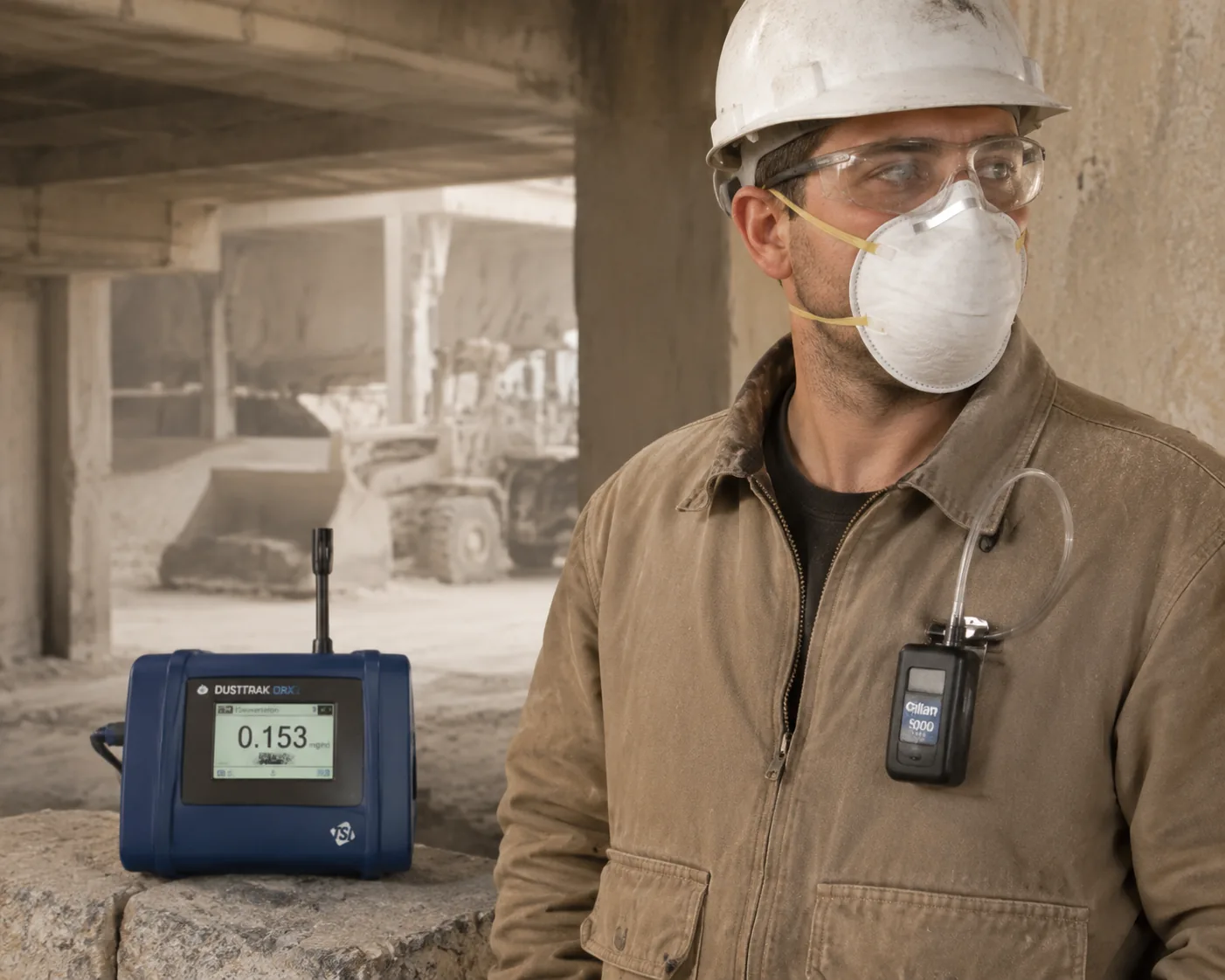
Silica (silicon dioxide, SiO₂, CAS 14808-60-7 for quartz) is the second most common mineral in the earth's crust, found in sand, stone, concrete, brick, mortar, and engineered stone. In its solid form it is harmless; the hazard arises when cutting, sawing, grinding, drilling, crushing, or blasting these materials generates the respirable dust that reaches the deep lung. The three crystalline polymorphs of silica — quartz (the most common), cristobalite, and tridymite — are regulated as the carcinogenic respirable crystalline silica, while the amorphous forms (fumed silica, silica gel, diatomaceous earth) are not classified as carcinogens and are regulated separately.
The standards governing silica testing span the US OSHA 29 CFR 1926.1153 (construction) and 1910.1053 (general industry) with the permissible exposure limit (PEL) of 50 µg/m³ TWA; the NIOSH Manual of Analytical Methods (NMAM) with Method 7500 (XRD), 7602 (FTIR), and 7603 (coal-mine dust IR); the OSHA Method ID-142 (XRD); the MSHA Method P7 (coal-mine dust); the European EN 481 (respirable-fraction convention) and the UK MDHS 101 (FTIR); the international ISO 16258-1:2015 (XRD); the Australian AS 2985 (gravimetric) and the Victorian WorkSafe standard (0.05 mg/m³); the ISO 7708 respirable-fraction definition (D50 = 4 µm); and the Chinese GBZ 2.1-2019 occupational exposure limit and GBZ/T 192.4-2007 analytical method. A workplace in the US must demonstrate OSHA PEL compliance; in China, GBZ 2.1; in Australia, the WHS / Victorian standard; in the EU, the IND limit.
The standard stack: OSHA, NIOSH, GBZ, ISO, EN, MDHS, AS, MSHA
A complete silica testing project draws on a stack of US, international, European, Australian, and Chinese standards.
| Family | Standard | Scope |
|---|---|---|
| OSHA 29 CFR 1926.1153 | Respirable Crystalline Silica — Construction | The US construction-industry standard; PEL 50 µg/m³ TWA; the Table 1 specified-task pre-engineering controls; the written exposure control plan; the competent person |
| OSHA 29 CFR 1910.1053 | Respirable Crystalline Silica — General Industry | The US general-industry standard; same PEL 50 µg/m³ TWA; medical surveillance; the regulated areas |
| NIOSH 7500 | Silica, Crystalline, by X-Ray Diffraction (XRD, filter redeposition) | The preferred US analytical method for crystalline silica in a mineral matrix; speciates quartz, cristobalite, tridymite |
| NIOSH 7602 | Silica, Crystalline, by Infrared Spectroscopy (IR) | The IR alternative; suitable when the amorphous-silica and silicate interferences are minimal |
| NIOSH 7603 | Silica, Crystalline, in Coal Mine Dust (by IR) | The coal-mine-dust-specific method |
| OSHA ID-142 | Quartz and Cristobalite in Workplace Atmospheres (XRD) | The OSHA analytical method, equivalent to NIOSH 7500 |
| MSHA P7 | Sampling and analysis of coal-mine dust for silica | The MSHA coal-dust method |
| ISO 16258-1:2015 | Workplace air — Determination of respirable crystalline silica — Part 1: X-ray diffraction | The international XRD method |
| MDHS 101 (UK HSE) | Crystalline silica in respirable airborne dusts (FTIR) | The UK Health and Safety Executive method |
| EN 481:1993 | Workplace atmospheres — Size fraction definitions for measurement of airborne particles | The European respirable-fraction convention (harmonised with ISO 7708) |
| AS 2985-2009 | Workplace atmospheres — Method for sampling and gravimetric determination of respirable dust | The Australian gravimetric method |
| ISO 7708:1995 | Air quality — Particle size fraction definitions for health-related sampling | The international respirable-fraction definition (D50 = 4 µm aerodynamic diameter) |
| GBZ 2.1-2019 | 《工作场所有害因素职业接触限值 第 1 部分:化学有害因素》 | The Chinese occupational-exposure-limit standard; RCS PC-TWA for total dust (1 mg/m³ at 10 % SiO₂ + 2) and respirable dust (0.7 mg/m³ at 10 % SiO₂ + 2) |
| GBZ/T 192.4-2007 | 《工作场所空气中粉尘测定 第 4 部分:游离二氧化硅含量》 | The Chinese analytical method for free silica in workplace air; phosphoric-acid (焦磷酸) method + XRD + IR |
| IARC Monograph 100C | Silica dust, crystalline, in the form of quartz or cristobalite | The IARC classification of crystalline silica as Group 1 carcinogen (sufficient evidence for lung cancer) |
The single most consequential fact for a Chinese workplace is that GBZ 2.1-2019 sets the RCS exposure limit as a function of the % SiO₂ content — the PC-TWA is 1 mg/m³ for total dust and 0.7 mg/m³ for respirable dust when the silica content is 10 % (the formula is 10 % SiO₂ + 2 mg/m³ for total dust, 10 % SiO₂ + 2.5 mg/m³ for respirable dust). The Chinese limit is therefore not a single number but a function of the silica content of the dust — quite different from the US PEL of 50 µg/m³ (independent of the silica content, but reported as crystalline silica specifically).
The three crystalline polymorphs and the amorphous / crystalline distinction
Silica exists in two broad forms: crystalline (the ordered crystalline lattice with the Si-O tetrahedral framework) and amorphous (the disordered, non-crystalline structure). Only the crystalline form is regulated as RCS.
| Form | Crystal system | Density (g/cm³) | Carcinogenic classification | Common source | Regulation |
|---|---|---|---|---|---|
| Quartz (α-quartz) | Trigonal-trapezohedral | 2.65 | IARC Group 1 (carcinogenic to humans); OSHA regulated | Sand, sandstone, granite, concrete, mortar, brick | RCS |
| Cristobalite | Tetragonal (high-temperature) | 2.32 | IARC Group 1 | Calcined diatomite, refractory bricks, found at high-temperature silica processing | RCS |
| Tridymite | Orthorhombic (high-temperature) | 2.26 | IARC Group 1 | Volcanic rock, high-temperature silica processing | RCS |
| Amorphous silica (fumed, gel, precipitated, diatomaceous earth uncalcined) | No crystal structure | 2.0-2.2 | IARC Group 3 (not classifiable) | Fumed silica (used as a thickener), silica gel (desiccant), diatomaceous earth (filter aid) | Not regulated as RCS; regulated under the nuisance-dust limit |
The crystalline polymorphs all share the SiO₂ chemical composition but differ in the arrangement of the SiO₄ tetrahedra. Quartz is the stable form at ambient temperature; cristobalite and tridymite are the high-temperature polymorphs (formed at 1470 °C and 870 °C respectively), found in refractories and in the high-temperature silica processing. The XRD analysis (NIOSH 7500) distinguishes the three polymorphs by their characteristic diffraction peaks (quartz main peak at 2θ = 26.66° on Cu-Kα; cristobalite at 21.93°; tridymite at 20.50°) — a discrimination that the IR method cannot fully achieve.
The amorphous / crystalline distinction matters because the amorphous forms are not carcinogenic (the IARC Group 3 classification) and are not regulated under the RCS standards. The amorphous fumed silica, silica gel, and diatomaceous earth are regulated under the general particulate-not-otherwise-classified (PNOC) limit (OSHA 15 mg/m³ total, 5 mg/m³ respirable; China GBZ 2.1 PC-TWA 8 mg/m³ total dust).
The international RCS exposure limits: a six-jurisdiction comparison
The RCS exposure limits have been progressively tightened since the 2016 OSHA final rule; the limits vary by jurisdiction.
| Jurisdiction | RCS exposure limit (TWA) | Standard | Note |
|---|---|---|---|
| USA — OSHA | 50 µg/m³ (0.050 mg/m³) | 29 CFR 1926.1153 / 1910.1053 | The 2016 OSHA final rule; halved the previous 100 µg/m³ |
| USA — ACGIH TLV | 25 µg/m³ | ACGIH 2023 TLV | The ACGIH threshold limit value (more stringent than the OSHA PEL) |
| Canada — OHS (most provinces) | 25 µg/m³ | Provincial OHS regulations | Aligned with ACGIH |
| Australia | 50 µg/m³ | WorkSafe / WHS; in force since 1 July 2020 | Halved the previous 100 µg/m³ |
| European Union | 0.1 mg/m³ (100 µg/m³) — being reduced to 0.05 mg/m³ in some member states | Directive 2017/2398 (amendment to the Carcinogens and Mutagens Directive); the EU limit is higher than the US but is being tightened | EU member states may set lower limits |
| United Kingdom (HSE) | 0.1 mg/m³ (WEL — Workplace Exposure Limit) | EH40/2005 | The UK Workplace Exposure Limit |
| China | 0.7 mg/m³ (respirable dust, at 10 % SiO₂; the formula 10 % SiO₂ + 2.5 mg/m³) | GBZ 2.1-2019 PC-TWA | The Chinese limit is dust-composition-dependent, not a fixed RCS limit |
| Japan | 0.03 mg/m³ ( respirable dust) | Japan Society for Occupational Health | Among the most stringent |
The Chinese limit is structurally different: it is a function of the % SiO₂ content of the dust, expressed as the total or respirable dust limit. A workplace with 50 % SiO₂ dust has a respirable-dust limit of 10/(50 + 2) = 0.19 mg/m³ — substantially higher than the US 50 µg/m³ RCS limit. The Chinese manufacturer targeting the US market must test for the crystalline silica specifically (not the total dust) and report against the 50 µg/m³ PEL.
The respirable fraction and the ISO 7708 D50 = 4 µm definition
The "respirable" fraction of the airborne dust is the particle-size fraction that, when inhaled, penetrates to the deep (gas-exchange) region of the lung. The respirable fraction is defined by the ISO 7708 convention (and the harmonised EN 481) as the fraction that passes a separator with a 50 % cut-point at 4 µm aerodynamic diameter (D50), with a 100 % passage below 1 µm and 0 % passage above 12 µm. The respirable-fraction convention is implemented by the cyclone sampler (a small centrifugal separator that removes the larger particles before the filter) used upstream of the PVC filter in the gravimetric sampling train.
The cyclone is run at a flow rate of 2.7 L/min (the flow rate that gives the standard D50 = 4 µm cut for the specified cyclone design, e.g. the SKC Aluminum Cyclone, the BGI GK2.69). The flow-rate calibration is the most critical parameter of the sampling train — a flow rate 10 % off gives a 10 % shift in the cut-point and a corresponding bias in the respirable-fraction mass. The cyclone leak test (OSHA TED 1-0.15A) verifies the integrity of the cyclone assembly before each sampling run.
Three analytical methods: XRD, FTIR, and visible spectrophotometry
Three analytical methods are used to quantify the crystalline silica on the PVC filter, each with its strengths and interferences.
| Method | Standard | Principle | Speciation | Interferences | Detection limit (filter) |
|---|---|---|---|---|---|
| XRD (X-ray diffraction) | NIOSH 7500 / OSHA ID-142 / ISO 16258-1 / GBZ/T 192.4 | Each crystalline polymorph gives a characteristic diffraction pattern; the peak intensity is proportional to the mass | Yes — quartz, cristobalite, tridymite separately | Aluminium oxide, zircon, some minerals | ~ 5 µg quartz per filter |
| FTIR (Fourier-transform infrared) | NIOSH 7602 / MDHS 101 / GBZ/T 192.4 | The Si-O bond absorbs at 800 cm⁻¹ (quartz), 620 cm⁻¹ (cristobalite), 790 cm⁻¹ (tridymite) | Limited — quartz and cristobalite separated; tridymite difficult | Silicates (the Si-O bond is common), amorphous silica | ~ 10 µg quartz per filter |
| Visible spectrophotometry | NIOSH 7601 | Colorimetric — the molybdate-reactive silica | No speciation | High — false positives from amorphous silica and silicates | Higher than XRD / FTIR |
The XRD is the preferred method because it speciates the three polymorphs and has the lowest interference — it is the reference method of OSHA ID-142, NIOSH 7500, ISO 16258-1, and the international analytical practice. The FTIR is the UK MDHS 101 method and the NIOSH 7602 alternative, suitable when the silicate interference is minimal (the IR absorption of silicates at the same wavelength is the main limitation). The visible spectrophotometry (NIOSH 7601) is rarely used today because of the high false-positive rate.
The Chinese GBZ/T 192.4 also includes the phosphoric-acid (焦磷酸) method — a wet-chemical dissolution method in which the non-silicate minerals are dissolved in hot phosphoric acid and the insoluble residue (the crystalline silica) is weighed. The phosphoric-acid method is the historical Chinese reference for the bulk-material silica content; the XRD and IR methods are the modern methods for the airborne dust.
Gravimetric sampling: cyclone, PVC filter, 2.7 L/min, 8-hour TWA
The gravimetric sampling is the reference method for the RCS compliance measurement (the method required by OSHA for the final compliance verification). The procedure:
- Calibrate the pump at 2.7 L/min with the cyclone + filter in line, using a primary calibrator (a bubble flowmeter or a DryCal).
- Wear the sampler — the cyclone + filter is clipped to the worker's lapel (within the breathing zone, defined as within 30 cm of the nose / mouth), the pump is worn on the belt; the air is drawn through the cyclone at 2.7 L/min for the full shift (typically 8 hours, ~1296 L total volume).
- The cyclone removes the non-respirable fraction (the larger particles); the respirable fraction (D50 ≤ 4 µm) deposits on the 5 µm pore PVC filter.
- At the end of the shift — the filter cassette is removed, sealed, and shipped to the laboratory; the field blank (an unopened cassette that travelled with the sample cassettes but was not opened to the air) is shipped alongside.
- The laboratory analyses the filter by XRD (or FTIR) for the three crystalline polymorphs; reports the mass of quartz, cristobalite, and tridymite on the filter; the TWA concentration is mass / volume (in µg/m³).
- Field blank correction — the field-blank mass is subtracted from the sample mass to correct for any background contamination of the filter.
OSHA reporting — the result is reported as the time-weighted average (TWA) concentration in µg/m³ over the 8-hour shift, with the field-blank correction, against the 50 µg/m³ PEL. The reported TWA must be ≤ 50 µg/m³ for compliance. A TWA above 50 µg/m³ triggers the OSHA action level (25 µg/m³, half the PEL) and the medical-surveillance requirement; a TWA above 50 µg/m³ triggers the PEL exceedance and the corrective-action requirement.
Real-time monitoring: light-scattering and the end-of-shift method
The gravimetric sampling is the reference method but has a 1-2 week turnaround (the filter is shipped to the laboratory). The real-time monitoring (light-scattering photometric instrument, e.g. TSI SidePak, TSI DustTrak,TSI 8530) provides immediate data on the respirable-dust concentration, with the advantage of the end-of-shift feedback (the data is available on the same shift, allowing the engineer to verify the engineering controls and to make adjustments before the gravimetric sampling is repeated).
The real-time monitor is calibrated to the gravimetric reference by the side-by-side sampling: the photometric monitor and the gravimetric cyclone are run in parallel for the same shift; the photometric monitor's mass concentration is regressed against the gravimetric filter mass to give a calibration factor specific to the workplace dust (the photometric monitor responds to all respirable dust, not just the crystalline silica; the calibration factor corrects for the % of crystalline silica in the dust). The calibrated photometric monitor then gives a real-time estimate of the RCS concentration.
The end-of-shift (EOS) method (NIOSH) is a rapid gravimetric method in which the filter is weighed at the end of the shift (rather than sent to the laboratory) — providing a same-shift feedback on the respirable-dust mass, with the crystalline-silica content estimated from the historical calibration factor of the workplace. The EOS method is not a substitute for the full XRD compliance sampling but is a rapid engineering-control verification tool.
Health surveillance: spirometry, DLCO, ILO chest X-ray, B reader
The RCS-exposed worker is subject to medical surveillance per the OSHA 1910.1053 standard and the corresponding national regulations. The surveillance includes:
| Test | What it detects | Frequency |
|---|---|---|
| Spirometry (FVC, FEV1, FEV1/FVC) | The obstructive (COPD-like) and restrictive (fibrosis-like) lung-function deficit | Baseline at hire; periodic (every 3 years for OSHA 1910.1053; annual for the Australian Victorian WHS) |
| DLCO (diffusing capacity of the lung for carbon monoxide) | The gas-exchange deficit — the earliest sign of the silicotic fibrosis (the RACP considers DLCO a more sensitive test than spirometry for early disease) | As spirometry |
| ILO chest X-ray | The radiographic signs of silicosis (the small rounded opacities, the progressive massive fibrosis) | Baseline at hire; every 3 years for OSHA; periodically per national standard |
| B reader (NIOSH-certified radiologist) | The ILO classification of the chest X-ray — the certified radiologist who has passed the NIOSH B-reader examination | The chest X-ray must be read by a B reader to be valid for the silicosis classification |
| Tuberculosis screening | Silicosis increases the risk of tuberculosis | Baseline; periodic for the high-risk groups |
The B-reader examination (NIOSH) is a rigorous certification of the radiologist's ability to classify the chest X-ray per the ILO system — the international standard for the radiographic classification of the pneumoconioses. The B reader is the cornerstone of the silicosis surveillance; a chest X-ray read by a non-B-reader is not accepted for the OSHA 1910.1053 medical-surveillance record.
FAQ
What is the OSHA PEL for respirable crystalline silica?
The OSHA Permissible Exposure Limit is 50 µg/m³ (0.050 mg/m³) TWA over the 8-hour shift, set by the 2016 OSHA final rule (29 CFR 1926.1153 for construction, 1910.1053 for general industry). The action level is 25 µg/m³ (half the PEL) — a workplace at or above the action level triggers the periodic sampling and the medical surveillance.
What is the difference between XRD and FTIR for silica analysis?
XRD (NIOSH 7500 / OSHA ID-142) identifies the three crystalline polymorphs (quartz, cristobalite, tridymite) by their characteristic diffraction peaks and is the reference method. FTIR (NIOSH 7602 / UK MDHS 101) measures the Si-O bond absorption and has lower speciation capability and higher interference from the silicates. XRD is the preferred method; FTIR is the alternative when the silicate interference is minimal.
What is the ISO 7708 respirable fraction and why does it matter?
The ISO 7708 respirable fraction is the particle-size fraction that penetrates to the deep lung — defined as D50 = 4 µm aerodynamic diameter (50 % of the 4 µm particles pass; 100 % below 1 µm; 0 % above 12 µm). The respirable fraction is sampled by the cyclone separator upstream of the filter, and the 2.7 L/min flow rate of the cyclone is calibrated to give the D50 = 4 µm cut for the standard cyclone design.
What is the difference between the US PEL and the Chinese GBZ 2.1 limit?
The US OSHA PEL is a fixed 50 µg/m³ for the crystalline silica, independent of the % SiO₂ content of the dust. The Chinese GBZ 2.1-2019 limit is a function of the % SiO₂ content: 10/(% SiO₂ + 2) mg/m³ for total dust and 10/(% SiO₂ + 2.5) mg/m³ for respirable dust. The Chinese limit is therefore a dust-composition-dependent limit, not a fixed RCS limit; the Chinese manufacturer targeting the US market must test for the crystalline silica specifically and report against the 50 µg/m³ PEL.
Why is the amorphous silica not regulated as RCS?
The amorphous silica (fumed silica, silica gel, diatomaceous earth uncalcined) has no ordered crystalline structure and is not classified as carcinogenic by IARC (Group 3). The biological mechanism of the silica-induced fibrosis requires the ordered crystalline surface; the amorphous forms do not produce the same effect. The amorphous silica is regulated under the general particulate-not-otherwise-classified (PNOC) limit, not under the RCS standard.
Our silica testing capabilities
Beijing ZKGX Research (ISO/IEC 17025 accredited, CMA- and CNAS-accredited testing laboratory) provides complete respirable crystalline silica testing across the OSHA, NIOSH, GBZ, ISO, EN, MDHS, AS, and MSHA standard stack:
- OSHA 29 CFR 1926.1153 / 1910.1053 RCS sampling and analysis — gravimetric sampling at 2.7 L/min with the cyclone + PVC filter, the 8-hour TWA, the 50 µg/m³ PEL compliance; the field-blank correction; the action-level assessment.
- NIOSH 7500 / OSHA ID-142 / ISO 16258-1 XRD analysis — the three polymorphs (quartz, cristobalite, tridymite) separately; the XRD diffraction pattern; the 5 µg-per-filter detection limit.
- NIOSH 7602 / MDHS 101 FTIR analysis — the IR alternative; the silicate-interference assessment; the 10 µg-per-filter detection limit.
- NIOSH 7603 / MSHA P7 coal-mine-dust IR analysis — for the coal-mine-dust-specific RCS measurement.
- GBZ/T 192.4-2007 Chinese analytical method — the phosphoric-acid (焦磷酸) method, the XRD, and the IR for the free-silica content of the bulk material and the airborne dust.
- GBZ 2.1-2019 Chinese occupational-exposure-limit assessment — the dust-composition-dependent PC-TWA calculation (10/(% SiO₂ + 2) for total dust; 10/(% SiO₂ + 2.5) for respirable dust); the GBZ 2.1 compliance reporting.
- Real-time monitoring — light-scattering photometric instruments (TSI SidePak, DustTrak), calibrated to the gravimetric reference; the end-of-shift method for the engineering-control verification.
- Cyclone leak test — OSHA TED 1-0.15A cyclone-assembly leak test; the 2.7 L/min flow-rate calibration with a primary calibrator (bubble flowmeter or DryCal).
- Bulk-material silica content — the XRD / phosphoric-acid analysis of the bulk material (concrete, mortar, brick, engineered stone) for the % crystalline silica content.
- Health-surveillance support — the ILO chest X-ray classification by a NIOSH-certified B reader; spirometry and DLCO; the OSHA 1910.1053 medical-surveillance record.
Suitable sample matrices include: workplace air (the cyclone + PVC filter gravimetric sample); bulk materials (concrete, mortar, brick, engineered stone, sand, refractory); settled dust; and the coal-mine dust. Each project is delivered with a full data report (sampling protocol, instrument calibration, raw XRD / FTIR data, field-blank correction, statistical analysis, classification conclusion per the applicable standard) in English and/or Chinese, with CMA/CNAS stamping. Contact Beijing ZKGX Research to scope the silica test applicable to your workplace and target jurisdiction.