Air cooler testing is the laboratory verification that an evaporative air cooler (蒸发式冷风扇) — a household appliance that cools air by evaporating water through a wet pad while a fan blows air across it — meets the product standard GB/T 23333-2024 (Evaporative Air Cooler), the general safety standard GB/T 4706.1-2024 plus the new air-cooler-specific safety part GB/T 4706.115-2024 (implementing 2026-08-01), the energy-efficiency grade standard QB/T 4977, and the EMC standards GB 4343.1 / GB/T 4343.2. The defining trait of the test is that it is a four-standard stack — product performance, electrical safety, energy efficiency, and electromagnetic compatibility — that together govern whether an evaporative air cooler may be sold. It is distinct from the testing of a PC CPU cooler (a heatsink/fan component) or a charge-air cooler (an automotive turbo component), which share the word "cooler" but are entirely different products under different standards.
Air Cooler ≠ CPU Cooler ≠ Charge-Air Cooler
The search results for "air cooler testing" are dominated by content about two unrelated products, and the first job of any explanation is to separate them: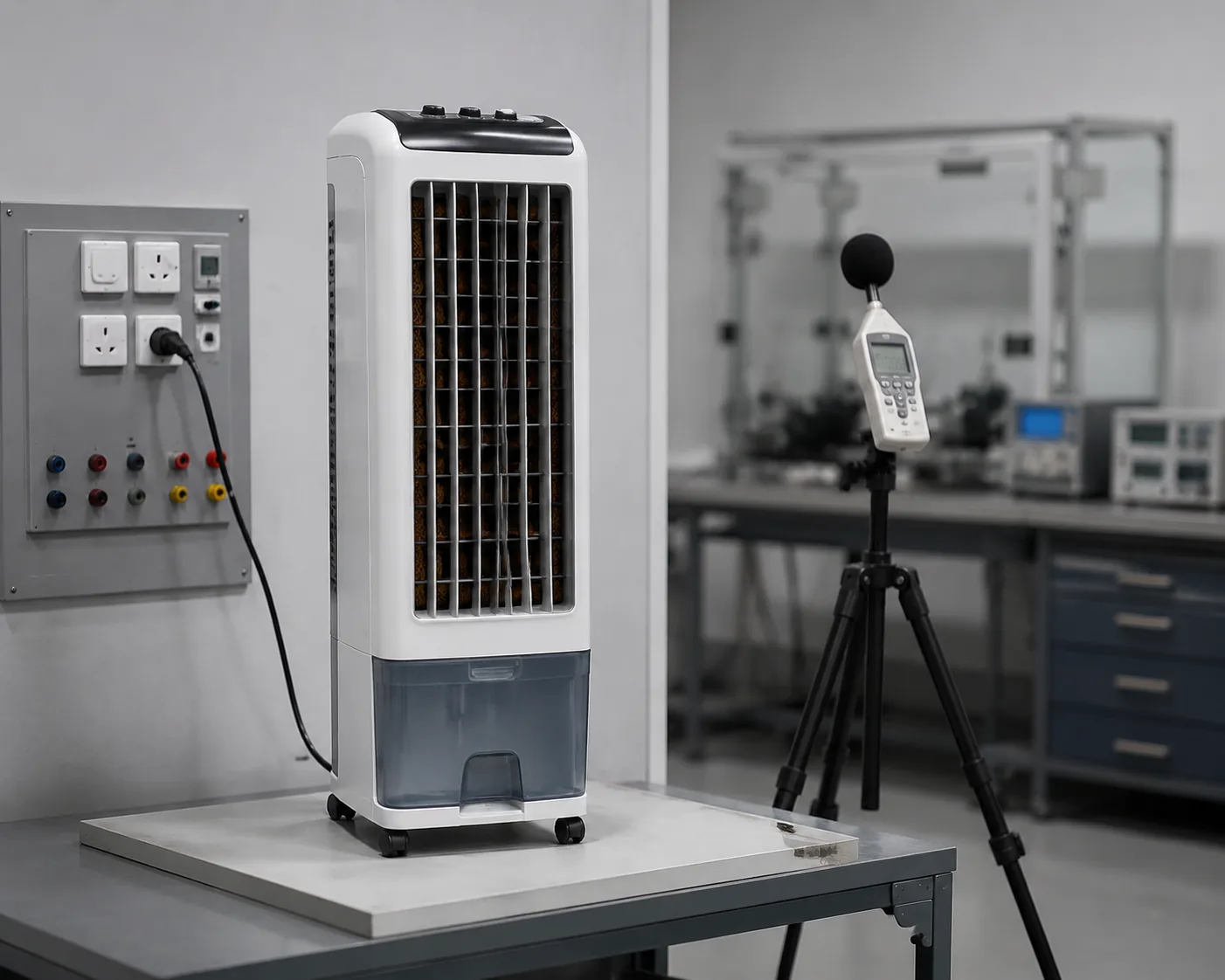
| Product | What it is | Governing standard |
|---|---|---|
| Evaporative air cooler (this article) | Household appliance that cools room air by water evaporation through a wet pad | GB/T 23333-2024 (product), GB/T 4706.115 (safety) |
| PC CPU cooler | A heatsink-and-fan or liquid component that cools a computer processor | PC-component standards, IT-equipment safety |
| Charge-air cooler | An automotive turbocharger intercooler that cools compressed intake air | Automotive standards |
This article addresses the evaporative air cooler — the room-cooling household appliance — and its GB standard stack. The PC CPU cooler and the automotive charge-air cooler are different products in different industries.
The Four-Standard Stack
An evaporative air cooler is, at once, a household electrical appliance, a product with defined performance, an energy-consuming device subject to efficiency grading, and an electromagnetic-disturbance source. Each identity pulls in a different standard:
| Layer | Standard | What it governs |
|---|---|---|
| Product performance | GB/T 23333-2024 — Evaporative Air Cooler | Airflow, evaporation efficiency, cooling capacity, noise, water consumption |
| Electrical safety | GB/T 4706.1-2024 (general) + GB/T 4706.115-2024 (air-cooler-specific) | Electrical safety of the appliance |
| Energy efficiency | QB/T 4977 — Energy-Efficiency Grade Requirements for Evaporative Air Coolers | Energy-efficiency class assignment |
| EMC | GB 4343.1-2024 (emission) + GB/T 4343.2-2020 (immunity) | Electromagnetic compatibility |
A complete air-cooler compliance report draws on all four layers; a report citing only one is incomplete.
Product Performance: GB/T 23333-2024
GB/T 23333-2024 (蒸发式冷风扇, Evaporative Air Cooler) is the product standard, implemented 2024-10-01 to replace GB/T 23333-2009. It covers single-phase appliances rated ≤250 V and others ≤480 V for household and similar use. The standard defines the key performance parameters that an evaporative air cooler must meet:
- Airflow (风量) — the volume of air the cooler moves per unit time (m³/h), measured under standard conditions; this is the headline capacity number that determines the room size the cooler can serve.
- Evaporation efficiency (蒸发效率) — the cooler's ability to lower air temperature through evaporation, measured as the temperature drop between inlet and outlet air relative to the wet-bulb depression. This is the defining performance metric of an evaporative cooler — it distinguishes a real cooler from a mere fan.
- Effective cooling capacity (有效风量/有效冷量) — the combination of airflow and temperature drop into a single cooling-effect metric.
- Noise (噪声) — the A-weighted sound power level, measured per the standard's acoustic method, because air coolers are often used in bedrooms at night.
- Water consumption (耗水量) — the rate of water use during cooling, relevant for running cost and tank-size sizing.
The 2024 edition updated the measurement methods, refined the test-condition definitions, and aligned the technical requirements with current product practice. A current product report cites GB/T 23333-2024; the 2009 edition is withdrawn.
Electrical Safety: GB/T 4706.1 + GB/T 4706.115-2024
Electrical safety of an air cooler is governed by the household-appliance safety series — the general requirements GB/T 4706.1-2024 plus the air-cooler-specific special requirements. The single most current and consequential fact here is the brand-new air-cooler-specific safety part:
- GB/T 4706.115-2024 (家用和类似用途电器的安全 第115部分:蒸发式冷风扇的特殊要求), implementing 2026-08-01. This is the dedicated safety standard for evaporative air coolers, layering product-specific clauses (the water-system electrical safety, the fan-guard requirements, the pump insulation, the wet-environment leakage-current limits) on top of the general GB/T 4706.1 base.
A correctness point worth making: the air-cooler-specific safety part is GB/T 4706.115, not GB 4706.45 — GB 4706.45 is the special-requirements standard for air purifiers, a different product that is sometimes mis-attributed to air coolers. A current air-cooler safety report cites GB/T 4706.1-2024 + GB/T 4706.115-2024; citing GB 4706.45 for an air cooler is a category error.
Energy Efficiency: QB/T 4977
Like fans and air conditioners, evaporative air coolers are subject to energy-efficiency grading. The industry standard QB/T 4977 (蒸发式冷风扇能效等级评定要求, Energy-Efficiency Grade Requirements for Evaporative Air Coolers) assigns each cooler an energy-efficiency class based on its cooling capacity per unit of power input — the higher the cooling-per-watt, the higher the grade. The grade is a market-relevant compliance parameter (efficient appliances carry a marketing advantage and may qualify for energy-label programs), and a complete product report includes the efficiency-grade result.
EMC: GB 4343 Series
As a motor-driven household appliance with electronic controls, an air cooler is an electromagnetic-disturbance source and must meet the household-appliance EMC standards:
- GB 4343.1-2024 (家用电器、电动工具和类似器具的电磁兼容要求 第1部分:发射, IDT CISPR 14-1) — the emission standard, limiting the conducted and radiated disturbances the cooler may produce.
- GB/T 4343.2-2020 — the immunity standard.
The emission standard was updated to the 2024 edition (implementing 2026-06-01); a current EMC report cites GB 4343.1-2024.
How an Evaporative Air Cooler Works
The compliance parameters above derive from the working principle: a fan draws warm ambient air through a wet porous pad (the cooling pad). As the air passes, water evaporates from the pad into the air, absorbing latent heat and lowering the air's dry-bulb temperature. The cooled, humidified air is discharged into the room. Because the cooling comes from evaporation (a latent-heat process), an evaporative cooler is most effective in hot, dry climates where the wet-bulb depression is large — and it adds humidity to the air, which is a benefit in dry climates but a limitation in already-humid ones. This is why the evaporation efficiency parameter in GB/T 23333 is the defining performance metric: it measures how effectively the cooler exploits the available wet-bulb depression.
Why the Search Results Are Off the Compliance Intent
The search results for "air cooler testing" are dominated by content that answers a different question:
- UK 2026 best-air-cooler buying guides (Princess Smart, Tristar, Shark FlexBreeze, Honeywell, Symphony) — consumer product reviews ranking coolers by cooling effect, noise, and price. Consumer-purchase intent, no GB standard.
- PC CPU cooler reviews (Tom's Hardware, Gamers Nexus — Arctic Freezer, Thermalright, Noctua) — heatsink/fan or AIO-liquid component reviews for PC builds. PC-hardware-review intent, a different product.
- Automotive charge-air-cooler content (Taylor Dyno) — turbocharger intercooler performance. Automotive intent.
None tells an air-cooler manufacturer, an appliance lab, or a regulator which GB standard stack applies, what the evaporation-efficiency parameter is, or what the new GB/T 4706.115-2024 safety part means. That compliance question is what this article addresses.
Our Testing Capabilities
Beijing ZKGX Research conducts evaporative air cooler testing across the four-standard stack:
- Product performance (GB/T 23333-2024): airflow (m³/h), evaporation efficiency, effective cooling capacity, noise (A-weighted sound power), and water consumption, with the 2024 edition's refined test methods.
- Electrical safety (GB/T 4706.1-2024 + GB/T 4706.115-2024): the general safety requirements plus the new air-cooler-specific safety part (implementing 2026-08-01) — water-system electrical safety, fan-guard, pump insulation, wet-environment leakage current.
- Energy efficiency (QB/T 4977): the energy-efficiency grade based on cooling capacity per watt.
- EMC (GB 4343.1-2024 emission + GB/T 4343.2-2020 immunity): the household-appliance EMC tests.
- Sample types: household and similar-use evaporative air coolers, in all sizes and configurations (tower, box, portable, desktop).
- Deliverable: a test report identifying the product, the four-standard stack applied, each measured value with its method citation, and pass/fail (and the efficiency grade) against each standard's limit.
If you have an evaporative air cooler product requiring compliance verification, contact our testing team to scope the standard stack, the applicable efficiency grade, and the 2026-08-01 GB/T 4706.115 transition status.
Frequently Asked Questions
What standard governns evaporative air cooler testing?
It is a four-standard stack: GB/T 23333-2024 (product performance — airflow, evaporation efficiency, noise, water consumption), GB/T 4706.1-2024 + GB/T 4706.115-2024 (electrical safety — general + air-cooler-specific), QB/T 4977 (energy-efficiency grade), and GB 4343.1-2024 / GB/T 4343.2-2020 (EMC). A complete report cites all four.
What replaced GB/T 23333-2009?
GB/T 23333-2009 (Evaporative Air Cooler) was replaced by GB/T 23333-2024, implemented 2024-10-01. The 2024 edition updated the measurement methods, refined the test-condition definitions, and aligned the technical requirements with current product practice.
What is GB/T 4706.115-2024?
GB/T 4706.115-2024 (Safety of Household and Similar Electrical Appliances — Part 115: Particular Requirements for Evaporative Air Coolers) is the air-cooler-specific safety standard, implementing 2026-08-01. It layers product-specific clauses (water-system electrical safety, fan-guard, pump insulation, wet-environment leakage current) on top of the general GB/T 4706.1-2024 base. Note: GB 4706.45 is for air purifiers, not air coolers — the correct air-cooler safety part is GB/T 4706.115.
Is evaporative air cooler testing the same as CPU cooler testing?
No. A PC CPU cooler (a heatsink/fan or liquid component cooling a processor) is a PC component tested under IT-equipment standards. An automotive charge-air cooler (a turbo intercooler) is tested under automotive standards. The evaporative air cooler (a household appliance cooling room air by water evaporation) is tested under GB/T 23333-2024 and the GB/T 4706 safety series. They share the word "cooler" but are different products under different standards.
What is the key performance parameter for an evaporative air cooler?
Evaporation efficiency — the temperature drop the cooler achieves through evaporation, relative to the available wet-bulb depression. This is the defining metric because it measures how effectively the cooler exploits the evaporation process; it distinguishes a real evaporative cooler from a mere fan. Airflow (m³/h) and noise (A-weighted sound power) are the other headline GB/T 23333 parameters.