Beta-hemolytic streptococcus testing is the laboratory detection and identification of streptococci that produce complete (β) hemolysis — the full clearing of red blood cells around a colony on blood agar — in food, textile, environmental, or product samples, to the method standard GB 4789.11-2014 (food) or SN/T 4656.10-2024 (imported/exported textiles). It is distinct from clinical streptococcal diagnosis, which tests patient specimens to guide treatment; the laboratory-compliance test asks whether the organism is present in a product or environment, against a standard that specifies the detection method and the regulatory limit. The defining trait of the test is the β-hemolysis phenotype itself, which selects the target organism.
Clinical Diagnosis vs Laboratory Compliance: Two Different Tests
The search results for "beta-hemolytic streptococcus testing" are dominated by clinical-diagnosis content, and the first job of any explanation is to separate the two:
| Clinical strep testing | Laboratory-compliance strep testing (this article) | |
|---|---|---|
| Question | "Does this patient have a strep infection?" | "Is β-hemolytic strep present in this food/product/environment?" |
| Specimen | Throat swab, blood, wound swab, vaginal swab | Food sample, textile swatch, environmental swab |
| Driver | Patient symptoms, Centor score, antibiotic decision | Regulatory limit, batch release, product safety |
| Reporting | Culture/antigen/nucleic-acid result to clinician | Presence/absence or CFU count against a GB/SN/T standard |
| Governing reference | Clinical guidelines (CDC, IDSA), Medicare LCDs | GB 4789.11-2014 (food), SN/T 4656.10-2024 (textiles) |
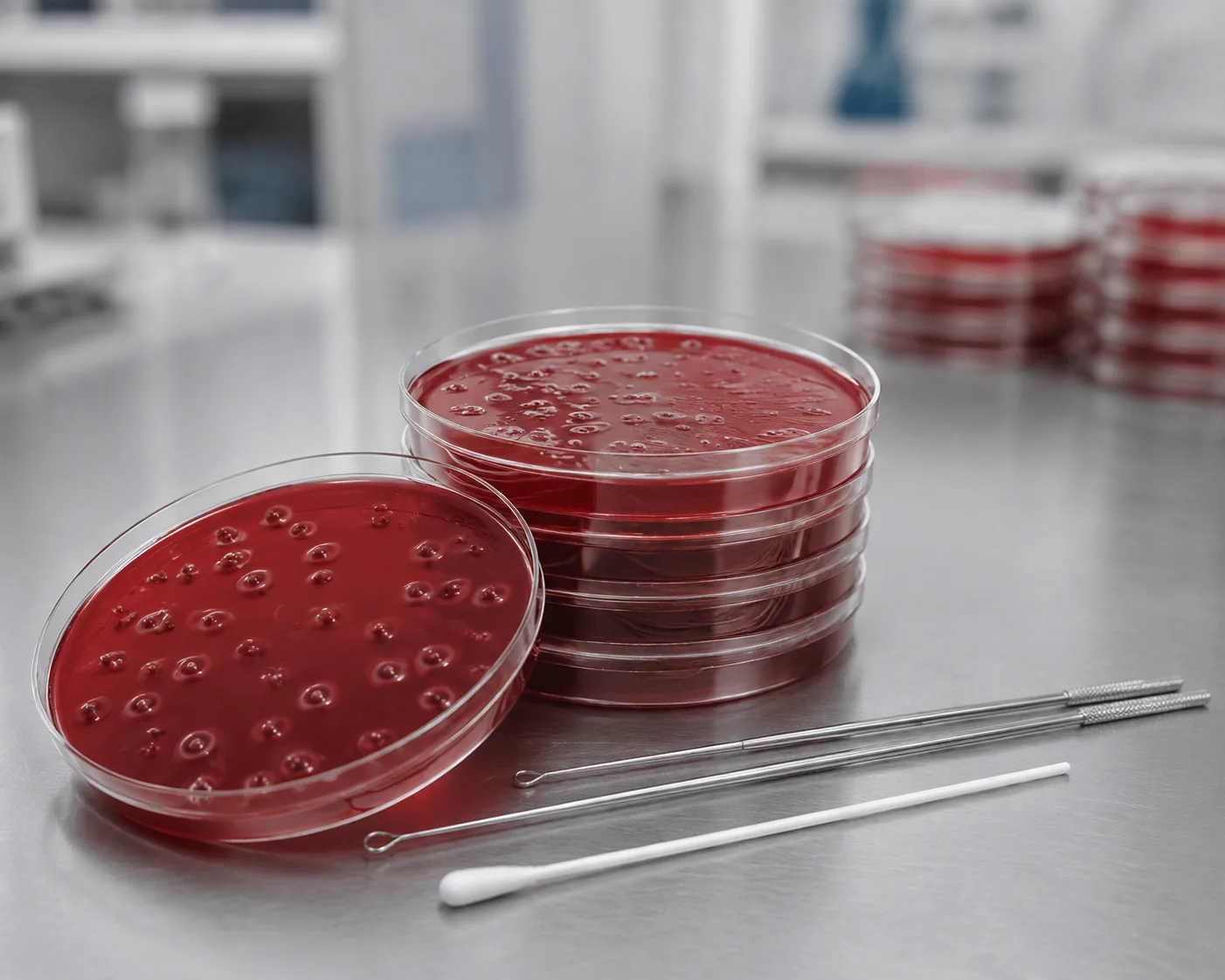
The clinical test is run on a person; the compliance test is run on a product. They share the target organism but answer fundamentally different questions and are governed by different standards. This article addresses the compliance test.
Why β-Hemolysis Is the Selection Principle
Streptococci are classified by their hemolytic reaction on blood agar, and the β-hemolytic group is the pathogenic target because the complete-hemolysis phenotype correlates with the Lancefield groups that cause human disease:
| Hemolysis type | Appearance on blood agar | Streptococcal groups |
|---|---|---|
| α (alpha) | Partial greenish clearing (partial RBC lysis) | S. pneumoniae, viridans group — generally not the target |
| β (beta) | Complete transparent clearing (full RBC lysis) | Group A (S. pyogenes), Group B (S. agalactiae), Groups C/G — the pathogenic target |
| γ (gamma) | No hemolysis | Enterococci and others — not the target |
The β-hemolysis ring is the visual signature that selects the pathogenic streptococci from the many harmless streptococci present in food and the environment. This is why the GB standard was renamed — see below — to specify β-hemolytic streptococcus rather than hemolytic streptococcus in general: the target is the complete-hemolysis phenotype, not just any streptococcus that affects blood agar.
The Lancefield Groups: A and B
Within the β-hemolytic streptococci, the pathogenic species fall into Lancefield serological groups defined by their cell-wall carbohydrate antigen:
- Group A — Streptococcus pyogenes — the principal human pathogen, causing pharyngitis, impetigo, cellulitis, and the post-infectious complications acute rheumatic fever (ARF) and post-streptococcal glomerulonephritis (PSGN).
- Group B — Streptococcus agalactiae — a neonatal pathogen (cause of neonatal sepsis and meningitis) and an opportunistic pathogen in adults.
- Groups C and G (S. dysgalactiae and related) — also β-hemolytic, cause pharyngitis and skin infections.
In GB 4789.11, after β-hemolysis is confirmed, identification proceeds to the Lancefield group (typically A and B) using latex-agglutination grouping sera or biochemical panels — this is the endpoint that tells the laboratory which β-hemolytic streptococcus was isolated.
Which Standard Governs the Test?
The standard depends on the matrix:
| Matrix | Standard | Status |
|---|---|---|
| Food | GB 4789.11-2014 — Food microbiological examination: β-hemolytic streptococcus | Mandatory national food-safety standard |
| Imported/exported textiles | SN/T 4656.10-2024 — Biosafety examination of import/export textiles, Part 10: β-hemolytic streptococcus | Entry-exit inspection standard |
| Clinical specimens | Clinical microbiology guidelines (not addressed here) | Diagnostic, not compliance |
The GB/T 4789.11-2003 → GB 4789.11-2014 Change
A correctness point worth stating because it reflects both a scope change and a status change: GB/T 4789.11-2003 (Hemolytic streptococcus examination) was replaced by GB 4789.11-2014 (β-hemolytic streptococcus examination). Two things changed at once: the title was narrowed from the broad "hemolytic streptococcus" to the specific "β-hemolytic streptococcus" (focusing the target on the pathogenic complete-hemolysis phenotype), and the standard was promoted from recommended (GB/T) to mandatory (GB) national food-safety standard. A current food-microbiology report cites GB 4789.11-2014, and the β-qualification in the title is itself a scope statement, not a redundancy.
The Test Method (GB 4789.11-2014)
The food-microbiology procedure, in outline:
- Sample preparation and enrichment — the food sample is homogenized and enriched in a selective broth (Todd-Hewitt or similar streptococcal enrichment broth) to recover low-level contamination.
- Plating on blood agar — the enrichment is streaked onto blood agar (columbia or trypticase soy base with 5% sheep blood), the medium on which the hemolysis phenotype is read.
- Hemolysis reading — after incubation, colonies are examined for the complete transparent β-hemolysis ring. Suspect β-hemolytic colonies are picked for confirmation.
- Confirmation — purity streak, Gram stain (gram-positive cocci in chains), catalase test (negative — streptococci are catalase-negative, distinguishing them from staphylococci), and the biochemical/serological identification.
- Lancefield grouping — the isolate is grouped by latex agglutination with Lancefield grouping sera (typically A and B), confirming which β-hemolytic streptococcus was found.
- Reporting — the result is reported as β-hemolytic streptococcus detected/not detected in a defined sample quantity, with the Lancefield group where identified.
The textile method (SN/T 4656.10) follows the same microbiological logic adapted to a textile specimen — surface-swab or elution recovery, enrichment, blood-agar plating, and β-hemolysis confirmation — and is the compliance route for textile biosafety assessments where β-hemolytic strep is a controlled organism.
The Limits
Unlike chemical contaminants with mg/kg limits, β-hemolytic streptococcus in food is governed primarily by a presence/absence criterion in a defined sample quantity (typically n/25 g), reflecting that the organism is a pathogen for which any detectable level in a ready-to-eat food is unacceptable. Product-specific and pathogen-specific standards set the exact sampling plan and the detected/not-detected decision rule, and GB 4789.11 supplies the method by which the detection is made. For ready-to-eat foods and the pathogens panel, the relevant product standard (e.g., GB 29921 for ready-to-eat foods) specifies whether β-hemolytic streptococcus / S. pyogenes is among the controlled pathogens for that category.
Why the Search Results Are Off the Compliance Intent
The search results for "beta-hemolytic streptococcus testing" are dominated by content that answers a different question:
- US Medicare reimbursement LCDs (e.g., Centene/Wellcare CPCPLAB053) — coverage rules for clinical throat swab, blood culture, ASO titer, Group A/B panels. Health-insurance clinical-diagnostic intent.
- Clinical microbiology (Merck Manual, CDC Group B pregnancy guidelines, clinical micro textbooks) — pharyngitis diagnosis, neonatal Group B screening, post-infectious serology. Clinical intent.
- Clinical method notes — RADT (rapid antigen detection), MALDI-TOF identification, nucleic-acid panels (Solana, Lyra). Clinical-lab methods.
None tells a food producer, a textile exporter, or a quality laboratory which GB/SN/T standard applies, what the detection method is, or what the criterion is. That compliance question is what this article addresses.
Our Testing Capabilities
Beijing ZKGX Research conducts β-hemolytic streptococcus testing across food and textile matrices:
- Food (GB 4789.11-2014): enrichment → blood-agar plating → β-hemolysis confirmation → catalase test → Lancefield grouping (A/B), reported as detected/not-detected in the defined sample quantity.
- Textiles (SN/T 4656.10-2024): surface-swab/elution recovery → enrichment → blood-agar plating → β-hemolysis confirmation and grouping, for imported/exported textile biosafety assessment.
- Identification to Lancefield group: latex-agglutination grouping for Group A (S. pyogenes) and Group B (S. agalactiae), and Groups C/G where relevant.
- Sample types: ready-to-eat foods, dairy, meat and aquatic products, food-contact surfaces, textile products and swatches, and environmental swabs.
- Deliverable: a test report stating the matrix, the method standard (GB 4789.11-2014 or SN/T 4656.10-2024), the hemolysis phenotype read, the Lancefield group identified, and the detected/not-detected result against the applicable sampling plan.
If you have a food or textile sample requiring β-hemolytic streptococcus verification, contact our testing team to scope the matrix, the applicable standard, and the sampling plan.
Frequently Asked Questions
What standard governns β-hemolytic streptococcus testing?
For food it is GB 4789.11-2014 (Food microbiological examination — β-hemolytic streptococcus), a mandatory national food-safety standard. For imported/exported textiles it is SN/T 4656.10-2024 (Biosafety examination of import/export textiles — Part 10: β-hemolytic streptococcus). Clinical specimens are governed by clinical guidelines, which are diagnostic rather than compliance standards.
Is β-hemolytic streptococcus testing the same as a strep throat test?
No. A strep throat test is a clinical-diagnostic test on a patient's throat swab to guide treatment, governed by clinical guidelines and Medicare LCDs. β-Hemolytic streptococcus laboratory-compliance testing detects the organism in a food, textile, or environmental sample against GB 4789.11-2014 or SN/T 4656.10-2024. They share the target organism but answer different questions.
What changed from GB/T 4789.11-2003 to GB 4789.11-2014?
Two changes at once: the title was narrowed from "hemolytic streptococcus" to "β-hemolytic streptococcus," focusing the target on the complete-hemolysis phenotype; and the standard was promoted from recommended (GB/T) to mandatory (GB) national food-safety standard. A current report cites GB 4789.11-2014.
What is the difference between α, β, and γ hemolysis?
α (alpha) is partial greenish clearing (partial RBC lysis, e.g., S. pneumoniae, viridans strep). β (beta) is complete transparent clearing (full RBC lysis) — the phenotype of the pathogenic Groups A, B, C/G. γ (gamma) is no hemolysis. The β-hemolysis ring on blood agar is the visual signature that selects the pathogenic streptococci, which is why the GB standard targets β specifically.
Which Lancefield groups are tested?
The principal β-hemolytic human pathogens are Group A (S. pyogenes) and Group B (S. agalactiae), with Groups C and G (S. dysgalactiae and related) also β-hemolytic. After blood-agar β-hemolysis is confirmed, GB 4789.11 identifies the isolate by Lancefield grouping (typically latex agglutination for A and B) — the endpoint that tells the laboratory which β-hemolytic streptococcus was isolated.