Carcinogenic aromatic amine dye testing is the laboratory determination of whether a textile or leather product, dyed with azo colorants, can release any of the banned carcinogenic aromatic amines when the dye's azo bond is reductively cleaved. The test is governed in China by the limit standard GB 18401-2010 (textiles, 24 amines, ≤ 20 mg/kg) or GB 20400-2006 (leather, 23 amines, ≤ 30 mg/kg), and performed by the method standard GB/T 17592-2024 (textiles) — a method that deliberately re-creates, in the laboratory, the same azo-to-amine reduction that the human body performs, then measures the amines released. The defining trait of the test is that it measures the hazard precursor, not the dye itself.
Why the Test Measures Amines, Not Dyes
The single most important fact, and the one the search results explain chemically but never connect to the test method, is this: azo dyes are generally not carcinogenic themselves, but they release carcinogenic aromatic amines when their azo bond (R—N=N—R') is reductively cleaved. That cleavage happens in the human body — mediated by liver enzymes (cytochrome P450 reductase), skin microflora, and intestinal bacteria — when a dyed textile is in prolonged skin contact or oral contact. So the hazard is not the dye on the fabric; the hazard is the amine the dye becomes inside the body.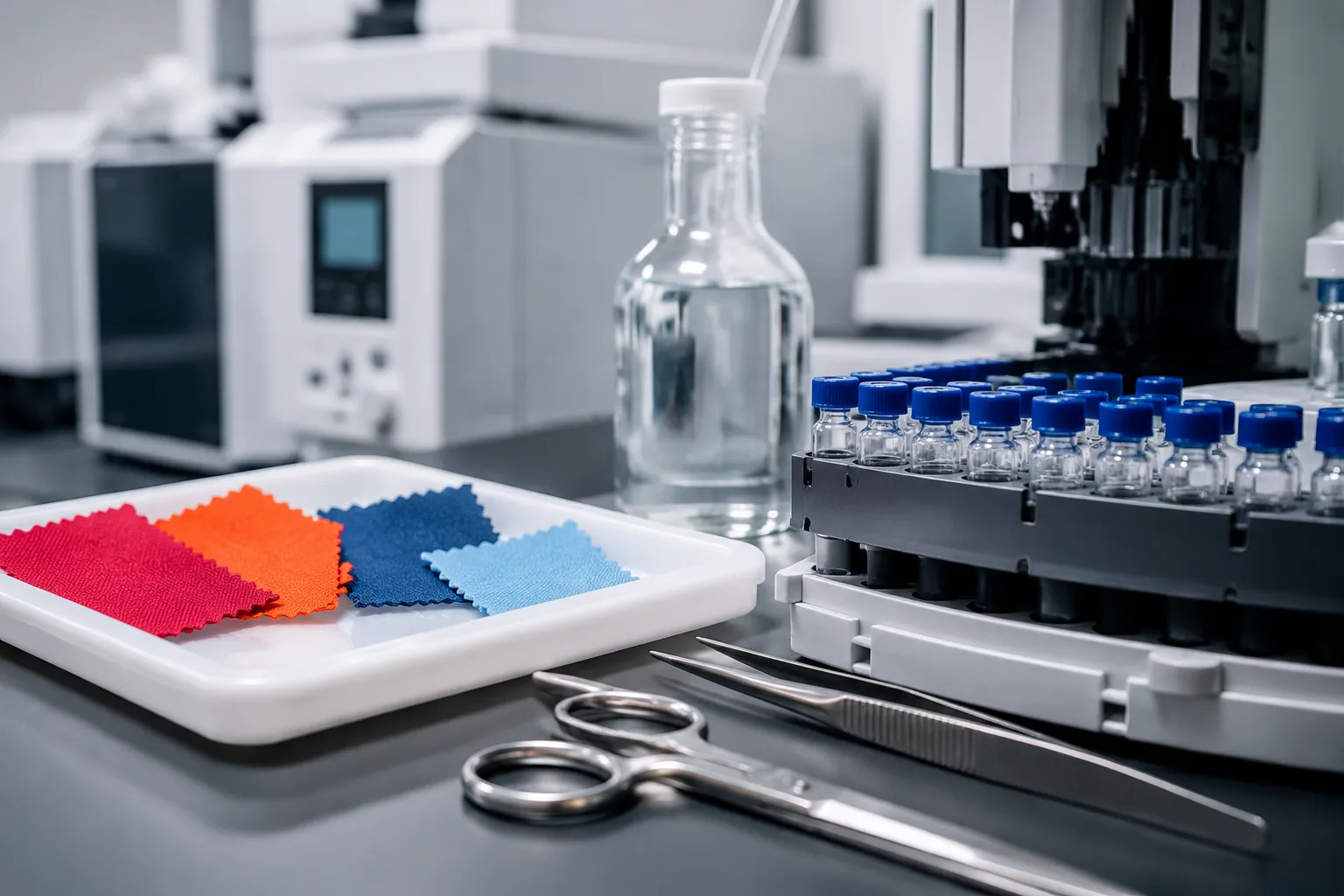
The test method makes a direct copy of this process in the laboratory. GB/T 17592 reduces the dye on the sample with sodium dithionite (Na₂S₂O₄) in a citrate buffer at pH 6 — the same reductive cleavage chemistry, performed under controlled conditions — and then measures the aromatic amines the dye releases. The test therefore asks the precise question the hazard poses: if a person wears this fabric, how much carcinogenic amine could the dye release? This is why the test targets the amines (benzidine, 2-naphthylamine, etc.) rather than the parent dyes, and why a result is reported as amine concentration in mg/kg, not as dye presence.
Which Amines and What Limit
The banned aromatic amines and their limits differ by matrix and by regulatory regime:
| Regulation / standard | Matrix | Number of amines | Limit |
|---|---|---|---|
| GB 18401-2010 | Textiles (all A/B/C classes) | 24 | ≤ 20 mg/kg each |
| GB 20400-2006 | Leather | 23 | ≤ 30 mg/kg each |
| EU REACH Annex XVII | Textile & leather (skin contact) | 22 | ≤ 30 mg/kg each |
| Japan (Household Goods Act) | Textiles | 24 | ≤ 30 mg/kg each |
Two compliance facts worth stating. First, China's GB 18401 is stricter than EU REACH on two axes: the limit is 20 mg/kg (vs REACH's 30), and it regulates 24 amines (vs REACH's 22) — the two additional amines being 2,4-dimethylaniline and 2,6-dimethylaniline. A textile that passes REACH can still fail GB 18401. Second, GB 18401 applies the 20 mg/kg limit uniformly across all three product classes (A infant, B skin-contact, C non-contact) — unlike some GB 18401 parameters (e.g., formaldehyde, pH) that are graded by class, the banned-amine requirement is absolute.
The 24 GB 18401 amines include the most hazardous: benzidine and 2-naphthylamine (both IARC Group 1 human carcinogens), 4-aminobiphenyl, o-toluidine, o-anisidine, 4-chloro-o-toluidine, and the dimethylanilines. These are the compounds whose release from azo dyes is the cancer risk the test exists to prevent.
The Test Method: GB/T 17592-2024
The test method for textiles is GB/T 17592-2024 (Textiles — Determination of Certain Banned Azo Colorants), implemented 2025-04-01, replacing the 2011 edition and aligning with the ISO 14362 series. The procedure, in outline:
- Sample preparation — a representative specimen is taken from the dyed part of the textile (the colored fabric, not the undyed ground), cut into small pieces.
- Reductive cleavage — the specimen is immersed in a citrate buffer (pH 6) and treated with sodium dithionite at 70 °C. This reductively cleaves the azo bonds in any azo dyes present, releasing the aromatic amines — the laboratory copy of the body's metabolism.
- Extraction — the released amines are extracted into an organic solvent (typically tert-butyl methyl ether) and concentrated.
- Instrumental analysis — the extract is analyzed by GC-MS (gas chromatography–mass spectrometry, the reference method) or HPLC-DAD (high-performance liquid chromatography with diode-array detection), identifying and quantifying each of the 24 target amines against calibration standards.
- Reporting — each detected amine is reported in mg/kg, and the sample passes only if every one of the 24 is ≤ 20 mg/kg.
A special case: 4-aminoazobenzene is one of the 24 amines, but it does not survive the standard dithionite cleavage cleanly (it undergoes further breakdown), so it is determined separately by GB/T 23344 (Textiles — Determination of 4-Aminoazobenzene). A complete GB 18401 amine panel therefore pairs GB/T 17592 (23 amines) with GB/T 23344 (the 24th).
Textile vs Leather vs Other Matrices
The matrix determines the standard set:
| Matrix | Limit standard | Method standard |
|---|---|---|
| Textiles (clothing, bedding, towels, fabrics) | GB 18401-2010 (24 amines, 20 mg/kg) | GB/T 17592-2024 + GB/T 23344 |
| Leather (footwear, gloves, bags, leather garments) | GB 20400-2006 (23 amines, 30 mg/kg) | GB/T 19942 (leather method) |
| Food-contact (paper, coatings migrating amines) | GB 31604 series | matrix-specific methods |
A textile-and-leather composite product (e.g., a shoe with textile upper and leather lining) is tested under both standard sets, on each material separately. The skin-contact scope matters: both GB 18401 and EU REACH focus on articles with prolonged skin or oral contact — clothing, bedding, towels, wigs, toys, wristwatch straps — because that is the exposure route the amine-release hazard follows.
How China Compares to the EU and Japan
| Aspect | China (GB 18401) | EU (REACH Annex XVII) | Japan |
|---|---|---|---|
| Amines regulated | 24 | 22 | 24 |
| Limit | 20 mg/kg | 30 mg/kg (30 ppm) | 30 mg/kg |
| Extra amines vs EU | 2,4- and 2,6-dimethylaniline | — | — |
| Matrix | Textiles | Textile & leather (skin contact) | Textiles |
The practical export consequence: a Chinese textile producer selling domestically reports against GB 18401 (20 mg/kg, 24 amines); the same producer exporting to the EU reports against REACH (30 mg/kg, 22 amines); and to Japan against its Household Goods Act (30 mg/kg, 24 amines). The Chinese regime is the strictest of the three on the limit value.
Why the Search Results Are Off the Compliance Intent
The search results for "carcinogenic aromatic amines dye testing" are dominated by content that is chemically rich but not compliance testing:
- Regulatory toxicology assessments (e.g., the Australian NICNAS IMAP report) explain the azo-reduction chemistry, the enzyme pathways, and the carcinogenicity — the hazard science, not the test procedure.
- EU REACH regulation pages state the Annex XVII ban and the 30 ppm limit but do not describe the GB method or the Chinese regime.
- Instrument application notes (SCIEX, Shimadzu) describe GC-MS / LC-MS-MS methods for the amines but as analytical-chemistry showcases, not as a compliance-test framework anchored to GB 18401.
None of these tells a textile or leather manufacturer which amines, what limit, what method, in which regime. That compliance question is what this article addresses.
Our Testing Capabilities
Beijing ZKGX Research conducts carcinogenic-aromatic-amine (banned-azo-dye) testing across textile and leather matrices:
- Textiles — the 24 GB 18401-2010 amines at the ≤ 20 mg/kg limit, by GB/T 17592-2024 (implemented 2025-04-01) for 23 amines and GB/T 23344 for 4-aminoazobenzene (the 24th).
- Leather — the 23 GB 20400-2006 amines at the ≤ 30 mg/kg limit, by GB/T 19942.
- Methods: reductive cleavage (sodium dithionite, citrate buffer pH 6) → solvent extraction → GC-MS (reference) and HPLC-DAD, with method detection limits well below the 20 mg/kg compliance floor.
- Export support: parallel reporting against EU REACH Annex XVII (22 amines, 30 mg/kg) and Japan's Household Goods Act (24 amines, 30 mg/kg) for products destined to those markets.
- Sample types: dyed textiles and fabrics, leather garments and accessories, textile toys, bedding, towels, and composite textile/leather products (each material tested under its own standard).
- Deliverable: a test report listing each of the target amines with its measured value (mg/kg), the method standard, the limit standard (GB 18401 / GB 20400 / REACH), and pass/fail.
If you have a textile or leather product requiring banned-azo-dye / aromatic-amine verification, contact our testing team to scope the matrix (textile vs leather), the target market (China / EU / Japan), and the applicable standard set.
Frequently Asked Questions
What standard governs carcinogenic aromatic amine dye testing?
For textiles it is GB 18401-2010 (24 amines, ≤ 20 mg/kg) tested by GB/T 17592-2024 (implemented 2025-04-01, replacing the 2011 edition), plus GB/T 23344 for 4-aminoazobenzene. For leather it is GB 20400-2006 (23 amines, ≤ 30 mg/kg) tested by GB/T 19942. EU REACH Annex XVII sets 22 amines at 30 mg/kg for skin-contact textile and leather.
Why does the test measure amines instead of the dyes?
Azo dyes are generally not carcinogenic themselves, but they release carcinogenic aromatic amines when the azo bond is reductively cleaved — a cleavage that occurs in the human body via liver enzymes, skin microflora, and intestinal bacteria. The test deliberately re-creates this reduction in the lab (sodium dithionite, citrate buffer pH 6) and measures the amines released, because the amine — not the parent dye — is the cancer hazard.
Is China's limit stricter than the EU's?
Yes. GB 18401-2010 sets the limit at 20 mg/kg for each of 24 amines; EU REACH sets 30 mg/kg for each of 22 amines. China is stricter on both the limit value (20 vs 30) and the amine count (24 vs 22, the extra two being 2,4- and 2,6-dimethylaniline). A textile that passes REACH can still fail GB 18401.
What is the most hazardous banned amine?
Benzidine and 2-naphthylamine — both classified by IARC as Group 1 (carcinogenic to humans). These are the strongest-known human bladder carcinogens among the aromatic amines and historically the cause of the dyestuffs-industry cancer clusters that motivated the original bans.
Is 4-aminoazobenzene tested by GB/T 17592?
No. 4-Aminoazobenzene does not survive the standard dithionite cleavage cleanly, so it is determined by a separate method, GB/T 23344 (Textiles — Determination of 4-Aminoazobenzene). A complete GB 18401 amine panel pairs GB/T 17592 (23 amines) with GB/T 23344 (the 24th).