Chemical oxygen demand (COD) testing is the laboratory measurement of the mass of oxygen equivalent consumed when the organic (and some inorganic) matter in a water or wastewater sample is oxidized by a strong chemical oxidant under defined conditions. COD is the primary fast indicator of organic pollution in water, and in China it is governed by the method standard HJ 828-2017 (the dichromate reflux-titration reference method, which replaced GB 11914-89 in 2017) or HJ/T 399-2007 (the fast digestion photometric method), and judged against the limit standards GB 3838-2002 (surface-water quality) and GB 8978-1996 (sewage discharge). A COD value without a named method standard and a named limit standard is a number without a compliance meaning.
What COD Measures and Why It Matters
COD, written CODCr when the dichromate oxidant is used, is reported in mg/L and represents the oxygen that the oxidizable matter in the sample would consume. The environmental logic: when wastewater with a high COD is discharged into a river or lake, the organic matter it carries is decomposed by bacteria, and those bacteria consume the receiving water's dissolved oxygen to do it. A high COD discharge therefore drives the receiving water toward hypoxia — the oxygen depletion that stresses and kills aquatic life. COD limits on effluent exist precisely to keep that depletion within what the receiving ecosystem can tolerate.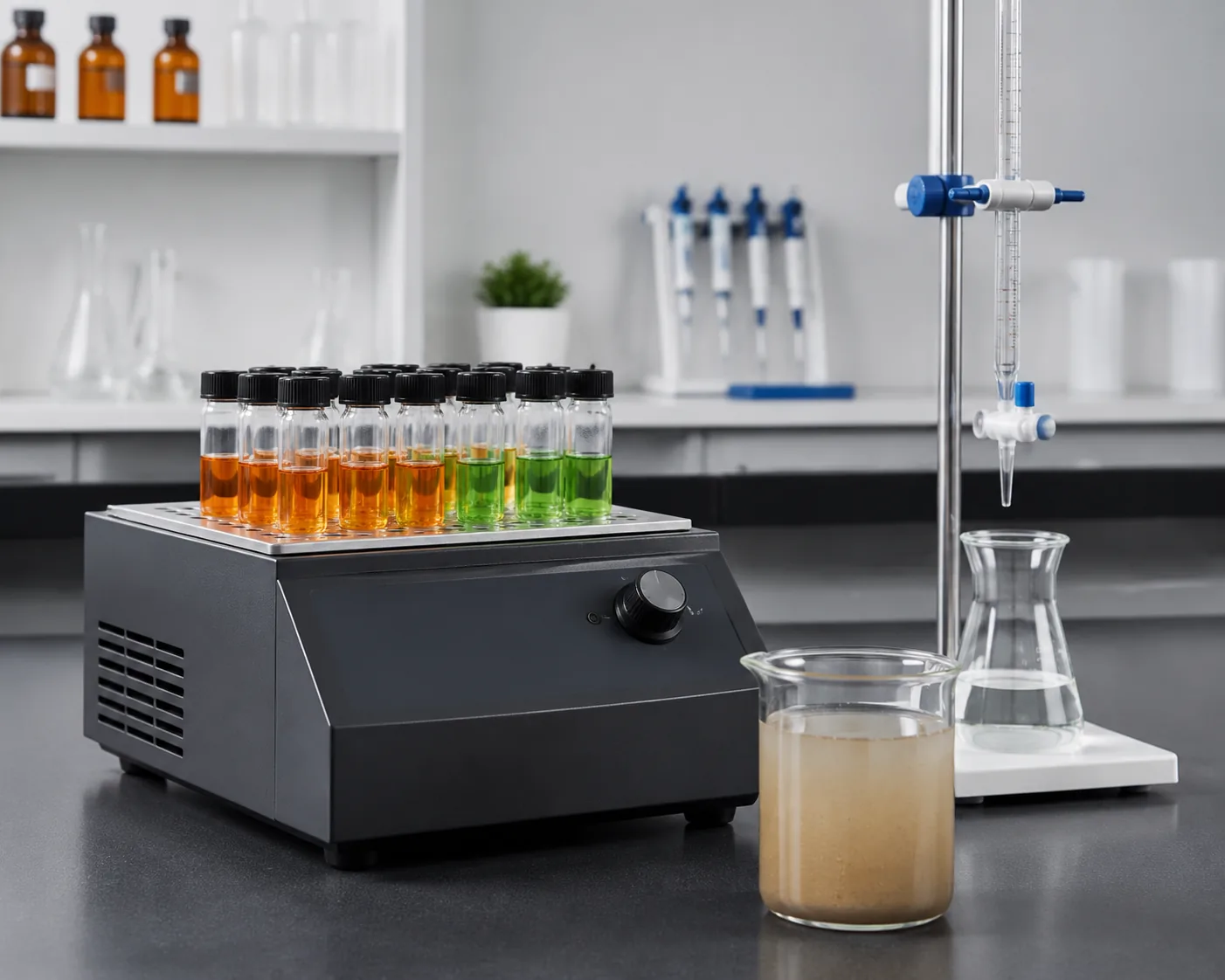
COD is one of three organic-pollution parameters that are commonly measured together, and they are not interchangeable:
| Parameter | What it measures | Time to result |
|---|---|---|
| COD (chemical oxygen demand) | Oxidizable matter by a chemical oxidant (dichromate) — fast, total | ~2 h (or ~20 min fast method) |
| BOD (biochemical oxygen demand) | Oxidizable matter by microbial action over 5 days (BOD₅) — biodegradable fraction only | 5 days |
| TOC (total organic carbon) | The carbon in organic matter, directly — fast, specific | minutes |
COD is the fast, total-oxidation indicator; BOD is the biodegradable-fraction indicator that takes five days; TOC measures the carbon directly. The three are correlated within a stable waste type but diverge when the waste composition changes, which is why a wastewater permit specifies which one is the compliance parameter (most commonly COD for its speed).
The Two Method Standards
China regulates two principal COD method standards, used for different throughput and precision needs:
| Standard | Method | Principle | When used |
|---|---|---|---|
| HJ 828-2017 | Dichromate reflux titration | Sample refluxed 2 h with K₂Cr₂O₇/H₂SO₄ + Ag₂SO₄ catalyst; unreacted dichromate titrated with ferrous ammonium sulfate (ferroin indicator) | The reference method — highest accuracy, used for compliance disputes and low-throughput work |
| HJ/T 399-2007 | Fast digestion photometry | Sample digested ~15 min at 165 °C in a sealed dichromate vial; absorbance read photometrically | Routine high-throughput monitoring (the Hach/Lovibond vial method) |
The method standards differ in oxidation completeness, detection principle, and throughput, but both report the same quantity (mg/L CODCr) and both are accepted for compliance reporting when applied within their scope. A report must name which method was used, because the limit and the method are paired.
The GB 11914-89 → HJ 828-2017 Transition
A correctness point worth stating because many references are out of date: GB 11914-89, the original "Water quality — Determination of COD — Dichromate method," was replaced by HJ 828-2017, effective 2017-05-01. The method content is the reflux-titration reference method; the standard was transferred from the GB system to the HJ (environmental-industry-standard) system and reissued with refined sampling volumes, mercury-sulfate masking amounts, and procedural detail. A current COD report cites HJ 828-2017, not GB 11914-89. Citing the 1989 standard on a current report is a staleness flag.
The Chloride-Interference Limitation
The dichromate method has a known limitation: chloride ion is oxidized by dichromate and inflates the COD result. HJ 828 handles this by adding mercury sulfate (HgSO₄) to mask chloride, but the masking works only up to a chloride concentration of about 1000 mg/L. For high-chloride wastewater (seawater, brine, certain industrial effluents) where Cl⁻ exceeds 1000 mg/L, HJ 828 does not apply and HJ/T 70 (the chloride-correction method) is used instead — it measures and subtracts the chloride contribution. A COD report on a high-chloride matrix that does not cite HJ/T 70 is suspect.
The Two Limit Standards
A COD measurement has no compliance meaning until it is compared against a limit, and the limit depends on whether the water is receiving environment (how clean should the river be) or effluent (how dirty may the discharge be):
GB 3838-2002 (Environmental Quality Standard for Surface Water) sets the receiving-water quality classes:
| Class | I / II | III | IV | V |
|---|---|---|---|---|
| COD (mg/L) ≤ | 15 | 20 | 30 | 40 |
Class I/II is source water and drinking-water-source protection zones; III is secondary drinking-water source and fisheries; IV is industrial and non-contact recreational; V is agricultural and landscape.
GB 8978-1996 (Integrated Wastewater Discharge Standard) sets the effluent limits, graded by the class of the receiving water:
| Discharge grade | Receiving water | COD limit (mg/L) |
|---|---|---|
| First grade | GB 3838 Class III waters | ≤ 100 (most industries); ≤ 60 (petrochemical, municipal WWTP) |
| Second grade | GB 3838 Class IV/V waters | ≤ 150–300 (industry-specific) |
| Third grade | Sewer to municipal WWTP | ≤ 500–1000 |
The practical logic: a factory discharging into a Class III river must meet the first-grade limit (typically COD ≤ 100 mg/L); the same factory discharging into a sewer to a municipal treatment plant may discharge at the third-grade limit. Many industries have their own discharge standards that supersede GB 8978 (e.g., the electroplating, pharmaceutical, and paper industries have industry-specific pollutant discharge standards).
How the Test Is Performed (Dichromate Reference Method)
The HJ 828 reference procedure, which the fast-photometric method approximates at lower effort:
- A measured sample volume is placed in a reflux flask with a known excess of potassium dichromate solution, sulfuric acid (the reaction medium), silver sulfate catalyst, and mercury sulfate (to mask chloride).
- The mixture is refluxed for 2 hours — the defined oxidation time that ensures consistent completeness.
- After cooling, the unreacted dichromate is titrated with standardized ferrous ammonium sulfate, using ferroin as the redox indicator (the color change from blue-green to reddish-brown marks the endpoint).
- The COD is calculated from the difference between the dichromate added and the dichromate remaining, expressed as the oxygen equivalent in mg/L.
The fast photometric method (HJ/T 399) compresses steps 2–4: a sealed dichromate vial is digested at 165 °C for ~15 minutes and the absorbance is read directly, exploiting the color change from orange (Cr⁶⁺) to green (Cr³⁺) as the measure of dichromate consumed. The vial ranges are typically 0–150, 0–1500, and 0–15000 mg/L, and the range is chosen by the expected COD level.
Our Testing Capabilities
Beijing ZKGX Research conducts COD testing across the HJ method standards and against the Chinese limit standards:
- Methods: HJ 828-2017 (dichromate reflux titration, the reference method) and HJ/T 399-2007 (fast digestion photometry) for routine and high-throughput work; HJ/T 70 (chloride-correction method) for high-chloride wastewater above 1000 mg/L Cl⁻.
- Sample matrices: surface water, groundwater, domestic sewage, and industrial effluent; samples analyzed within 24 h of collection per the standard's preservation requirement.
- Limit reporting: COD results reported against GB 3838-2002 (surface-water class) and GB 8978-1996 (discharge grade), with the applicable class/grade and pass/fail stated.
- Companion parameters: BOD₅ and TOC, for the full organic-pollution panel where a permit requires more than COD alone.
- Deliverable: a test report stating the method standard, the matrix, the measured COD (mg/L), the applicable limit standard and class/grade, and pass/fail.
If you have a water or wastewater sample requiring COD determination, contact our testing team to scope the method (reflux vs fast photometric), the chloride level, and the applicable discharge or surface-water limit.
Frequently Asked Questions
What standard governns COD testing?
The method standards are HJ 828-2017 (dichromate reflux titration, the reference method that replaced GB 11914-89 in 2017) and HJ/T 399-2007 (fast digestion photometry). High-chloride wastewater above 1000 mg/L Cl⁻ uses HJ/T 70 (chloride correction). The limit standards are GB 3838-2002 for surface-water quality (COD 15–40 mg/L by class) and GB 8978-1996 for sewage discharge (60–1000 mg/L by grade).
What is the difference between HJ 828 and HJ/T 399?
HJ 828-2017 is the reflux-titration reference method — 2 hours of reflux followed by titration, the highest accuracy, used for disputes and low-throughput work. HJ/T 399-2007 is the fast digestion photometric method — ~15 minutes at 165 °C in a sealed vial, read by absorbance, used for routine high-throughput monitoring. Both report mg/L CODCr.
What replaced GB 11914-89?
GB 11914-89 (Water quality — Determination of COD — Dichromate method) was replaced by HJ 828-2017, effective 2017-05-01. The method content is the same reflux-titration reference method, transferred from the GB system to the HJ environmental-standard system with refined procedural detail. A current COD report cites HJ 828-2017.
What is the COD limit for wastewater discharge?
Under GB 8978-1996, the first-grade discharge limit (into GB 3838 Class III waters) is typically COD ≤ 100 mg/L, or ≤ 60 mg/L for petrochemical and municipal WWTP discharge; second-grade (into Class IV/V waters) is 150–300 mg/L by industry; third-grade (to sewer/municipal WWTP) is 500–1000 mg/L. Industry-specific discharge standards may supersede these.
What is the difference between COD, BOD, and TOC?
COD measures oxidizable matter by a chemical oxidant in ~2 hours (total oxidation). BOD measures the biodegradable fraction by microbial action over 5 days. TOC measures the organic carbon directly in minutes. COD is the fast total-oxidation indicator; BOD is the biodegradable fraction; TOC is the carbon-specific measure. The three are correlated within a stable waste type but diverge when composition changes.