Comparative Tracking Index (CTI) testing is the laboratory measurement of a solid insulating material's resistance to electrical tracking — the progressive formation of a conductive carbonized path across the material's surface under moisture, contamination, and sustained voltage stress. The test is governed by the method standard GB/T 4207-2022 (Method for the Determination of the Proof and the Comparative Tracking Indices of Solid Insulating Materials), the identical adoption of IEC 60112:2020, which replaced GB/T 4207-2012. The result, reported in volts, determines the material's insulation material group (I–IV), which in turn sets the minimum creepage distance the material is allowed to use in equipment insulation coordination (GB/T 16935.1 / IEC 60664-1). The single most important fact about the test — and the one the search results routinely miss — is that GB/T 4207 defines two distinct indices, PTI and CTI, that answer different questions.
The Two Indices: PTI and CTI
The 2022 title of GB/T 4207 names two indices, and they are not the same test:
| PTI (Proof Tracking Index) | CTI (Comparative Tracking Index) | |
|---|---|---|
| What it answers | "Does this material pass at this specified voltage?" | "At what voltage does this material fail?" |
| Method | Verification: 50 drops at a single specified test voltage; pass or fail | Comparative: voltage stepped down from a failure to find the maximum passing voltage |
| Use | Quality control, lot acceptance, accept/reject against a specification | Material characterization, comparison between materials |
| Reported as | PTI = 175 V (passed at 175 V) | CTI = 250 V (failed above 250 V) |
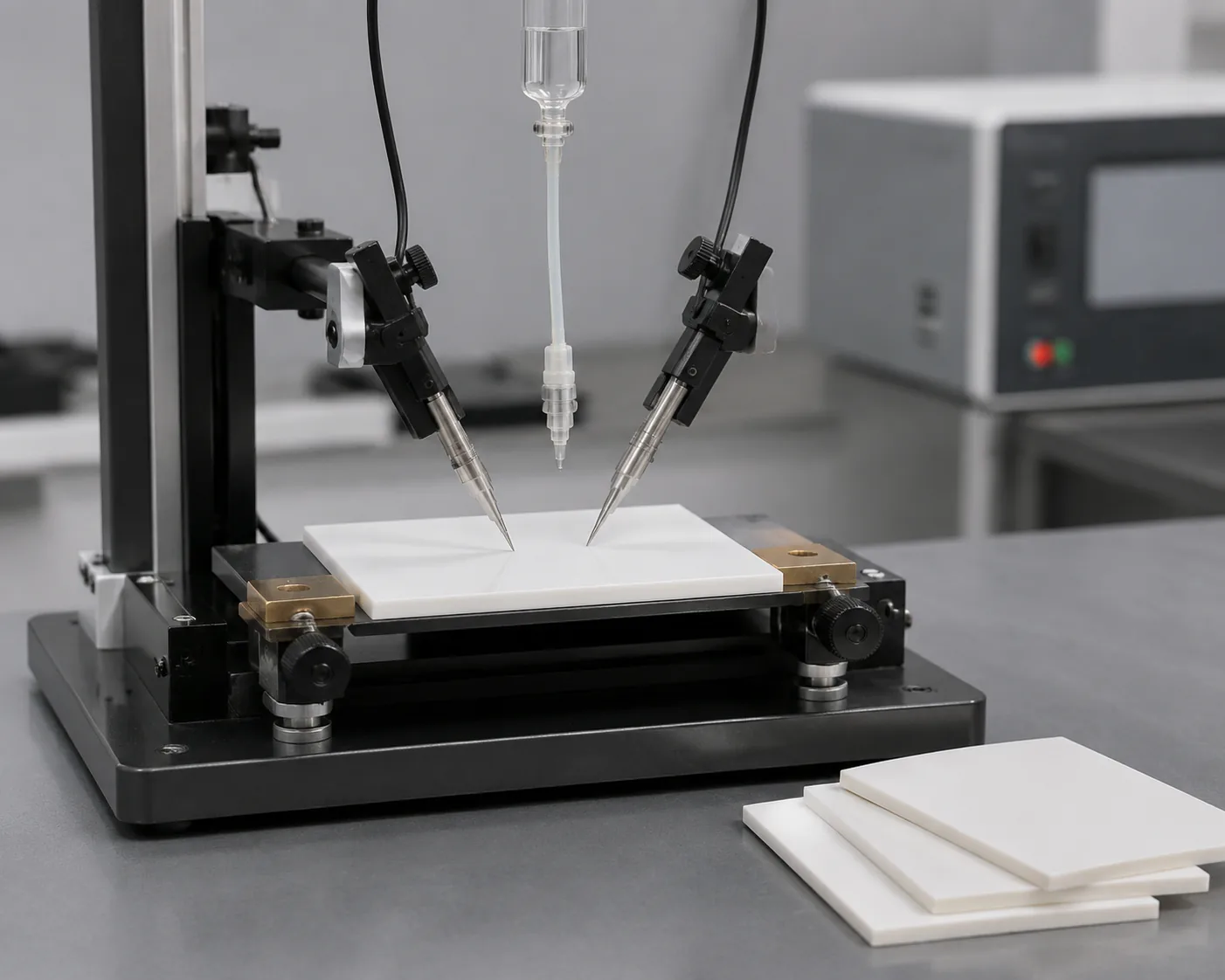
PTI is the verification index: it confirms that a material withstands 50 drops of electrolyte at a single declared voltage, used for incoming-inspection lot acceptance and for compliance against a specification that names a voltage. CTI is the characterization index: it finds the actual voltage at which the material fails, used to compare materials and to assign the material to its insulation group. A report that reports "CTI 175 V" without stating whether it is a PTI pass or a stepped CTI result is ambiguous — the two indices share a voltage scale but have different procedural meanings.
The 2022 Title Change
GB/T 4207-2022 carried the dual PTI/CTI title forward from the 2012 edition but added the electrical-erosion determination procedure (电蚀损测定) and updated the term "resistivity" to "conductivity" (电导率) to align with the 2020 IEC edition. A current report cites GB/T 4207-2022 (IDT IEC 60112:2020); the 2012 edition is withdrawn.
The Tracking Phenomenon
Tracking is the failure mode the test exists to measure. When a solid insulating surface is exposed to moisture and contamination in the presence of a sustained voltage difference, a small leakage current flows across the wet, contaminated surface. That current locally heats the material, carbonizing it; the carbonized track is conductive, so it concentrates the field at its tip, extending the track further. The process is progressive — each cycle of wetting and drying extends the carbonized path — until the track bridges the gap between conductors, creating a permanent short circuit that can cause equipment failure or fire.
Tracking is distinct from the bulk dielectric breakdown of the material (a through-thickness puncture) and from surface flashover (an instantaneous arc across a clean dry surface). Tracking is specifically the progressive carbonization of the surface, and it is accelerated by the exact conditions of outdoor, humid, or contaminated service — which is why the CTI value matters most for materials in those environments.
The Test Method
The GB/T 4207 / IEC 60112 procedure:
- Specimen — a flat plate of the solid insulating material, ≥3 mm thick (the result at 3 mm is taken as representative of the material's performance at any thickness).
- Electrodes — two platinum electrodes, shaped to a defined chisel geometry, placed on the specimen surface at a defined separation and angle (30° to the surface), each loaded with a defined force.
- Electrolyte — a 0.1 % ammonium-chloride (NH₄Cl) solution, the standardized contaminant that simulates the moisture-plus-salt conditions of real service.
- Drops — the electrolyte is dropped onto the specimen surface between the electrodes at a defined rate and drop size, with the test voltage applied between the electrodes.
- Failure criterion — tracking is judged to have occurred when the leakage current exceeds a defined value (>0.5 A for >2 s) or when the specimen burns; the test at that voltage is a fail.
- PTI test — 50 drops at the specified voltage; a pass means the material withstood 50 drops without tracking.
- CTI test — the voltage at which the material fails is found by stepping down from an initial failure; the CTI is the maximum voltage at which 50 drops pass.
CTI → Material Group → Creepage Distance
The CTI value is not an end in itself; it is the input to the insulation coordination of equipment. GB/T 16935.1 (Insulation Coordination for Equipment within Low-Voltage Systems, IDT IEC 60664-1) assigns solid insulating materials to four material groups by CTI:
| Material group | CTI range |
|---|---|
| I | ≥ 600 V |
| II | 400 – 599 V |
| III a | 250 – 399 V |
| III b | 175 – 249 V |
The material group then sets the minimum creepage distance the material is allowed to use at a given working voltage and pollution degree — a higher CTI (lower group number) permits a smaller creepage distance, which is why high-CTI materials enable more compact equipment. This is the link the PCB-selection guides describe for board layout, but it applies to all equipment insulation coordination, not only PCBs. Most standard FR-4 laminates fall in group III a/b (CTI 175–249 V), while high-reliability applications specify group I/II materials (CTI ≥ 400 V) to allow tighter creepage in high-voltage, miniaturized designs.
How GB/IEC Maps to the UL PLC System
The search results heavily reference the UL 746A Performance Level Category (PLC) system. UL PLC and GB/IEC material groups classify the same property on two different scales, and a comparison is useful:
| CTI (GB/T 4207 / IEC 60112) | UL 746A PLC | GB/IEC material group |
|---|---|---|
| ≥ 600 V | 0 | I |
| 400 – 599 V | 1 | II |
| 250 – 399 V | 2 | III a |
| 175 – 249 V | 3 | III b |
| 100 – 174 V | 4 | (below group III b) |
| < 100 V | 5 | (below group III b) |
The UL PLC system was introduced to avoid the "implied precision" of quoting an exact CTI voltage (PLC 3 covers the 175–249 V band rather than quoting "CTI 220 V"). A Chinese-market report cites GB/T 4207-2022 with the CTI value and material group; a US-market report cites UL 746A with the PLC category; the two are describing the same measured performance.
Why the Search Results Are Off the Compliance Intent
The search results for "Comparative Tracking Index" are dominated by content that explains the concept but does not frame the GB compliance framework:
- PCB material-selection guides (Ucreate, LinkedIn) explain CTI's role in PCB creepage design and cite IPC-2221 and IEC 60950 — competent, but PCB-industry scope, with no GB standard.
- UL 746A PLC tables and TI digital-isolator datasheets describe the PLC 0–5 system at the device level — UL-system content, with no GB.
- General CTI definitions describe the tracking phenomenon with creepage/clearance diagrams but cite neither GB/T 4207 nor the PTI/CTI distinction.
None tells an insulation-material manufacturer, an appliance maker, or a compliance engineer which GB standard applies, how PTI differs from CTI, or how the CTI value feeds the GB/T 16935.1 creepage-distance coordination. That compliance question is what this article addresses.
Our Testing Capabilities
Beijing ZKGX Research conducts Comparative Tracking Index testing to GB/T 4207-2022:
- Standard: GB/T 4207-2022 (IDT IEC 60112:2020), the current edition replacing GB/T 4207-2012. International reports to IEC 60112:2020 or ASTM D3638 on request.
- Indices: both PTI (proof tracking index — 50-drop verification at a specified voltage) and CTI (comparative tracking index — stepped voltage to find the failure point), reported distinctly per the standard.
- Test: platinum chisel electrodes at 30°, 0.1 % NH₄Cl electrolyte, 50-drop protocol, at ≥3 mm specimen thickness.
- Material-group assignment: the CTI value mapped to GB/T 16935.1 (IDT IEC 60664-1) insulation material groups I / II / III a / III b, for creepage-distance coordination.
- Sample types: solid insulating materials — plastics, rubbers, laminates (FR-4 and high-CTI PCB laminates), potting compounds, and device packages.
- Deliverable: a test report stating the index type (PTI or CTI), the voltage, the standard (GB/T 4207-2022 / IEC 60112:2020), the material group, and the test conditions.
If you have an insulating material requiring CTI/PTI verification, contact our testing team to scope the index type (PTI verification vs CTI characterization), the test voltage, and the material-group target.
Frequently Asked Questions
What standard governns CTI testing?
In China, GB/T 4207-2022 (Method for the Determination of the Proof and the Comparative Tracking Indices of Solid Insulating Materials), the identical adoption (IDT) of IEC 60112:2020, replacing GB/T 4207-2012. In the US, UL 746A applies; ASTM D3638 is an alternative method. The GB/IEC, UL, and ASTM methods measure the same property.
What is the difference between PTI and CTI?
PTI (Proof Tracking Index) is a verification test: 50 drops of electrolyte at a single specified voltage, pass or fail — used for lot acceptance and compliance against a declared voltage. CTI (Comparative Tracking Index) is a characterization test: the voltage is stepped to find the maximum voltage at which 50 drops pass — used to compare materials and assign the material group. They share a voltage scale but answer different questions.
What replaced GB/T 4207-2012?
GB/T 4207-2012 was replaced by GB/T 4207-2022, the IDT adoption of IEC 60112:2020. The 2022 edition added the electrical-erosion determination procedure and updated the term "resistivity" to "conductivity" to align with the 2020 IEC edition. A current report cites GB/T 4207-2022.
How does CTI relate to creepage distance?
The CTI value assigns the material to one of four insulation material groups (I ≥600 V, II 400–599 V, III a 250–399 V, III b 175–249 V) per GB/T 16935.1 (IDT IEC 60664-1). The material group then sets the minimum creepage distance the material is allowed to use at a given working voltage and pollution degree. A higher CTI (lower group number) permits a smaller creepage distance, enabling more compact equipment design.
How does the GB/IEC material group compare to the UL PLC?
They are two classification scales for the same property. UL PLC 0 = CTI ≥600 V = group I; PLC 1 = 400–599 V = group II; PLC 2 = 250–399 V = group III a; PLC 3 = 175–249 V = group III b. The UL PLC system groups the values into bands to avoid the implied precision of quoting an exact CTI voltage. A Chinese report cites GB/T 4207 with the material group; a US report cites UL 746A with the PLC.