Crystal oscillator testing is the laboratory verification of whether a quartz crystal oscillator meets its declared frequency accuracy and stability over temperature, supply, load, and time, against the methods and requirements of IEC 60679-1 (adopted in China as GB/T 12274.1). The test scope breaks into five measurements: frequency tolerance at reference temperature, frequency stability over temperature, aging over time, phase noise, and the load-capacitance match that determines whether the oscillator actually runs at its nominal frequency in circuit.
What Does Crystal Oscillator Testing Measure?
A crystal oscillator uses the piezoelectric resonance of a quartz blank (most commonly an AT-cut) as the frequency-determining element of an oscillator circuit. Because the resonance is fixed by the blank's physical dimensions and cut, it is far more stable than an RC or LC oscillator — which is why crystals are the timing reference in microcontrollers, communication systems, and instruments. Testing measures how closely the oscillator's actual output tracks its nominal frequency under the conditions it will meet in service.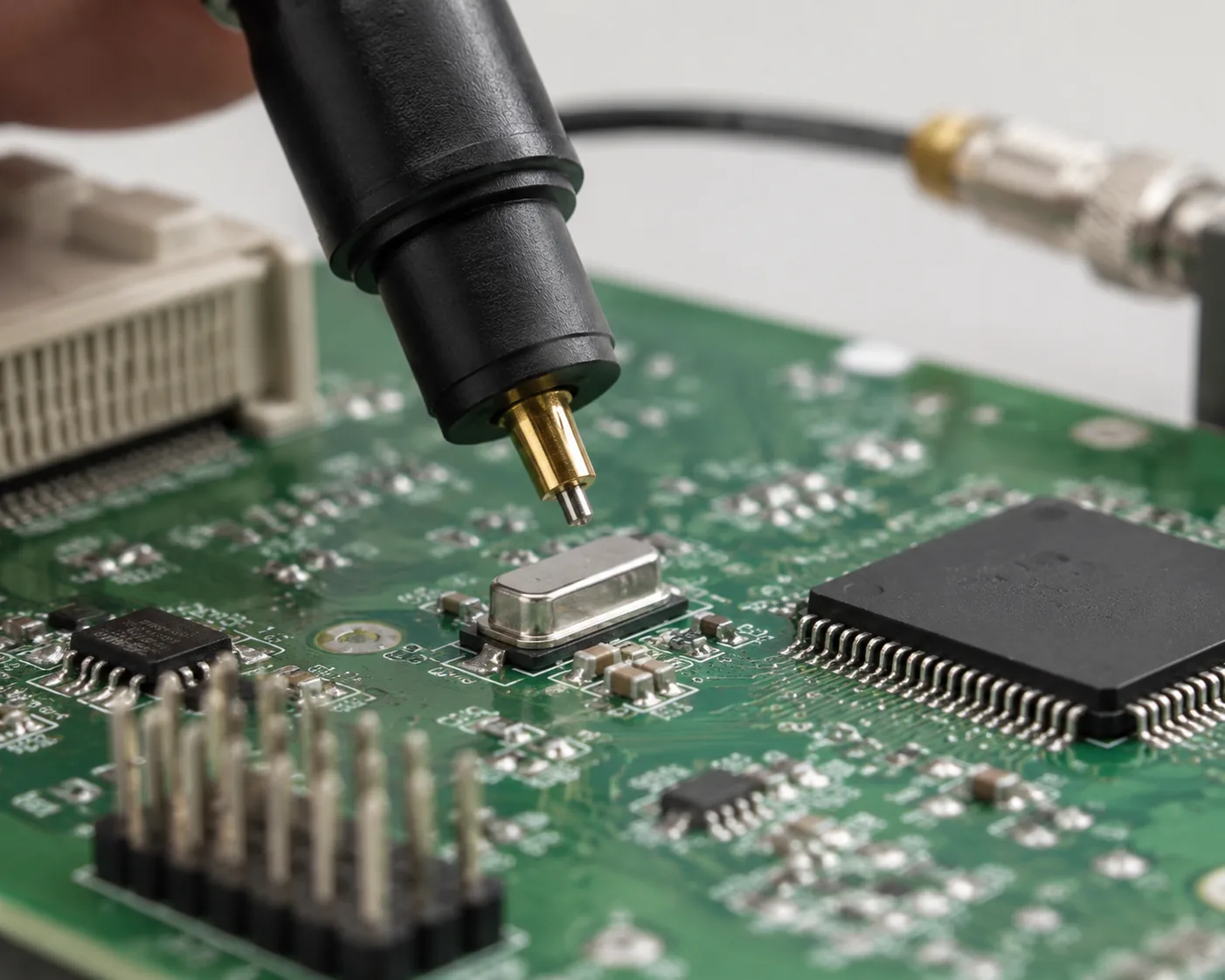
The parameters a laboratory report covers, grouped by the physical quantity they describe:
| Parameter | What it measures | Units |
|---|---|---|
| Frequency tolerance | Deviation from nominal at reference temperature (25 °C) | ppm |
| Frequency stability (vs. temperature) | Max shift across the operating range (e.g., −40 to +85 °C) | ppm |
| Aging | Slow frequency drift over time (first year, and per year after) | ppm / year |
| Phase noise / jitter | Short-term frequency instability in the frequency or time domain | dBc/Hz, ps |
| Load capacitance (CL) match | Whether the circuit's load capacitance equals the crystal's nominal CL | pF |
| Start-up time | Time from power-on to stable oscillation | ms |
A crystal that is "good" is one whose total frequency error — the sum of tolerance, stability, and aging — stays within the budget the application allows. That budget view is the correct way to read a crystal test report, and it is the part most explanations omit.
Which Standard Governs Crystal Oscillator Testing?
The governing standards, with a distinction that is frequently confused:
| Document | Scope | Status |
|---|---|---|
| IEC 60679-1 | Quartz crystal controlled oscillators of assessed quality — generic specification & test methods | IEC TC 49; current edition 2007 + amendment |
| GB/T 12274.1-2012 | CN equivalent of IEC 60679-1 — quartz crystal oscillators, generic specification | Current in China |
| IEC 1178-1 / GB/T 12273.1-2017 | Quartz crystal units/resonators (the bare blank, not the oscillator) | Different object, different standard |
The point worth stating plainly: the standard for the oscillator (the complete component that includes the crystal plus the sustaining circuitry) is IEC 60679-1 / GB/T 12274.1. The standard for the bare crystal unit (the resonator measured by itself, before it is built into a circuit) is IEC 1178-1 / GB/T 12273. These are two different objects governed by two different standards, and a test report that names the wrong one — quoting GB/T 12273 for an oscillator, for example — is a category error. This article addresses the oscillator; the resonator is a separate test.
The Total Frequency Error Budget
The single most useful way to think about crystal accuracy is the total error budget, because no single parameter tells you whether a crystal will keep time in your application. The budget is the sum of three independent contributions:
Total error ≈ frequency tolerance + frequency stability + aging
A worked example for a consumer-grade AT-cut crystal:
| Contribution | Typical value | Driven by |
|---|---|---|
| Frequency tolerance (25 °C) | ±10 ppm | Blank manufacturing and calibration |
| Frequency stability (−40 to +85 °C) | ±20 ppm | The AT-cut cubic temperature curve |
| Aging (first year) | ±3 ppm | Stress relaxation and contamination migration |
| Total first-year error | ≈ ±33 ppm | Sum of the three |
An application that requires ±25 ppm total cannot be met by a crystal whose tolerance alone is ±50 ppm, regardless of how good its stability or aging are — the budget must add up. The first test-report question is therefore not "what is the frequency accuracy?" but "do tolerance + stability + aging fit my budget?" The three numbers are measured separately because they respond to different stresses and are improved by different means.
How Is Each Parameter Tested?
Frequency tolerance is measured at reference conditions (25 °C, nominal supply, nominal load) by comparing the oscillator output against a frequency reference of far higher stability (a rubidium or OCXO reference, or a calibrated counter). Acceptance is the datasheet tolerance band — commonly ±10, ±20, ±30, or ±50 ppm. The critical measurement pitfall: the crystal must not be probed directly with an oscilloscope probe, because a typical probe adds ~0.5 pF (and high-capacitance probes far more) to the load, pulling the frequency off by the crystal's trim sensitivity (a few to tens of ppm per pF). The correct methods are a buffered MCU clock-out pin into a frequency counter, or a near-field E-field probe into a spectrum analyzer with a narrow resolution bandwidth (10–100 Hz) — both achieving instrument accuracy of roughly ±1 ppm without disturbing the oscillation.
Frequency stability vs. temperature is measured by sweeping the oscillator through its operating range (typically −40 to +85 °C) in a thermal chamber while continuously logging frequency. The AT-cut's appeal is its cubic frequency-temperature curve, which keeps the peak-to-peak shift small over a wide band; typical stability values are ±20, ±50, or ±100 ppm. The reported value is the maximum excursion from the 25 °C reference across the sweep.
Aging is the slow frequency drift over time, measured by running the oscillator continuously under standard conditions and logging frequency against a reference over days to weeks, then extrapolated. Aging is highest in the first 30–60 days (stress relaxation, contamination migration in the holder) and then decays. Typical values for an AT-cut oscillator are on the order of ±5 ppm in the first year and ±3 ppm per year thereafter; inexpensive XOs may be ±15 ppm/year, while TCXO/OCXO grades reach ±0.5 to ±2 ppm/year. Because aging is a time effect and stability is a temperature effect, the two must be measured and specified separately — a confusion that produces meaningless specifications.
Phase noise / jitter measures the short-term instability: phase noise in the frequency domain (dBc/Hz at a given offset from the carrier) or its time-domain counterpart, jitter (ps rms). Measured with a phase-noise analyzer or high-end spectrum analyzer. A high-Q crystal (Q of 10,000–100,000+) yields low close-in phase noise, which is why crystals are preferred over RC or LC references in precision applications.
Load-capacitance (CL) match verifies that the circuit's total load capacitance equals the crystal's nominal CL, because frequency accuracy depends on it. CL is measured without contacting the crystal (a near-field probe above the circuit), then the crystal is removed and measured on a crystal network analyzer at nominal CL. Mismatch is corrected by changing the external load capacitors; typical nominal CL values are 9–30 pF (18 and 20 pF being the most common).
How to Test Without Disturbing the Oscillation
The non-contact measurement principle deserves its own section because it is the single most common source of bad crystal data. Any direct probe contact with the crystal terminals or the load capacitors adds parasitic capacitance to the resonant circuit, which pulls the frequency by the crystal's trim sensitivity and can even stop a marginal oscillator. The accepted non-contact methods are:
- Buffered clock-out into a frequency counter — many MCUs expose a digital "master clock-out" pin that mirrors the oscillator; feeding this to a calibrated counter (±1 ppm or better) measures the frequency without loading the resonator. Requires firmware but no hardware change.
- Near-field E-field probe into a spectrum analyzer — hold a small E-field probe near the oscillating crystal; the analyzer, with RBW reduced to 10–100 Hz for fine resolution, reads the carrier frequency to roughly ±1 ppm. Hardware-only, no firmware.
- Crystal network analyzer (for the removed component) — for CL match and the bare resonator parameters, the crystal is desoldered and characterized off-circuit at its nominal CL.
The rule: if a measurement contacts the crystal terminals, the result is suspect. Validated crystal testing is non-contact.
Our Testing Capabilities
Beijing ZKGX Research conducts crystal oscillator testing to IEC 60679-1 / GB/T 12274.1:
- Standards basis: IEC 60679-1 and GB/T 12274.1-2012 for crystal oscillators; the resonator-unit standard GB/T 12273.1 / IEC 1178-1 is covered as a separate test for bare crystals.
- Measured parameters: frequency tolerance (at 25 °C), frequency stability over the full operating temperature range, aging over time, phase noise/jitter, and load-capacitance match.
- Methods: non-contact near-field probe + spectrum analyzer / frequency counter (±1 ppm class instrument accuracy); thermal-chamber temperature sweep; crystal network analyzer for CL and bare-resonator parameters.
- Sample types: AT-cut XOs, TCXOs, OCXOs, VCXOs, and MCU-mounted crystal circuits; through-hole and surface-mount packages.
- Deliverable: a test report giving, for each parameter, the measured value, the test condition, and pass/fail against the declared datasheet limit — plus the assembled total error budget (tolerance + stability + aging).
If you have a crystal oscillator or crystal unit requiring verification, contact our testing team to scope the parameters, the temperature range, and the applicable standard.
Frequently Asked Questions
What standard governs crystal oscillator testing?
Crystal oscillators (the complete component with the sustaining circuitry) are tested to IEC 60679-1, adopted in China as GB/T 12274.1-2012. The bare quartz crystal unit (the resonator alone) is a different object tested to IEC 1178-1 / GB/T 12273.1-2017 — the two standards are not interchangeable.
What is the difference between frequency tolerance, stability, and aging?
Tolerance is the deviation from nominal at 25 °C, set by manufacturing. Stability is the maximum shift across the operating temperature range, set by the crystal cut's temperature curve. Aging is the slow drift over time, set by stress relaxation and contamination. They are three independent contributions that sum into the total frequency error budget.
What is a typical crystal oscillator aging rate?
For a standard AT-cut oscillator it is on the order of ±5 ppm in the first year and ±3 ppm per year thereafter, with the highest drift in the first 30–60 days. Inexpensive XOs may be up to ±15 ppm/year; high-grade TCXO/OCXO reach ±0.5 to ±2 ppm/year.
Why can't I probe a crystal directly with an oscilloscope?
A typical oscilloscope probe adds roughly 0.5 pF of capacitance (high-capacitance probes far more) to the crystal's load. Because the frequency is sensitive to load capacitance (the trim sensitivity, in ppm per pF), this pulls the measured frequency off the true value and can stop a marginal oscillator. Validated measurement is non-contact — via an MCU clock-out pin to a counter, or a near-field probe to a spectrum analyzer.
What is a normal load capacitance (CL) for a crystal?
Common nominal CL values are 9 pF to 30 pF, with 18 pF and 20 pF the most frequently specified. The circuit's total load capacitance must match the crystal's nominal CL for the frequency to land on target; mismatch is corrected by changing the external load capacitors.