The damp heat steady-state test (IEC 60068-2-78, Test Cab; GB/T 2423.3) is the environmental test that exposes a specimen to a constant, elevated temperature and relative humidity for a prescribed duration, deliberately without producing condensation, so that the dominant failure mechanism is moisture absorption into materials rather than surface wetting. It is the steady-state counterpart of the cyclic Damp Heat Test (IEC 60068-2-30), and the two are chosen according to which mechanism — absorption or condensation — the product must survive.
What Is the Damp Heat Steady-State Test?
IEC 60068-2-78:2025 (Environmental testing — Part 2-78: Tests — Test Cab: Damp heat, steady state), adopted in China as GB/T 2423.3, holds a specimen at a fixed temperature and relative humidity for a defined period. Its purpose is to assess how electrical, electronic, and other products withstand prolonged exposure to high humidity at constant temperature — the conditions of tropical, coastal, or continuously humid service and storage environments.
The defining trait of Test Cab, and the fact that most distinguishes it from every other humidity test, is that it is designed not to produce condensation. The chamber conditions are ramped so that the specimen surface temperature never falls below the dew point; moisture therefore enters the specimen by absorption (and diffusion/adsorption) into materials — plastics swelling, coatings permeating, insulation resistance dropping as water penetrates — rather than by forming liquid water on the surface. This makes Test Cab the test for absorption-driven failures: long-term moisture ingress, bulk-material degradation, and insulation-resistance loss. Surface-condensation failures belong to the cyclic test.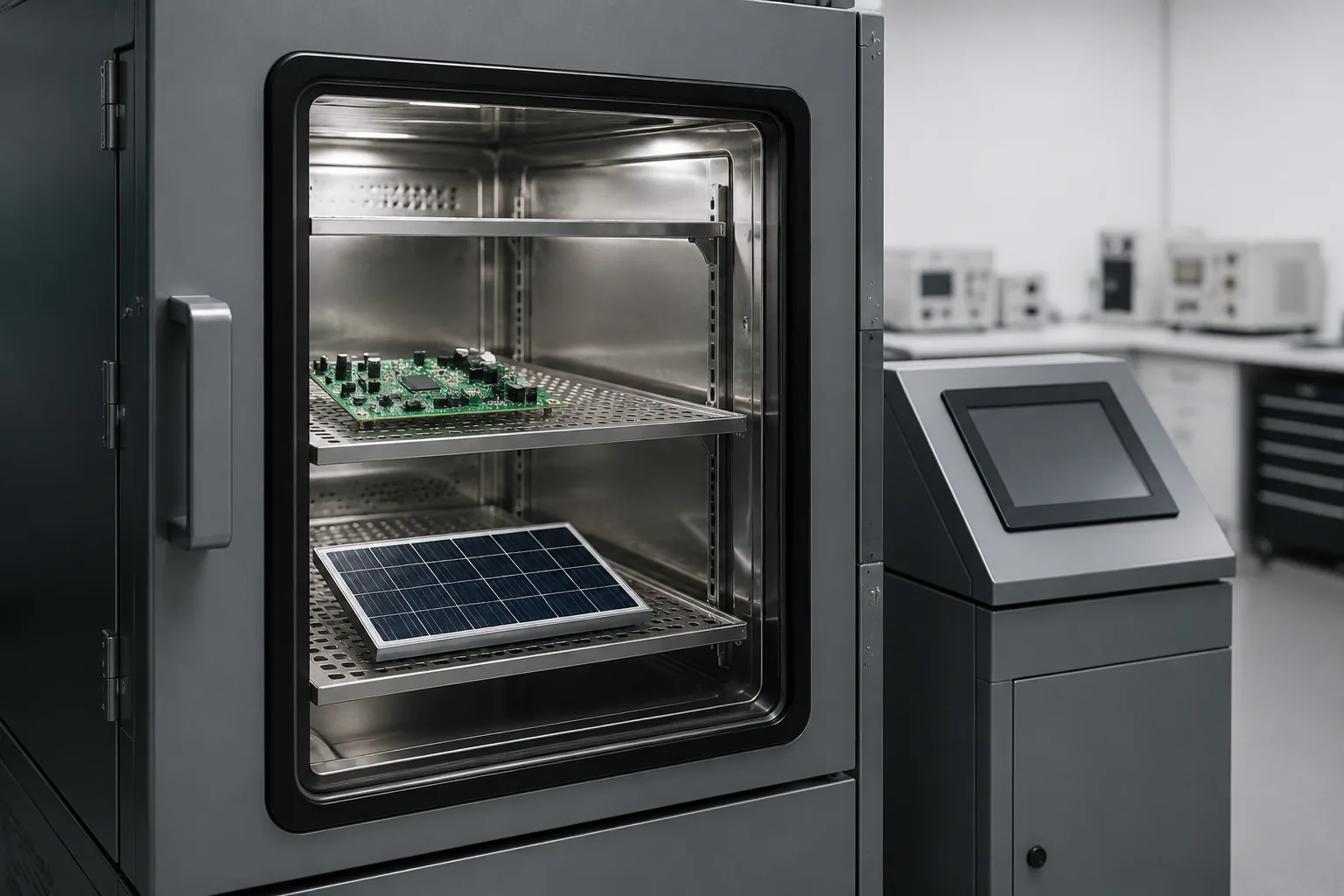
Steady-State vs Cyclic: The Two Damp-Heat Mechanisms
The most common confusion is treating "damp heat test" as one test. The steady-state and cyclic tests model opposite physical mechanisms and detect different failure modes:
| Steady-state (Test Cab) | Cyclic (Test Db) | |
|---|---|---|
| Standard | IEC 60068-2-78 / GB/T 2423.3 | IEC 60068-2-30 / GB/T 2423.4 |
| Profile | Constant temperature and humidity | 24 h cycle (12 + 12 h) with temperature swing |
| Condensation | Deliberately not produced | Intentionally produced on cooling |
| Dominant mechanism | Moisture absorption / diffusion | Breathing + condensation |
| Failure modes detected | Long-term ingress, bulk material degradation, insulation-resistance drop | Dew corrosion, breathing-driven moisture entry into enclosures |
| Typical duration | Days to weeks (to 1000 h for PV) | 1, 2, 6, 12, 21, or 56 cycles |
A product whose failure mode is years of moisture soaking in a humid warehouse is tested to Test Cab. A product whose failure mode is dew forming inside its enclosure during day-night temperature cycling is tested to Test Db. Many qualification programs run both, but they are not interchangeable.
Severity: Temperature, Humidity, and Duration
Test severity is the combination of temperature, relative humidity, and total duration. IEC 60068-2-78:2025 specifies five preferred temperature/humidity combinations:
| Temperature (°C) | Relative humidity (% RH) |
|---|---|
| 30 ± 2 | 93 ± 3 |
| 30 ± 2 | 85 ± 3 |
| 40 ± 2 | 93 ± 3 |
| 40 ± 2 | 85 ± 3 |
| 85 ± 2 | 85 ± 3 |
… and eight preferred durations: 12 h, 16 h, 24 h, 2 days, 4 days, 10 days, 21 days, and 56 days (1344 h). The two most-used severity points are:
- 40 °C / 93 % RH — the classic tropical / storage condition, recommended by the standard when no other is specified.
- 85 °C / 85 % RH — the well-known "85/85" accelerated damp-heat severity, used as the basis for electronics, semiconductor, and photovoltaic accelerated aging (below).
The test tolerances during exposure are ±2 °C for temperature and ±3 % RH for humidity.
Procedure: How Condensation Is Avoided
The procedure is built around keeping the specimen from seeing condensation:
- The specimen is placed in the chamber in its ready-for-use state. For heat-dissipating specimens, the chamber volume should be at least five times the specimen volume so its heat does not distort the chamber environment.
- Temperature and humidity are ramped to the specified levels within about 2 hours, with the ramp controlled so the specimen temperature stays above the dew point — this is the step that prevents condensation.
- The specimen is held under steady-state conditions for the full test duration.
- Measurements are taken during or after exposure per the test plan, with recovery under standard atmospheric conditions before post-test measurement if condensation-free handling is required.
The chamber must maintain uniform conditions, monitor temperature and humidity in real time, and be designed so that condensation does not drip onto the specimen — a detail that matters because a single drip event invalidates the absorption-only premise of the test.
The 85/85 Photovoltaic Application (IEC 61215 DH1000)
The single largest industrial use of the 85 °C / 85 % RH severity is the photovoltaic (PV) module damp-heat test, which is why "85/85" is so widely known. IEC 61215 (the PV module design qualification standard) specifies in its MQT 13 damp-heat test that a module is held at 85 °C / 85 % RH for 1000 hours — the "DH1000" test — with the pass criterion of maximum-power degradation ≤ 5 % and no visual defects. The method draws on IEC 60068-2-78.
The DH1000 test is an accelerated-aging gate: 1000 hours at 85/85 is estimated to correspond to several years of outdoor tropical exposure, and it is the principal qualification screen for moisture-ingress failure modes in PV modules — encapsulant delamination, cell corrosion, and potential-induced degradation (PID). Independent reliability scorecards (e.g., PVEL) run two consecutive 1000-hour periods (2000 h total) to push beyond the IEC 61215 baseline. The 85/85 PV use case is the clearest illustration of why the steady-state absorption test exists: the failure it catches (bulk moisture ingress over years) is precisely what the cyclic condensation test does not reproduce.
What Failures Does the Steady-State Test Reveal?
Because the dominant mechanism is absorption rather than surface wetting, the failures Test Cab accelerates are the long-term, bulk-material ones:
- Insulation-resistance drop as absorbed moisture lowers the resistivity of insulating materials and conformal coatings — frequently the first measurable electrical symptom.
- Corrosion of metallization and conductor traces driven by absorbed moisture, distinct from the surface-pooling corrosion of the cyclic test.
- Swelling and dimensional change of plastics and elastomers as they absorb water, causing mechanical stress and fit problems.
- Delamination of multi-layer structures as moisture permeates along interfaces.
- Dielectric-strength reduction of insulating materials under long-term humid conditioning.
A product that passes a short cyclic test can still fail a 1000-hour steady-state test, because the bulk-absorption failures take time to develop that condensation cycling does not accelerate.
Our Testing Capabilities
Beijing ZKGX Research conducts the damp heat steady-state test to IEC 60068-2-78 / GB/T 2423.3:
- Standards covered: IEC 60068-2-78:2025 (Test Cab) and GB/T 2423.3; alongside the cyclic test IEC 60068-2-30 / GB/T 2423.4 for products requiring the condensation mechanism.
- Severities: all five preferred temperature/humidity combinations (30 °C and 40 °C at 93 % or 85 % RH, and 85 °C / 85 % RH), across the full duration range from 12 h to 56 days, including the PV DH1000 profile.
- PV application: IEC 61215 MQT 13 damp-heat (85 °C / 85 % RH / 1000 h) with maximum-power degradation measurement, plus extended-duration (2000 h) testing.
- Sample types: electronic assemblies, semiconductors, PV modules, automotive ECUs, aerospace components, coatings and laminates, and medical devices.
- Deliverable: a test report stating the severity (temperature, humidity, duration), the logged temperature/humidity record demonstrating tolerance compliance and no-condensation ramp, and the before/after measurement results.
If you have a specimen requiring steady-state damp heat verification, contact our testing team to scope the severity, the duration, and whether the PV DH1000 profile applies.
Frequently Asked Questions
What is the difference between IEC 60068-2-78 and IEC 60068-2-30?
IEC 60068-2-78 (Test Cab) is the steady-state damp heat test — constant temperature and humidity, deliberately without condensation, so moisture absorption dominates. IEC 60068-2-30 (Test Db) is the cyclic test — a 24 h 12+12 h cycle that intentionally produces condensation on cooling. The steady-state test detects absorption-driven failures; the cyclic test detects condensation-driven failures.
What is the 85/85 damp heat test?
85/85 refers to the 85 °C / 85 % RH severity of IEC 60068-2-78. It is the accelerated damp-heat condition widely used for electronics and, most prominently, for photovoltaic modules — where IEC 61215 MQT 13 specifies 1000 hours at 85/85 (the DH1000 test) as the moisture-ingress qualification gate, with a ≤ 5 % maximum-power-degradation pass criterion.
Why does the steady-state test avoid condensation?
Condensation would shift the dominant mechanism from absorption to surface wetting, producing a different failure mode (surface corrosion, pooling) than the bulk absorption the test is designed to accelerate. The chamber is ramped so the specimen temperature stays above the dew point, keeping the mechanism absorption-only and the result reproducible.
How long is a damp heat steady-state test?
The standard's preferred durations are 12 h, 16 h, 24 h, 2 days, 4 days, 10 days, 21 days, and 56 days (1344 h). The choice depends on the product specification; the PV DH1000 application uses 1000 h, and extended reliability testing may run 2000 h.
What is the GB/T equivalent of IEC 60068-2-78?
GB/T 2423.3 (环境试验 第2部分:试验方法 试验Cab:恒定湿热) is the identical adoption of IEC 60068-2-78. The cyclic counterpart is GB/T 2423.4 (Test Db, IEC 60068-2-30).