Electrical fast transient/burst (EFT/Burst) immunity testing is the electromagnetic-compatibility (EMC) test defined in GB/T 17626.4-2018 (Electromagnetic Compatibility — Testing and Measurement Techniques — Electrical Fast Transient/Burst Immunity Test, IDT IEC 61000-4-4:2012) that verifies whether electrical and electronic equipment continues to function correctly when subjected to repetitive bursts of fast, high-frequency voltage transients on its power, signal, control, and ground lines. The test simulates the switching transients produced by inductive-load interruption (contact bouncing in relays and contactors), and it is fundamentally a disturbance-immunity test — its purpose is to verify that the equipment is not upset by the transients, not to verify that it survives damage (that is the separate surge test). The defining traits of the test are its fast 5/50 ns pulse, its high repetition rate, and its burst grouping into 300 ms packets.
Why EFT/Burst Exists — the Switching-Transient Phenomenon
When an inductive load (a relay coil, a motor winding, a transformer) is interrupted by a mechanical switch or contactor, the contacts bounce as they part. Each bounce interrupts and re-strikes the arc, and because the inductive load cannot release its stored magnetic energy instantly, it drives sharp voltage spikes back into the line at each interruption. The result is a burst of dozens of fast, high-frequency voltage transients — each pulse only tens of nanoseconds wide but rising in nanoseconds and carrying substantial high-frequency content — that propagates along the power and signal cables toward other equipment connected to the same circuit.
The hazard the test addresses is functional disturbance, not hardware damage. The fast transients couple capacitively into adjacent signal and control cables, where their high-frequency content can flip logic states, corrupt data, reset microcontrollers, or trip protection circuits — disrupting equipment operation without physically destroying it. This is what distinguishes EFT from the surge test (GB/T 17626.5 / IEC 61000-4-5), which simulates the slower, higher-energy lightning and large-switching events that physically damage insulation.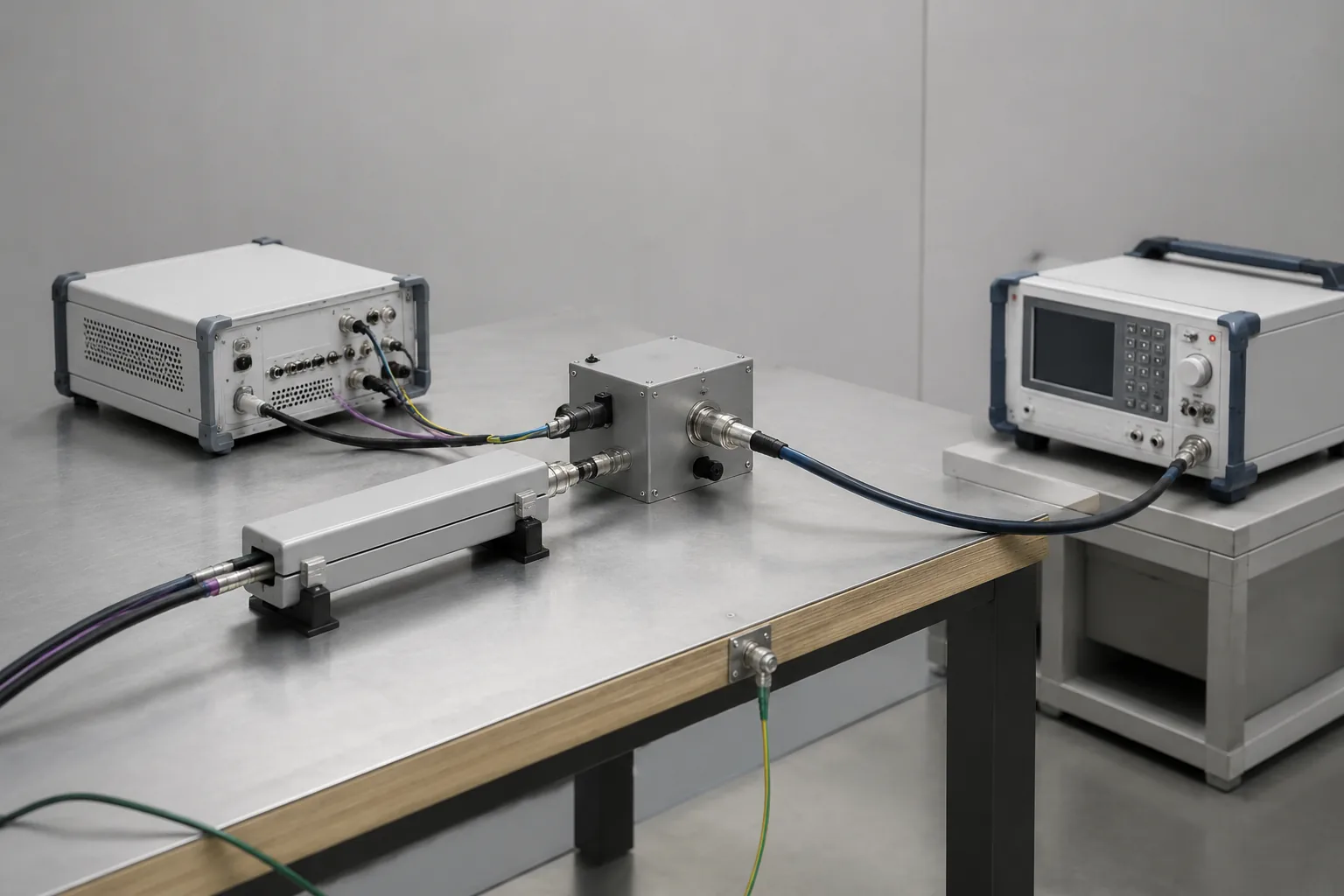
The Three Switching-Transient Immunity Tests
EFT is one of three distinct EMC immunity tests that address different transient phenomena, and they must not be conflated:
| Test | Standard | Phenomenon | Waveform | Purpose |
|---|---|---|---|---|
| EFT/Burst | GB/T 17626.4 (IEC 61000-4-4) | Repetitive switching transients (contact bounce) | 5/50 ns, 5 kHz, burst | Disturbance immunity (upset) |
| Surge | GB/T 17626.5 (IEC 61000-4-5) | Lightning / large-power-switching | 1.2/50 μs voltage, 8/20 μs current | Damage immunity (energy) |
| ESD | GB/T 17626.2 (IEC 61000-4-2) | Electrostatic discharge (human touch) | Single pulse, contact/air discharge | Disturbance + possible damage |
EFT pulses are fast, repetitive, and low-energy (disturbance); surges are slow, single, and high-energy (damage); ESD is a single human-touch event. A product may pass surge and ESD tests yet still fail EFT, because the EFT's fast edges and high repetition rate couple into digital circuits that the slower surges never reach. The three tests are specified together in most product EMC standards.
The Method Standard: GB/T 17626.4-2018
The governing method standard is GB/T 17626.4-2018 (电磁兼容 试验和测量技术 电快速瞬变脉冲群抗扰度试验), implemented to replace GB/T 17626.4-2008. It is the identical adoption (IDT) of IEC 61000-4-4:2012. A current Chinese-market report cites GB/T 17626.4-2018; an international report cites IEC 61000-4-4:2012; the technical content is identical.
The standard defines the test waveform, the test levels, the coupling methods, and the pass/fail performance criteria.
The Waveform: 5/50 ns at 5 kHz in Bursts
The EFT waveform has three nested time scales, and all three define the test:
- The single pulse — a 5/50 ns waveform: 5 ns rise time (10–90 %), 50 ns pulse width at 50 % of peak (half-value width). This fast edge is what gives the pulse its high-frequency content and its ability to couple into digital circuits.
- The pulse repetition rate — 5 kHz (5,000 pulses/second) in the standard test, with 100 kHz available as a higher-repetition-rate option for applications requiring it. The repetition rate reflects the actual contact-bounce frequency of a real interrupting contactor.
- The burst envelope — pulses are grouped into 15 ms bursts (so ~75 pulses per burst at 5 kHz), repeated every 300 ms for the test duration. The burst-on/burst-off pattern is the signature of repeated contact bouncing during a switching sequence.
The combination — fast edges, high repetition, burst grouping — is what makes EFT a disturbance test rather than a damage test: each individual pulse carries little energy, but the rapid repetition drives cumulative functional upset.
The Test Levels
The test severity is set by the peak voltage, applied to power and signal ports at different levels:
| Level | Power port (PE) (kV) | Signal / control / data port (kV) | Repetition rate |
|---|---|---|---|
| 1 | 0.5 | 0.25 | 5 kHz |
| 2 | 1 | 0.5 | 5 kHz |
| 3 | 2 | 1 | 5 kHz |
| 4 | 4 | 2 | 5 kHz (or 100 kHz) |
| X (open) | special | special | special |
The applicable level is set by the product standard according to the equipment's installation environment — Level 2 or 3 for most commercial/industrial products, Level 4 for harsh industrial environments. The power-port level is typically double the signal-port level because the transients are larger on the power circuit where they originate.
The Two Coupling Methods
The transients are delivered to the EUT (equipment under test) by one of two coupling devices, depending on the port:
Coupling/Decoupling Network (CDN) — for power ports. The CDN injects the EFT pulses onto the EUT's AC/DC power lines while isolating the auxiliary equipment and the mains supply on the far side. The CDN is the standard coupling method for power ports because it provides a defined coupling impedance (typically 50 Ω) and ensures the pulses reach the EUT without disturbing the source. A CDN is rated for the EUT's rated voltage and current, and the EUT is operated in its normal mode during the test.
Capacitive Coupling Clamp — for signal, control, and data ports. For I/O lines that cannot be interrupted by a CDN, the EFT pulses are coupled through a capacitive coupling clamp — a clamp that surrounds the cable without contacting it, capacitively coupling the fast pulses onto the signal lines. The clamp is positioned at a defined distance from the EUT, and a ground reference plane provides the return path.
Pass/Fail: Performance Criteria
The test result is judged against the generic performance criteria of the IEC 61000-4 family (defined in IEC 61000-4-1), with the criterion set by the applicable product standard:
| Criterion | Meaning | Typical EFT assignment |
|---|---|---|
| A | Normal performance during the burst — no degradation | Required for most products |
| B | Temporary degradation or function loss that self-recovers when the burst ceases | Permitted for some functions |
| C | Operator intervention required | Generally a fail |
| D | Non-recoverable damage | Fail |
Because EFT is a disturbance test (not a damage test), most product standards require Criterion A — the equipment must keep working normally throughout the burst application. Criterion B (a recoverable glitch) may be permitted for functions where a brief interruption is tolerable. Any Criterion D (damage) result is a fail and indicates a real hardware weakness. The test report states, for each EUT function, the criterion required and the criterion observed.
Why the Search Results Are Off the Compliance Intent
The search results for "electrical fast transient/burst immunity" are dominated by content that does not frame the GB compliance framework:
- Classic NIST academic papers (Martzloff & Leedy 1990 IEEE Transactions) — the seminal study of EFT propagation and attenuation in power wiring, the contact-bounce origin, and the theoretical attenuation model. Historical academic content, no GB, no test levels.
- EFT generator calibration research — deconvolution methods, burst-divider frequency limits, measurement-system uncertainties. Metrology research, not compliance.
- Standler's classic surge/EFT background series — engineering-history context from the 1980s.
None tells an equipment manufacturer, an EMC test lab, or a compliance engineer which GB standard applies, what the 0.5–4 kV test levels are, what the 5/50 ns / 5 kHz waveform is, or how CDN vs capacitive clamp coupling is chosen. That compliance question is what this article addresses.
Our Testing Capabilities
Beijing ZKGX Research conducts electrical fast transient/burst immunity testing to GB/T 17626.4-2018:
- Standard: GB/T 17626.4-2018 (IDT IEC 61000-4-4:2012), the current edition replacing GB/T 17626.4-2008. International reports to IEC 61000-4-4 on request.
- Test levels: 0.5 / 1 / 2 / 4 kV on power ports; 0.25 / 0.5 / 1 / 2 kV on signal/control/data ports; at 5 kHz (and 100 kHz where required).
- Waveform: 5/50 ns pulse in 15 ms bursts repeated every 300 ms, per the standard.
- Coupling: CDN for AC/DC power ports; capacitive coupling clamp for signal, control, and data ports.
- Judgment: functional monitoring during burst application against performance criteria A (normal) and B (self-recovering) per IEC 61000-4-1 and the applicable product standard.
- Sample types: industrial control equipment, household appliances, IT equipment, medical devices, automotive ECUs, and power electronics.
- Deliverable: a test report stating the standard, the test level(s) by port, the coupling method, the waveform repetition rate, and the performance criterion required versus observed for each EUT function.
If you have equipment requiring EFT/burst immunity verification, contact our testing team to scope the applicable product standard, the test levels by port, and the required performance criterion.
Frequently Asked Questions
What standard governns EFT/burst immunity testing?
GB/T 17626.4-2018 (Electromagnetic Compatibility — Electrical Fast Transient/Burst Immunity Test), the IDT adoption of IEC 61000-4-4:2012, replacing GB/T 17626.4-2008. It defines the 5/50 ns pulse waveform, the test levels (0.5–4 kV power, 0.25–2 kV signal), the CDN and capacitive-clamp coupling methods, and the performance criteria.
What is the difference between EFT and surge testing?
EFT (GB/T 17626.4) simulates the repetitive fast transients from contact bouncing in inductive-load switching — many 5/50 ns pulses at 5 kHz grouped into bursts. It is a disturbance test: it verifies the equipment is not upset. Surge (GB/T 17626.5) simulates the slower, single, higher-energy lightning and large-switching events — 1.2/50 μs voltage pulses. It is a damage test: it verifies the equipment is not physically destroyed. The two address different phenomena and are specified together.
What are the EFT test levels?
Level 1 is 0.5 kV (power) / 0.25 kV (signal); Level 2 is 1 / 0.5 kV; Level 3 is 2 / 1 kV; Level 4 is 4 / 2 kV; all at 5 kHz (or 100 kHz for the higher-repetition option). The power-port level is typically double the signal-port level because the transients originate on the power circuit. The applicable level is set by the product standard for the equipment's environment.
What is the EFT waveform?
A 5/50 ns single pulse (5 ns rise, 50 ns half-value width), repeated at 5 kHz (5,000 pulses/second), grouped into 15 ms bursts (≈75 pulses per burst) that repeat every 300 ms. The fast edge gives the pulse its high-frequency content; the burst grouping reflects the repeated contact-bounce pattern of a real switching event.
Why is EFT a disturbance test and not a damage test?
Each individual EFT pulse carries little energy (the 5/50 ns pulse is high-frequency but low-energy). The hazard is the cumulative functional upset — the fast edges and high repetition rate couple capacitively into digital circuits, flipping logic states and corrupting data, without physically destroying the hardware. Damage is the surge test's domain; EFT verifies that the equipment keeps working during the burst.