Environmental Stress Screening (ESS) is a 100% production-screening process that applies controlled environmental stresses — primarily temperature cycling and random vibration — to electronic assemblies to precipitate latent manufacturing defects into detectable failures before shipment. The defining trait of ESS, and the source of most confusion around it, is that it is a manufacturing process control, not a qualification test: its purpose is not to validate the design but to force weak units out of the population so that the surviving shipped product has measurably higher reliability.
What Is Environmental Stress Screening?
ESS exposes newly manufactured electronic products to environmental stresses that accelerate the failure of marginal units while leaving sound units undamaged. The stress is applied to 100% of production — not a sample — because the defect it hunts (infant mortality) is stochastic and sample screening cannot catch it.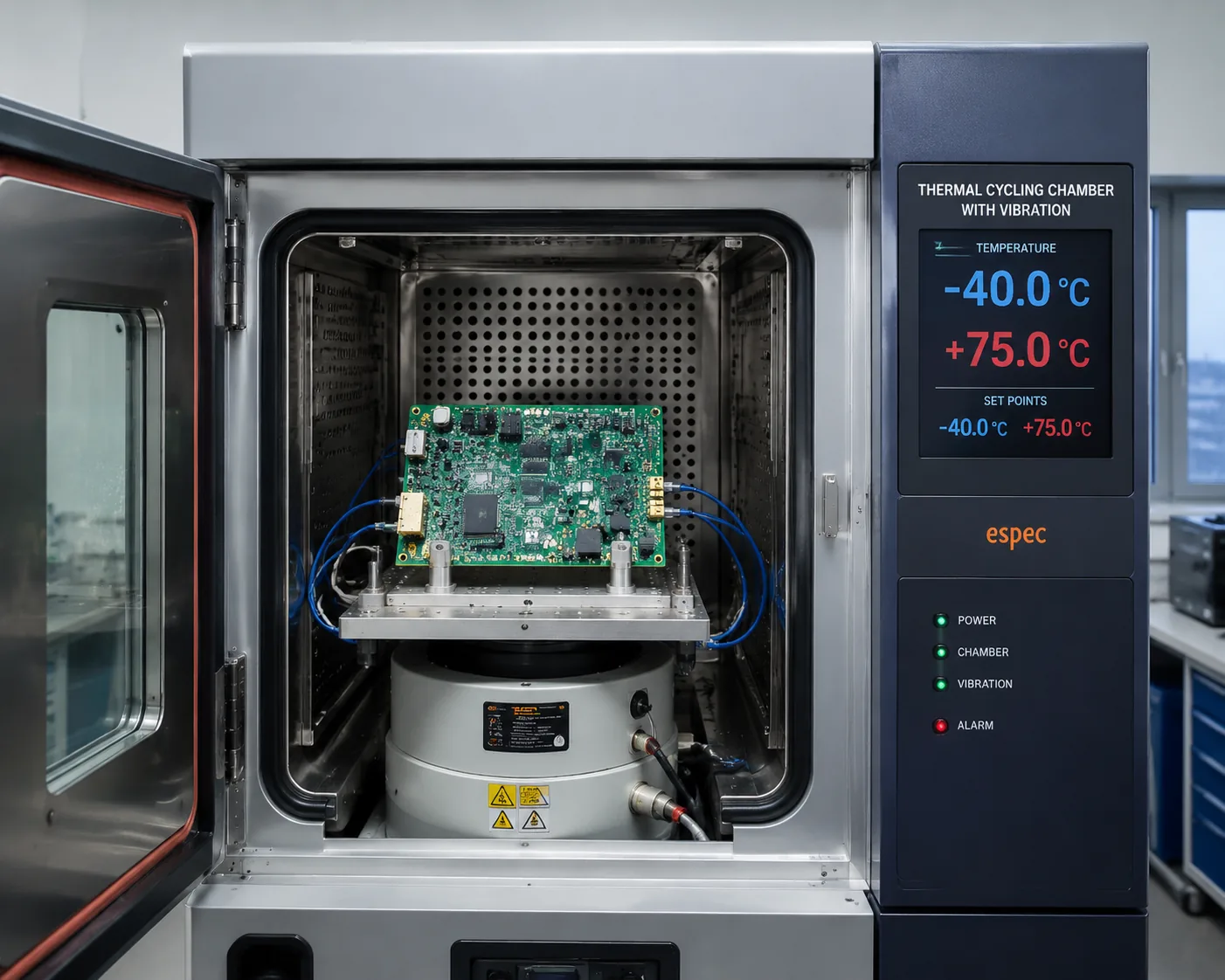
The key concept that distinguishes ESS from every other test is precipitation versus detection:
- Precipitation — the environmental stress converts a latent defect (a marginal solder joint that still conducts, a micro-crack that has not yet propagated) into a hard, detectable failure. The stress does the converting.
- Detection — the subsequent functional or electrical test catches that now-manifest failure.
A latent defect that passes room-temperature functional testing on the bench is, by definition, undetectable until the stress precipitates it. ESS works because temperature cycling and random vibration are precisely the stresses that drive crack growth in solder, work-loosening of fasteners, and intermittent opens in poorly wetted joints — converting each into a failure the end-of-line test can see. This is why ESS is characterized by the absence of conventional pass/fail criteria: the screen succeeds when weak units fail in the factory, not when nothing fails.
The Bathtub Curve and Why ESS Targets Infant Mortality
The reliability case for ESS rests on the bathtub curve — the failure-rate-over-life model. Failure rate is high immediately after manufacture (infant mortality, driven by manufacturing and workmanship defects), drops to a low constant through useful life, then rises again at wear-out. The infant-mortality region is the population ESS exists to collapse: by applying the same physical mechanisms that would otherwise take weeks or months of field operation to fail a weak unit, ESS compresses that period into hours of chamber time. The shipped population then enters service past its infant-mortality knee, with a failure rate far lower than an unscreened population — the goal of the entire process.
The Two Stresses: Thermal Cycling and Random Vibration
ESS programs are built from two stresses, applied because they target complementary defect populations.
Thermal Cycling Stress Screening (TCSS) is the dominant defect precipitator. Cycling an assembly between temperature extremes drives differential thermal expansion between components, leads, solder, and the PCB substrate. That expansion mismatch creates the mechanical strain that propagates micro-cracks in cold or insufficient solder, opens head-in-pillow BGA contacts, and completes separation in lifted pads. Recommended parameters for an effective screen:
| Parameter | Typical ESS value | Engineering note |
|---|---|---|
| Temperature range | −40 °C to +70/75 °C | Set as wide as component ratings allow |
| Rate of change | 5 to 15 °C/min | Higher rates raise screening strength |
| Number of cycles | 10–20 (defence) up to 20–30 (industrial) | Monitor failure rate to optimize |
| Dwell time | ~10 min at each extreme | Only until product reaches thermal stability |
| Air velocity | High (≥ 4 m/s) | Required for the rated change rate |
Random Vibration Stress Screening (RVSS) is the second stress, effective at defects that thermal cycling misses: loose fasteners, poorly seated connectors, wire-harness faults, and marginal BGA/QFP joints. Random (not sinusoidal) vibration is used because it excites all resonances simultaneously, matching real-world broadband excitation. The reference profile is NAVMAT P-9492 (see below).
Research and field experience consistently show that thermal cycling precipitates the majority of electronic defects and that the two stresses applied together produce a synergistic effect — precipitating defects that neither stress alone would catch.
The NAVMAT P-9492 Random Vibration Profile
The single most-cited random vibration screen for electronic ESS is the NAVMAT P-9492 profile, which defines a broadband random vibration input tailored to excite the resonances common in electronic assemblies. The verified profile is:
| Frequency band | PSD level | Slope |
|---|---|---|
| 20–80 Hz | rising from 0.01 g²/Hz | +3 dB/octave |
| 80–350 Hz | 0.04 g²/Hz flat | — |
| 350–2000 Hz | falling | −3 dB/octave |
The overall level is ≈ 6.06 Grms, applied for 10 minutes per axis across 3 axes. Note that several popular references mis-state the plateau as 0.01 g²/Hz; the correct flat level in the 80–350 Hz band is 0.04 g²/Hz, with 0.01 g²/Hz being only the starting value of the rising low-frequency leg. The profile is energy-efficient precisely because it concentrates energy in the 80–350 Hz band where electronic-assembly resonances cluster.
In execution, a pre-screen sinusoidal sweep (20–2000 Hz) is typically run first to identify resonances, with notching applied around any resonance that would risk overstress, and the specimen is rigidly fixtured to avoid amplification.
ESS Process Sequence: Why Thermal → Vibration → Thermal
A structured ESS program applies the stresses in a defined three-stage sequence rather than randomly. The rationale matters because the order is what makes the screen effective:
- Thermal cycling at PCB level (power off) — pre-stresses every board and propagates latent thermal defects partway.
- Random vibration — accelerates the growth of the defects the thermal stage has begun to precipitate, and catches the mechanical-workmanship defects (fasteners, connectors) that thermal cycling does not touch.
- Thermal cycling at higher indenture level (power on) — verifies stability of the assembled unit under thermal stress with the hardware running, and confirms no new defects were introduced.
The principle is that thermal stress weakens latent defects and vibration completes them, so the final powered thermal stage then acts as both a continued screen and a functional verification. A failure-handling rule follows from this: a failure in the early cycles requires corrective action and a restart, whereas a late-cycle failure is restarted from the relevant point, and the final cycles must be defect-free before the unit passes.
ESS vs HALT vs HASS: Three Different Tools
These three are constantly conflated, but they answer different questions and apply stress at different levels relative to the product's limits.
| ESS | HALT | HASS | |
|---|---|---|---|
| Full name | Environmental Stress Screening | Highly Accelerated Life Test | Highly Accelerated Stress Screen |
| Phase | Production (100% of units) | Design / development | Production (100% of units) |
| Stress level | Within specification limits | Beyond spec, to destruction | Beyond spec, below destruct limit |
| Purpose | Precipitate manufacturing defects | Find design weaknesses | Fast manufacturing-defect screen |
| Duration | Hours to days | Days (to failure) | Minutes to hours |
HALT is a design tool — you push prototypes until they break to discover the design's fundamental limits. ESS is the conservative production screen, staying within the product's specified operating limits. HASS uses the destruct limits discovered in HALT to run an aggressive-but-safe production screen at typically ~80–85% of the operating limit, achieving in 1–2 hours what a conventional ESS screen would take 8–24 hours to do. The practical rule: if HALT has been done and the operating limits are characterized, HASS is the faster production choice; if those limits are unknown, ESS with conservative parameters is the starting point.
Which Standards Govern ESS? (And Their Real Status)
The ESS standards landscape is fragmented, and competitors frequently present cancelled and contested documents as if they were equivalently current. The accurate picture:
| Document | Status | Role |
|---|---|---|
| MIL-STD-2164 | Cancelled | Original mandatory ESS spec (1985); technical content carried into the handbook |
| MIL-HDBK-2164 / 2164A | Active (guidelines) | Qualitative ESS guidelines; successor to the cancelled MIL-STD-2164 |
| MIL-HDBK-344A | Reaffirmed (2007) but contested | Quantitative ESS planning methodology; subject of academic calls for cancellation over its statistical model |
| NAVMAT P-9492 | Active reference | Random vibration screening profile |
| MIL-STD-810 | Active | General environmental test methods (ESS draws on its methods) |
Two distinctions are worth stating plainly. First, MIL-STD-2164 (the mandatory specification) is cancelled and superseded by MIL-HDBK-2164A (a guideline handbook) — they are not parallel current documents. Second, MIL-HDBK-344A, which describes a quantitative screen-strength and planning approach, was reaffirmed as valid for use in acquisition as of its 2007 review but is the subject of a published IEEE critical review arguing its 1993 statistical foundations are obsolete for modern electronics; it is best treated as a planning reference whose quantitative outputs should be validated against current data, not as a checklist. This nuance — that the governing documents are a mix of cancelled, guideline-only, and contested — is itself a reason to work with a laboratory that knows which clause is actually enforceable.
What Failures Does ESS Precipitate?
Because ESS targets the manufacturing-defect population, the defects it precipitates map directly to workmanship and component-infant-mortality failure modes:
- Solder defects — cold/grainy joints, insufficient solder, cracked solder, head-in-pillow BGA, solder bridges (thermal cycling propagates the crack; vibration completes the open).
- Component infant defects — marginal capacitors with weak dielectric, cracked ceramic packages, weak wire bonds (thermal and electrical stress precipitate breakdown).
- Workmanship defects — loose or partially seated connectors, missing fasteners, damaged PCB traces, lifted pads (vibration reveals intermittent connections; thermal completes separations).
The common thread is that every one of these passes bench functional testing and fails only after the stress accelerates it. That is the entire value proposition of screening 100% of units.
Our Testing Capabilities
Beijing ZKGX Research conducts environmental stress screening as part of its reliability testing scope for electronic assemblies:
- Standards basis: MIL-HDBK-2164A (guidelines), NAVMAT P-9492 (vibration profile), with reference to MIL-STD-810 methods; quantitative planning reference to MIL-HDBK-344A where applicable.
- Stress capabilities: thermal cycling (to −40 / +75 °C at ≥5 °C/min), random vibration to the NAVMAT P-9492 profile (0.04 g²/Hz plateau, 6.06 Grms, 3 axes), and combined-environment screening.
- Sequence support: the three-stage thermal→vibration→thermal sequence, with powered and unpowered configurations and functional monitoring during screening.
- Sample types: PCB assemblies, electronic control units, military/aerospace assemblies, industrial control systems, and consumer electronic products.
- Deliverable: a screening report documenting the applied profile, the failure log with cycle/timing of each failure, and the post-screen functional verification result.
If you have an electronic assembly requiring ESS, or need to scope a screening profile to your product's operating limits, contact our testing team to define the stress levels, cycle count, and sequence.
Frequently Asked Questions
Is ESS the same as burn-in or HALT?
No. Burn-in is a generic term (often thermal soak at elevated temperature) that ESS sometimes subsumes. HALT (Highly Accelerated Life Test) is a design-phase test that pushes prototypes beyond spec to destruction to find design limits. ESS is a production screen applied to 100% of units within specification limits to precipitate manufacturing defects. They are different tools for different phases.
What is the NAVMAT P-9492 vibration profile?
NAVMAT P-9492 is the reference random vibration profile for electronic ESS. It specifies a flat power spectral density of 0.04 g²/Hz between 80 and 350 Hz, with +3 dB/octave rising from 20 Hz and −3 dB/octave falling to 2000 Hz, giving an overall level of ≈6.06 Grms, applied for 10 minutes per axis across 3 axes. (Note: 0.01 g²/Hz is only the starting value of the rising low-frequency leg, not the plateau level.)
What is the difference between precipitation and detection in ESS?
Precipitation is the act of the environmental stress converting a latent defect into a hard, detectable failure. Detection is the subsequent functional test that catches that failure. ESS is defined by precipitation: its job is to force weak units to fail in the factory, which is why it has no conventional pass/fail criterion — success is measured by the reliability of the surviving shipped population, not by the absence of failures during screening.
Why is MIL-STD-2164 no longer used?
MIL-STD-2164 (the original 1985 mandatory ESS specification) was cancelled; its technical content was carried forward into MIL-HDBK-2164A, which is a guideline handbook rather than a mandatory specification. Current ESS programs reference the handbook and the NAVMAT P-9492 profile, and use MIL-HDBK-344A's quantitative planning approach where applicable — with its 1993 statistical basis understood as a planning reference to be validated against current data.
Does ESS shorten the life of good units?
A correctly profiled ESS screen precipitates defects in weak units while consuming only a small fraction of the good units' life. The residual-life impact is monitored during profile development precisely to keep it negligible; an over-stressed screen that consumes significant life of sound units is a profile error, not an inherent property of ESS.