A free fall test is the laboratory test that drops a product — packaged or unpackaged, complete device or component — from a prescribed height onto an impact surface to verify it survives the shocks encountered in handling, transport, and end-use drops. Free fall testing is governed by two distinct regimes: IEC 60068-2-31 (the environmental-test free-fall standard for products), and the EU 2023/1670 Repeated Free Fall reliability class (the mandatory durability rating on the EU Energy Label for smartphones and tablets since 2025-06-20). Neither has anything to do with the physics concept of free fall that dominates the search results.
"Free Fall" Means Three Different Things — Which One Are You?
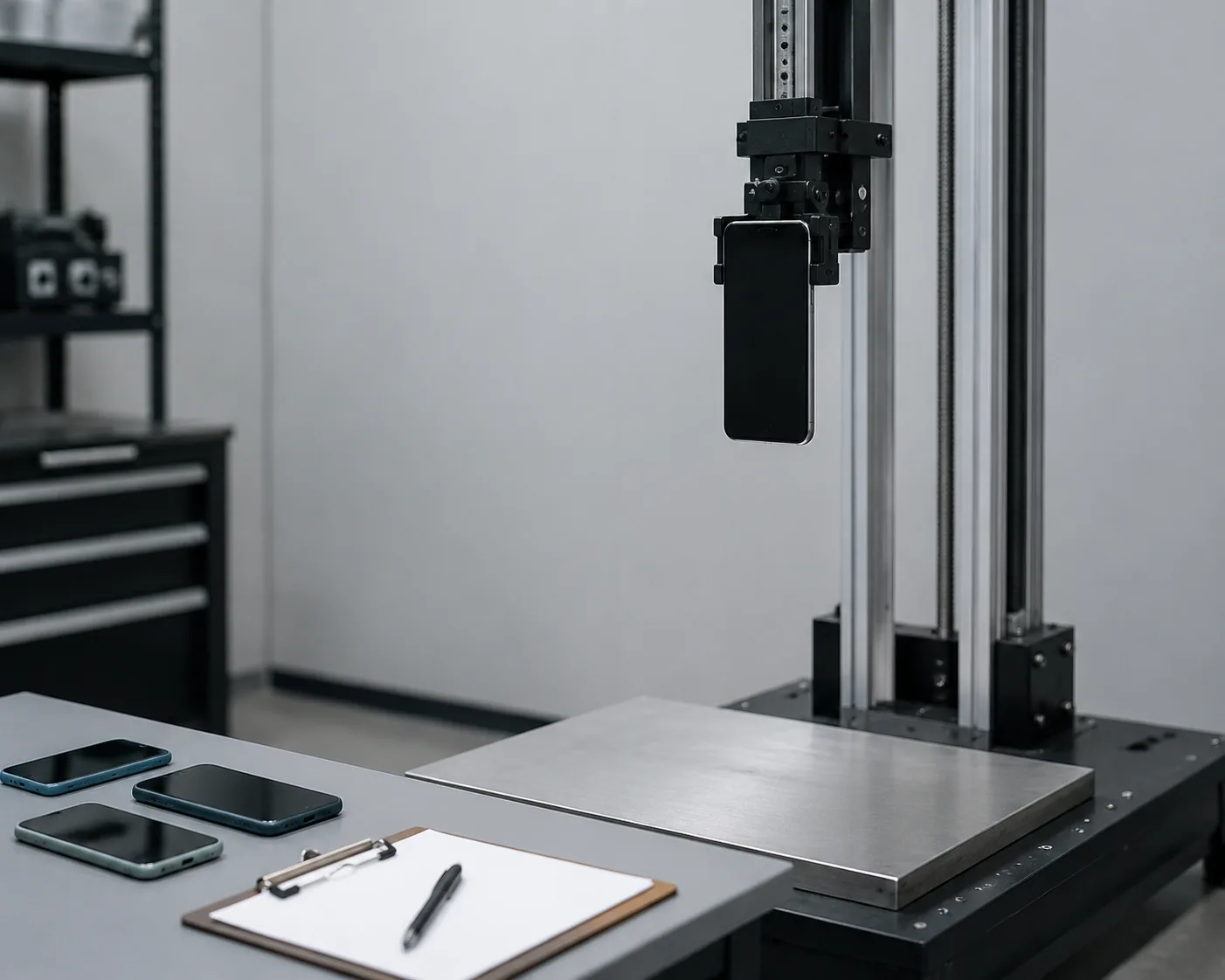
The term "free fall" is ambiguous, and the search results are dominated by a meaning unrelated to product testing. The three must be separated:
| Meaning | What it is | Governing reference |
|---|---|---|
| Free fall test (product) (this article) | Laboratory drop test of a product for handling/durability | IEC 60068-2-31, EU 2023/1670, ISTA, GB/T 4857 |
| Physics free fall | The motion of an object under gravity alone (g = 9.8 m/s², Galileo, skydiving) | Newtonian mechanics — unrelated to product testing |
| Free fall (drop) drop-test glossary | The EU Energy Label "Repeated Free Fall reliability class" A-to-E grade | EU Regulation 2023/1670 (a product test, covered below) |
This article addresses the product free-fall test. The physics free fall (the equations of motion under gravity, the stratosphere-jump record, the inclined-plane experiment) is a different subject taught in physics class — it explains why a dropped object accelerates at g, but it is not a product test and has no standard, no pass criterion, and no test report.
IEC 60068-2-31: The Product Free-Fall Standard
IEC 60068-2-31 (Environmental testing — Part 2-31: Tests — Test Ec: Rough handling shocks, primarily for equipment-type specimens) is the IEC standard for free-fall testing of products. It is the test used to assess damage from the falls a product experiences during rough handling and transport — distinct from the mechanical-shock test (IEC 60068-2-27), which applies a controlled half-sine pulse, and from the packaging drop test (ISTA / GB/T 4857 / ASTM D5276), which tests the shipping package, not the product inside.
Test Ec provides two free-fall procedures, used for different objects:
| Procedure | Object | What it does |
|---|---|---|
| Free fall — Procedure 1 | Complete equipment, packaged or unpackaged | A simple drop from a prescribed height onto each face |
| Repeated free fall — Procedure 2 | Small specimens (e.g., loose components) | Repeated drops at ~10 falls/min, typically into a tumbling barrel |
Procedure 1 (the common product free-fall test) drops the specimen freely in its normal transport/use attitudes, normally once on each of the 6 faces of the specimen. The drop heights are nominal values of 100 mm, 250 mm, 500 mm, or 1000 mm, chosen in relation to the specimen's mass and its intended handling — heavier specimens are dropped from lower heights. The impact surface is typically concrete or steel of specified hardness and flatness.
Procedure 2 (the repeated free-fall for small specimens) repeatedly drops a small, typically unpackaged specimen from a low height (commonly 100 mm) at roughly ten falls per minute, often in a rotating tumble barrel. This is the procedure that the EU Repeated Free Fall class (below) builds on.
A standards-hygiene point worth making: many older references cite IEC 60068-2-32 for "26 drops" (6 faces, 12 edges, 8 corners). That standard was withdrawn and its content folded into IEC 60068-2-31; the current free-fall test is 2-31, and the 26-drop protocol now lives in the packaging-drop standards (ISTA, ASTM D5276, GB/T 4857). Citing 2-32 as current is an error.
EU 2023/1670: The New Repeated Free Fall Reliability Class
The single most current and consequential free-fall requirement is the EU Repeated Free Fall reliability class, introduced by Commission Regulation (EU) 2023/1670 under the Ecodesign for Sustainable Products framework. It became mandatory on the EU Energy Label for all smartphones and tablets sold in the European Union from 20 June 2025.
The class is a durability grade from A (most drop-resistant) to E (least drop-resistant), determined by the number of drops a device survives before a functional defect. The methods differ by device type:
| Device | Method | Height | Check intervals |
|---|---|---|---|
| Smartphone | Tumble tester (rotating rectangular barrel, random orientation) | 1 m | 45, 90, 180, 270 drops |
| Tablet | Programmed free-fall onto 3 mm steel plate backed by 10–19 mm hardwood, 26 prescribed orientations | 1 m | 52, 104, 156, 208 drops |
For both device types, 4 out of 5 sample units must pass each interval check for the device to continue to the next interval; the grade is set by the highest interval reached. A key definition: a "defect" is functional failure — cracks of the touchscreen, cover glass, frame, or back are not counted as a defect as long as the unit retains full functionality and safe use. This intentionally rewards functional durability over cosmetic survival.
For any smartphone or tablet manufacturer placing product on the EU market from mid-2025, the Repeated Free Fall class is now a mandatory label element alongside the energy-efficiency class — making it the highest-volume free-fall test requirement in the consumer-electronics market today.
Free-Fall vs Related Mechanical Tests
Free fall is one of several mechanical-environment tests, and it is selected for the specific failure mode of an uncontrolled impact after a drop. It is distinct from its neighbors:
| Test | Standard | What it simulates | Pass metric |
|---|---|---|---|
| Free fall (drop) | IEC 60068-2-31 | Uncontrolled impact after a drop in handling/use | Function after drop |
| Mechanical shock | IEC 60068-2-27 | A controlled half-sine or post-shock pulse (e.g., vehicle crash, pyrotechnic) | Function after shock |
| Packaging drop | ISTA / GB/T 4857 / ASTM D5276 | Drop of the shipping package to verify package protection | Product inside survives |
| Drop-ball impact | (varies) | A defined mass/height impact on a surface/material | Surface/material damage |
The free-fall test verifies the product's own drop survival; the packaging drop test verifies the package's ability to protect the product. A product tested for direct end-user handling (a phone, a handheld instrument) is free-fall tested without its shipping carton; a product tested for transport survival is packaging-drop tested in its carton.
What Failures Does the Free Fall Test Reveal?
The free-fall test accelerates the failures caused by peak impact deceleration when a product hits a hard surface:
- Display and cover-glass breakage — the dominant failure in consumer-electronics drop testing.
- Housing and frame cracks — structural failure at stress concentrations.
- Internal connector and battery displacement — flexing of the chassis unseats connectors or shifts the battery.
- Solder-joint and BGA fractures — the impact shock propagates to board-level interconnects, cracking brittle solder.
- Camera and lens module damage — optical-element misalignment or fracture.
- Function loss — the EU Repeated Free Fall defect criterion, where the unit fails to operate correctly regardless of cosmetic condition.
The failures a free-fall test reveals are the same failures that drive consumer warranty claims and EU label grades — which is why the test sits at the intersection of product design, reliability engineering, and (now) mandatory market regulation.
Our Testing Capabilities
Beijing ZKGX Research conducts free-fall testing across the IEC 60068-2-31 and EU 2023/1670 regimes:
- IEC 60068-2-31 (Test Ec): Free fall Procedure 1 (simple drop on each face, packaged or unpackaged equipment) at drop heights of 100 / 250 / 500 / 1000 mm; Repeated free fall Procedure 2 for small specimens. Equivalent GB/T and ISTA packaging-drop methods available.
- EU 2023/1670 Repeated Free Fall class: smartphone tumble-tester method (1 m, random orientation, check at 45/90/180/270 drops) and tablet programmed-orientation method (1 m onto 3 mm steel + 10–19 mm hardwood, 26 orientations, check at 52/104/156/208 drops), with the A-to-E grade determination and 4-of-5 interval rule.
- Sample types: smartphones and tablets (for the EU label), handheld instruments, small electronic devices, packaged products, and loose components.
- Deliverable: a test report stating the standard/regulation, the procedure, the drop height(s) and orientations, the number of drops and check intervals, and the functional result / EU grade.
If you have a product requiring free-fall verification or an EU Repeated Free Fall class determination, contact our testing team to scope the applicable regime (IEC 60068-2-31 vs EU 2023/1670), the device type, and the target grade.
Frequently Asked Questions
What standard governs the free fall test?
For products it is IEC 60068-2-31 (Test Ec), which provides Free fall Procedure 1 (simple drop on each face) and Repeated free fall Procedure 2 (small specimens). For smartphones and tablets on the EU market, the EU 2023/1670 Repeated Free Fall reliability class (A-to-E grade, mandatory from 2025-06-20) is the regulatory requirement. The older IEC 60068-2-32 is withdrawn.
Is the free fall test the same as the physics free fall?
No. The physics free fall is the motion of an object under gravity (g = 9.8 m/s²), described by equations of motion — it explains why a dropped object accelerates but is not a product test. The free fall test is a laboratory drop test that verifies a product survives impact, governed by IEC 60068-2-31 or EU 2023/1670.
What is the EU Repeated Free Fall reliability class?
It is a mandatory durability grade (A = most drop-resistant, E = least) on the EU Energy Label for smartphones and tablets, required since 20 June 2025 under Regulation (EU) 2023/1670. Smartphones are tumble-tested from 1 m and checked at 45/90/180/270 drops; tablets are dropped in 26 prescribed orientations from 1 m and checked at 52/104/156/208 drops; 4 of 5 units must pass each interval. A "defect" is functional failure, not cosmetic cracking.
What are the drop heights in IEC 60068-2-31?
The nominal drop heights for Procedure 1 are 100 mm, 250 mm, 500 mm, and 1000 mm, chosen in relation to the specimen's mass and intended handling (heavier specimens from lower heights). For Procedure 2 (repeated free fall of small specimens), the height is typically 100 mm at about 10 falls per minute.
What is the difference between a free fall test and a packaging drop test?
The free fall test (IEC 60068-2-31) verifies the product's own survival when dropped in handling or use, often without its shipping carton. The packaging drop test (ISTA, GB/T 4857, ASTM D5276) verifies the shipping package's ability to protect the product inside during transport. A handheld device is free-fall tested bare; a transport carton is packaging-drop tested sealed.