Gibberellin testing is the laboratory determination of the concentration of gibberellins — a family of diterpenoid plant hormones of which gibberellic acid (GA₃) is the most commercially and regulatorily significant — in fruits, vegetables, tea, and other food and agricultural products. In China, gibberellin is regulated as a plant-growth regulator (PGR) under the pesticide-residue framework: the method standard is GB 23200.21-2016 (Determination of Gibberellic Acid Residues in Fruits by LC-MS/MS), and the residue limit is set under GB 2763 (Maximum Residue Limits for Pesticides in Foods), with GB 2763-2026 (effective 2026-03-01) as the latest edition. The defining analytical challenge is that gibberellins are endogenous plant hormones — they occur naturally in all plants at low levels — so a compliance test must distinguish applied (agricultural) residues from the natural background, a challenge that makes gibberellin testing fundamentally different from synthetic-pesticide residue analysis.
The Endogenous-Background Problem
The single most important fact about gibberellin testing — and one absent from the search results — is that gibberellins are not synthetic contaminants; they are natural plant hormones. Every plant produces gibberellins (GA₁, GA₃, GA₄, GA₇, and dozens more) endogenously as regulators of stem elongation, seed germination, and fruit development. The agricultural use of gibberellic acid (spraying GA₃ on grapes to enlarge berries, on citrus to improve set, on kiwifruit to elongate fruit) adds to this natural background.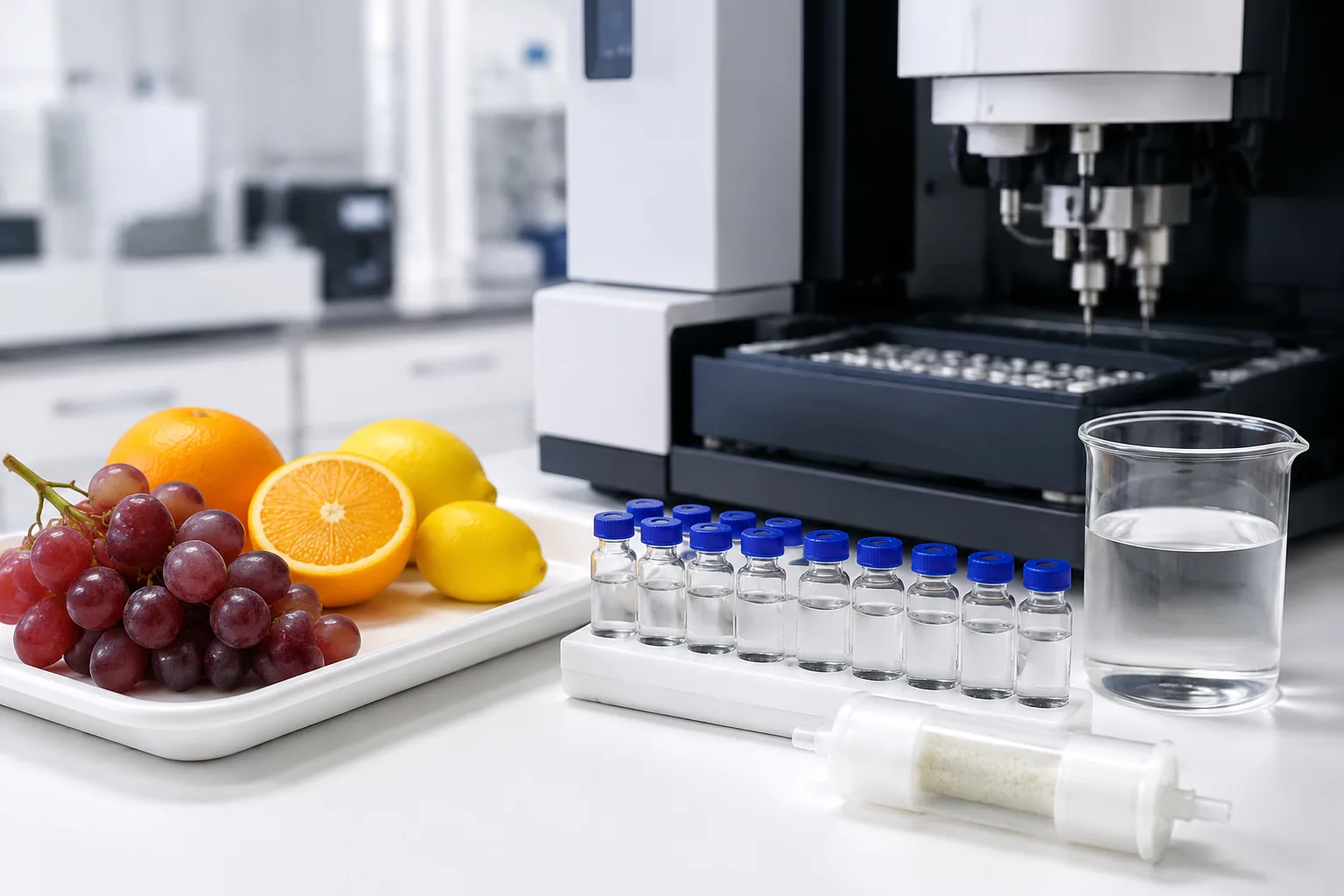
This creates a unique compliance problem: how do you distinguish the applied GA₃ from the natural GA₃ that was already in the fruit? Unlike a synthetic pesticide (which should be zero if not applied), a gibberellin residue is always present at a natural level. The MRL therefore represents a tolerance above the natural background — not a zero-tolerance limit — and the residue limit is set at a level that accounts for legitimate agricultural use plus a safety margin, not at the analytical detection limit.
The Plant-Growth-Regulator Regulatory Framework
Gibberellin (as GA₃) is registered in China as a plant-growth regulator — a sub-category of pesticides regulated by ICAMA (the Institute for the Control of Agrochemicals, Ministry of Agriculture). Its residue is governed under the same pesticide-residue framework as insecticides and fungicides:
| Standard | Role |
|---|---|
| GB 2763-2026 (effective 2026-03-01, replacing GB 2763-2021) | Sets the MRL for gibberellic acid by crop — the compliance limit |
| GB 23200.21-2016 | Specifies the LC-MS/MS method for GA₃ residues in fruits |
| GB 2763 exempt list (Appendix B) | Pesticines for which no MRL is required (gibberellic acid is not exempt — it has crop-specific MRLs) |
The MRL for gibberellic acid in GB 2763 varies by crop (e.g., specific limits for grapes, citrus, kiwifruit), reflecting the approved use patterns and the resulting residue levels. The GB 2763-2026 edition (replacing the 2021 edition, effective 2026-03-01) updated the overall pesticide MRL framework to 564+ pesticides across 376+ food categories, with gibberellic acid retaining its crop-specific limits.
The Method: GB 23200.21-2016
GB 23200.21-2016 (食品安全国家标准 水果中赤霉酸残留量的测定 液相色谱-质谱/质谱法, Determination of Gibberellic Acid Residues in Fruits — LC-MS/MS) is the food-safety method standard for GA₃ in food. It applies to import/export fruits (apples, oranges, peaches, pears, grapes) and may be referenced for other foods.
The method:
- Extraction — the fruit sample is homogenized and extracted with methanol (or acidified methanol), recovering the GA₃ from the plant tissue.
- Cleanup — the extract is purified by liquid-liquid extraction (ethyl acetate) and/or C18 solid-phase extraction (SPE), removing co-extracted matrix components (sugars, organic acids, pigments) that would interfere with the LC-MS/MS.
- LC-MS/MS analysis — the cleaned extract is analyzed by reversed-phase HPLC (C18 column, acidified water-acetonitrile mobile phase) coupled to a triple-quadrupole mass spectrometer in negative-ion electrospray (ESI⁻) multiple-reaction-monitoring (MRM) mode. GA₃ is detected by its precursor-to-product ion transitions, with quantification against a GA₃ calibration standard and an internal standard where available.
- Reporting — the result is reported as mg/kg GA₃ residue, compared against the applicable GB 2763 MRL.
Why LC-MS/MS — Not GC-MS
Gibberellic acid is a polar, thermally labile, non-volatile compound (MW 346, multiple hydroxyl and carboxyl groups). It cannot be analyzed by GC without derivatization (which adds complexity and error). LC-MS/MS is the natural fit: reversed-phase LC separates GA₃ from matrix interferences, and the triple-quadrupole MS provides the selectivity (MRM transitions) and sensitivity (low μg/kg) needed for trace residue work in complex fruit matrices. This is why GB 23200.21 specifies LC-MS/MS, not GC-MS — a point that distinguishes gibberellin analysis from the GC-MS methods used for most organochlorine and organophosphorus pesticide residues.
GA₃ vs GA₄ vs GA₇
While GA₃ (gibberellic acid) is the most commercially used gibberellin and the primary regulated analyte, other gibberellins are also used agriculturally:
- GA₄₊₇ (a mixture of GA₄ and GA₇) — used on apples (to reduce russeting) and cherries. Not always covered by a standalone GB method; typically determined by multi-component LC-MS/MS methods.
- GA₃ — the dominant form used on grapes, citrus, kiwifruit, hops; covered by GB 23200.21.
A compliance test for "gibberellin" typically targets GA₃ as the primary analyte, with GA₄ and GA₇ included where the use pattern requires.
The Agricultural Use That Drives the Testing
Gibberellic acid is used in Chinese agriculture on:
- Grapes (table and wine) — to enlarge berry size and loosen clusters (the dominant use driving residue testing volume).
- Citrus (oranges, mandarins) — to improve fruit set and delay rind aging.
- Kiwifruit — to elongate the fruit shape.
- Apples — GA₄₊₇ to reduce russeting.
- Tea, hops, vegetables — various growth-regulation uses.
The residue concern is not acute toxicity (GA₃ has very low mammalian toxicity) but regulatory compliance with the approved-use MRL — confirming that the grower used GA₃ at the registered rate and pre-harvest interval, not at excessive rates that would violate the MRL.
Our Testing Capabilities
Beijing ZKGX Research conducts gibberellin (gibberellic acid) testing across the food and agricultural framework:
- Method (GB 23200.21-2016): GA₃ residue by LC-MS/MS (ESI⁻, MRM), with methanol extraction and C18 SPE cleanup, for fruits (grapes, citrus, apples, pears, peaches, kiwifruit) and other food matrices.
- MRL reporting (GB 2763-2026): GA₃ residue reported against the crop-specific MRL, with the applicable limit stated on the report.
- Multi-gibberellin panel: GA₃, GA₄, and GA₇ by LC-MS/MS multi-component methods where the use pattern requires.
- Sample types: fruits (table grapes, wine grapes, citrus, apples, kiwifruit, pears, peaches), vegetables, tea, hops, and processed products.
- Deliverable: a test report stating the matrix, the standard applied (GB 23200.21-2016), the measured GA₃ residue (mg/kg), the applicable GB 2763 MRL, and pass/fail.
If you have a fruit, vegetable, or agricultural product requiring gibberellin residue verification, contact our testing team to scope the matrix, the target gibberellin(s), and the applicable MRL.
Frequently Asked Questions
What standard governns gibberellin testing?
GB 23200.21-2016 (Determination of Gibberellic Acid Residues in Fruits — LC-MS/MS) is the method standard. The MRL is set under GB 2763 (Maximum Residue Limits for Pesticides in Foods), with GB 2763-2026 (effective 2026-03-01) as the latest edition, setting crop-specific limits for gibberellic acid.
Is gibberellin a pesticide?
Gibberellic acid is regulated as a plant-growth regulator (PGR) — a sub-category of pesticides under China's pesticide-management framework (ICAMA registration). It is subject to the same pesticide-residue MRL framework as insecticides and fungicides, with crop-specific limits under GB 2763.
Why is gibberellin testing different from synthetic-pesticide testing?
Because gibberellins are endogenous plant hormones — they occur naturally in all plants. The MRL therefore represents a tolerance above the natural background, not a zero-tolerance limit. A compliance test confirms that the applied GA₃ residue is within the MRL set for legitimate agricultural use, not that the compound is absent (which it never is).
What is GB 23200.21-2016?
GB 23200.21-2016 specifies the LC-MS/MS method for GA₃ residues in fruits (apples, oranges, peaches, pears, grapes). The method uses methanol extraction, C18 SPE cleanup, reversed-phase LC separation, and triple-quadrupole MS detection in negative-ion ESI MRM mode. It may be referenced for other food matrices.
What replaced GB 2763-2021?
GB 2763-2021 (Maximum Residue Limits for Pesticides in Foods) was replaced by GB 2763-2026, effective 2026-03-01. The 2026 edition covers 564+ pesticides across 376+ food categories, with gibberellic acid retaining its crop-specific MRLs. A current gibberellin residue report cites GB 2763-2026.