Legionella testing is the laboratory detection and enumeration of Legionella bacteria (军团菌) — primarily Legionella pneumophila (嗜肺军团菌), the causative agent of Legionnaires' disease — in cooling-tower water, warm-water systems, and other environmental water sources associated with building HVAC and water systems. In China, the test is governed by GB/T 18204.5 (Examination Methods for Public Health — Part 5: Centralized Air Conditioning and Ventilation Systems) and GB/T 40392-2021 (Detection of Legionella in Recirculating Cooling Water), with the building-system hygiene requirement set by WS 10013-2023 (Hygienic Specification for Centralized Air Conditioning and Ventilation Systems in Public Places). The defining microbiological trait is that Legionella will not grow on ordinary laboratory media — it requires the specialized BCYE (buffered charcoal yeast extract) agar containing L-cysteine and iron, which is the basis for its isolation and identification.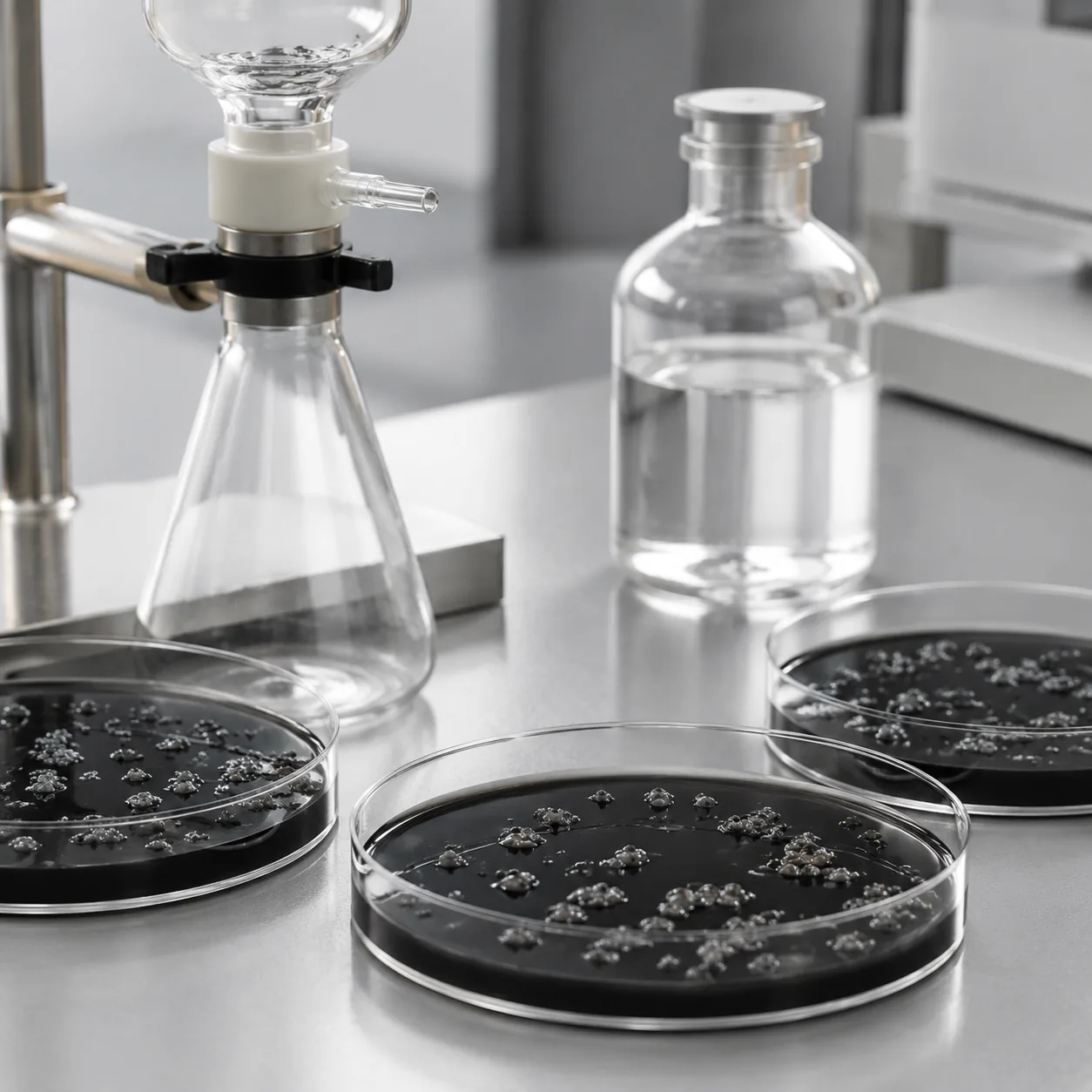
The BCYE Principle — Why Legionella Testing Is Unique
The single most important fact about Legionella testing — and one absent from the search results — is that Legionella bacteria do not grow on standard microbiological media. The routine agar used for total bacterial counts, coliforms, Salmonella, and Pseudomonas (nutrient agar, blood agar, MacConkey, CN agar) will not support Legionella growth. The organism requires:
- L-cysteine — an essential amino acid that Legionella cannot synthesize.
- Iron (soluble ferric pyrophosphate or other iron source) — required for its metabolism.
- Activated charcoal — to absorb toxic peroxides and lipids in the medium.
- ACES buffer — to maintain the pH at 6.9 (narrow tolerance).
This is BCYE (buffered charcoal yeast extract) agar, the Legionella-specific medium and the foundation of all Legionella culture testing. A selective variant, GVPC agar (BCYE + glycine + vancomycin + polymyxin B + cycloheximide), adds antibiotics to suppress competing bacteria in water samples. Without BCYE, Legionella is invisible to standard microbiological testing — a fact that explains why the organism was not discovered until 1976 (the Philadelphia American Legion convention outbreak).
The Matrix-Specific Framework
Legionella is governed by different standards depending on the matrix and application:
| Matrix | Standard | What it governs |
|---|---|---|
| Centralized HVAC cooling water / condensate | GB/T 18204.5 (Examination Methods for Public Health — Part 5) | Detection of L. pneumophila in cooling-tower water, condensate, and air |
| Recirculating cooling water (industrial) | GB/T 40392-2021 | Detection and enumeration of Legionella in cooling-water systems |
| Building-system hygiene requirement | WS 10013-2023 (Hygienic Specification for Centralized HVAC in Public Places) | The action level: when Legionella is detected, what must be done |
| Drinking water (GB 5749-2022) | GB 5749-2022 | Legionella is not a GB 5749 indicator — it is an HVAC/building-water-system pathogen, not a drinking-water-distribution indicator |
The key regulatory point: Legionella in China is not regulated under the drinking-water standard (GB 5749-2022 does not include Legionella among its 97 water-quality indicators). It is regulated under the public-place / building-HVAC framework — WS 10013, GB/T 18204.5 — because the risk is in aerosolized water from cooling towers and warm-water systems inhaled by building occupants, not in consumed drinking water.
The Detection Method (GB/T 18204.5 / GB/T 40392)
The standard Legionella detection pipeline:
- Sample collection — water samples from cooling towers, condensate, hot-water tanks, showers, and faucets, collected in sterile containers (often with sodium thiosulfate to neutralize residual chlorine).
- Concentration — because Legionella is typically present at low concentrations (often <10 CFU/L in cooling water), the sample is concentrated by membrane filtration (0.2 μm filter) or by centrifugation.
- Pre-treatment (acid or heat) — to suppress the competing background flora (which would overgrow Legionella on BCYE), the concentrated sample is treated with acid buffer (pH 2.2, 5 min) or heat (50 °C, 30 min) — Legionella survives both treatments that kill most other bacteria.
- Plating on BCYE / GVPC agar — the treated concentrate is plated onto BCYE and GVPC agars, incubated at 35–37 °C for 3–10 days in a humidified atmosphere (with 2.5–5 % CO₂ for some methods). Legionella colonies appear grey-white, ground-glass textured, and may exhibit a cut-glass or speckled appearance.
- Confirmation — suspect colonies are confirmed by:
- Subculture on BCYE with and without L-cysteine — Legionella grows only on the cysteine-containing plate (the defining confirmatory test).
- Serological identification — latex agglutination or direct fluorescent antibody (DFA) with L. pneumophila serogroup 1 and serogroups 2–14 antisera.
- Biochemical tests — hippurate hydrolysis, gelatinase, oxidase (weak/variable).
- Reporting — reported as Legionella (or L. pneumophila) detected/not-detected per defined volume, or as CFU/L if enumerated. The report notes whether L. pneumophila specifically was confirmed.
Why the L-Cysteine Differential Test
The most elegant confirmatory step: Legionella is an L-cysteine auxotroph — it cannot grow without L-cysteine. Plating the suspect colony on two plates (BCYE with cysteine, and BCYE without cysteine) and observing growth only on the cysteine plate confirms the isolate as Legionella. No other common waterborne bacterium has this absolute cysteine requirement, making this differential test the definitive identification.
The Health Hazard and the Cooling-Tower Connection
Legionella pneumophila causes two diseases:
- Legionnaires' disease — a severe atypical pneumonia with ~10 % mortality (higher in immunocompromised patients). Acquired by inhalation of aerosolized contaminated water — the transmission route is respiratory, not oral.
- Pontiac fever — a milder, self-limiting flu-like illness from the same bacterium.
The environmental reservoir is warm water (25–45 °C) in building systems — cooling towers, evaporative condensers, hot-water tanks, showerheads, spa pools, decorative fountains. The organism thrives in biofilms and proliferates inside amoebae in these warm-water systems. When a cooling tower generates aerosols, the contaminated droplet nuclei are inhaled by building occupants or downwind pedestrians, causing outbreaks. This is why Legionella testing is focused on HVAC cooling-water systems, not on drinking-water distribution.
The Action Level (WS 10013-2023)
WS 10013-2023 (公共场所集中空调通风系统卫生规范, Hygienic Specification for Centralized Air Conditioning and Ventilation Systems in Public Places) sets the building-system hygiene requirements: cooling-tower water and condensate must be tested for Legionella, and if L. pneumophila is detected, the system must be cleaned, disinfected, and retested. The standard drives the compliance testing volume — building managers of hotels, hospitals, office buildings, shopping malls, and other public places with centralized HVAC must conduct periodic Legionella testing of their cooling-water systems.
Our Testing Capabilities
Beijing ZKGX Research conducts Legionella testing across the building-water-system framework:
- Method (GB/T 18204.5 / GB/T 40392-2021): membrane-filtration concentration → acid/heat pre-treatment → BCYE/GVPC plating at 35–37 °C for 3–10 days → L-cysteine differential confirmation → serological identification of L. pneumophila serogroups.
- Matrices: cooling-tower water, condensate, hot-water system water, showerheads/faucets, spa pools, decorative fountains, and other warm-water-system sources.
- Building-system compliance (WS 10013-2023): detection and enumeration for periodic public-place HVAC hygiene compliance.
- Rapid-method support: PCR detection of Legionella DNA for faster presumptive results, with culture confirmation for compliance.
- Sample types: centralized HVAC cooling water, condensate, warm-water systems, and environmental water.
- Deliverable: a test report stating the matrix, the standard applied, the detection method, the result (L. pneumophila detected/not-detected per defined volume or CFU/L), and the serogroup identification where confirmed.
If you have a cooling-water, HVAC, or warm-water-system sample requiring Legionella verification, contact our testing team to scope the matrix, the applicable standard, and the sampling plan.
Frequently Asked Questions
What standard governns Legionella testing?
GB/T 18204.5 (Examination Methods for Public Health — Part 5: Centralized Air Conditioning and Ventilation Systems) and GB/T 40392-2021 (Detection of Legionella in Recirculating Cooling Water) are the method standards. WS 10013-2023 (Hygienic Specification for Centralized HVAC in Public Places) sets the building-system action level. Legionella is not regulated under the drinking-water standard GB 5749-2022.
Why does Legionella need BCYE agar?
Because Legionella cannot grow on ordinary laboratory media. It is an L-cysteine auxotroph — it requires L-cysteine, iron, and other specific nutrients not present in standard agar. BCYE (buffered charcoal yeast extract) agar provides L-cysteine, iron (ferric pyrophosphate), activated charcoal (to absorb toxins), and an ACES buffer at pH 6.9. GVPC agar adds antibiotics (vancomycin, polymyxin B, cycloheximide) for selective isolation from contaminated water.
Is Legionella regulated in drinking water?
No — GB 5749-2022 does not include Legionella among its water-quality indicators. Legionella is regulated under the public-place / building-HVAC framework (WS 10013, GB/T 18204.5) because the risk is inhalation of aerosolized water from cooling towers and warm-water systems, not consumption of drinking water.
How is Legionella confirmed?
The definitive confirmatory test is the L-cysteine differential: the suspect colony is plated on BCYE agar with and without L-cysteine. Legionella grows only on the cysteine-containing plate — its absolute L-cysteine requirement is unique among common waterborne bacteria. Serological identification (latex agglutination or DFA) then confirms L. pneumophila and its serogroup.
What is WS 10013-2023?
WS 10013-2023 (Hygienic Specification for Centralized Air Conditioning and Ventilation Systems in Public Places) is the building-system hygiene standard that requires periodic Legionella testing of cooling-tower water and condensate in public buildings (hotels, hospitals, offices, malls). If L. pneumophila is detected, the system must be cleaned, disinfected, and retested. It drives the compliance testing volume for centralized HVAC systems.