Sanitary napkin testing is the laboratory verification that a sanitary napkin (sanitary pad) and panty liner meets the two Chinese national standards that jointly govern its safety and quality: the hygiene standard GB 15979 (mandatory, for the microbiological and toxicological safety of disposable sanitary products) and the product standard GB/T 8939 (for physical performance, absorbency, pH, and formaldehyde). The two standards address different hazard sets and must be applied together — a common confusion worth clearing up front, alongside the viral "C-class" pH controversy of late 2024.
The Two-Standard Structure: Hygiene and Product
Sanitary napkins are governed by two standards that answer two different questions, and a complete test report draws on both:
| Standard | Scope | What it answers |
|---|---|---|
| GB 15979 (hygiene) | Microbiological, toxicological, and chemical safety of disposable sanitary products | "Is the product free of harmful microbes and toxins?" |
| GB/T 8939 (product) | Physical performance, absorbency, pH, formaldehyde, dimensions | "Does the product perform as a sanitary napkin should?" |
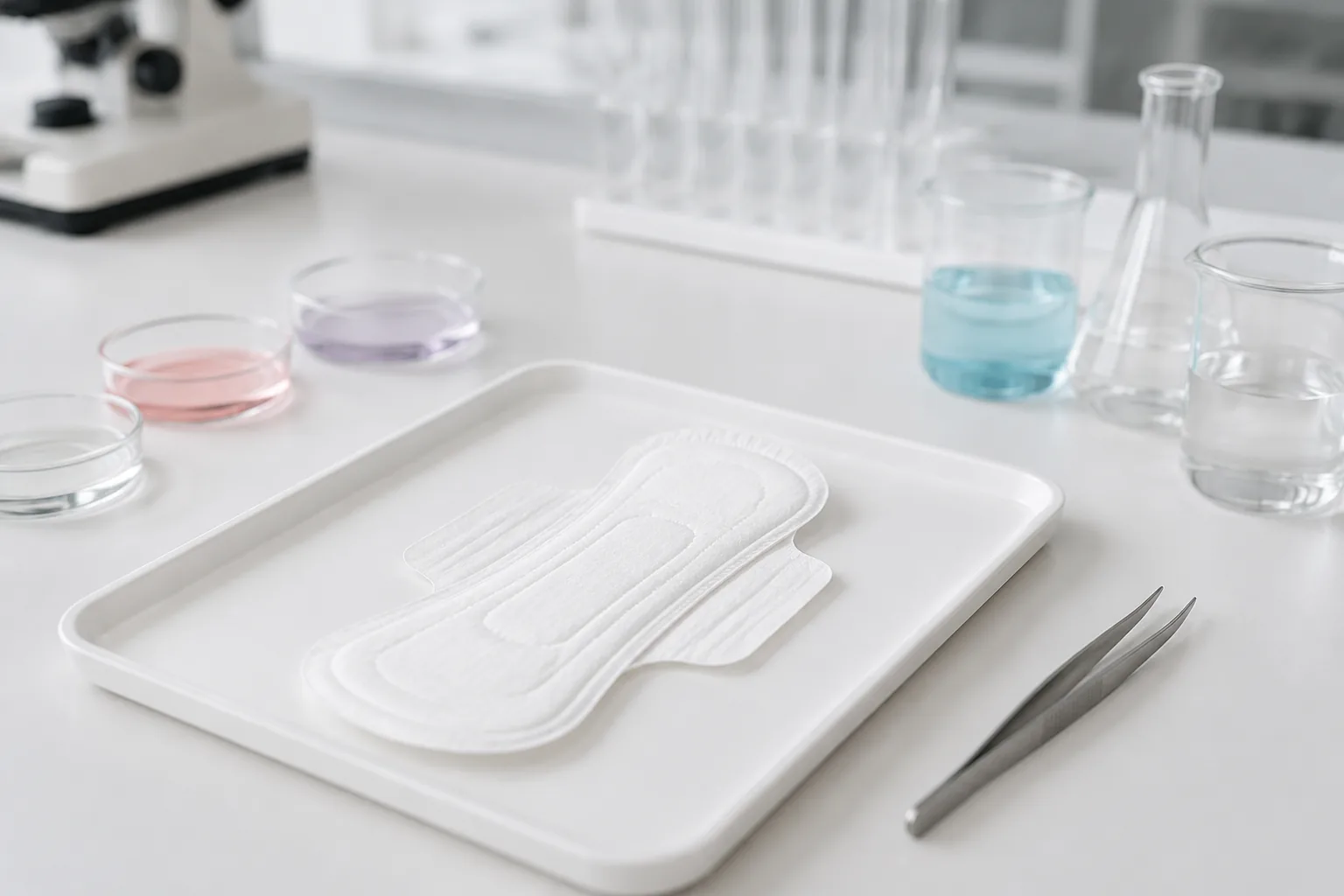
A report that cites only GB/T 8939 (physical performance) without GB 15979 (hygiene) is incomplete, because the microbiological safety of a product used on intimate mucosal tissue is exactly the hazard the hygiene standard exists to control. Conversely, citing only GB 15979 verifies safety but not whether the product actually absorbs. Both are required.
GB 15979-2024: The New Hygiene Standard
GB 15979-2024 (Hygienic Requirements for Disposable Sanitary Products), implemented 2025-07-01, is the first revision of this mandatory standard in 22 years (replacing GB 15979-2002). The 2024 edition substantially expanded the chemical-safety requirements:
- Microbiological limits — total bacterial count, coliforms, pathogenic bacteria (Pseudomonas aeruginosa, Staphylococcus aureus, Salmonella), and fungal counts, graded by product risk class.
- pH value — now a required indicator, graded by product risk class, with the sanitary-napkin pH measured by the method of GB/T 8939.
- Heavy metals — newly added limits for lead, arsenic, and mercury.
- Migratable fluorescent whitening agents — now a restricted residue indicator.
- Formaldehyde — the limit value was adjusted in the new edition.
- Antibacterial claims — products claiming antimicrobial function must demonstrate ≥ 50 % inhibition of E. coli and S. aureus by the shake-flask method (Annex E).
- Production water and prohibited substances — newly specified.
For the first time, a sanitary napkin on the Chinese market must be tested for heavy metals and fluorescent agents, not only microbes — a significant expansion of the chemical-safety scope.
GB/T 8939: The Product Performance Standard
GB/T 8939-2018 (Sanitary Absorbent Pads (Panty Liners)), and its newly published revision GB/T 8939-2025, define the product-performance requirements. The standard applies to products built from a topsheet, an absorbent core (fluff pulp and/or superabsorbent polymer), and a fluid-impervious backsheet. The principal technical indicators:
| Indicator | Requirement (GB/T 8939-2018) |
|---|---|
| pH value | 4.0 – 9.0 |
| Formaldehyde | ≤ 75 mg/kg |
| Water absorption multiple | Sanitary napkin ≥ 7.0×; panty liner ≥ 2.0× |
| Absorption speed | Specified (replaced the old "penetration amount" indicator in the 2008 edition) |
| Moisture at delivery | Limited |
| Migratable fluorescent substances | Not detectable (prohibited) |
| Length deviation | Within tolerance |
| Adhesive peel strength (back glue) | Specified |
| Marking | Conforming |
A key 2018 change was the replacement of the old penetration amount (渗入量) test with the absorption speed (吸收速度) test, which measures how quickly the product takes up fluid — a more functionally relevant metric. Panty liners, which are not expected to absorb menstrual flow, are exempt from the absorption-speed test. The 2025 revision further refined the physical-performance, use-performance, and safety requirements, including the length-measurement method.
The "C-Class" pH Controversy — What the Limit Actually Means
In late 2024, a public controversy erupted over the pH limit in GB/T 8939, driven by a comparison that spread widely online: the sanitary-napkin pH window of 4.0–9.0 is numerically identical to the "Class C" pH window in GB 18401 (the textile-safety standard's non-direct-skin-contact category — i.e., curtains). The framing — "a sanitary napkin is held to the same pH standard as a curtain" — caused widespread alarm and a wave of testing-related searches.
The laboratory-side clarification, which is absent from the search results, is:
- The two windows are numerically the same but come from different standards with different test methods and different product scopes. GB/T 8939 is the sanitary-product standard; GB 18401 is the textile standard. Quoting the curtain comparison as evidence of laxity conflates two unrelated standards.
- The pH 4.0–9.0 window is the minimum compliance floor, not the product-quality ceiling. Within that floor, the GB 15979-2024 hygiene standard now layers additional risk-class-graded chemical requirements, and manufacturer quality grades and the medical-grade group standard (T/NAHIEM 37) impose tighter pH bands closer to the skin-compatible range.
- The controversy nonetheless drove real regulatory action: the new GB 15979-2024 (implemented 2025-07-01) added pH as a formal risk-graded indicator, partly in response.
The takeaway for a compliance reader: a sanitary napkin that passes GB/T 8939 at pH 4.0–9.0 and meets the new GB 15979-2024 chemical requirements is compliant; whether a specific product's pH sits at the skin-friendlier lower end of that window is a quality-grade question, addressed by the higher group standards, not a non-compliance.
Why the SERP Is Off-Intent
The search results for "sanitary napkin testing" are dominated by three unrelated meanings, none of which is GB-standards compliance testing:
- Medical-research content (e.g., the ETH Zurich "MenstruAI" menstrual-blood biomarker project) — research technology, not product compliance.
- Importer / OEM-buyer quality control — ball-burst strength, biodegradation, water retention, flexibility, typically ASTM-based factory checks. Buyer-side QC, not national-standard compliance.
- Brand-owner OEM evaluation guides — absorbency, rewet, wicking, FDA/CE documentation, supplier scorecards. Brand due diligence.
Each of these is a legitimate activity, but none answers the question "does this sanitary napkin comply with the Chinese mandatory standards that govern its sale." That compliance question is what this article addresses, and it is governed by GB 15979-2024 + GB/T 8939, not by ASTM factory checks or FDA filings.
Our Testing Capabilities
Beijing ZKGX Research conducts sanitary napkin and panty-liner testing to the GB 15979 + GB/T 8939 framework:
- Hygiene (GB 15979-2024): microbiological limits (total bacterial count, coliforms, P. aeruginosa, S. aureus, Salmonella, fungi), pH, heavy metals (Pb, As, Hg), migratable fluorescent whitening agents, formaldehyde, and antibacterial-claim verification (Annex E) for products making such claims.
- Product performance (GB/T 8939-2018 / 2025): pH, formaldehyde, water absorption multiple, absorption speed, delivery moisture, migratable fluorescent substances, length deviation, back-glue peel strength, and marking.
- Sample types: sanitary napkins (daytime, overnight, winged), panty liners, and other disposable feminine-hygiene absorbent products.
- Deliverable: a test report stating, for each item, the applied standard, the measured value with method citation, and pass/fail against the limit, with both the hygiene (GB 15979) and product (GB/T 8939) results present.
If you have a sanitary napkin or panty-liner product requiring compliance verification, contact our testing team to scope the applicable standard edition (2018 vs 2025) and the hygiene risk class.
Frequently Asked Questions
What standard governs sanitary napkin testing?
Two standards apply jointly: GB 15979-2024 (the mandatory hygiene standard for disposable sanitary products — microbes, pH, heavy metals, fluorescent agents, formaldehyde) and GB/T 8939 (the product standard — absorbency, pH, formaldehyde, dimensions). A complete report cites both.
What changed in GB 15979-2024?
The 2024 edition (implemented 2025-07-01, the first revision in 22 years) added pH as a risk-graded indicator, added heavy-metal limits (lead, arsenic, mercury), added migratable fluorescent-whitening-agent restrictions, adjusted the formaldehyde limit, and added antibacterial-claim verification. It is a substantial expansion of the chemical-safety scope.
Is the pH 4.0–9.0 limit really the same as for curtains?
The 4.0–9.0 window in GB/T 8939 is numerically the same as the Class C window in GB 18401 (the textile standard), but the two come from different standards with different test methods and different product scopes. The comparison conflates two unrelated standards. The 4.0–9.0 window is the compliance floor; tighter pH bands closer to the skin-compatible range are set by higher quality grades and the medical-grade group standard.
Is sanitary napkin testing the same as the OEM/importer factory checks?
No. Importer factory checks (ball burst, biodegradation, water retention, flexibility — typically ASTM-based) are buyer-side quality control. Sanitary napkin compliance testing verifies the product against the Chinese mandatory standards GB 15979-2024 and GB/T 8939. They answer different questions.
What is the formaldehyde limit for sanitary napkins?
Under GB/T 8939-2018 the formaldehyde limit is ≤ 75 mg/kg. The 2024 revision of GB 15979 adjusted the formaldehyde requirement within the hygiene standard's chemical-safety framework. Both standards must be met.