Seed germination rate testing is the laboratory determination of the percentage of seeds in a sample that produce normal seedlings under standardised optimum conditions, to the method standard GB/T 3543.4-2025 (Rules for Agricultural Seed Testing — Part 4: Germination Test), and judged against the crop-specific grade limits in GB 4404 (Seed of Food Crops). A germination result has no compliance meaning until both the method standard and the grade-limit standard are named, because the same percentage can pass or fail depending on the crop and the grade. Germination is also one of three distinct seed-quality parameters — germination, viability, and vigour — that are often confused but measure different things.
Germination vs Viability vs Vigour: Three Different Parameters
The single most common confusion is treating germination, viability, and vigour as the same thing. They are not, and a compliance report must name which one it measured:
| Parameter | What it measures | Method | Time |
|---|---|---|---|
| Germination | The % of seeds that produce normal seedlings under optimum conditions | GB/T 3543.4 (7–28 days by species) | days to weeks |
| Viability | Whether the embryo is alive (including dormant seed that will not germinate now) | Tetrazolium (TZ) biochemical staining | hours |
| Vigour | The seed's ability to emerge under stress (cold, drought, field conditions) | Accelerated-aging / cold / conductivity tests | days |
The differences matter operationally. Viability (the tetrazolium test) tells you faster whether the embryo is alive but overestimates field emergence, because it counts dormant and chemically damaged seeds as alive that will germinate abnormally or not at all in the field. Vigour tests predict field emergence under non-optimal conditions better than germination does, because a standard germination test runs under ideal temperature, moisture, and substrate. Germination is the headline compliance parameter — the one the seed-grade standards (GB 4404) regulate — because it measures the practical outcome: how many seeds actually produce a usable seedling.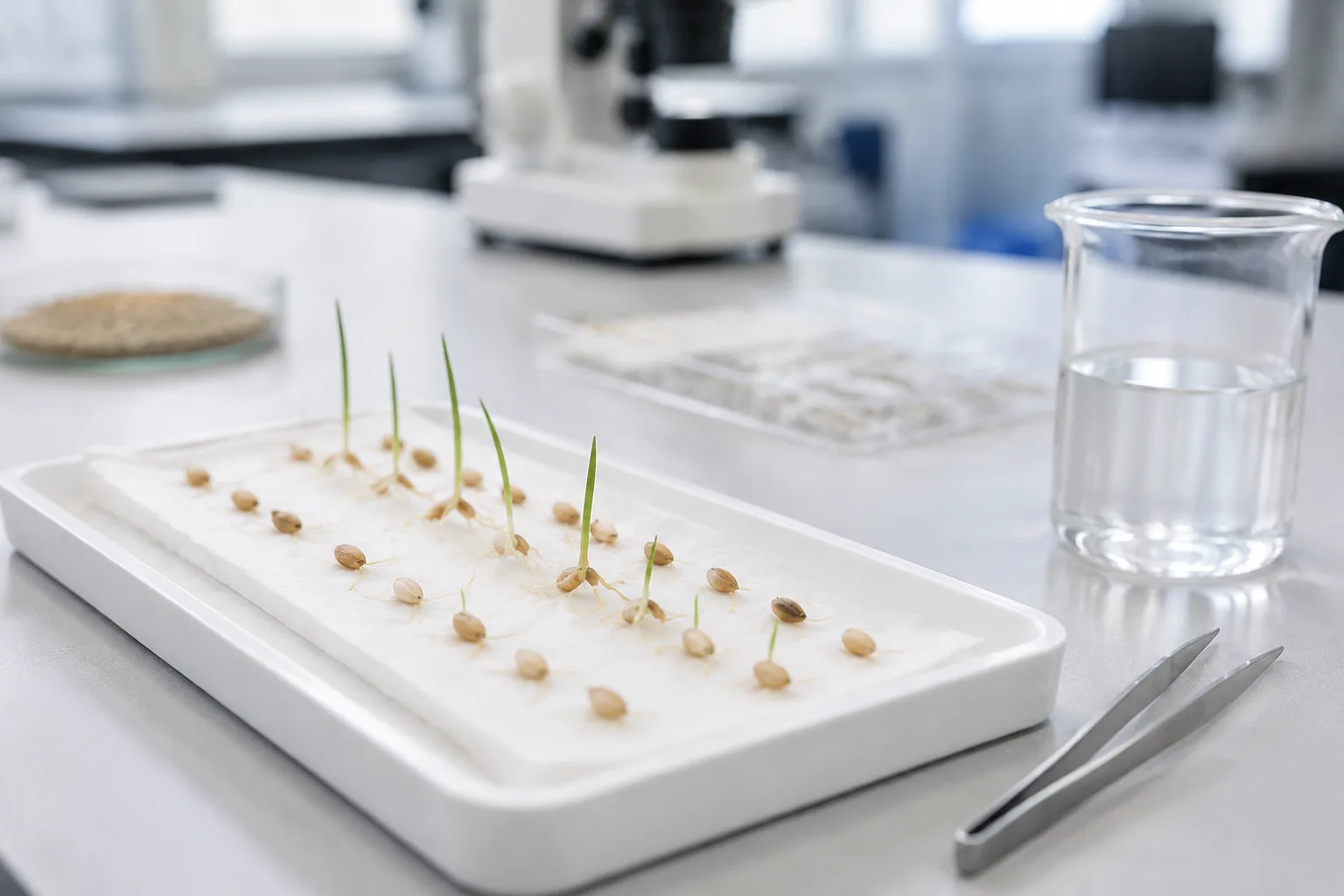
The Method Standard: GB/T 3543.4-2025
The germination-test method is defined in GB/T 3543.4-2025 (农作物种子检验规程 第4部分:播种质量 发芽试验 / Rules for Agricultural Seed Testing — Part 4: Sowing Quality — Germination Test), the current edition that replaced GB/T 3543.4-1995 — the 1995 edition that had governed the test for thirty years. The 2025 revision broadened the title from "发芽试验" to "播种质量 发芽试验" (sowing-quality germination test) and aligned the procedure with the ISTA International Rules for Seed Testing, the global seed-testing reference. A current germination report cites GB/T 3543.4-2025; the 1995 edition is withdrawn.
The method, in outline:
- Sample — a working sample of 400 seeds (typically two replicates of 200) drawn per GB/T 3543.2 (the sampling part), representing the lot.
- Germination substrate and conditions — seeds are placed on a defined substrate (paper, sand) at the species' optimum temperature and moisture, with light or dark as the species requires, for the species' standard test duration (e.g., ~7–8 days for wheat and rice, up to ~4 weeks for some grasses).
- Dormancy-breaking — where a species shows dormancy (fresh ungerminated seed), dormancy-breaking treatments (prechilling, KNO₃, light) are applied so the test measures full germination potential, not just the non-dormant fraction.
- Seedling evaluation — at the end of the test period, each seed is classified as a normal seedling, an abnormal seedling, a hard seed, a fresh ungerminated seed, or a dead seed, per the evaluation rules in the standard.
- Reporting — germination % = (normal seedlings / total seeds tested) × 100, with the abnormal and dead fractions separately reported.
Why Normal Seedlings — Not Just Radicles — Count
The defining rule of the standard germination test, and the one that separates it from the gardener's paper-towel check, is that germination % counts normal seedlings, not just seeds that produced a radicle (root). A normal seedling is one that has developed the essential structures (root system, shoot, and depending on species the cotyledons) needed to grow into a healthy plant under favourable field conditions. A seed that produces a stunted, broken, or malformed seedling — or one that emerged but is decayed — counts as abnormal, not as germinated. This is why a laboratory germination test takes days (not hours) and why it requires trained evaluation: the result depends on whether the seedling is normal, not merely on whether something emerged.
The Grade-Limit Standard: GB 4404
A germination percentage has no pass/fail meaning until it is compared against the crop's grade limit, and the limit differs by crop and by quality grade. The governing grade standards are the GB 4404 series (Seed of Food Crops), with parallel standards for other crop types:
| Standard | Crop type |
|---|---|
| GB 4404.1 | Seed of food crops — rice, wheat, corn, sorghum, millet |
| GB 4404.2 | Seed of oil crops (rapeseed, soybean, peanut, sunflower) |
| GB 4406 / GB 8079 / GB 8080 | Vegetables, sugar beet, cotton |
| GB/T 2930 | Forage and turfgrass seed (separate series) |
| GB 20464 | Forage seed for sowing (general) |
Each standard sets the minimum germination % (and purity %, moisture %) by crop × grade — for example, a hybrid-rice seed of the highest grade carries a higher germination floor than a conventional open-pollinated variety, and a seed lot is graded against the lowest grade threshold among its parameters. The practical compliance question is therefore: "what crop, what grade, what is the germination floor, and did this lot's measured % meet it?" — which requires both the GB/T 3543.4 method result and the GB 4404 grade threshold.
Crop-Specific Quality Issues
The competitor literature correctly notes that germination quality is crop-dependent, and this is reflected in how a germination report is read:
- Cereals (wheat, rice) — generally high germination; dormancy in freshly harvested seed is the main complication, addressed by dormancy-breaking.
- Barley — dormancy is more pronounced; embryo exposure makes mechanical damage more consequential.
- Pulses (field beans) — highly variable due to mechanical damage to the embryo, worse in dry years.
- Oilseed rape — heat damage (from artificial drying or hot harvest weather), mechanical damage, and chemical damage (e.g., glyphosate drift, sprout-suppressant residue) all reduce germination, and chemically damaged seed may germinate abnormally — a case where the tetrazolium viability test would overestimate field performance.
This is why a laboratory germination report may include diagnostic notes (heat damage, mechanical damage, abnormal-seedling types) alongside the headline %, even though only the % is the grade criterion.
Forage and Turfgrass: A Separate Standard
For forage, turfgrass, and other herbaceous-plant seed, the germination method is GB/T 2930.4-2017 (Rules of Seed Testing for Forage, Turfgrass and Other Herbaceous Plant — The Germination Test), a separate standard from GB/T 3543.4 because grass species have different substrates, durations (up to ~4 weeks), and dormancy behaviour. A forage-grass seed report cites GB/T 2930.4, not GB/T 3543.4.
Why the Search Results Are Off the Compliance Intent
The search results for "seed germination rate testing" are dominated by gardener and farmer content:
- University Extension "are my seeds still good" guides — paper towel in a plastic bag, 10 seeds on the refrigerator, a home % calculation. Consumer/gardener home-check, not a laboratory compliance test.
- NIAB UK lab service descriptions — technically correct on germination/viability/vigour and the 200-seed standard, but a UK service page, not a GB-standards article.
- Crop-quality problem notes — wheat/barley/oilseed germination issues, useful context but not a compliance framework.
None tells a seed producer, a crop merchant, or a regulatory inspector which GB standard applies, what the 400-seed protocol is, what the GB 4404 grade floor is for the crop. That compliance question is what this article addresses.
Our Testing Capabilities
Beijing ZKGX Research conducts seed germination rate testing to the GB/T 3543 + GB 4404 framework:
- Germination test (GB/T 3543.4-2025): 400-seed standard (2 × 200 replicates) under species-optimum substrate/temperature/moisture/light, with dormancy-breaking where applicable, and normal/abnormal/hard/fresh/dead seedling evaluation per the standard.
- Grade reporting (GB 4404): germination % reported against the crop- and grade-specific floor (food crops GB 4404.1, oil crops GB 4404.2, vegetables, cotton, forage).
- Forage/turfgrass (GB/T 2930.4-2017): the grass-seed germination method, with the longer durations and grass-specific substrates.
- Companion tests: thousand-seed weight (for sowing-rate calculation), purity (GB/T 3543.3), and moisture (GB/T 3543.6) for the full sowing-quality panel; tetrazolium viability on request for a faster viability read, with the overestimate caveat noted.
- Sample types: cereal (rice, wheat, corn), oilseed (rapeseed, soybean), vegetable, forage and turfgrass seed lots.
- Deliverable: a test report identifying the crop and grade, the germination % with the normal/abnormal/dead breakdown, the method standard (GB/T 3543.4-2025 or GB/T 2930.4), the grade standard (GB 4404 series), and pass/fail against the grade floor.
If you have a seed lot requiring germination-rate verification, contact our testing team to scope the crop, the grade, and the applicable GB standard set.
Frequently Asked Questions
What standard governns seed germination rate testing?
The method is GB/T 3543.4-2025 (Rules for Agricultural Seed Testing — Part 4: Germination Test), the 2025 edition that replaced the 30-year-old GB/T 3543.4-1995 and aligned with the ISTA Rules. For forage/turfgrass, the method is GB/T 2930.4-2017. The grade floor (the pass/fail limit) is in the GB 4404 series by crop.
Is a seed germination test the same as the gardener's paper-towel test?
No. The gardener's paper-towel test is a home check (10 seeds in a plastic bag, a rough %). The laboratory germination test (GB/T 3543.4) uses a 400-seed standard sample under species-optimum conditions, applies dormancy-breaking, and — critically — counts normal seedlings, not just seeds that produced a radicle. A normal seedling is one with the essential structures to grow into a healthy plant; abnormal and dead seeds are reported separately.
What is the difference between germination, viability, and vigour?
Germination is the % of seeds that produce normal seedlings under optimum conditions (GB/T 3543.4, days to weeks). Viability is whether the embryo is alive, including dormant seed, measured by the tetrazolium test (hours) — faster but it overestimates field emergence. Vigour is the ability to emerge under stress conditions, measured by accelerated-aging or cold tests. Germination is the headline grade parameter.
What is the germination limit for a seed lot?
There is no universal germination limit — it is crop- and grade-specific, set by the GB 4404 series. A hybrid-rice seed of the highest grade carries a higher germination floor than a conventional variety; a seed lot is graded against the lowest threshold among its parameters. The practical question is "what crop, what grade, what floor, did this lot's measured % meet it" — which requires both the GB/T 3543.4 result and the GB 4404 floor.
What replaced GB/T 3543.4-1995?
GB/T 3543.4-1995 (Rules for Agricultural Seed Testing — Germination Test) was replaced by GB/T 3543.4-2025 (Rules for Agricultural Seed Testing — Part 4: Sowing Quality — Germination Test). The 2025 edition broadened the title to "sowing-quality germination test," updated the procedure, and aligned it with the ISTA International Rules for Seed Testing. A current germination report cites GB/T 3543.4-2025.