Total fungal count testing is the laboratory enumeration of the combined mould and yeast population (霉菌和酵母计数) in a product or material, reported as colony-forming units per gram or per millilitre (CFU/g, CFU/mL), as a hygiene-indicator screen for fungal contamination. In China, the test is governed by a matrix-specific GB framework: food under GB 4789.15-2016 (Food Microbiological Examination — Mould and Yeast Count), cosmetics under the Safety and Technical Standards for Cosmetics (2015 edition), and disposable hygiene products under GB 15979-2024. The defining trait of the test is that it is a hygiene-indicator count, not a pathogen identification — it measures how much fungal contamination is present, not which species, and it reports mould and yeast together as a single combined population.
Fungal Count vs Bacterial Count vs Pathogen Detection
The first concept to separate is what the total fungal count is not. It is one of three distinct microbiological tests that answer different questions:
| Test | What it counts | Question |
|---|---|---|
| Total fungal count (this article) | Mould + yeast colonies | "How much fungal contamination is present?" |
| Total bacterial count (aerobic plate count) | Total viable bacteria | "What is the general bacterial load?" |
| Pathogen detection (e.g., Salmonella) | A specific pathogenic organism | "Is this specific pathogen present?" |
The total fungal count is a hygiene indicator: it does not identify the fungal species (no Aspergillus, Candida, or Penicillium identification), and it does not distinguish toxigenic from benign moulds. A high count signals poor hygiene, moisture intrusion, or storage failure — conditions that also favour mycotoxin production — but the count itself does not measure mycotoxins. Mycotoxins (aflatoxin, ochratoxin) are chemical contaminants tested by separate methods (HPLC, ELISA); the fungal count is the microbiological precursor that flags the risk.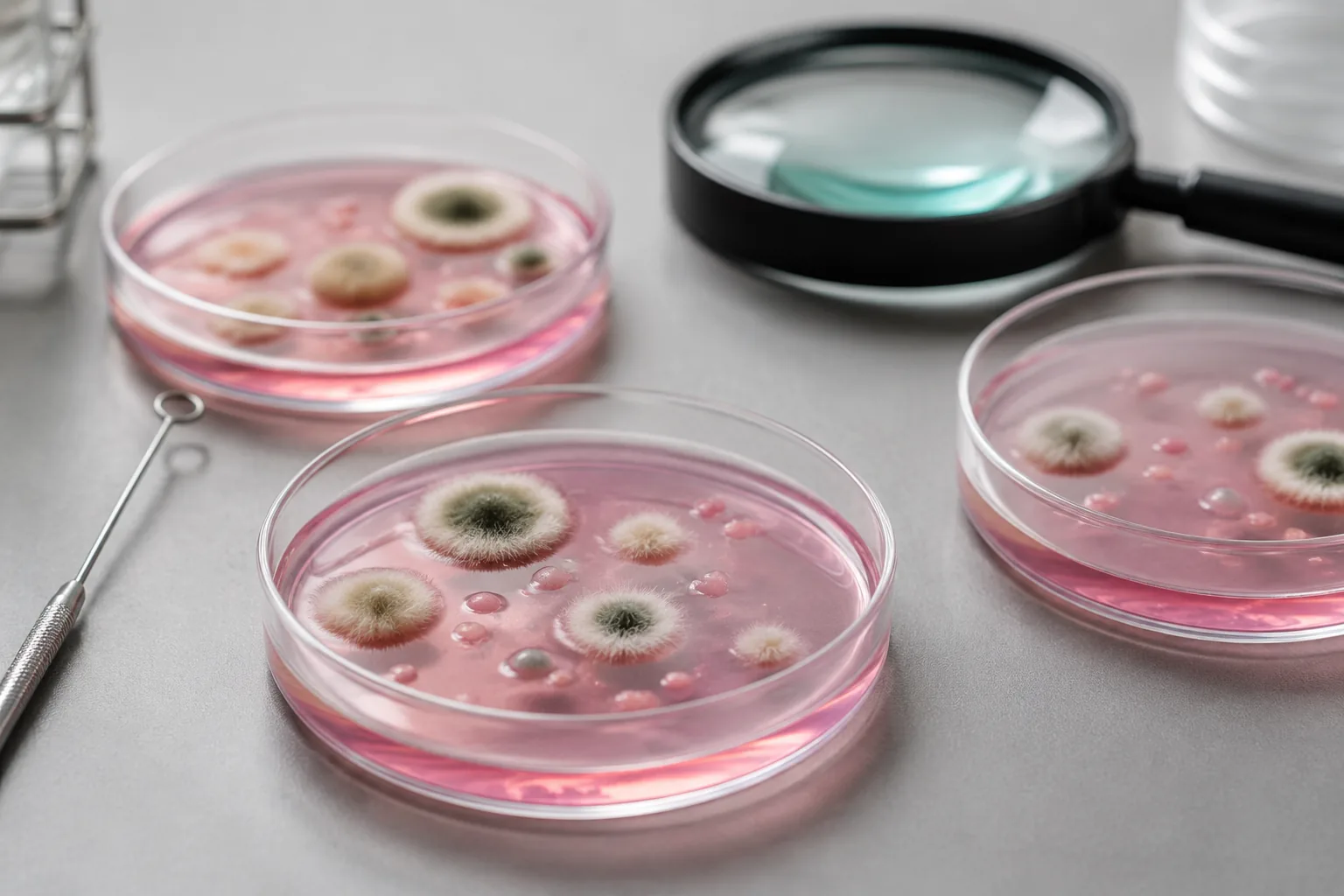
The Matrix-Specific GB Framework
Fungal contamination is governed by different standards depending on the product category:
| Matrix | Standard | Report |
|---|---|---|
| Food | GB 4789.15-2016 — Mould and Yeast Count | Mould + yeast CFU/g (or separate) |
| Cosmetics | Safety and Technical Standards for Cosmetics (2015 ed.) | Total fungal count CFU/g |
| Disposable hygiene products | GB 15979-2024 — Hygienic Requirements for Disposable Sanitary Products | Fungal count CFU/g |
The three share the same underlying microbiology (fungi grown on selective media at defined temperature/time, counted as colonies) but are governed by different standard families, each with its own media, incubation, and reporting conventions. A report must name the matrix and the applicable standard; a "fungal count" result without a named standard is ambiguous.
Food: GB 4789.15-2016 — Two Methods
The food standard GB 4789.15-2016 (食品安全国家标准 食品微生物学检验 霉菌和酵母计数) is the mandatory food-safety method standard. It replaced GB 4789.15-2010 (and before that GB/T 4789.15-2003), was promoted from recommended (GB/T) to mandatory (GB), and defines two distinct methods for different applications:
First Method — Mould and Yeast Count (Pour-Plate)
The standard method for counting mould and yeast in all food types:
- Sample preparation — the food sample is homogenized and serially diluted.
- Plating — dilutions are poured-plate inoculated onto Rose Bengal (chloramphenicol) agar (孟加拉红, the standard medium) or Potato Dextrose Agar (PDA) (马铃薯葡萄糖琼脂). The chloramphenicol in Rose Bengal suppresses bacterial growth, and the rose-bengal dye stains yeast colonies pink, distinguishing them from mould.
- Incubation — plates are incubated at 25–28 °C for 5–7 days (fungi grow more slowly than bacteria).
- Counting — colonies are counted on plates with 10–150 CFU; moulds are identified by their fuzzy filamentous appearance, yeasts by their smooth pink/cream bacterial-like colonies.
- Reporting — the result is calculated from the dilution and reported as mould + yeast CFU/g (some applications report mould and yeast separately).
Second Method — Direct Microscopic Mould Count (Howard Method)
A specialised method for specific products — tomato paste, canned tomatoes, tomato juice — where the concern is not colony count but the visible mould filaments indicative of mouldy raw material:
- The sample is spread on a Howard mould-count slide (a special slide with a calibrated 0.1 mm-deep counting chamber).
- Examined under the microscope at a defined magnification.
- Each field-of-view is scored positive (mould filaments present) or negative.
- The result is the percentage of positive fields (the Howard mould count), indicating the extent of mould contamination in the raw tomato.
The Howard method is specific to tomato products because their processing concentrates any mould from the raw fruit into the final paste, and the microscope-direct method catches the mould mycelium that plate counts may miss in heat-treated product.
The Culture Media and Why They Matter
The choice of medium is decisive for an accurate fungal count:
- Rose Bengal chloramphenicol agar (孟加拉红) — the GB 4789.15 standard medium. Rose Bengal dye restricts the lateral spread of fast-growing mould colonies (so they don't overgrow the plate and obscure the count), and it stains yeast colonies pink for visual distinction. Chloramphenicol suppresses the bacteria that would otherwise overgrow the fungal colonies at the long (5–7 day) incubation. This is the most-used GB medium for food fungal counts.
- Potato Dextrose Agar (PDA, 马铃薯葡萄糖琼脂) — the classical mould-and-yeast medium, slightly acidic (pH ~5.6), favouring fungi over bacteria. Used as the GB 4789.15 alternative.
- Martin's medium (马丁培养基) — a medium with rose-bengal and chloramphenicol, historically used for fungal isolation. Less common in current GB 4789.15 practice but still referenced.
The antibiotic (chloramphenicol) and the dye (rose bengal) are what make these media selective for fungi: without them, the faster-growing bacteria would overrun the plate during the 5–7 days fungi need, and the count would be invalid.
Cosmetics and Hygiene Products
For cosmetics, the Safety and Technical Standards for Cosmetics (2015 edition) specifies the total fungal count method using Rose Bengal / PDA, reported as CFU/g, with the acceptance limit depending on the product category (eye-area and children's cosmetics carry the strictest limits). The principle is the same as the food method — selective fungal medium, 5–7 day incubation — but the regulatory framework is the cosmetics standard, not GB 4789.15.
For disposable hygiene products (sanitary napkins, tissues, masks), GB 15979-2024 specifies the fungal-count method as part of its microbiological panel, alongside total bacterial count and pathogen detection. The medium and incubation are consistent with the food method.
Why the Search Results Are Off the Compliance Intent
The search results for "total fungal count testing" / "mould and yeast count" are typically dominated by content that does not frame the GB compliance framework:
- Laboratory service pages describe the mould-and-yeast count method generically, citing ISO 21527 (food and animal feed), USP <61> (pharmaceutical microbiological examination), or FDA BAM Chapter 18 (yeast, mould, and mycotoxins). Western standards, zero GB.
- 3M Petrifilm product pages promote the rapid mould-and-yeast plate for food testing. Rapid-method product, no GB standard.
- Pharmaceutical/USP <61> content describes microbial limits for pharmaceuticals, a different regulatory framework from food.
None tells a food producer, a cosmetics manufacturer, or a hygiene-products maker which GB standard governs their product's fungal count, what the two GB 4789.15 methods are, or how to choose between Rose Bengal and PDA. That compliance question is what this article addresses.
Our Testing Capabilities
Beijing ZKGX Research conducts total fungal count (mould and yeast count) testing across the matrix-specific GB framework:
- Food (GB 4789.15-2016): mould and yeast count by the first method (pour-plate on Rose Bengal chloramphenicol agar or PDA, 25–28 °C, 5–7 days, reported CFU/g), and the second method (Howard direct-microscopic mould count for tomato paste and tomato products).
- Cosmetics (Safety and Technical Standards for Cosmetics): total fungal count by the specified medium and method, against the product-category limit.
- Hygiene products (GB 15979-2024): fungal count as part of the microbiological panel for disposable sanitary products.
- Sample types: foods of all categories (cereals, dairy, beverages, condiments, tomato products), cosmetics, and disposable hygiene products.
- Deliverable: a test report stating the matrix, the standard applied (GB 4789.15-2016 for food, cosmetics technical standard, GB 15979-2024 for hygiene products), the method (plate-count vs Howard), the medium, the mould+yeast CFU/g result, and pass/fail against the product's microbiological limit.
If you have a food, cosmetic, or hygiene-product sample requiring total fungal count verification, contact our testing team to scope the matrix, the applicable standard, and the method.
Frequently Asked Questions
What standard governns total fungal count in food?
GB 4789.15-2016 (Food Microbiological Examination — Mould and Yeast Count), the mandatory food-safety method standard replacing GB 4789.15-2010. It provides two methods: the first (pour-plate on Rose Bengal / PDA, 25–28 °C, 5–7 days, CFU/g) for all foods, and the second (Howard direct-microscopic mould count) for tomato paste and tomato products.
What is the difference between the pour-plate and the Howard method?
The pour-plate method (GB 4789.15 first method) counts living mould and yeast colonies grown on selective agar — it gives CFU/g and applies to all foods. The Howard method (GB 4789.15 second method) counts visible mould filaments under the microscope on a Howard slide — it gives a percentage of positive fields and applies specifically to tomato paste and tomato products, where processing concentrates raw-fruit mould into the paste.
Why is Rose Bengal agar used for fungal counting?
Rose Bengal chloramphenicol agar is the GB 4789.15 standard medium because the rose-bengal dye restricts the lateral spread of fast-growing mould colonies (preventing overgrowth) and stains yeast colonies pink for visual distinction, while the chloramphenicol suppresses bacterial growth during the 5–7 day incubation that fungi require. These selective features make the medium specific for fungi.
Is total fungal count the same as mycotoxin testing?
No. Total fungal count is a microbiological count of the living (or viable) mould and yeast population — a hygiene indicator. Mycotoxin testing (aflatoxin, ochratoxin, etc.) is a chemical analysis of the toxic metabolites some moulds produce — measured by HPLC or ELISA in μg/kg. A high fungal count signals the risk of mycotoxin contamination, but the count itself does not measure mycotoxins.
Is total fungal count the same as pathogen detection?
No. Total fungal count is a non-specific hygiene-indicator count of all moulds and yeasts. It does not identify fungal species (no Aspergillus, Candida identification) and does not target a specific pathogen. Pathogen detection (like Salmonella for bacteria, or specific fungal pathogen identification) answers "is this specific organism present" — a different question from "how much fungal contamination is present."