Table of Contents
- What is cellulose ether testing?
- The cellulose ether family: MC, HPMC, HPC, CMC, HEC, MHEC
- The standard stack: FAO JECFA, USP, EP, GB 1886, EFSA, AOAC
- Substituent determination: methoxyl, hydroxypropoxyl, and the Zeisel HI-GC method
- Viscosity testing: rotational, capillary, and the 80–120 % tolerance
- Purity tests: loss on drying, sulfated ash, heavy metals, residual solvents
- Thermal gelation and the flocculation temperature
- Identification tests: solubility, ninhydrin, film, and flocculation
- Food-matrix quantification: the AOAC 991.43 enzymatic-SEC method
- GB 2760 usage scope and EFSA re-evaluation
- FAQ
- Our cellulose ether testing capabilities
What is cellulose ether testing?
Cellulose ether testing is the measurement and validation of the identity, composition, purity, and functional performance of the cellulose-ether family of additives — methylcellulose (MC, E461, CAS 9004-67-5), hydroxypropyl methylcellulose (HPMC, E464, CAS 9004-65-3), hydroxypropyl cellulose (HPC, E463, CAS 9004-37-1), sodium carboxymethylcellulose (CMC-Na, E466, CAS 9004-32-4), hydroxyethyl cellulose (HEC), and methylhydroxyethyl cellulose (MHEC, E465) — across the food, pharmaceutical, feed, cosmetic, and construction-material markets where they are used as thickeners, stabilisers, emulsifiers, gelling agents, binders, film-formers, and water-retention aids. The output of a cellulose ether test is a dossier covering the substituent content (methoxyl, hydroxypropoxyl, hydroxyethoxyl — the chemical fingerprint of the ether), the viscosity (the functional performance, with its 80–120 % tolerance on the labelled value), the purity (loss on drying, sulfated ash, heavy metals, residual solvents), and the thermal gelation behaviour (the reversible thermal-gel transition that distinguishes MC and HPMC from non-gelling CMC).
The cellulose ethers are derivatives of natural cellulose — the linear polysaccharide of β-1,4-linked D-glucose — produced by etherification of the alkali-cellulose intermediate with methyl chloride (→ MC), methyl chloride + propylene oxide (→ HPMC), propylene oxide (→ HPC), sodium chloroacetate (→ CMC-Na), ethylene oxide (→ HEC), or methyl chloride + ethylene oxide (→ MHEC). The substituent type and the degree of substitution (DS) determine the solubility, viscosity, thermal gelation, and regulatory classification of the resulting ether. The standards governing cellulose ether testing span the FAO JECFA cellulose-ether monographs (1989, 1998, with the group ADI "not specified" re-confirmed at each review), the USP monographs for Methylcellulose, Hydroxypropyl Methylcellulose, Hydroxypropyl Cellulose, and Carboxymethylcellulose, the European Pharmacopoeia (EP) monographs (01/2016:0345 MC; 01/2016:0348 HPMC), the Chinese GB 1886 series (GB 1886.109-2015 HPMC, GB 1886.232-2016 CMC-Na, GB 1886.103-2015 microcrystalline cellulose, GB 1886.374-2024 cellulose), the EFSA ANS Panel 2018 re-evaluation of the celluloses (E 460(i) through E 469), and the AOAC 991.43 enzymatic-SEC method for the quantification of MC/HPMC in food matrices. A cellulose ether placed on the Chinese market as a food additive must satisfy the applicable GB 1886 standard, with usage regulated by GB 2760; on the US market, the USP monograph; on the EU market, the E-number specification under Commission Regulation (EU) No 231/2012.、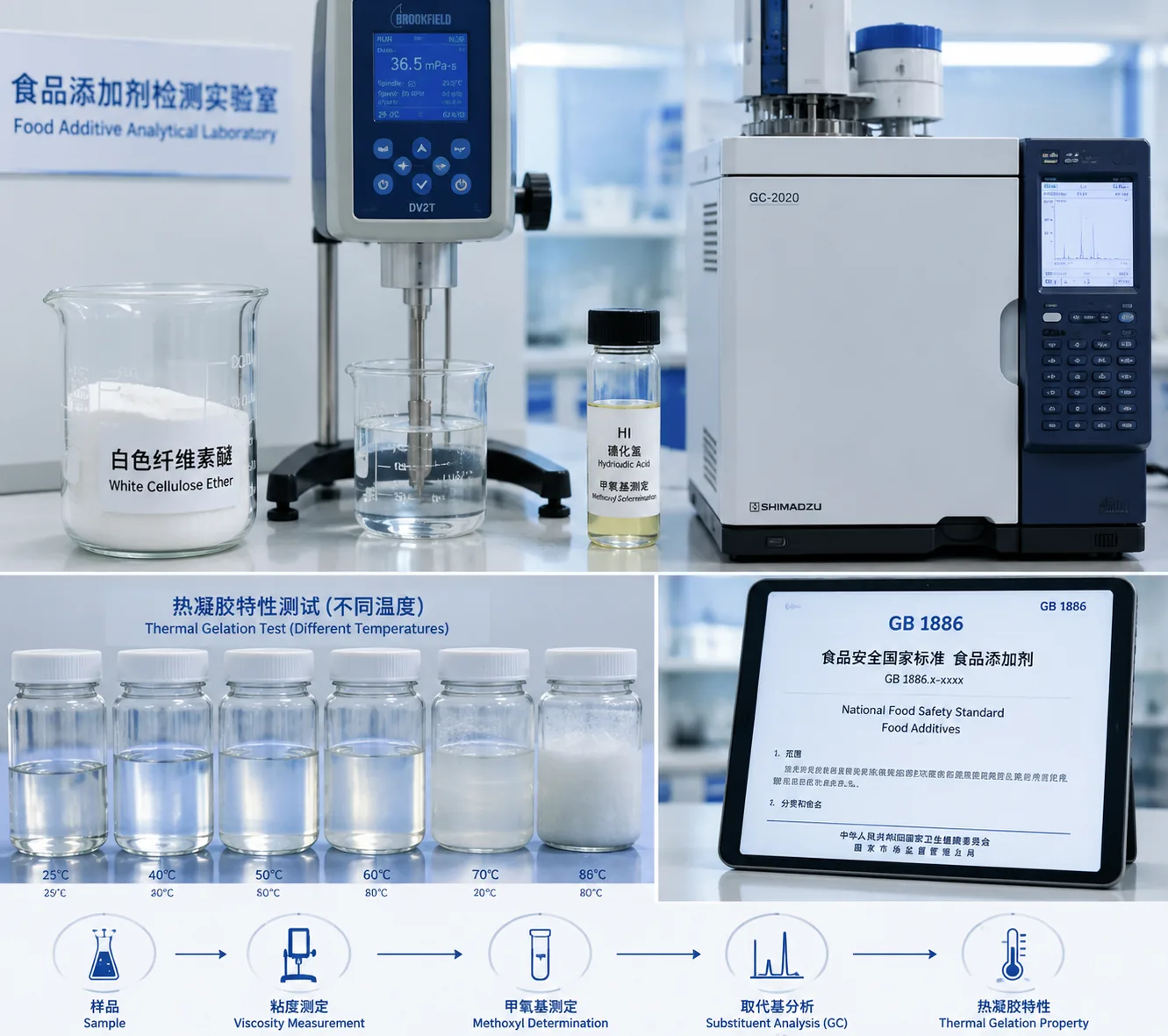
The cellulose ether family: MC, HPMC, HPC, CMC, HEC, MHEC
The cellulose ether family is differentiated by the substituent group(s) attached to the cellulose backbone, which in turn determine the solubility, viscosity, thermal behaviour, and regulatory classification.
| Ether | Substituent(s) | INS / E | CAS | GB 1886 | USP | EP | Solubility / thermal behaviour |
|---|---|---|---|---|---|---|---|
| Methylcellulose (MC) | –OCH₃ only | 461 / E461 | 9004-67-5 | (no standalone GB 1886; covered under GB 1886.374-2024 cellulose or under USP/EP) | Methylcellulose | 0345 | Cold-water soluble; reversible thermal gel at 50–65 °C |
| Hydroxypropyl methylcellulose (HPMC) | –OCH₃ + –OCH₂CH(OH)CH₃ | 464 / E464 | 9004-65-3 | GB 1886.109-2015 | Hypromellose | 0348 | Cold-water soluble; reversible thermal gel at 50–85 °C |
| Hydroxypropyl cellulose (HPC) | –OCH₂CH(OH)CH₃ | 463 / E463 | 9004-37-1 | (no standalone GB 1886) | Hydroxypropyl Cellulose | 0337 | Cold-water and ethanol soluble; thermoplastic |
| Sodium carboxymethylcellulose (CMC-Na) | –OCH₂COONa | 466 / E466 | 9004-32-4 | GB 1886.232-2016 | Carboxymethylcellulose Sodium | 0344 | Cold-water soluble; ionic; non-gelling |
| Hydroxyethyl cellulose (HEC) | –OCH₂CH₂OH | 465 / E465 (with MHEC) | 9004-62-0 | — | (no USP monograph; cited in FCC and cosmetics) | — | Cold-water soluble; non-ionic; non-gelling |
| Methylhydroxyethyl cellulose (MHEC) | –OCH₃ + –OCH₂CH₂OH | 465 / E465 (with HEC) | 9032-42-2 | — | (no USP monograph) | — | Cold-water soluble; non-ionic; thermal gel like MC |
| Ethyl cellulose (EC) | –OC₂H₅ | 462 / E462 | 9004-57-3 | — | Ethylcellulose | — | Water-insoluble; ethanol-soluble; film-former |
The three most-tested members are MC (the original methyl ether, used in pharmaceutical oral preparations, food coatings, and construction adhesives), HPMC (the most widely used cellulose ether, used in pharmaceutical tablet coatings, capsule shells, food glazes, cement-based tile adhesives, and paint thickeners), and CMC-Na (the ionic ether, used in food thickening, ice-cream stabilisation, toothpaste, and oil-drilling muds). The degree of substitution (DS) — the average number of hydroxyl groups per anhydroglucose unit (0–3) that carry the substituent — and the molar substitution (MS) for the hydroxyalkyl ethers — the average number of substituent moles per anhydroglucose unit (can exceed 3 for HPC and HEC because the hydroxyalkyl group adds a new hydroxyl that can itself be etherified) — together define the chemical fingerprint of the ether and are the regulatory specifications.
The standard stack: FAO JECFA, USP, EP, GB 1886, EFSA, AOAC
A complete cellulose ether testing project draws on a stack of international, US, EU, Chinese, and AOAC standards, the choice of which depends on the ether type, the application (food vs pharmaceutical vs feed), and the target market.
| Family | Standard | Scope |
|---|---|---|
| FAO JECFA | Methyl cellulose, Hydroxypropylmethyl cellulose, Ethyl cellulose, Hydroxypropyl cellulose, Sodium carboxy methyl cellulose monographs (Compendium Addendum 11 / Vol. 4) | International reference specifications; group ADI "not specified" since 1989 |
| USP | Methylcellulose, Hypromellose (HPMC), Hydroxypropyl Cellulose, Carboxymethylcellulose Sodium, Ethylcellulose monographs | US pharmacopeial monographs; the primary reference for pharmaceutical-grade and dietary-supplement-grade cellulose ethers |
| EP | 01/2016:0345 Methylcellulose; 01/2016:0348 Hypromellose; 01/2016:0337 Hydroxypropylcellulose; 01/2016:0344 Carboxymethylcellulose Sodium | European pharmacopeial monographs; harmonised with USP under the PDG |
| GB 1886.109-2015 | Food additive — Hydroxypropyl methylcellulose (HPMC) | Chinese national standard for HPMC |
| GB 1886.232-2016 | Food additive — Sodium carboxymethylcellulose (CMC-Na) | Chinese national standard for CMC-Na |
| GB 1886.103-2015 | Food additive — Microcrystalline cellulose (MCC) | Chinese national standard for MCC (E460(ii)) |
| GB 1886.374-2024 | Food additive — Cellulose (2024 revision) | Chinese national standard for cellulose (E460(i)); covers broader cellulose category |
| GB 2760-2024 | Use of food additives | Chinese usage scope — most cellulose ethers are GMP ("按生产需要适量使用") in most food categories |
| EFSA ANS Panel 2018 | Re-evaluation of celluloses E 460(i), E 460(ii), E 461, E 462, E 463, E 464, E 465, E 466, E 468, E 469 as food additives (EFSA Journal 16:5047) | The 2018 EFSA scientific opinion; no ADI; read-across among the modified celluloses |
| EFSA FEEDAP 2020 | Scientific opinion on methyl cellulose for all animal species (EFSA Journal 18:6271) | The 2020 EFSA feed-additive re-evaluation; no maximum content in feed |
| Commission Regulation (EU) No 231/2012 | Specifications for food additives — celluloses E 460–E 469 | EU purity specifications; harmonised with FAO JECFA |
| AOAC 991.43 + collaborative (2008) | Enzymatic-SEC method for MC and HPMC in food | The only official method for the quantification of MC/HPMC in food matrices |
The single most consequential fact for a Chinese manufacturer is that the GB 1886 series provides product standards for HPMC (GB 1886.109-2015) and CMC-Na (GB 1886.232-2016) but does not (as of the 2024 revision) provide a standalone product standard for MC — methylcellulose is therefore typically tested in China against the FAO JECFA monograph, the USP monograph, or the EP 0345 monograph, and against the broader GB 1886.374-2024 cellulose specification where applicable.
Substituent determination: methoxyl, hydroxypropoxyl, and the Zeisel HI-GC method
The chemical fingerprint of a cellulose ether is its substituent content: the percentage by mass of the methoxyl (–OCH₃), hydroxypropoxyl (–OCH₂CH(OH)CH₃), or hydroxyethoxyl (–OCH₂CH₂OH) groups on the cellulose backbone. The substituent content determines the ether type (MC vs HPMC vs HPC vs CMC), the DS, the regulatory specification, and the functional behaviour.
The reference method for substituent determination is the Zeisel hydroiodic-acid cleavage + gas-chromatographic (HI-GC) method:
- Ether cleavage — The cellulose ether (65 mg) is heated with hydriodic acid (HI, 55–57 %) at 130 °C for 60 min in a sealed pressure vial with an internal standard (n-octane in o-xylene). The HI cleaves the ether bond, converting each –OCH₃ to methyl iodide (CH₃I) and each –OCH₂CH(OH)CH₃ to isopropyl iodide + allyl iodide (the hydroxypropyl ether cleavage products).
- GC analysis — The upper organic layer (o-xylene with the methyl iodide and the internal standard) is analysed by GC with a thermal-conductivity or flame-ionisation detector; a 10–20 % liquid phase G1 column (3–4 mm × 1.8–3 m) at 100 °C; helium carrier gas; the retention time of the internal standard is set to ~10 min by the flow-rate adjustment.
- Calculation — The methoxyl percentage is calculated as:
% methoxyl = X × (Rᵤ / Rₛ) × (Wₛ / W) × 100
where X = ratio of formula weights of methoxy to methyl iodide × 100 % = 21.864; Rᵤ and Rₛ = peak-area ratios (methyl iodide / internal standard) in the sample and standard; Wₛ and W = weights of methyl iodide in the standard and of the sample (mg).
USP acceptance criteria for Methylcellulose: NLT 26.0 % and NMT 33.0 % methoxyl (on the dried basis). For Hypromellose (HPMC) the criteria are specified as combinations of methoxyl and hydroxypropoxyl (the USP "substitution type code", e.g., 1828, 2208, 2906, 2910).
FAO JECFA / EFSA / Commission Regulation (EU) 231/2012 for MC: methoxyl 25–33 %, hydroxyethoxyl < 5 %, sulfated ash < 1.5 %, loss on drying < 10 %, pH 5–8.
Viscosity testing: rotational, capillary, and the 80–120 % tolerance
The viscosity is the single most commercially important specification of a cellulose ether — the parameter that the customer specifies (e.g. "HPMC 100,000 mPa·s grade") and that the laboratory verifies. The USP Methylcellulose monograph and the FAO JECFA monograph specify two viscosity methods:
| Method | Range | Procedure |
|---|---|---|
| Method 1 — Capillary viscometer | For viscosities < 600 mPa·s | Dissolve 4.000 g (dried basis) in 200.0 g hot water; stir 10–20 min at 400 ± 50 rpm; cool to < 5 °C; stir 20–40 min; adjust to 200.0 g; centrifuge to remove bubbles; measure kinematic viscosity ν at 20 ± 0.1 °C; determine density ρ separately; η = ρν |
| Method 2 — Rotational viscometer (Brookfield LV or equivalent) | For viscosities ≥ 600 mPa·s | Dissolve 10.00 g in 500.0 g hot water by the same procedure; measure with the Brookfield LV viscometer using the rotor, rpm, and calculation multiplier specified by the labelled viscosity (Table: rotor 3 @ 60 rpm for 600–1400 mPa·s; rotor 4 @ 6 rpm for 99,500 mPa·s and higher) |
USP acceptance criteria — 80.0–120.0 % of the labelled viscosity for viscosities < 600 mPa·s; 75.0–140.0 % of the labelled viscosity for viscosities ≥ 600 mPa·s. The wider tolerance at high viscosity reflects the higher measurement uncertainty of the rotational viscometer at low shear rates and the thixotropic (shear-thinning) behaviour of the high-molecular-weight cellulose ethers.
A commercial HPMC grade sold as "100,000 mPa·s" must therefore measure between 75,000 and 140,000 mPa·s by the rotational method at the declared concentration (typically 2 % w/w). A batch outside this range is non-conforming and must be re-blended to grade.
Purity tests: loss on drying, sulfated ash, heavy metals, residual solvents
The purity tests cap the contaminants that arise from the cellulose-ether manufacturing process — the residual solvents (methyl chloride, propylene oxide, ethylene oxide, sodium chloroacetate) used in the etherification; the inorganic salts (Na₂SO₄) from the neutralisation; the heavy metals from the raw cellulose; and the moisture picked up during storage.
| Test | USP / FAO JECFA limit | Method |
|---|---|---|
| Loss on drying | NMT 5.0 % (USP) / NMT 10 % (FAO JECFA), 105 °C, 1 h | Gravimetric |
| Sulfated ash (residue on ignition) | NMT 1.5 % (USP / FAO JECFA) | Ignition with H₂SO₄ at 800 °C |
| Heavy metals (Pb) | NMT 20 ppm (USP <231> Method III; FAO JECFA 10 mg/kg) | AAS or ICP-MS |
| Arsenic (As) | Per FAO JECFA (3 mg/kg) | ICP-MS |
| Residual solvents — methyl chloride, propylene oxide | ≤ 1 % total per FAO JECFA (Class 3 solvents per ICH Q3C); propylene oxide a Class 2 solvent (PDE 4.2 mg/day) | Headspace GC |
| Glyoxal (in HPMC) | Per FAO JECFA | HPLC |
| 2-Methoxyethanol, ethylene glycol (in HPMC) | Per FAO JECFA | GC |
| Microbial limits | Per FAO JECFA (E. coli, Salmonella, total aerobic count) | Plate count |
The residual-solvent test (headspace GC) is the most commonly failed purity test for cellulose ethers: an HPMC that has been insufficiently washed after the propylene-oxide etherification will report > 1 % total residual solvents, failing the FAO JECFA / ICH Q3C specification. The propylene oxide residual is particularly scrutinised because it is a Class 2 solvent (suspected carcinogen) under ICH Q3C, with a PDE of 4.2 mg/day; the limit in the cellulose ether is therefore set by the patient's daily intake of the ether × the residual level.
Thermal gelation and the flocculation temperature
The thermal gelation is the behaviour that distinguishes MC and HPMC from the non-gelling cellulose ethers (CMC, HEC). When an aqueous solution of MC or HPMC is heated, the solution gels at a characteristic temperature (the gelation temperature or flocculation temperature); when cooled, the gel reverts to the solution. The gelation is reversible and is the basis of the "thermo-reversible gel" application of MC and HPMC in food (mousse, jam), pharmaceuticals (controlled-release matrix), and construction (water-retention in cement).
The USP Identification test E for Methylcellulose specifies the flocculation-temperature test: 50 mL of the identification-test-B solution is added to 50 mL of water in a beaker, the solution is stirred on a magnetic stirrer / hot-plate, and the temperature is raised at 2–5 °C/min. The temperature at which a turbidity increase begins is the flocculation temperature; USP acceptance: the flocculation temperature is higher than 50 °C. Typical values are 50–65 °C for MC, 50–85 °C for HPMC (depending on the methoxyl / hydroxypropoxyl ratio), and no flocculation (no gelation) for CMC.
The thermal-gelation mechanism is the hydrophobic interaction: at low temperature, water molecules are ordered around the methoxyl and hydroxypropoxyl substituents (the "hydrophobic hydration"); at high temperature, the ordered water is released and the substituents associate, forming the gel network. The higher the substituent content (especially the hydroxypropoxyl in HPMC), the higher the gelation temperature.
Identification tests: solubility, ninhydrin, film, and flocculation
The USP Methylcellulose monograph specifies five identification tests (A through E), which together confirm that the sample is methylcellulose and not another cellulose ether or another polysaccharide:
| Test | Method | Positive result |
|---|---|---|
| A. Aqueous dispersion | Distribute 1 g onto the surface of 100 mL water; let stand 1–2 min | The powder aggregates on the surface (does not dissolve immediately) |
| B. Cold-water dissolution | Add to 100 mL boiling water, stir with magnetic bar; cool to 5 °C, stir | A clear or slightly turbid solution forms; thickness depends on the viscosity grade |
| C. Ninhydrin colour reaction | To 0.1 mL of B-solution + 9 mL H₂SO₄ (9-in-10); heat in water bath 3 min; cool in ice; add 0.6 mL ninhydrin TS; let stand at 25 °C | A red colour develops immediately and does not change to purple within 100 min |
| D. Film formation | Pour B-solution onto a glass slide, let water evaporate | A coherent, clear film forms on the glass slide |
| E. Flocculation temperature | 50 mL of B-solution + 50 mL water; heat at 2–5 °C/min | Flocculation (turbidity) begins above 50 °C |
Test C (ninhydrin) distinguishes MC from CMC and other polysaccharides that give different colours or no colour with ninhydrin. Test E (flocculation temperature) distinguishes MC (and HPMC) from CMC, which does not flocculate on heating. The combination of the five tests is a strong identification of methylcellulose against other cellulose ethers and other polysaccharides.
Food-matrix quantification: the AOAC 991.43 enzymatic-SEC method
For the quantification of MC or HPMC added to a food matrix (bread, milk, fish, potato, juice drink), the existing dietary-fibre methods fail because the unusual solubility behaviour of MC/HPMC (cold-water soluble, hot-water gelling) is not captured by the standard enzymatic-gravimetric fibre methods. The AOAC collaborative method (2008) uses a modified procedure:
- Enzyme digestion per AOAC 991.43 (the standard total-dietary-fibre protocol with α-amylase, protease, and amyloglucosidase) to remove the starch and protein of the food matrix.
- Refrigeration of the digestate solutions to fully hydrate the MC/HPMC (cold-water hydration is required; hot-water digestion would gel the MC/HPMC and trap them in the insoluble residue).
- Filtration of the chilled, hydrated solution.
- Size-exclusion liquid chromatography of the filtrate to quantify the MC/HPMC peak against a standard curve.
The collaborative study (28 samples, 5 food matrices, blind duplicates) reported repeatability RSD_r 4.2–16 % for MC and 6.4–27 % for HPMC, reproducibility RSD_R 11–20 % for MC and 17–39 % for HPMC, and recovery 78–101 %. The method was adopted as AOAC Official First Action and is the only official method for the quantification of MC/HPMC in food matrices.
GB 2760 usage scope and EFSA re-evaluation
In China, the use of cellulose ethers as food additives is regulated by GB 2760 National food safety Standard for the Use of Food Additives. HPMC (E464), CMC-Na (E466), microcrystalline cellulose (E460(ii)), and cellulose (E460(i)) are permitted in a wide range of food categories, with the majority set to "按生产需要适量使用" (GMP).
In the EU, the 2018 EFSA ANS Panel re-evaluation of the celluloses (E 460–E 469) concluded that there was no need to set a numerical ADI for the group, based on (a) the chemical-inertness of the cellulose backbone, (b) the negligible gastrointestinal absorption of the modified celluloses (> 90 % excreted unchanged in faeces), (c) the absence of genotoxicity in the Ames / chromosomal-aberration / micronucleus assays, (d) the absence of carcinogenicity in chronic rat studies up to 5 % MC in the diet, and (e) the read-across among the modified celluloses. The 2020 EFSA FEEDAP Panel re-evaluation of MC as a feed additive confirmed safety for all animal species, the consumer, and the environment, with no maximum content in feed.
FAQ
What is the difference between methylcellulose (MC) and hydroxypropyl methylcellulose (HPMC)?
MC is the methyl ether of cellulose (–OCH₃ only); HPMC is the methyl + hydroxypropyl ether (–OCH₃ + –OCH₂CH(OH)CH₃). HPMC has a higher gelation temperature, broader pH stability, and a wider substitution-type range than MC. The USP distinguishes them by substituent content (methoxyl + hydroxypropoxyl) and by the substitution-type code.
What is the Zeisel HI-GC method for methoxyl determination?
The cellulose ether is heated with hydriodic acid (HI) at 130 °C in a sealed vial; the HI cleaves the methyl ether to methyl iodide, which is quantified by GC against an internal standard (n-octane in o-xylene). The methoxyl percentage is calculated from the methyl-iodide peak area. The USP acceptance for MC is 26.0–33.0 % methoxyl; for HPMC it depends on the substitution type.
Why is the viscosity tolerance 80–120 % at low viscosity and 75–140 % at high viscosity?
The wider tolerance at high viscosity reflects (a) the higher measurement uncertainty of the rotational viscometer at low shear rates, (b) the thixotropic (shear-thinning) behaviour of the high-molecular-weight cellulose ethers, and (c) the batch-to-batch variability of the natural-cellulose raw material. The USP monograph specifies the two-tier tolerance.
What is the AOAC 991.43 enzymatic-SEC method used for?
It is the only official method for the quantification of MC and HPMC added to a food matrix (bread, milk, fish, potato, juice drink). The standard dietary-fibre methods fail for MC/HPMC because of their unusual cold-water-soluble / hot-water-gelling behaviour; the AOAC method modifies the digestion with a refrigeration step to fully hydrate the MC/HPMC before SEC quantification.
Does methylcellulose have an ADI?
No. The FAO JECFA, the EU SCF, and the EFSA ANS Panel (2018 re-evaluation) all concluded that no numerical ADI need be set for methylcellulose or for the cellulose ether family (E 460–E 469), based on the chemical inertness, negligible absorption, and absence of toxicity in the long-term studies. The group ADI is "not specified".
Our cellulose ether testing capabilities
Beijing ZKGX Research (ISO/IEC 17025 accredited, CMA- and CNAS-accredited testing laboratory) provides complete cellulose ether testing across the FAO JECFA, USP, EP, GB 1886, EFSA, and AOAC standard stack:
- GB 1886.109-2015 food-additive HPMC — full conformance: methoxyl + hydroxypropoxyl, viscosity, loss on drying, sulfated ash, heavy metals, pH.
- GB 1886.232-2016 food-additive CMC-Na — full conformance: degree of etherification, viscosity, loss on drying, sulfated ash, sodium content, heavy metals.
- GB 1886.103-2015 / GB 1886.374-2024 microcrystalline cellulose and cellulose — full conformance for the E460(i) and E460(ii) members.
- USP Methylcellulose, Hypromellose, Hydroxypropyl Cellulose, Carboxymethylcellulose Sodium, Ethylcellulose monographs — methoxyl 26.0–33.0 %, hydroxypropoxyl, viscosity 80–120 % / 75–140 %, loss on drying ≤ 5 %, residue on ignition ≤ 1.5 %, heavy metals ≤ 20 ppm.
- EP 0345 Methylcellulose / 0348 Hypromellose / 0337 Hydroxypropylcellulose / 0344 Carboxymethylcellulose Sodium — harmonised with USP under the PDG.
- FAO JECFA Methyl cellulose, Hydroxypropylmethyl cellulose, Hydroxypropyl cellulose, Sodium carboxy methyl cellulose, Ethyl cellulose monographs — full specifications.
- Substituent determination (Zeisel HI-GC) — methoxyl, hydroxypropoxyl, hydroxyethoxyl by hydriodic-acid cleavage and gas chromatography with n-octane / o-xylene internal standard.
- Viscosity — capillary viscometer (< 600 mPa·s) and Brookfield rotational viscometer (≥ 600 mPa·s); the full rotor/rpm table; 80–120 % and 75–140 % tolerance per USP.
- Thermal gelation / flocculation temperature — per USP identification test E; the temperature of the onset of turbidity at the controlled heating rate.
- Purity tests — loss on drying, sulfated ash, heavy metals (Pb, As, Sb by ICP-MS), residual solvents (methyl chloride, propylene oxide by headspace GC per ICH Q3C), glyoxal, 2-methoxyethanol, ethylene glycol.
- AOAC 991.43 enzymatic-SEC method — quantification of MC and HPMC in food matrices (bread, milk, fish, potato, juice drink), with refrigeration hydration and SEC quantification.
- EFSA ANS 2018 / FEEDAP 2020 dossier support — full type-test data for the E 460–E 469 food-additive re-evaluation and the E461 feed-additive re-evaluation.
Suitable sample matrices include: commercial cellulose ether powders (MC, HPMC, HPC, CMC-Na, HEC, MHEC, EC); pharmaceutical-grade and dietary-supplement-grade powders; food matrices (bread, milk, fish, potato, juice drink); cosmetic and personal-care formulations; construction materials (cement, tile adhesive, paint). Each project is delivered with a full data report (test protocol, instrument calibration, raw GC and viscometry data, statistical analysis, identification-test evidence, classification conclusion per the applicable standard) in English and/or Chinese, with CMA/CNAS stamping. Contact Beijing ZKGX Research to scope the cellulose ether test battery applicable to your product and target market.