Why Fire Hose Testing Matters
A fire hose failure during an active incident can compromise suppression efforts, delay rescue operations, and put firefighters and civilians at serious risk. A burst supply line starves attack crews of water at the worst possible moment. A failed attack line under pressure can whip uncontrollably, causing catastrophic blunt-force injuries. Fire hose testing is the primary defense against these failures — a systematic process that verifies every length of hose in your inventory can safely hold its rated service pressure before it is needed on the fireground.
Beyond immediate safety, regular testing protects your department from liability. If a hose fails during an incident and no test records exist, the department faces significant legal exposure. NFPA 1962 compliance — including documented annual testing — is the recognized standard of care that courts and insurance carriers evaluate after an incident.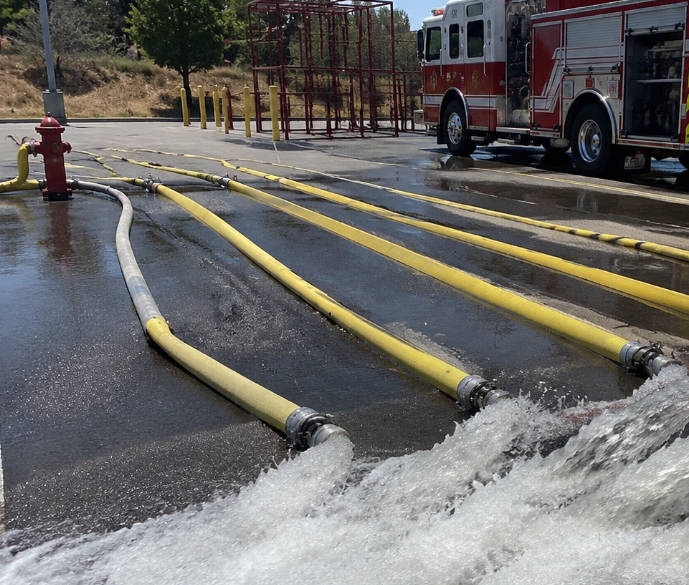
Key Standards Governing Fire Hose Testing
|
Standard |
Organization |
Scope |
|---|---|---|
|
NFPA 1962 (2018 Edition) |
National Fire Protection Association |
Care, use, inspection, service testing, and replacement of fire hose, couplings, nozzles, and fire hose appliances |
|
NFPA 1961 |
NFPA |
Fire hose design and construction standards |
|
NFPA 1911 |
NFPA |
Testing of fire pump systems on fire apparatus (related, for water supply during testing) |
|
UL 19 |
Underwriters Laboratories |
Lined fire hose standard (manufacturing) |
|
FM Approvals 2111 |
FM Global |
Industrial fire hose testing and approval |
NFPA 1962 is the primary standard that fire departments follow. Key mandates include:
-
Annual service testing: All hose in service must be service tested at least once per year (Chapter 4, Section 4.8).
-
Stored hose: Hose held in storage for more than one year must be tested before being placed into service.
-
Post-repair testing: Any hose that has been repaired must be service tested before returning to service.
-
Post-incident testing: Hose exposed to extreme conditions (chemical spills, heat damage, freezing) must be tested before reuse.
-
Hose manufactured before July 1987: Must be removed from service entirely.
-
Nozzle testing: Nozzles must be tested at least as frequently as the hose to which they are attached.
Types of Fire Hose and Their Test Pressures
Different hose types serve different roles on the fireground, and NFPA 1962 assigns different service test pressures accordingly:
|
Hose Type |
Diameter |
Minimum Service Test Pressure |
Notes |
|---|---|---|---|
|
Attack hose |
1.5", 1.75", 2", 2.5" |
300 PSI |
Or the service test pressure marked on the hose, whichever is higher |
|
Supply hose |
3", 4", 5" |
200 PSI |
Or the service test pressure marked on the hose, whichever is higher |
|
Forestry / wildland hose |
1" (typical) |
Per manufacturer spec |
Often tested at lower pressures due to lightweight construction |
|
Industrial hose |
Varies |
Per manufacturer spec |
May require higher pressures depending on application |
Some departments apply a higher test pressure (e.g., 400 PSI for attack hose 1.5"–3") as an additional safety margin. The test pressure is typically 10% above the maximum normal operating pressure for the hose.
Step-by-Step Fire Hose Testing Procedure
1. Documentation and Hose Identification
Each length of hose must have a unique identification number. Many departments use a barcode system on each coupling with a redundant marking on the hose jacket. The ID system typically encodes hose size:
-
A = 5 inch
-
B = 3 inch
-
C = 2.5 inch
-
D = 2 inch
-
E = 1.75 inch
Each size receives its own sequential numbering series department-wide. Before testing, record all tracking numbers and reapply any illegible markings.
2. Physical Inspection Before Pressurization
Before any water or pressure is introduced, conduct a thorough visual and tactile inspection of each section:
-
Outer jacket: Check for cuts, abrasions, burns, chemical damage, mildew, rot, and vermin damage
-
Inner liner: Inspect for delamination, bulging, or interior obstruction
-
Couplings: Verify they are tight, not deformed, with intact gaskets and lubricated threads
-
Overall condition: Rate as poor, fair, good, or replace
Any section failing the physical inspection is removed from the test area and either repaired or condemned.
3. Layout and Preparation
Lay hose out on a flat, horizontal surface in as straight a line as possible — no more than 300 feet per test layout. Ensure:
-
Long sweeping turns with NO kinks or twists
-
Hose is fully extended, not coiled
-
For 5-inch hose testing, use a 50-foot section of 2.5-inch hose between the engine and the first section of 5-inch hose. This protects the apparatus from damage if the large-diameter hose fails.
-
Connect one end to the water supply (hydrant or pump discharge) and attach a test cap with bleeder valve to the far end
-
The test valve should NOT be attached to any discharge outlet at or adjacent to the pump operator's position
4. Filling and Air Bleeding
This is a critical safety step. Trapped air compresses under pressure and stores enormous energy — if the hose fails with air inside, the explosive release is far more violent than a water-only failure.
-
With the test cap bleeder valve open, gradually admit water (hydrant pressure only, no pump engagement) at approximately 45 PSI (+/- 5 PSI)
-
Allow all air to escape through the bleeder valve
-
For 5-inch hose, maintain a slight water flow at the bleed device
-
Once all air is purged, slowly close the test cap
5. Low-Pressure Leak Check (45 PSI)
With the hose at 45 +/- 5 PSI:
-
Check each coupling for leakage
-
Draw a circle with a black marker at the back of each coupling around the circumference of the hose. This mark will reveal if the coupling or collar slips during the high-pressure test — any displacement of the mark indicates coupling failure.
-
Clear all personnel from the area except those necessary to complete the procedure
6. Service Test Pressurization
Increase pressure gradually at a rate not exceeding 15 PSI per second until the service test pressure is reached:
-
Attack hose (1.5"–2.5"): 300 PSI minimum (some departments test to 400 PSI)
-
Supply hose (3"–5"): 200 PSI minimum
For a typical department test sequence:
-
Raise to 100 PSI, hold for 2 minutes — observe for any immediate failures
-
If Step 1 passes, raise to full service test pressure (200 or 300/400 PSI)
During pressurization, discharge water slightly from a booster line for pump cooling when testing 5-inch hose.
7. Stabilization and Hold Period
Once service test pressure is reached:
-
Maintain pressure for a minimum stabilization period of 1 minute per 100 feet of hose in the test layout (e.g., 3 minutes for a 300-foot layout)
-
Many departments hold for a full 5 minutes as an additional safety margin
-
Monitor the pressure gauge continuously — any pressure drop indicates a leak or failure
8. Inspection Under Pressure
While the hose is at service test pressure, inspectors check for leaks — but from a safe distance:
-
Personnel must maintain at least 15 feet of clearance to the left side of the nearest hose line
-
Look for water seepage at couplings, along the hose jacket, or at any connection point
-
Check coupling marks for any signs of slippage
-
Listen for hissing sounds indicating micro-leaks
If the test layout does not hold service test pressure for the full duration, the test is terminated. The leaking section(s) have failed.
9. Depressurization and Post-Test Inspection
After the hold period:
-
Slowly open the test cap to drain the test layout — never release pressure suddenly
-
Once depressurized and drained, conduct a final visual inspection:
-
Check coupling bolts for any sign of movement
-
Verify the black marker rings at couplings have not shifted
-
Look for deformations, bulging, or jacket separation
-
Inspect gaskets and replace as required
-
-
Lubricate couplings with a fire hose manufacturer-approved 100% silicone lubricant
-
Reverse-pack (accordion fold) all 2.5", 3", and 5-inch hose
-
Return hose to apparatus or storage in the same location and manner as removed
Nozzle and Appliance Testing
NFPA 1962 requires that nozzles be tested at least as frequently as the hose to which they are attached. Nozzle testing includes:
-
Pressure testing: Verify the nozzle operates correctly at its rated pressure
-
Flow testing: Confirm flow rate matches the nozzle's specification
-
Waterway inspection: Check for internal obstruction or debris
-
Tip condition: Inspect for damage to the discharge tip
-
Shut-off valve operation: Verify smooth, complete open/close function
-
Thread and gasket condition: Inspect connection threads for damage and gaskets for wear
-
Identification: Assign ID numbers via barcode on each nozzle and appliance
Safety Considerations During Fire Hose Testing
Fire hose testing involves high-pressure water systems and carries genuine risk of catastrophic failure. Safety protocols are mandatory:
-
Maintain distance: No one should be in the vicinity of hose under pressure. A sudden burst at 300-400 PSI creates a lethal whip effect.
-
Use test cages: Dedicated test cages absorb the energy of a burst hose and prevent debris or water jets from reaching personnel or equipment.
-
Secure all connections: Loose couplings, nozzles, or test caps become dangerous projectiles under high pressure.
-
Eliminate trapped air: Air compression stores energy that makes failures exponentially more violent. Always bleed all air before pressurizing.
-
Trained personnel only: Only personnel trained in NFPA 1962 procedures should conduct testing. Many departments outsource to professional testing companies for this reason.
-
Pressure relief: Ensure a pressure relief device is in the system to prevent over-pressurization from equipment malfunction.
When to Retire a Fire Hose
Testing identifies problems, but not every hose can — or should — be saved. Retire hose from service when:
-
The hose was manufactured before July 1987
-
The hose fails the service pressure test (cannot hold rated pressure)
-
Visible structural damage: deep cuts, extensive abrasion, burns, chemical damage, or mildew/rot
-
Coupling failure: deformed, corroded, or loose couplings that cannot be repaired
-
Repeated test failures across consecutive years
-
The coupling mark shows slippage during testing
-
The hose has been exposed to hazardous materials contamination that cannot be remediated
Hose removed from service must be tagged with a distinctive tag noting the reason for removal. A replacement schedule should consider the age, usage history, and cumulative test results of each hose.
In-House vs. Third-Party Testing
Many departments face the decision of testing hose with their own personnel or outsourcing to a professional testing company.
|
Factor |
In-House Testing |
Third-Party Testing |
|---|---|---|
|
Cost |
Lower direct cost; higher labor cost |
Higher service cost; lower labor burden |
|
Calibration |
Most departments do NOT recalibrate pressure gauges annually, rendering tests technically invalid per NFPA |
Professional companies use annually calibrated gauges |
|
Speed |
Slower — limited by crew availability and training obligations |
Faster — professional crews test twice as much hose per day on average |
|
Liability |
Department bears full liability |
Independent third-party records reduce department liability |
|
Safety |
Volunteer and part-time firefighters may lack regular testing experience |
Professional testers do this daily with proper safety equipment |
|
Documentation |
Department-maintained records |
Online test results available 24/7 |
|
Apparatus downtime |
Longer apparatus out-of-service time |
Minimizes time apparatus is out of service |
Professional testing companies like Waterway, Inc. (established 1989, the largest fire hose testing company in the US) and Pye-Barker Fire & Safety provide ISO 9001 certified services with local franchise networks, independent test records, and online result access.
Documentation and Record Keeping
NFPA 1962 requires comprehensive documentation for every hose in your inventory. For each length, maintain a permanent hose record including:
-
Hose ID number: Unique identifier for each section
-
Hose location: Crosslay 1, preconnect 1, hose bed, storage, etc.
-
Hose size: Diameter of the hose
-
Hose condition: Poor, fair, good, replace
-
Purchase date: When the hose was acquired
-
Manufacturer: Original manufacturer and model
-
Last test date: Date of most recent service test
-
Test results: Pass/fail, test pressure, any issues noted
-
Repair history: All repairs performed, with dates and descriptions
-
Remarks: Any additional observations
Equipment tags (physical tags attached to each hose) provide immediate visibility into test status. Barcode-based tracking systems allow quick scanning and digital record updates. These records may be subpoenaed in litigation following a hose failure incident, making accuracy and completeness essential.
How to Choose a Fire Hose Testing Provider
-
NFPA 1962 compliance: Verify the provider follows the latest edition of NFPA 1962 to the letter.
-
Gauge calibration: Confirm all pressure gauges are recalibrated annually — this is a common NFPA compliance gap.
-
Insurance and liability coverage: The provider should carry adequate insurance for the high-pressure testing environment.
-
Safety record: Ask about the provider's safety incidents and protocols, including use of test cages and personnel distancing.
-
Documentation system: Look for providers offering online, 24/7 access to test results with barcode tracking.
-
ISO certification: Providers with ISO 9001 certification demonstrate quality management system commitment.
-
Local presence: A provider with local franchise or branch operations can respond faster and minimize apparatus downtime.
-
Experience and references: The provider should have a track record testing hose for departments of similar size and type.
Summary
Fire hose testing is a non-negotiable element of fire department operations. Governed primarily by NFPA 1962, the process requires annual service testing of all in-service hose, with attack hose tested to a minimum of 300 PSI and supply hose to 200 PSI. The procedure — from physical inspection and air bleeding through graduated pressurization and stabilization — must follow precise steps to ensure both test accuracy and personnel safety. Proper documentation, equipment tagging, and record keeping create an auditable compliance trail that protects firefighters on the job and shields departments from liability. Whether performed in-house or by a professional third-party service, fire hose testing is the foundation of reliable fireground water delivery and a critical investment in firefighter safety.