Ceramic testing is the systematic process of evaluating the physical, mechanical, thermal, chemical, and electrical properties of ceramic materials and finished products. From raw material characterization to finished product verification, ceramic testing ensures that materials perform as intended in their specific applications.
Ceramics are used everywhere: heat shields on spacecraft, medical implants in the human body, insulators in high-voltage systems, and cutting tools in manufacturing. Their unique combination of hardness, thermal resistance, and chemical inertness makes them indispensable — but also demands rigorous quality control.
Why is ceramic testing critical?
-
Performance validation: Ceramics in gas turbines must maintain structural integrity at temperatures exceeding 1,000°C. Testing confirms they can withstand these extreme conditions.
-
Safety assurance: A failed ceramic hip implant or brake component can have life-threatening consequences. Testing identifies defects before products reach end users.
-
Regulatory compliance: Medical ceramics must meet ISO 13356 for zirconia implants. Aerospace ceramics must satisfy strict military and ASTM specifications. Without accredited testing, market entry is impossible.
-
Product development: Testing data guides material selection, formulation improvements, and manufacturing process optimization.
Without comprehensive ceramic testing, there is no reliable way to predict how a ceramic component will behave under real-world conditions.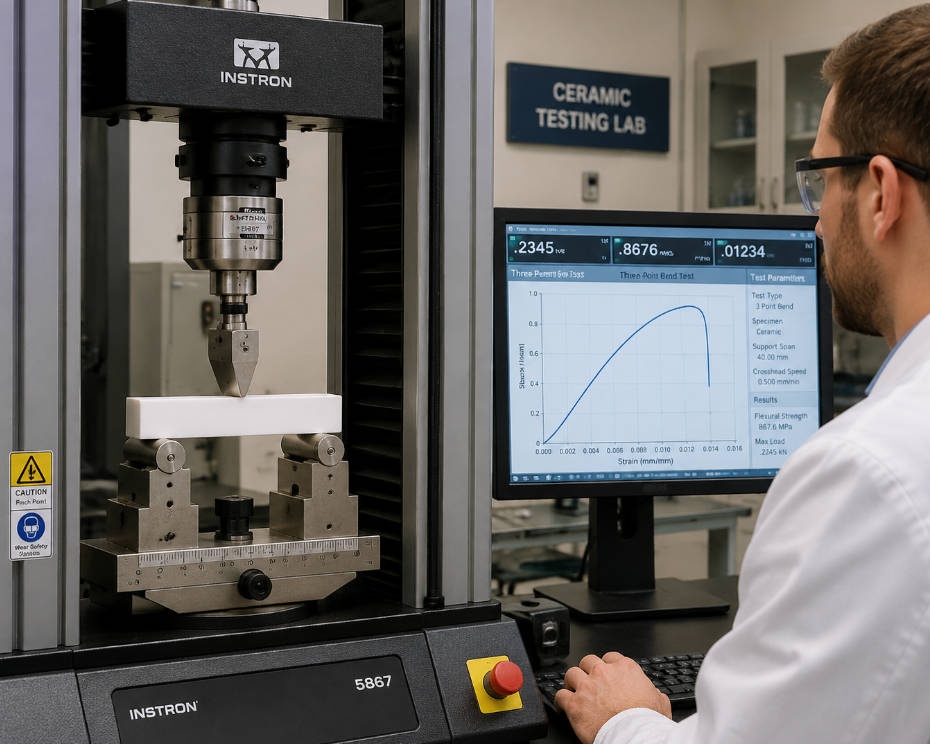
Key Ceramic Testing Standards You Need to Know
Ceramic testing follows internationally recognized standards that ensure consistency, reproducibility, and acceptance of results across industries.
Primary International Standards
|
Standard |
Scope |
Key Tests Covered |
|---|---|---|
|
ASTM C1161 |
Flexural strength of advanced ceramics |
3-point and 4-point bend testing |
|
ASTM C1326 |
Knoop hardness of ceramics |
Micro-indentation hardness |
|
ASTM C1421 |
Fracture toughness |
SEVNB, Chevron-notch methods |
|
ISO 14704 |
Flexural strength (international) |
Bend testing at ambient temperature |
|
ISO 13356 |
Zirconia for surgical implants |
Biocompatibility + mechanical |
|
DIN EN 993 |
Traditional ceramic properties |
Density, porosity, water absorption |
|
ISO 6486 / EN 1388 |
Toxic metal release from ceramics |
Food-contact safety testing |
National and Regional Standards
-
BS 6748: UK standard for metal release from ceramic ware
-
California Proposition 65: US requirements for heavy metal limits
-
US FDA guidelines: Food-contact ceramic safety
When selecting a testing laboratory, verify that they hold ISO 17025 accreditation, which demonstrates competence in performing these specific test methods.
Mechanical Properties Testing for Ceramics
Mechanical testing is the most critical category for ceramics because of their inherent brittleness. Unlike metals, ceramics exhibit almost no plastic deformation before fracture, making strength and toughness data essential for safe design.
Flexural Strength Testing
Flexural strength (also called bend strength or modulus of rupture) is the most widely reported mechanical property for ceramics. It measures the maximum stress a ceramic can withstand before fracturing under bending load.
How it works:
-
A rectangular bar of ceramic is placed on two support points
-
A load is applied at the center (3-point bending) or at two equidistant points (4-point bending)
-
The force at fracture is recorded and flexural stress is calculated
Key standard: ASTM C1161
-
3-point bending: Simpler fixtures, exposes only a small portion to maximum stress — tends to give higher strength values
-
4-point bending: Preferred for characterization because a larger volume of material experiences maximum stress, giving more representative results
Typical results: Advanced ceramics like silicon nitride can achieve flexural strengths exceeding 800–1,000 MPa, while traditional ceramics like alumina range from 200–400 MPa.
Compressive Strength Testing
Ceramics are generally much stronger in compression than in tension. Compressive strength testing measures the maximum compressive stress a ceramic can bear before failure.
Key standard: DIN EN 993-5
This test is particularly important for:
-
Refractory bricks used in furnace linings
-
Structural ceramics in load-bearing applications
-
Construction ceramics such as tiles and pipes
Hardness Testing
Hardness indicates a ceramic's resistance to permanent deformation and surface wear. It is critical for cutting tools, bearings, and armor applications.
|
Method |
Principle |
Typical Application |
|---|---|---|
|
Vickers (HV) |
Diamond pyramid indenter |
Advanced ceramics, coatings |
|
Knoop (HK) |
Asymmetric diamond indenter |
Thin sections, brittle materials |
|
Mohs |
Scratch resistance scale |
Quick comparative testing |
Vickers hardness is the most common for engineering ceramics. Alumina typically measures 1,500–2,000 HV, while silicon carbide can exceed 2,500 HV.
Fracture Toughness Testing
Fracture toughness (KIC) quantifies a ceramic's resistance to crack propagation. This is one of the most important properties for structural ceramics because it predicts how a material will tolerate flaws and defects.
Common test methods include:
-
SEVNB (Single Edge V-Notched Beam): A precise notch is cut into a specimen, and the stress required to propagate the crack is measured
-
Indentation fracture: A Vickers indent creates cracks whose length correlates with toughness
-
Chevron notch: A shaped notch forces crack initiation at a known location
Typical values:
|
Material |
Fracture Toughness (MPa·m^1/2) |
|---|---|
|
Alumina (Al₂O₃) |
3–5 |
|
Silicon nitride (Si₃N₄) |
5–8 |
|
Zirconia (Y-TZP) |
6–10 |
|
Silicon carbide (SiC) |
3–4 |
Transformation-toughened zirconia achieves the highest toughness among monolithic ceramics, making it the preferred material for dental crowns and hip joint heads.
Thermal Properties Testing
thermal testing evaluates how ceramics behave under temperature changes — critical for applications ranging from kiln furniture to turbine blades.
Thermal Shock Resistance
Thermal shock resistance measures a ceramic's ability to withstand sudden temperature changes without cracking. This is essential for materials used in environments with rapid heating and cooling cycles.
Testing approach:
-
Specimens are heated to a target temperature
-
They are then rapidly quenched in water or air
-
After repeated cycles, the specimens are examined for cracks or strength loss
Key factors affecting thermal shock resistance:
-
Coefficient of thermal expansion (lower is better)
-
Thermal conductivity (higher is better for uniform heat distribution)
-
Fracture strength (higher is better)
-
Elastic modulus (lower is better)
Coefficient of Thermal Expansion
The coefficient of thermal expansion (CTE) quantifies how much a ceramic expands or contracts per degree of temperature change. This is critical when ceramics are joined to other materials or subjected to thermal cycling.
A mismatch in CTE between a ceramic coating and its metallic substrate is one of the most common causes of coating failure and delamination.
Thermal Conductivity
Thermal conductivity measures a ceramic's ability to transfer heat. This property determines whether a ceramic is suitable for:
-
Heat sinks (need high conductivity, e.g., aluminum nitride)
-
Thermal barrier coatings (need low conductivity, e.g., yttria-stabilized zirconia)
-
Furnace linings (need low conductivity for insulation)
Chemical and Microstructural Analysis
Chemical Composition Analysis
Understanding the exact chemical composition of a ceramic is essential for quality control, regulatory compliance, and product development. Techniques include:
-
ICP-OES / ICP-MS: Trace element analysis down to parts per trillion
-
X-ray fluorescence (XRF): Rapid bulk composition analysis
-
Wet chemistry methods: Classical gravimetric and titrimetric analysis
Corrosion and Leaching Resistance
For ceramics in food contact, biomedical, or corrosive industrial environments, leaching and corrosion resistance testing is mandatory.
Key tests:
-
Toxic metal release testing per ISO 6486, EN 1388, BS 6748, and US FDA guidelines
-
Acid and alkali resistance tests for industrial ceramics
-
Molten metal corrosion for refractory materials
The results are compared against metal migration limits defined by regulations across 90+ countries.
Scanning Electron Microscopy (SEM)
SEM provides high-resolution imaging of ceramic microstructures at magnifications up to 100,000x. It reveals:
-
Grain boundaries and grain size distribution
-
Porosity (open and closed)
-
Surface defects and contamination
-
Phase distribution in multiphase ceramics
X-Ray Diffraction (XRD)
XRD identifies the crystalline phases present in a ceramic material. This is essential because different phases have dramatically different properties:
-
Alpha-alumina vs. gamma-alumina: Different hardness and chemical resistance
-
Quartz vs. cristobalite vs. tridymite: Different thermal expansion behavior in silica-based ceramics
-
Zirconia phases (monoclinic, tetragonal, cubic): Transformation toughening depends on phase control
Porosity and Density Testing
Porosity directly affects a ceramic's mechanical strength, thermal conductivity, chemical resistance, and electrical insulation properties. Lower porosity generally means higher performance.
|
Property |
Test Method |
Standard |
|---|---|---|
|
Water absorption |
Boiling, vacuum, or impregnation |
DIN EN 993-1, ISO 10545-3 |
|
Apparent bulk density |
Archimedes principle |
DIN EN 993-1 |
|
Open porosity |
Water saturation method |
DIN EN 993-1 |
|
True density |
Helium pycnometry |
DIN EN 993-2 |
|
Pore size distribution |
Mercury intrusion porosimetry |
DIN 66133 |
|
Specific surface area |
BET adsorption |
DIN 66132, ISO 18757 |
Mercury intrusion porosimetry can characterize pores from 116 µm down to approximately 4 nm, providing detailed pore size distribution data essential for advanced ceramics and filters.
Electrical Properties Testing
Electrical testing is critical for ceramics used in electronics, insulators, capacitors, and sensors.
|
Property |
What It Measures |
Why It Matters |
|---|---|---|
|
Dielectric strength |
Maximum electric field before breakdown |
High-voltage insulator reliability |
|
Dielectric constant |
Ability to store electrical energy |
Capacitor design |
|
Resistivity |
Resistance to current flow |
Insulation vs. conduction |
|
Loss tangent |
Energy dissipated as heat |
High-frequency electronics |
|
Piezoelectric response |
Charge generation under stress |
Sensors and actuators |
Ceramic insulators can achieve resistivity values in the teraohm range, making them essential for high-voltage transmission and electronic packaging.
Non-Destructive Testing Methods
Non-destructive testing (NDT) evaluates ceramic components without damaging them, making it ideal for quality control of finished products and in-service inspection.
|
Method |
What It Detects |
Best For |
|---|---|---|
|
Ultrasonic testing |
Internal cracks, voids, delaminations |
Thick sections, complex geometries |
|
Acoustic emission |
Active crack growth under stress |
Real-time monitoring during loading |
|
X-ray computed tomography |
3D internal structure and defects |
Additive manufactured parts |
|
Dye penetrant inspection |
Surface-breaking cracks |
Quick visual inspection |
|
Infrared thermography |
Subsurface defects |
Large area scanning |
For additively manufactured (3D-printed) ceramics, X-ray CT scanning is becoming the gold standard for detecting internal porosity, unmelted regions, and delamination between layers.
Industry Applications of Ceramic Testing
Aerospace and Defense
Ceramic matrix composites (CMCs) and monolithic ceramics face extreme temperatures, mechanical stress, and oxidation in jet engines, rocket nozzles, and re-entry vehicles. Testing focuses on:
-
High-temperature strength and creep resistance
-
Oxidation resistance at temperatures above 1,200°C
-
Fracture toughness under simulated flight conditions
Medical and Dental
Bioceramics — including alumina, zirconia, and hydroxyapatite — must pass rigorous biocompatibility and mechanical testing:
-
ISO 13356 for zirconia surgical implants
-
Fatigue testing simulating millions of loading cycles
-
Leachables analysis to ensure no toxic elements migrate into body tissues
Automotive
Ceramics in spark plugs, catalytic converters, brake discs, and diesel particulate filters require:
-
Thermal shock resistance (rapid heating/cooling cycles)
-
Wear resistance (brake applications)
-
Chemical resistance to exhaust gases
Electronics and Semiconductors
Ceramic substrates, insulators, and capacitor materials require:
-
Dielectric strength testing for voltage reliability
-
Thermal conductivity measurement for heat management
-
CTE matching with silicon chips to prevent failure
Destructive vs Non-Destructive Testing: How to Choose
|
Factor |
Destructive Testing |
Non-Destructive Testing |
|---|---|---|
|
Sample |
Destroyed during test |
Remains intact |
|
Data quality |
Absolute property values |
Comparative / screening |
|
Cost |
Higher (consumes samples) |
Lower per part |
|
Speed |
Slower (sample prep needed) |
Faster, can be automated |
|
Use case |
Material qualification, R&D |
Production QC, in-service |
Best practice: Use destructive testing during material qualification and development, then transition to NDT methods for production quality control and ongoing monitoring.
Ceramic Testing Labs: What to Look For
Choosing the right testing laboratory is as important as choosing the right tests. Key criteria:
-
ISO 17025 accreditation: Demonstrates technical competence and result reliability
-
Industry-specific experience: Aerospace, medical, and food-contact ceramics each have unique requirements
-
Range of capabilities: A lab that can perform mechanical, thermal, chemical, and microstructural analysis under one roof reduces project complexity
-
NIST-traceable calibration: Ensures measurement accuracy
-
Turnaround time: Some tests (e.g., corrosion) require weeks; plan accordingly
Common Challenges in Ceramic Testing
Ceramic testing is not straightforward. Several challenges frequently arise:
-
Brittle fracture behavior: Ceramics fail without warning. Statistical methods (Weibull analysis) are required to characterize strength reliably, often needing 30+ specimens for meaningful data.
-
Small specimen size effects: Some advanced ceramics can only be produced in small sizes, making standard test geometry difficult to achieve.
-
Surface finish sensitivity: Flexural strength of ceramics is highly dependent on surface preparation. A poorly prepared surface can reduce measured strength by 50% or more.
-
Environmental effects: Moisture can cause slow crack growth in oxide ceramics even at room temperature, affecting measured strength depending on test speed.
-
3D-printed ceramics: Additive manufacturing creates unique microstructures, residual stresses, and defect populations that may not be captured by traditional test methods.
Summary
Ceramic testing is an indispensable process that underpins the reliability, safety, and innovation of ceramic materials across every major industry. From validating the flexural strength of a turbine blade coating to ensuring a ceramic food bowl does not leach heavy metals, comprehensive testing protects both products and people.
The key takeaway: invest in testing early and thoroughly. The cost of a comprehensive testing program is always less than the cost of a product failure in the field.