What Is Surgical Implant Testing and Why Does It Matter?
Surgical implant testing is the systematic evaluation of medical devices designed to be permanently or temporarily placed inside the human body — covering hip and knee replacements, bone screws, spinal implants, dental fixtures, pacemakers, and more. Before any implant reaches a patient, it must pass a battery of mechanical, biological, chemical, and wear tests that verify it can withstand physiological loads, resist corrosion, and coexist safely with living tissue.
Why does this matter? A single failed hip implant can affect hundreds of thousands of patients. The metal-on-metal hip recall of 2010 exposed how inadequate pre-market testing — particularly insufficient wear debris analysis and corrosion assessment — led to systemic toxicity, tissue necrosis, and revision surgeries on a massive scale. Testing is the last line of defense between a design that looks good on paper and a device that performs reliably for 15–25 years inside a human body.
Under ISO 14630 for non-active surgical implants, preclinical evaluation requires both static and dynamic load tests conducted to recognized ASTM and ISO standards. These tests cover the full implant lifecycle: from raw material verification and manufacturing quality control through simulated long-term use and post-market surveillance.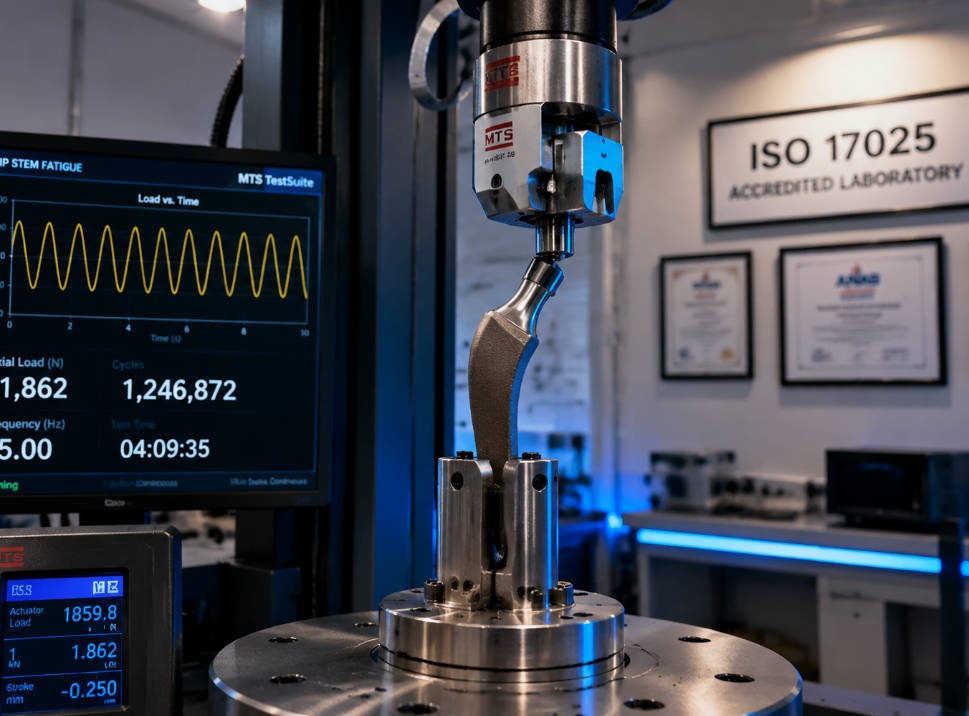
Key Surgical Implant Testing Standards (ASTM, ISO, and More)
Surgical implant testing draws on hundreds of published standards from ASTM International (Committee F04), ISO (Technical Committees TC 150, TC 194, and TC 168), and regional bodies. The table below lists the most widely referenced standards:
|
Standard |
Scope |
Key Tests |
|---|---|---|
|
ASTM F543 |
Bone screws |
Torsion, insertion/removal torque, pull-out strength |
|
ASTM F382 |
Bone plates |
Static bending, fatigue bending (4-point) |
|
ASTM F1717 |
Spinal implant constructs |
Static/fatigue compression, torsion in vertebrectomy model |
|
ASTM F2706 |
Modular tibial components |
Static/fatigue axial, shear at locking mechanism |
|
ASTM F2068 |
Femoral prostheses (metallic) |
Static/dynamic fatigue testing |
|
ASTM F3609 |
Modular implant locking mechanisms |
Disassembly force, toggle, fatigue |
|
ISO 7206 |
Hip implant femoral components |
Fatigue testing of stems and heads |
|
ISO 14242 |
Hip joint prostheses wear |
Wear simulation (hip simulator) |
|
ISO 14243 |
Knee joint prostheses wear |
Wear simulation (knee simulator) |
|
ISO 10993 (series) |
Biocompatibility |
Cytotoxicity, sensitization, genotoxicity, hemocompatibility |
|
ISO 14630 |
Non-active surgical implants |
General requirements for preclinical evaluation |
|
ISO 5832 (series) |
Metallic implant materials |
Chemical composition, mechanical properties of Ti, CoCr, SS alloys |
|
ASTM F136 |
Ti-6Al-4V ELI alloy |
Forging, bar, wire specifications |
|
ASTM F75 |
Co-Cr-Mo cast alloy |
Casting specification for implants |
|
ISO 14708-1 |
Active implantable devices |
General requirements for pacemakers, neurostimulators |
|
ASTM F2582 |
Hip implant impingement |
Dynamic impingement between femoral and acetabular components |
Mechanical Testing: Strength, Fatigue, and Durability
Mechanical testing is the foundation of implant evaluation. It answers a simple question: can this device survive the forces it will experience inside the body — not just once, but millions of times?
Static Testing
Static tests measure stiffness, yield strength, and ultimate failure load under single-load-to-failure conditions. Common configurations include:
-
Tension/compression: Uniaxial testing per ASTM E8/E8M for material characterization, and per implant-specific standards (ASTM F543 for screws, ASTM F382 for plates) for device-level properties.
-
Bending: Four-point bending per ASTM F382 is standard for bone plates, producing a uniform moment region between the inner load points.
-
Torsion: Required for screws (ASTM F543), intramedullary nails, and spinal fixation constructs.
-
Shear: Often evaluated as part of composite testing for plates and screws combined.
Equipment includes servo-hydraulic and electromechanical universal testing machines (Instron, MTS, ZwickRoell) with capacities from 10 kN for small devices to 100+ kN for spinal constructs.
Dynamic (Fatigue) Testing
Fatigue testing simulates the millions of loading cycles an implant experiences over its service life. A hip implant may endure 1–2 million steps per year; a spine fusion device must withstand 10+ years of daily bending and twisting.
Key parameters:
-
Run-out: The load level at which the implant survives a specified number of cycles (typically 5 million or 10 million) without failure. This defines the fatigue limit.
-
S-N curves: Plots of applied stress vs. number of cycles to failure, generated across 6–12 specimens per ASTM F543 or ASTM F1717.
-
Load profiles: Physiological loading curves (e.g., ISO 14243-1 for knees uses a double-peak axial force profile simulating gait).
Test Methods by Implant Type
|
Implant Type |
Key Standard |
Primary Loading Mode |
Typical Run-out Cycles |
|---|---|---|---|
|
Bone screws |
ASTM F543 |
Torsion, insertion torque |
5M cycles |
|
Bone plates |
ASTM F382 |
4-point bending fatigue |
1M cycles |
|
Hip stems |
ISO 7206-4 |
Cantilever fatigue |
10M cycles |
|
Knee components |
ASTM F3210 |
Axial compression fatigue |
10M cycles |
|
Spinal constructs |
ASTM F1717 |
Compression-torsion fatigue |
5M cycles |
|
Dental implants |
ISO 14801 |
Fatigue in bending |
5M cycles |
Biocompatibility Testing: Ensuring Safety Inside the Body
Biocompatibility testing evaluates how implant materials interact with living tissue. It is governed primarily by the ISO 10993 series, which provides a risk-based framework for biological evaluation.
Core Biocompatibility Tests
|
Test Category |
What It Evaluates |
Key Standard |
|---|---|---|
|
Cytotoxicity |
Cell death/damage from device extracts |
ISO 10993-5 |
|
Sensitization |
Allergic contact dermatitis potential |
ISO 10993-10 |
|
Irritation |
Local tissue inflammation |
ISO 10993-10 |
|
Genotoxicity |
DNA damage, mutagenic potential |
ISO 10993-3 |
|
Systemic toxicity |
Organ-level toxic effects (acute, subchronic, chronic) |
ISO 10993-11 |
|
Hemocompatibility |
Blood compatibility (hemolysis, coagulation, thrombosis) |
ISO 10993-4 |
|
Carcinogenicity |
Cancer-causing potential (long-term implants) |
ISO 10993-3 |
|
Implantation |
Local tissue response to implanted material |
ISO 10993-6 |
Genotoxicity Testing in Detail
Genotoxicity is critical because many implants release metal ions (titanium, cobalt, chromium, nickel) or polymer degradation products over time. The AMES test (ISO 10993-3) uses Salmonella typhimurium bacteria to detect point mutations, while the Mouse Lymphoma Assay detects both gene-level and chromosomal mutations. A positive result in either test requires material reformulation or additional in vivo testing.
Hemocompatibility Testing
For blood-contacting devices (stents, heart valves, vascular grafts, pacemaker leads), hemocompatibility testing includes:
-
Hemolysis test: Measures red blood cell destruction — hemoglobin release indicates material-induced cell damage.
-
Platelet adhesion/activation: Evaluates clot formation risk on device surfaces.
-
Coagulation testing: Measures clotting time (PT, aPTT) to detect pro-coagulant or anticoagulant effects.
Extractables and Leachables (E&L)
ISO 10993-18 requires identification of chemical substances that may migrate from the implant into surrounding tissue. This involves solvent extraction followed by analytical chemistry (GC-MS, LC-MS, ICP-MS) to quantify extractables and correlate them with toxicological risk thresholds.
Wear Testing and Tribology for Joint Replacements
Wear testing simulates the long-term articulation of joint replacement surfaces to predict debris generation, volume loss, and potential adverse tissue reactions.
Hip Wear Testing (ISO 14242)
Hip simulators apply physiological load profiles and multi-directional motion to hip joint couples (e.g., metal-on-polyethylene, ceramic-on-ceramic, metal-on-metal). Testing typically runs for 5 million cycles (equivalent to ~5 years of use), with gravimetric measurement of wear volume per ASTM F2025.
Key findings from hip wear testing:
|
Bearing Couple |
Volumetric Wear Rate (mm³/million cycles) |
Typical Debris Size |
|---|---|---|
|
Metal-on-UHMWPE |
30–80 |
0.1–10 μm (submicron predominance) |
|
Ceramic-on-UHMWPE |
15–40 |
0.1–1 μm |
|
Ceramic-on-ceramic |
0.1–1.0 |
5–90 nm (nanoscale) |
|
Metal-on-metal |
1–5 |
20–90 nm (nanoscale) |
Knee Wear Testing (ISO 14243)
Knee simulators replicate the complex rolling-sliding motion of the knee joint, including axial force, flexion-extension, anterior-posterior translation, and internal-external rotation. ISO 14243-1 defines force-control, while ISO 14243-3 defines displacement-control methods.
Particle Analysis
Wear debris characterization (size, shape, count, and chemical composition) is critical because submicron polyethylene particles and nanoscale metal particles are the primary triggers of osteolysis (bone resorption) and aseptic loosening — the leading cause of joint replacement revision.
Corrosion and Surface Analysis
Metallic implants are exposed to a warm, saline, protein-rich environment that accelerates corrosion. Testing must address:
Corrosion Test Methods
|
Test Type |
Standard |
What It Measures |
|---|---|---|
|
Pitting/crevice corrosion |
ASTM F746 |
Breakdown potential of surgical alloys |
|
Galvanic corrosion |
ASTM F3044 |
Current flow between dissimilar metal couples |
|
Fretting corrosion |
ASTM F1875 |
Corrosion at modular taper interfaces (hip heads) |
|
General corrosion |
ISO 16429 |
Ion release rate in simulated body fluid |
|
Salt spray (accelerated) |
ASTM B117 |
General corrosion resistance (screening) |
Fretting corrosion at modular taper interfaces (the cone where the femoral head connects to the stem) is a particularly insidious failure mode. Micromotion between the components under cyclic loading generates mechanically assisted crevice corrosion (MACC), releasing cobalt and chromium ions into surrounding tissue. This was the mechanism behind the high-profile recall of certain modular neck hip systems.
Surface Finish Inspection
Surface roughness (Ra) directly affects wear rate, fatigue strength, and osseointegration. Typical requirements:
-
Articulating surfaces: Ra < 0.05 μm (mirror finish)
-
Bone-contacting surfaces: Ra 1–4 μm (promotes osseointegration)
-
Taper interfaces: Ra 0.2–0.5 μm
Implant-Specific Test Protocols
Bone Screws (ASTM F543)
-
Torsional strength: Screw driven into standard test block until failure
-
Insertion/removal torque: Measures self-tapping performance
-
Pull-out strength: Axial force to extract screw from synthetic bone
-
Axial fatigue: Cyclic loading to determine fatigue limit
Bone Plates (ASTM F382)
-
Static 4-point bending: Stiffness, yield moment, ultimate moment
-
Fatigue 4-point bending: Cyclic loading at multiple stress levels to generate S-N curve
-
Construct testing: Plate + screws in synthetic bone model
Spinal Implants (ASTM F1717)
-
Static compression-shear, static torsion
-
Fatigue compression in vertebrectomy model (two ultrahigh-molecular-weight polyethylene blocks)
-
Additional tests per ASTM F2267 for intervertebral body fusion devices
Hip Implants (ISO 7206)
-
Stem fatigue: Cantilever loading with distal support
-
Head taper connection: Push-off, pull-off, and torsional resistance
-
Modular interface fretting: ASTM F1875
Knee Implants (ISO 14243, ASTM F3210)
-
Femoral component fatigue under closing conditions (ASTM F3210)
-
Tibial tray fatigue (ASTM F3843)
-
Mobile bearing dislocation resistance (ASTM F2724)
-
Wear simulation (ISO 14242/14243)
Dental Implants (ISO 14801)
-
Fatigue testing with 30° offset bending load
-
Represents worst-case clinical scenario (angled loading on single implant)
-
Torque retention of abutment screws
Regulatory Pathways: FDA, CE Mark, and UKCA
United States (FDA)
The FDA classifies implants into Class II (most) and Class III (e.g., new hip/knee designs). Class III devices require Premarket Approval (PMA), including:
-
Non-clinical mechanical and biocompatibility testing
-
Animal studies (if required)
-
Clinical investigation data
-
Manufacturing quality system (21 CFR 820)
The FDA issues guidance documents for specific test methods (e.g., "Guidance Document for Testing Non-Articulating, Mechanically Locked, Modular Implant Components").
European Union (CE Mark, MDR 2017/745)
The EU Medical Device Regulation (MDR) replaced the Medical Device Directive (MDD) in May 2021, imposing stricter requirements:
-
All implants are Class IIb or III (requiring Notified Body involvement)
-
Enhanced biocompatibility assessment per ISO 10993 series
-
Clinical evaluation must include systematic literature review
-
Unique Device Identification (UDI) required
-
Post-market clinical follow-up (PMCF) mandatory
United Kingdom (UKCA Mark)
Post-Brexit, the UK requires UKCA (UK Conformity Assessed) marking for devices placed on the Great Britain market:
-
UK Approved Bodies (e.g., BSI) conduct conformity assessment
-
UK MDR 2002 provides the regulatory framework
-
MHRA oversees device registration and post-market surveillance
-
CE marking accepted during transitional period (currently extended)
-
National Joint Registry (NJR) tracks implant performance outcomes
-
ODEP (Orthopaedic Data Evaluation Panel) provides independent ratings
Regulatory Comparison Table
|
Requirement |
FDA (US) |
MDR (EU) |
UKCA (UK) |
|---|---|---|---|
|
Classification |
II/III |
IIb/III (implants) |
IIb/III |
|
Notified Body |
— (FDA reviews) |
Required |
UK Approved Body |
|
Clinical data |
Required (PMA for III) |
Systematic literature review + PMCF |
Similar to MDR |
|
Quality system |
21 CFR 820 |
ISO 13485 |
ISO 13485 |
|
UDI |
Required |
Required |
Required |
|
Post-market surveillance |
MDR requirements |
PMCF mandatory |
MHRA registration |
|
Key testing standards |
ASTM F-series |
ASTM + ISO |
ASTM + ISO |
Independent Testing Laboratories and Accreditation
Independent testing laboratories provide unbiased, third-party verification of implant safety and performance. Key attributes:
-
ISO 17025 accreditation: Demonstrates technical competence and reliability of test results
-
GLP certification: Good Laboratory Practice for regulatory submission
-
Capabilities: Mechanical testing, biocompatibility, wear simulation, chemical analysis, failure analysis, sterilization validation
Notable testing laboratories in this field include:
|
Laboratory |
Location |
Key Accreditations |
|---|---|---|
|
Endolab |
Germany |
ISO 17025, extensive implant test database |
|
Lucideon |
UK |
ISO 17025, UKAS accredited |
|
IBV (Instituto de Biomecánica) |
Spain |
ENAC accredited, only Spanish implant lab |
|
ADMET |
USA |
ASTM standards development partner |
|
Intertek |
Global |
ISO 17025, comprehensive MD services |
|
NABI/EBI |
USA/Europe |
ISO 17025, GLP certified |
Manufacturers frequently outsource to these laboratories for specialized expertise, advanced equipment, and recognized accreditations that streamline regulatory submissions.
Emerging Trends in Implant Testing
3D-Printed and Patient-Specific Implants
Additive manufacturing (Ti-6Al-4V, CoCr, PEEK) creates implants with complex lattice structures that require new test methodologies. Porosity, surface roughness, and interlayer bonding present unique challenges not covered by traditional wrought/cast material standards. ASTM F3301 and ISO/ASTM 52911 are emerging to address this gap.
Bioresorbable Implants
PLA, PLGA, and magnesium alloys degrade over time, requiring testing at multiple degradation time points to capture changing mechanical properties. Standards like ASTM F2900 and ISO 10993-6 (implantation testing) are being adapted.
Digital Twin and Finite Element Analysis (FEA)
FEA per ASTM F3334 is increasingly used to supplement physical testing, optimizing test configurations and reducing specimen count. However, FEA results must be validated against physical test data.
Nanotechnology and Smart Implants
Sensor-integrated implants (e.g., OrthoLoad instrumented implants) provide in-vivo load data for validation of laboratory test conditions. Surface nano-texturing for improved osseointegration requires new characterization methods.
Regulatory Convergence
International efforts to harmonize FDA, MDR, and UKCA requirements aim to reduce redundant testing. The IMDRF (International Medical Device Regulators Forum) promotes consensus standards, though significant regional differences remain.
Summary
Surgical implant testing is a multi-layered process spanning mechanical strength and fatigue, biocompatibility, wear behavior, corrosion resistance, and surface quality — all governed by ASTM and ISO standards and enforced by regulatory bodies (FDA, EU MDR, UK MHRA). A hip implant, for example, undergoes stem fatigue testing per ISO 7206, wear simulation per ISO 14242, biocompatibility assessment per ISO 10993, and fretting corrosion testing per ASTM F1875 before reaching patients. The metal-on-metal hip crisis demonstrated the consequences of inadequate testing: robust, standards-based evaluation is not bureaucratic overhead — it is the engineering foundation that keeps implants functioning safely for decades inside the human body.