What Is Refractory material testing and Why It Matters
Refractory materials are specialized ceramics designed to retain physical and chemical stability at operating temperatures above 1,200 °C (2,192 °F). They are manufactured primarily from the oxides of aluminum (alumina), silicon (silica), magnesium (magnesia), and calcium (lime), and are used to line furnaces, kilns, reactors, ladles, and other high-temperature process equipment across industries from steelmaking to aerospace.
Refractory material testing is the systematic evaluation of these materials' mechanical strength, thermal behavior, chemical resistance, and microstructural integrity under conditions that simulate — or exceed — actual service environments. A single refractory failure in a steelmaking ladle or glass melting furnace can cost millions in lost production and equipment damage. Testing exists to prevent that failure before it happens.
The discipline covers five major property categories: physical properties (density, porosity, strength), thermal properties (conductivity, expansion, shock resistance), thermomechanical behavior (creep, refractoriness under load), chemical resistance (slag attack, oxidation, hydration), and microstructural characterization (XRD, SEM, petrography).
Key Standards for Refractory Material Testing
Refractory testing is governed by an extensive network of ASTM, ISO, DIN, and IS standards. The table below lists the most widely referenced standards organized by test category.
|
Category |
Standard |
Test Method |
|---|---|---|
|
Strength |
ASTM C133 |
Cold Crushing Strength (CCS) and Modulus of Rupture (MOR) |
|
|
ASTM C583 |
MOR at Elevated Temperatures |
|
|
ASTM C1099 |
MOR of Carbon-Containing Refractories at Elevated Temperatures |
|
|
ASTM C198 |
Cold Bonding Strength of Refractory Mortar |
|
|
ASTM C1548 |
Dynamic Young's Modulus, Shear Modulus, Poisson's Ratio by Impulse Excitation |
|
Density & Porosity |
ASTM C20 |
Apparent Porosity, Water Absorption, Bulk Density by Boiling Water |
|
|
ASTM C830 |
Same Properties by Vacuum Pressure Method |
|
|
ASTM C134 |
Size, Dimensional Measurements, Bulk Density of Brick |
|
|
ASTM C135 |
True Specific Gravity by Water Immersion |
|
|
ASTM C604 |
True Specific Gravity by Gas-Comparison Pycnometer |
|
Thermal Conductivity |
ASTM C201 |
Thermal Conductivity of Refractories (calorimeter method) |
|
|
ASTM C202 |
Thermal Conductivity of Refractory Brick |
|
|
ASTM C182 |
Thermal Conductivity of Insulating Firebrick |
|
|
ASTM C1113 |
Thermal Conductivity by Hot Wire (Platinum RTD) |
|
|
ISO 8894-1 |
Hot-Wire Method (Cross-Array) |
|
Thermal Expansion & Creep |
ASTM C832 |
Thermal Expansion and Creep Under Load |
|
|
ASTM C113 |
Reheat Change of Refractory Brick |
|
|
ASTM C210 |
Reheat Change of Insulating Firebrick |
|
|
ISO 1893 / DIN 51053 |
Refractoriness Under Load (RUL) and Creep |
|
Thermal Shock |
ASTM C1171 |
Quantitative Effect of Thermal Shock and Thermal Cycling |
|
Corrosion & Chemical |
ASTM C874 |
Rotary Slag Testing |
|
|
ASTM C621 |
Isothermal Corrosion Resistance to Molten Glass |
|
|
ASTM C863 |
Oxidation Resistance of SiC Refractories |
|
|
ASTM C987 |
Vapor Attack on Furnace Superstructures |
|
|
ASTM C288 |
Disintegration in Carbon Monoxide Atmosphere |
|
|
ASTM C454 |
Disintegration by Alkali |
|
Abrasion |
ASTM C704 |
Abrasion Resistance at Room Temperature |
|
Classification |
ASTM C27 |
Fireclay and High-Alumina Brick Classification |
|
|
ASTM C155 |
Insulating Firebrick Classification |
|
|
ASTM C401 |
Alumina and Alumina-Silicate Castable Classification |
|
|
ASTM C455 |
Chrome, Chrome-Magnesia, Magnesia Brick Classification |
Physical Property Testing Methods
Cold Crushing Strength (CCS)
Cold crushing strength measures the maximum compressive load a refractory can bear at room temperature before failure. Tested per ASTM C133, the load is applied to a 2-inch cube or 2-inch diameter × 2-inch high cylinder at a controlled rate. Five specimens per type/brand are recommended. CCS values range from 5 MPa for insulating firebrick to over 100 MPa for dense high-alumina brick. While refractories rarely fail under purely compressive cold loads, CCS serves as a quality consistency indicator — low or variable CCS often signals manufacturing defects.
Modulus of Rupture (MOR)
MOR measures flexural strength in three-point bending. At room temperature (ASTM C133), standard 9-inch bricks are loaded at mid-span. At elevated temperatures (ASTM C583), 1 × 1 × 6 inch bars are tested after a 12-hour hold at the target temperature. MOR at temperature is the more operationally relevant property, since refractories in service are simultaneously hot and mechanically stressed. Typical hot MOR values for high-alumina brick at 1,400 °C range from 10 to 30 MPa.
Bulk Density and Apparent Porosity
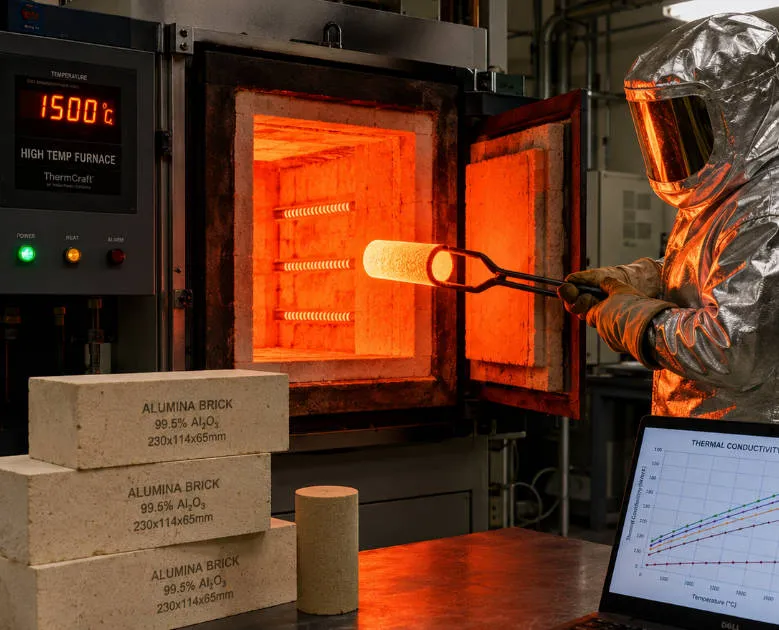
Bulk density and apparent porosity are the most fundamental refractory properties. Measured by the boiling water method (ASTM C20) or vacuum pressure method (ASTM C830), they directly affect thermal conductivity, slag resistance, and mechanical strength. Higher bulk density generally increases heat capacity, volume stability, and resistance to slag penetration. Typical values:
|
Refractory Type |
Bulk Density (g/cm³) |
Apparent Porosity (%) |
|---|---|---|
|
Insulating firebrick (IFB) |
0.5–1.3 |
50–80 |
|
Fireclay brick |
1.8–2.2 |
10–25 |
|
High-alumina brick (60–90% Al₂O₃) |
2.3–3.0 |
12–22 |
|
Magnesia brick |
2.8–3.1 |
15–20 |
|
Magnesia-carbon brick |
2.9–3.2 |
3–8 |
|
Silica brick |
1.7–1.9 |
20–25 |
Abrasion Resistance
ASTM C704 measures the volume of material removed from a 4.5 × 4.5 × 3 inch specimen by a controlled blast of silicon carbide grit. This test is particularly relevant for refractories in circulating fluidized bed combustors, cement kiln preheaters, and other applications with high-velocity particulate flow. Results are reported in cm³ of material lost — lower values indicate better abrasion resistance.
Thermal and Thermomechanical Testing
Thermal Conductivity
Thermal conductivity determines how much heat passes through a refractory at steady state. It is critical for both insulation design (minimize heat loss) and process efficiency (maximize heat transfer in recuperators).
Four principal methods are used:
|
Method |
Standard |
Temperature Range |
Best For |
|---|---|---|---|
|
Water-cooled calorimeter |
ASTM C201/C202/C182 |
Up to 1,480 °C (2,700 °F) |
Dense brick and insulating firebrick |
|
Hot wire (platinum RTD) |
ASTM C1113 |
Up to 1,250 °C |
Monolithics and shaped products |
|
Hot wire (cross-array) |
ISO 8894-1 |
Up to 1,250 °C |
Powders, granular materials, shaped products |
|
Laser flash |
— |
Up to 1,600 °C |
Thermal diffusivity → conductivity calculation |
Thermal conductivity of most refractories decreases with increasing temperature for crystalline materials (phonon scattering) but can increase for amorphous/glass-rich compositions (radiative transfer). Alumina-rich dense brick typically shows 2–5 W/(m·K) at 1,000 °C, while insulating firebrick ranges from 0.1–0.5 W/(m·K).
Refractoriness Under Load (RUL)
RUL (ISO 1893 / DIN 51053) measures the deformation of a refractory cylinder (50 mm diameter × 50 mm high) under a constant compressive load (typically 0.2 N/mm²) while temperature increases at a controlled rate. The test records the temperature at which the specimen deforms by specific amounts (0.5%, 1.0%, 2.0%, 5.0%). RUL distinguishes between refractories that survive high temperatures under no load and those that maintain structural integrity under actual service stresses. A high-alumina brick may have a pyrometric cone equivalent (PCE) above 1,770 °C but an RUL T₀.₅ of only 1,500 °C.
Creep in Compression
Creep testing (ASTM C832, ISO 3187) records the time-dependent deformation of a refractory under constant load at constant temperature. Standard conditions are 25 psi compressive stress for 50 hours. The result is expressed as percent linear change — industry standards typically restrict creep to no more than 0.3% in the first 50 hours for normal working conditions. Creep data is essential for designing furnace roofs, suspended walls, and other structural applications where long-term dimensional stability is critical.
Thermal Shock Resistance
Thermal shock resistance quantifies a refractory's ability to withstand rapid temperature changes without cracking or spalling. ASTM C1171 uses five alternating cycles of 10-minute heating at 1,200 °C (2,190 °F) followed by air cooling, measuring the change in strength and ultrasonic velocity after cycling. Materials with low thermal expansion (silica brick, SiC), high thermal conductivity (SiC, carbon), and high strain tolerance (fibrous materials) generally exhibit superior thermal shock resistance.
Permanent Linear Change (PLC)
PLC (ASTM C113, C210) measures the irreversible dimensional change after firing at a specified temperature and hold time. A positive PLC (growth) can cause structural distress in furnace linings; a negative PLC (shrinkage) can open joints and allow slag penetration. Most refractory specifications limit PLC to within ±0.5% to ±2.0% depending on the application.
Chemical and Corrosion Resistance Testing
Rotary Slag Testing (ASTM C874)
Rotary slag testing is the most widely used method for evaluating refractory resistance to molten slag. Five specimens machined from standard 9-inch bricks form the lining of a rotary furnace. Molten slag is introduced, and the furnace rotates to create dynamic slag-refractory contact that simulates service conditions. After the test, the depth of corrosion and slag penetration are measured. This test is critical for steelmaking and nonferrous metallurgy applications.
Corrosion in Molten Glass (ASTM C621)
ASTM C621 evaluates refractory resistance to molten glass under static, isothermal conditions using 0.39 × 0.39 × 2.0 inch specimens. In glass industry practice, both static and dynamic corrosion tests are used — the static test reveals interface stability and glass defect potential, while the dynamic test (with stirring) better simulates convective flow in glass melting furnaces. Test temperatures reach 1,600 °C.
Oxidation Resistance of SiC Refractories (ASTM C863)
Silicon carbide refractories oxidize in service, converting SiC to SiO₂ with accompanying volume and density changes. ASTM C863 uses steam to accelerate oxidation at 800–1,200 °C for 500 hours, then measures average volume and bulk density changes across three specimens.
Alkali and CO Disintegration (ASTM C454, C288)
Carbon refractories and some fireclay products are susceptible to disintegration by alkali attack or carbon monoxide decomposition. ASTM C454 tests alkali resistance by packing alkali compounds against the specimen surface at elevated temperature. ASTM C288 exposes specimens to nearly pure CO at 940 °F and rates performance by visual criteria.
Smelter Finger Test and Crucible Test
In nonferrous metallurgy (copper, ferroalloy smelting), two specialized methods evaluate refractory durability against process slags and mattes:
-
Finger test: Refractory "finger" specimens are drilled from production bricks and immersed in process melt held in an Al₂O₃ crucible inside an induction furnace. The induction current vigorously agitates the melt, creating dynamic conditions that closely simulate real operations. Standard conditions: 1,450 °C, N₂ or Ar atmosphere, 6 hours.
-
Crucible test: The melt is held in a crucible machined from the test refractory itself, heated in a chamber furnace (static conditions). Best for refractory masses and new process concepts.
After testing, specimens are sectioned and examined for dissolution, melt infiltration, and microstructural changes using optical and scanning electron microscopy.
Nondestructive and Advanced Characterization
Sonic and Ultrasonic Methods
ASTM C1548 (impulse excitation of vibration) nondestructively determines dynamic Young's modulus, shear modulus, and Poisson's ratio. ASTM C1419 measures sonic velocity at room temperature to approximate Young's modulus. These methods are used for quality control lot acceptance because they are fast, nondestructive, and sensitive to internal cracking and porosity changes.
X-Ray Fluorescence (XRF) and X-Ray Diffraction (XRD)
XRF provides rapid elemental analysis of refractory compositions. Portable XRF (pXRF) analyzers can deliver individual results within five minutes with ±10% error margins, compared to traditional acid-base titration which yields only 2–3 results per day per technician. XRD identifies crystalline phases, which directly determine refractory behavior — for example, the α-alumina to mullite ratio in high-alumina brick, or the periclase to spinel ratio in magnesia-based products.
Scanning electron microscopy (SEM-EDS)
SEM with energy-dispersive spectroscopy provides microstructural imaging and elemental mapping at the micron scale. Essential for post-service failure analysis, corrosion product identification, and understanding slag penetration mechanisms.
Petrographic Analysis
Optical microscopy of thin sections and polished surfaces identifies mineral phases, grain size distributions, bonding matrix characteristics, and crack patterns. Petrographic analysis is often the first step in a refractory failure investigation.
Industry Applications
Iron and Steel
The largest consumer of refractories (~70% of global production). Applications include blast furnace linings, hot blast stoves, steel ladles, tundishes, continuous casting components (stopper rods, submerged entry nozzles, sliding gates), and reheat furnaces. Alumina-carbon, alumina-magnesia-carbon, magnesia-carbon, and magnesia-chrome brick dominate. Critical tests: rotary slag (ASTM C874), hot MOR (ASTM C583), creep (ASTM C832), thermal shock (ASTM C1171).
Nonferrous Metals (Copper, Aluminum, Nickel)
Copper smelting uses magnesia-chrome and alumina-chrome brick in flash smelters and converters. Aluminum melting furnaces use high-alumina and alumina-silica castables. The finger test and crucible test are the primary refractory durability evaluation methods, using authentic process slag or matte at 1,450 °C.
Glass Manufacturing
Glass contact refractories (fusion-cast AZS — alumina-zirconia-silica) must resist both dissolution and exudation. Critical tests include static and dynamic glass corrosion (ASTM C621), glass exudation from AZS (ASTM C1223), vapor attack on superstructure (ASTM C987), and metal line corrosion testing at temperatures up to 1,600 °C.
Cement and Lime
Rotary kiln burning zones use magnesia-spinel, magnesia-hercynite, and dolomite brick. Coating formation and alkali attack are the primary degradation mechanisms. ASTM C454 (alkali disintegration) and rotary slag testing are key.
Petrochemical and Hydrogen
Refinery furnaces, cracking units, and hydrogen-fired kilns demand refractories that withstand thermal cycling, carburization, and reducing atmospheres. Emerging hydrogen-firing applications (up to 100% H₂) require testing refractories in hydrogen-rich atmospheres — facilities like the AMRICC center offer testing up to 3,200 °C in multiple atmospheres.
Aerospace
Rocket nozzle throats, thermal protection systems, and re-entry vehicle heat shields use ultra-high-temperature ceramics (ZrB₂, HfC, C/SiC composites). Testing requires specialized equipment capable of temperatures above 2,000 °C and controlled atmospheres.
Selecting the Right Testing Laboratory
|
Criteria |
What to Evaluate |
|---|---|
|
Accreditation |
ISO 17025 accreditation for specific test methods |
|
Temperature capability |
Standard (up to 1,600 °C) vs. extreme (up to 3,200 °C) |
|
Standards coverage |
ASTM C16 committee methods, ISO, DIN, IS as required |
|
Specimen preparation |
In-house casting (ASTM C862), pressing (ASTM C975), and firing (ASTM C865) |
|
Post-test analysis |
SEM-EDS, XRD, XRF, petrography for failure analysis |
|
Industry experience |
Track record in your specific industry (steel, glass, nonferrous, cement) |
|
Turnaround |
Standard 2–4 weeks; accelerated available at premium |
|
Reporting |
Clear pass/fail against specification, with raw data for independent verification |
Emerging Trends in Refractory Testing
100% Hydrogen-Ready Kiln Testing
As industries transition from natural gas to hydrogen fuel, refractories face new challenges: hydrogen can reduce iron oxide impurities, alter thermal conductivity, and change sintering behavior. Dedicated hydrogen-fired intermittent and tunnel kilns now enable refractory performance testing under realistic hydrogen combustion conditions.
Advanced Computational Modeling
Thermal profiling, stress distribution prediction, and in-service performance simulation (using finite element analysis) complement physical testing. These models allow design optimization of lining systems and anchor patterns before costly full-scale trials.
Digital Quality Control
Nondestructive sonic and ultrasonic testing is being integrated into automated production lines for real-time lot acceptance, replacing traditional batch-sampled destructive testing. Statistical process control (SPC) charts track density, strength, and sonic velocity trends to detect process drift before out-of-spec product ships.
Nanotechnology and Advanced Castables
Nanoparticle additions (nano-Al₂O₃, nano-SiO₂) to low-cement and ultra-low-cement castables are improving hot strength and slag resistance. Testing these advanced materials requires modified specimen preparation and extended conditioning to account for the nano-engineered bonding matrix.
Summary
Refractory material testing is the quantitative foundation for selecting, qualifying, and monitoring materials that must survive extreme temperatures, corrosive environments, and mechanical stress simultaneously. Governed by over 100 ASTM, ISO, DIN, and IS standards, the discipline spans physical properties (CCS, MOR, density, porosity), thermal behavior (conductivity, expansion, shock, creep), chemical resistance (slag, glass, oxidation, alkali), and advanced microstructural characterization. Whether you are lining a blast furnace, a glass melting tank, or a hydrogen-fired kiln, the right test program — executed by an accredited laboratory with industry-specific expertise — is the difference between a five-year campaign and a catastrophic mid-campaign failure.