Table of Contents
-
What Is Glass Testing and Why Does It Matter?
-
What Are the Types of Glass Testing?
-
Mechanical Testing of Glass
-
How Is Flexural Strength Measured?
-
What Is Hardness Testing for Glass?
-
How Is Impact Resistance Tested?
-
-
thermal testing of Glass
-
What Is Thermal Shock Resistance Testing?
-
How Is the Coefficient of Thermal Expansion Measured?
-
What Do Annealing Point and Strain Point Tests Reveal?
-
How Is the Softening Point of Glass Determined?
-
-
Optical Testing of Glass
-
How Are Transmittance and Reflectance Measured?
-
What Is Optical Distortion Testing?
-
How Is Refractive Index Determined?
-
-
Chemical Testing of Glass
-
What Is Hydrolytic Resistance Testing?
-
How Are Acid and Alkali Resistance Evaluated?
-
What Is Hydrophobic Contamination Testing?
-
-
Viscosity and Liquidus Testing of Glass
-
How Is Glass Viscosity Measured Above the Softening Point?
-
What Is Viscosity Measurement Between Softening and Annealing Points?
-
How Is Liquidus Temperature Determined?
-
-
electrical testing of Glass
-
Surface Stress Testing of Glass
-
How Is Laminated Glass Tested Before Installation?
-
Visual Inspection and Dimensional Check
-
Layer Adhesion and Bond Strength Test
-
Stress and Residual Stress Test
-
Impact Resistance and Fragment Retention Test
-
Heat-Soak, Thermal Cycling, UV, and Weather Resistance Test
-
-
What Certification Standards Apply to Glass Testing?
-
How Do Glass Testing Methods Map to Industry Standards?
What Is Glass Testing and Why Does It Matter?
Glass testing is the systematic evaluation of glass materials across mechanical, thermal, optical, chemical, and electrical properties to verify they meet safety, performance, and quality standards before reaching end use. From architectural float glass and automotive windscreens to pharmaceutical vials, optical fiber, and semiconductor display substrates, every glass product demands rigorous testing.
Glass is inherently brittle and fails in tension. Without proper testing, defective glass can cause injuries from unexpected breakage, reduced product lifespan, costly recalls, and structural failures in buildings. Testing confirms whether glass products are suitable for their specific application—whether that means withstanding hurricane-force winds, resisting chemical leaching in pharmaceutical packaging, or maintaining optical clarity in precision instruments.
What Are the Types of Glass Testing?
Glass testing falls into six major categories, each targeting different performance characteristics:
|
Category |
What It Evaluates |
Key Applications |
|---|---|---|
|
Mechanical |
Strength, hardness, impact resistance |
Structural glass, automotive, electronics |
|
Thermal |
Heat resistance, expansion, viscosity |
Cookware, aerospace, laboratory glass |
|
Optical |
Light transmission, distortion, refractive index |
Windows, lenses, display panels |
|
Chemical |
Durability against water, acid, alkali |
Pharmaceutical packaging, labware |
|
Electrical |
Volume resistivity |
Electronic substrates, insulators |
|
Surface Stress |
Compressive stress in tempered glass |
Safety glazing certification |
Each category uses standardized test methods—primarily from ASTM International and ISO—to produce reproducible, comparable results.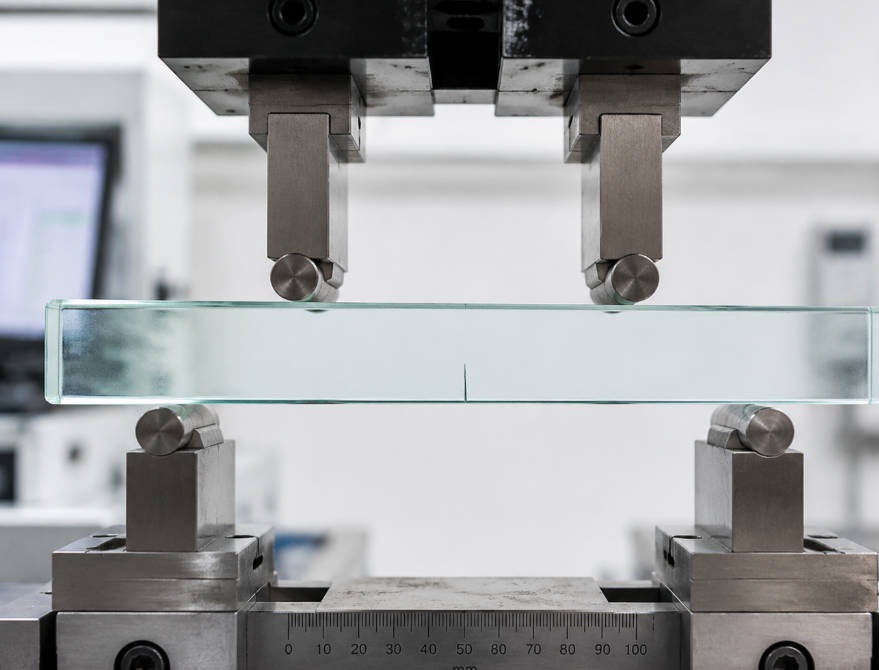
Mechanical Testing of Glass
Mechanical testing determines how glass responds to forces: bending, indentation, and impact. These properties directly influence structural design and safety certification.
How Is Flexural Strength Measured?
Flexural strength (modulus of rupture) characterizes the tensile stress at which a glass surface fractures. Because glass fails in tension, flexural testing is the primary strength metric used in structural glass design—facades, floors, balustrades—and for comparing different glass types (annealed, heat-strengthened, fully tempered, laminated).
ASTM C158 specifies three-point or four-point bending on bars of rectangular or circular cross-section. Four-point loading creates a uniform stress zone between the loading points, providing more representative data than three-point bending. ASTM recommends 10 to 30 specimens per type or brand to account for the statistical nature of glass fracture.
The European equivalent, EN 1288, covers similar methods and is widely referenced for CE marking of construction glass.
What Is Hardness Testing for Glass?
Vickers microhardness testing (ASTM E384) measures the indentation hardness of glass, characterizing its resistance to surface scratching. A diamond indenter pressed into the glass surface under a controlled load creates a measurable impression—the smaller the impression, the harder the glass.
Silicate glass typically achieves 500–700 HV (Vickers hardness). Surface coatings—anti-scratch, low-emissivity, anti-reflective—are evaluated for their effect on surface hardness, which is critical for consumer electronics and architectural applications where scratch resistance matters.
How Is Impact Resistance Tested?
Impact testing evaluates how glass and glazed assemblies respond to sudden loading. Methods include:
-
Drop weight and ball drop tests — A standardized weight or steel ball is dropped from a specified height onto the glass specimen. Related to ASTM C149 for container glass.
-
Pendulum impact test (EN 12600) — A weighted pendulum strikes the glass to classify its impact behavior. Widely used in European safety glass certification.
-
Manual attack resistance (EN 356) — Falling ball and hammer attack tests classify glass resistance to deliberate physical attack.
For automotive glazing, impact testing must meet ANSI Z26.1 and ECE R43 requirements. For building safety glass, ANSI Z97.1 and CPSC 16 CFR 1201 define breakage and fragmentation criteria.
Thermal Testing of Glass
Glass expands and contracts with temperature changes, and its viscosity shifts dramatically across a defined temperature range. Thermal testing measures these behaviors to ensure glass performs safely under real-world conditions.
What Is Thermal Shock Resistance Testing?
Thermal shock resistance testing evaluates how glass withstands rapid temperature changes—moving directly from a hot environment to a cold water bath. This test is critical for container glass, laboratory glassware, and cookware where sudden temperature shifts occur in normal use.
ASTM C149 and ISO 7459 define the standard methods. Specimens are heated to a specified temperature and then plunged into cold water. The test determines the maximum temperature differential the glass can survive without cracking. Results directly influence product design and material selection for thermally demanding applications.
How Is the Coefficient of Thermal Expansion Measured?
The coefficient of thermal expansion (CTE) quantifies how much glass expands per degree of temperature change. This property determines suitability for thermal cycling applications and glass-to-metal seal design.
ASTM E228 and ISO 7991 specify push-rod dilatometry methods. A sample is heated at a controlled rate while a sensor measures dimensional change. Key values include:
-
Borosilicate glass CTE: ~3.3 × 10⁻⁶/°C — enabling use in laboratory and thermal shock applications
-
Soda-lime glass CTE: ~9 × 10⁻⁶/°C — standard for architectural and container glass
Low-CTE glass resists thermal stress cracking, making it essential for precision optics, laboratory ware, and cookware.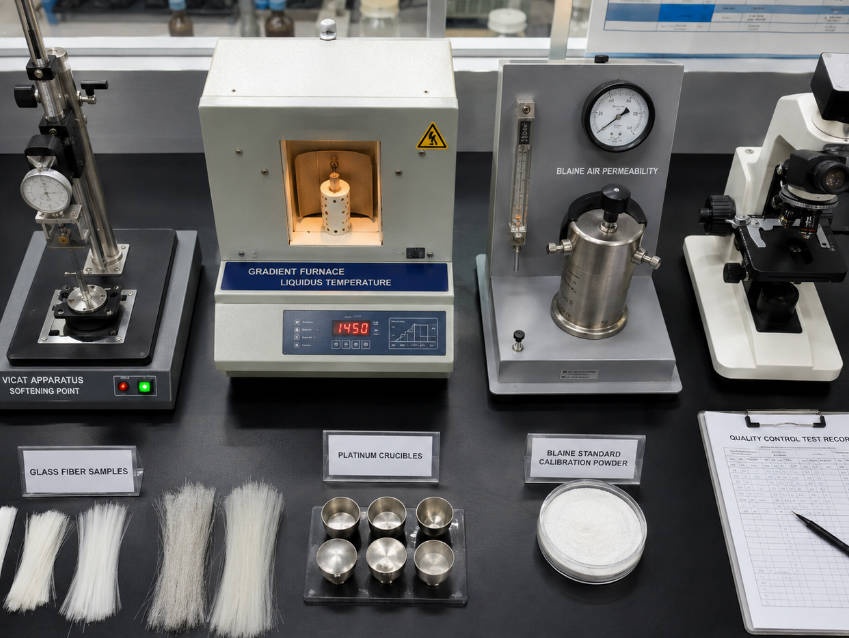
What Do Annealing Point and Strain Point Tests Reveal?
The annealing point and strain point define the temperature range where glass transitions from a viscous liquid to a rigid solid. These are critical for manufacturing—controlling cooling rates to eliminate residual stress.
Two ASTM methods measure these points:
Fiber Elongation (ASTM C336) — A round fiber, nominally 0.65 mm in diameter, elongates under a load of 1.0 kg. The annealing point is the temperature at which the fiber elongates at 0.14 mm/min when cooled at 4°C/min. The strain point is determined by extrapolation—the temperature where the elongation rate is 0.0316 times that at the annealing temperature. Requires a representative sample of 50 g or more of flame-workable glass in pieces at least 5 mm in diameter.
Beam Bending (ASTM C598) — A three-point loaded beam, nominally 3–4 mm in cross-section on a 50 mm span, elongates under a load of 0.2–1.0 kg. Same annealing and strain point definitions apply. Specimens are nominally 3–4 mm in cross-section and 75 mm in length.
The beam bending method accommodates samples that cannot be drawn into fibers, making it more versatile for specialty glasses.
How Is the Softening Point of Glass Determined?
The softening point is the temperature at which a glass fiber elongates under its own weight—a practical indicator of where glass begins to flow under gravity.
ASTM C338 defines the method: a round fiber, 0.65 mm in diameter and 235 mm long, elongates at 1 mm/min under its own weight when the upper 100 mm is heated at 5°C/min. Like ASTM C336, this test requires 50 g or more of flame-workable glass in pieces at least 5 mm in diameter. Fritted or ground samples must be remelted to obtain pieces large enough for fiber drawing.
The softening point is a key reference temperature for glass processing—it marks the upper limit of the working range for many forming operations.
Optical Testing of Glass
Optical properties determine how glass interacts with light—critical for architectural glazing, automotive windshields, precision optics, and display technology.
How Are Transmittance and Reflectance Measured?
Spectrophotometry measures how much light and solar energy passes through or reflects off glass surfaces. Key metrics include:
-
Visible Light Transmittance (VLT) — The percentage of visible light passing through the glass
-
Solar Energy Transmittance (TSET) — Total solar energy transmitted
-
UV Transmittance — Ultraviolet radiation passage
-
Reflectance — Light and energy reflected from glass surfaces
ASTM E308 and ISO 9050 define measurement methods. These values directly determine energy efficiency ratings—U-value and Solar Heat Gain Coefficient (SHGC)—for architectural glass per NFRC (National Fenestration Rating Council) standards. Low-emissivity coatings, tinted glass, and insulated units are all characterized through transmittance and reflectance testing.
What Is Optical Distortion Testing?
Optical distortion testing assesses surface quality and visual clarity—particularly important for automotive glazing where driver visibility is a safety requirement.
ASTM C1651 and EN 572-2 define visual and instrumental methods. The zebra board test is a common approach: a striped pattern is viewed through the glass at various angles, and distortion of the pattern reveals surface waviness or irregularities. Even minor distortions can cause eye strain or visual misjudgment at highway speeds.
How Is Refractive Index Determined?
Refractive index measurement precisely characterizes optical glass types—borosilicate, flint, crown—for lens and instrument design applications.
ASTM C1648 and ISO 11667 specify measurement methods using refractometers. The refractive index must be controlled to tight tolerances for optical systems, where even small variations cause aberrations. Different glass compositions produce distinct refractive indices, enabling optical designers to select materials that correct chromatic aberration in multi-element lens systems.
Chemical Testing of Glass
Chemical testing evaluates how glass interacts with its environment—water, acids, alkalis, and contaminants. These properties are critical for pharmaceutical packaging, laboratory glassware, and marine applications.
What Is Hydrolytic Resistance Testing?
Hydrolytic resistance measures how well glass withstands attack by water—a fundamental durability metric for any glass that contacts aqueous solutions.
USP <660>, ISO 719, and ISO 720 define two approaches:
-
Powder method — Glass is crushed to a specified particle size, mixed with water, and heated. The amount of alkali leached into solution is measured by titration.
-
Whole container method — Water is filled into a glass container and heated. Surface leaching is measured directly.
Results classify glass into hydrolytic resistance types—Type I (borosilicate, highest resistance), Type II (treated soda-lime), and Type III (soda-lime, lowest resistance). Pharmaceutical glass packaging must meet Type I or Type II requirements to prevent drug contamination.
How Are Acid and Alkali Resistance Evaluated?
Acid and alkali resistance testing determines how glass performs when exposed to corrosive chemicals:
-
Acid resistance (ISO 8424) — Mass loss after immersion in standardized acid solution classifies glass into acid resistance classes
-
Alkali resistance (ISO 695) — Mass loss after immersion in standardized alkali solution classifies glass into alkali resistance classes
These classifications are essential for laboratory glassware, chemical processing equipment, and marine applications where glass may encounter aggressive chemical environments over extended periods.
What Is Hydrophobic Contamination Testing?
ASTM C813 measures contact angle to verify surface cleanliness—critical for processes that require glass surfaces to bond properly, such as:
-
Automotive windscreen bonding — Adhesive must wet the glass surface completely
-
Optical coating application — Coatings adhere poorly to contaminated surfaces
-
Silane treatment — Surface energy affects treatment effectiveness
A water droplet placed on the surface forms a measurable contact angle. High contact angles indicate contamination; clean glass surfaces produce low contact angles (strong wetting). Even invisible hydrophobic residues from manufacturing or handling can cause bonding failures.
Viscosity and Liquidus Testing of Glass
Viscosity—the resistance to flow—defines how glass behaves at every stage of processing, from melting and forming to annealing. Liquidus temperature determines the risk of unwanted crystallization during manufacturing.
How Is Glass Viscosity Measured Above the Softening Point?
ASTM C965 measures viscosity above the softening point using a platinum alloy spindle immersed in a platinum crucible of molten glass. The crucible sits in a vertical tube furnace capable of 1600°C, and a viscometer mounted above measures viscosity from 1.5 to 5.0 Poise (log₁₀).
Approximately 400 g of glass is required per test. After data collection, results are fit to a Fulcher equation—a three-parameter model that describes the viscosity-temperature relationship across the entire working range. This equation is essential for process engineers who need to predict glass behavior during melting, refining, and forming.
What Is Viscosity Measurement Between Softening and Annealing Points?
ASTM C1350 fills the viscosity gap between the softening point and the annealing range—approximately 10⁸ to 10¹³ Pa·s (log₁₀ 8 to 13). This method uses beam bending: a loaded glass beam bends viscously at a measurable rate, and the viscosity is calculated from the bending rate, beam dimensions, and applied load.
Specimens are nominally 3–4 mm in cross-section and 75 mm in length—the same dimensions used in ASTM C598 for annealing and strain point determination. The beam bending method provides continuous viscosity data across this critical temperature range, bridging the gap between fiber elongation and spindle viscometry methods.
How Is Liquidus Temperature Determined?
The liquidus temperature is the maximum temperature where equilibrium exists between the amorphous glass and its primary crystalline phase. Knowing this temperature is essential because crystallization during forming ruins glass products.
ASTM C829 uses the gradient furnace method:
-
About 30 g of glass is crushed to −20 mesh
-
The sample is placed in a platinum boat (0.5" × 0.5" × 6.0")
-
The boat is held in a furnace with a controlled temperature gradient along its entire length
-
After sufficient time for thermal equilibrium, the specimen is quenched and viewed under a microscope
-
The glass/crystalline interface location and corresponding temperature are identified
The liquidus temperature must be below the forming temperature to prevent devitrification during production.
Electrical Testing of Glass
D-C volume resistivity (ASTM C657) measures the electrical resistance of glass—important for applications where glass serves as an insulator or dielectric material.
Surface and volume electrical resistivity are determined by both DC and AC methods. Specimen dimensions and electrode configuration are determined on an individual basis, depending on the glass type and application requirements.
High resistivity is essential for:
-
Electronic substrates — Glass used in display panels and semiconductor packaging
-
High-voltage insulators — Glass insulators in power transmission
-
Capacitor dielectrics — Glass layers in electronic components
Volume resistivity typically increases as temperature decreases, making this test particularly relevant for applications exposed to elevated operating temperatures.
Surface Stress Testing of Glass
Surface stress measurement confirms that tempered and heat-strengthened glass has adequate compressive stress on its surfaces—the mechanism that gives safety glass its strength and controlled breakage pattern.
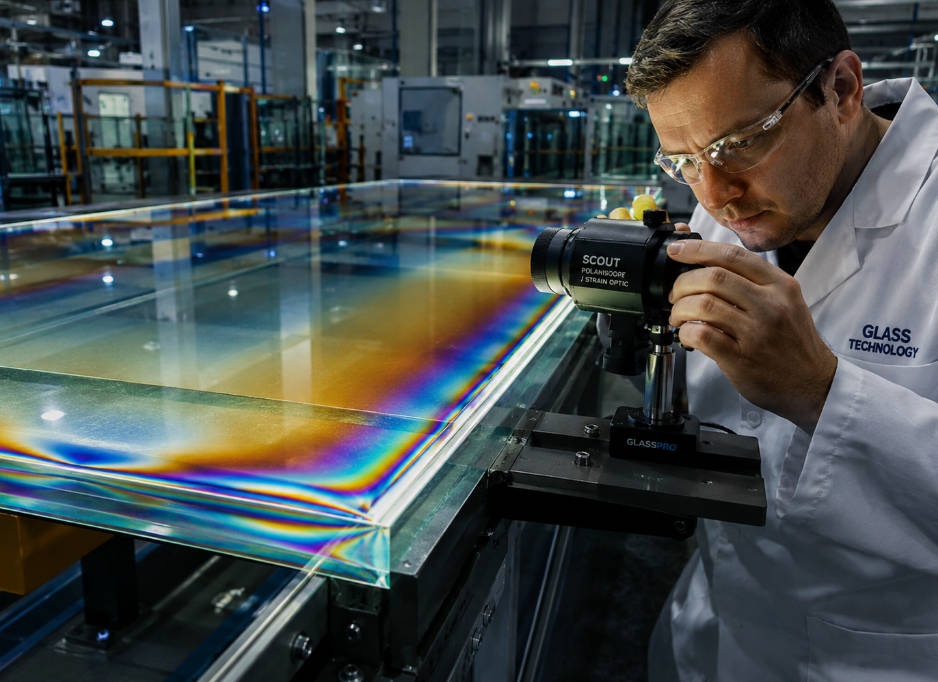
Polariscopy (ASTM C1279, ASTM C148) is a non-destructive method that uses polarized light to measure surface and edge stress in tempered glass. The principle relies on photoelasticity: stressed glass rotates polarized light proportionally to the stress level, and instruments measure this rotation to calculate compressive stress.
This testing is required for safety glass certification—ensuring that:
-
Tempered glass meets minimum compressive stress levels for strength
-
Fragmentation patterns will be safe (small, blunt pieces) if breakage occurs
-
Heat-strengthened glass has intermediate stress levels between annealed and fully tempered
Without adequate surface stress, "tempered" glass may not perform as safety glass when broken.
How Is Laminated Glass Tested Before Installation?
Laminated glass has a complex structure—multiple glass panes bonded with PVB or EVA interlayers—that requires specialized testing beyond standard glass evaluation. Skipping these tests risks delamination, reduced strength, bubble formation, and optical defects.
Visual Inspection and Dimensional Check
Surfaces are examined for scratches, bubbles, inclusions, and edge defects. Dimensions, thicknesses, and tolerances are verified against design drawings. This first-line check catches manufacturing mismatches and cosmetic defects before further testing.
Layer Adhesion and Bond Strength Test
Peel, shear, or delamination tests confirm that the interlayer bonds properly to the glass surfaces. Weak adhesion causes layers to separate under stress or environmental exposure—a critical safety failure in laminated safety glass. Tests use specialized tools or sample blocks pulled under controlled conditions.
Stress and Residual Stress Test
Polarized light, photoelastic methods, and stress viewers scan for internal stresses, uneven tempering, and stress concentrations—especially important in curved or large panels where manufacturing introduces complex stress patterns. Hidden residual stresses can cause spontaneous breakage long after installation.
Impact Resistance and Fragment Retention Test
Simulated impacts verify that when laminated glass breaks, fragments remain bonded to the interlayer rather than scattering. This is the defining safety characteristic of laminated glass—broken pieces stay in place, reducing laceration risk. Testing follows safety glass standards such as EN 12600, ANSI Z97.1, and EN 356.
Heat-Soak, Thermal Cycling, UV, and Weather Resistance Test
These tests are crucial for large outdoor panels and curtain walls:
-
Heat-soak testing accelerates the failure of panels containing nickel sulfide inclusions that cause spontaneous breakage
-
Thermal cycling exposes specimens to repeated hot-cold shifts to test interlayer stability
-
UV aging evaluates PVB stability, bond strength, and transparency changes over time
-
Weather resistance per ISO 12543-4 tests laminated glass durability under humidity, high temperature, and radiation
Results confirm that laminated glass will maintain structural and optical integrity throughout its service life.
What Certification Standards Apply to Glass Testing?
Glass products must meet certification requirements before they can be sold for many applications. Key certification programs include:
|
Program |
What It Covers |
Applicable Standards |
|---|---|---|
|
IGCC/IGMA |
Insulated glass durability, fogging, cycling |
EN 1279-2 through 1279-6 |
|
SGCC |
Safety glazing fragmentation and penetration |
ANSI Z97.1, CPSC 16 CFR 1201 |
|
NFRC |
U-factor, SHGC, condensation resistance |
ASTM E1423, ASTM E2263 |
|
CE Marking |
Construction glass per EU CPR |
EN 12150, EN 14449, EN 1863, EN 1096 |
|
Florida Product Approval |
High-wind zone compliance |
TAS 201, 202, 203 |
|
Miami-Dade NOA |
Windborne debris impact for HVHZ |
ASTM E1886, ASTM E1996 |
|
ICC-500 |
Tornado windborne debris shelters |
ICC-500 |
For laminated glass specifically, certification must include heat-soak test reports, stress-test documentation, batch traceability, and compliance with standards such as EN 14449 (laminated glass), EN 12150 (thermally toughened glass), and ANSI Z97.1 (safety glazing).
How Do Glass Testing Methods Map to Industry Standards?
The table below maps each major glass test to its governing ASTM standard and primary application area:
|
Test |
ASTM Standard |
What It Measures |
|---|---|---|
|
Flexural Strength |
C158 |
Modulus of rupture by bending |
|
Annealing/Strain Point (Fiber) |
C336 |
Viscosity reference points by fiber elongation |
|
Softening Point |
C338 |
Temperature where glass flows under own weight |
|
Annealing/Strain Point (Beam) |
C598 |
Viscosity reference points by beam bending |
|
D-C Volume Resistivity |
C657 |
Electrical insulation properties |
|
Liquidus Temperature |
C829 |
Maximum crystallization temperature |
|
Viscosity Above Softening |
C965 |
High-temperature flow behavior |
|
Viscosity (Softening to Annealing) |
C1350 |
Mid-range viscosity by beam bending |
|
Thermal Shock Resistance |
C149 |
Resistance to rapid temperature change |
|
CTE |
E228 |
Thermal expansion coefficient |
|
Vickers Hardness |
E384 |
Surface indentation hardness |
|
Hydrophobic Contamination |
C813 |
Surface cleanliness by contact angle |
|
Surface Stress |
C1279, C148 |
Compressive stress in tempered glass |
Understanding which tests apply to which product and specification ensures glass is evaluated against the correct criteria. When all specified tests pass, manufacturers can certify their products with confidence, architects can specify with certainty, and building occupants are protected by verified, standards-compliant glass.