Table of Contents
- What is melatonin testing?
- The pharmacopeial stack: USP, EP, DAC, Chinese Pharmacopoeia, GB/T 5009.170
- The USP Melatonin monograph: assay, impurities, dissolution, acceptance criteria
- GB/T 5009.170-2016: the Chinese national standard and how it differs from USP
- Related compound A (5-methoxytryptamine) and melatonin degradation chemistry
- HPLC method parameters: column, mobile phase, flow, detection, system suitability
- Method validation per ICH Q2(R2)
- Forced degradation: the four stress conditions and stability-indicating methods
- Dissolution testing of melatonin tablets per USP <2040>
- Stability testing per ICH Q1A(R2)
- Regulatory status: SAMR filing, FDA dietary supplement cGMP, EU novel-food
- The label-claim accuracy problem and why QC testing matters
- FAQ
- Our melatonin testing capabilities
What is melatonin testing?
Melatonin testing is the measurement and validation of melatonin content, related impurities, dissolution behaviour, and long-term stability in a melatonin-containing product — typically a dietary supplement tablet or capsule, but also the active pharmaceutical ingredient (API) powder and, in the European Union, foods and beverages to which melatonin has been added under the EFSA health-claim authorisation. The output of a melatonin test is a quantitative assay result (mass of melatonin per dose unit, compared to the label claim), an impurity profile (typically the single specified related compound A, 5-methoxytryptamine), a dissolution profile, and — in a stability study — the time-course of melatonin potency and degradation-product formation under ICH long-term and accelerated conditions. The test is performed by reversed-phase HPLC with UV or fluorescence detection, against a traceable melatonin reference standard, in a laboratory qualified to the applicable pharmacopeial method.
Melatonin (N-acetyl-5-methoxytryptamine, C₁₃H₁₆N₂O₂, MW 232.28) is a methoxyindole hormone synthesised from tryptophan in the mammalian pineal gland. Since the Lerner group's 1958 isolation from bovine pineal tissue, it has been identified in a wide range of foods (fish, wheat, vegetables, fruits, seeds, nuts, wine, tea) and has been sold over-the-counter as a dietary supplement for three decades for the alleviation of jetlag and the support of sleep. The European Commission has authorised two health claims for melatonin-containing foods (alleviation of subjective feelings of jetlag at ≥ 0.5 mg, and reduction of sleep-onset latency at ≥ 1 mg). In China, melatonin is one of the five grandfathered health-food ingredients (alongside coenzyme Q10, fish oil, broken Ganoderma lucidum spore powder, and spirulina) that may be filed — rather than registered — for domestic health-food certification, and one of the most widely consumed over-the-counter sleep aids. Across all major markets, melatonin is subject to a content-claim tolerance: the labelled amount and the measured amount must agree within a specified band, and recent published surveys of commercial supplements (showing deviations of −83 % to +478 % from label) have made this tolerance the focal point of regulatory and laboratory attention.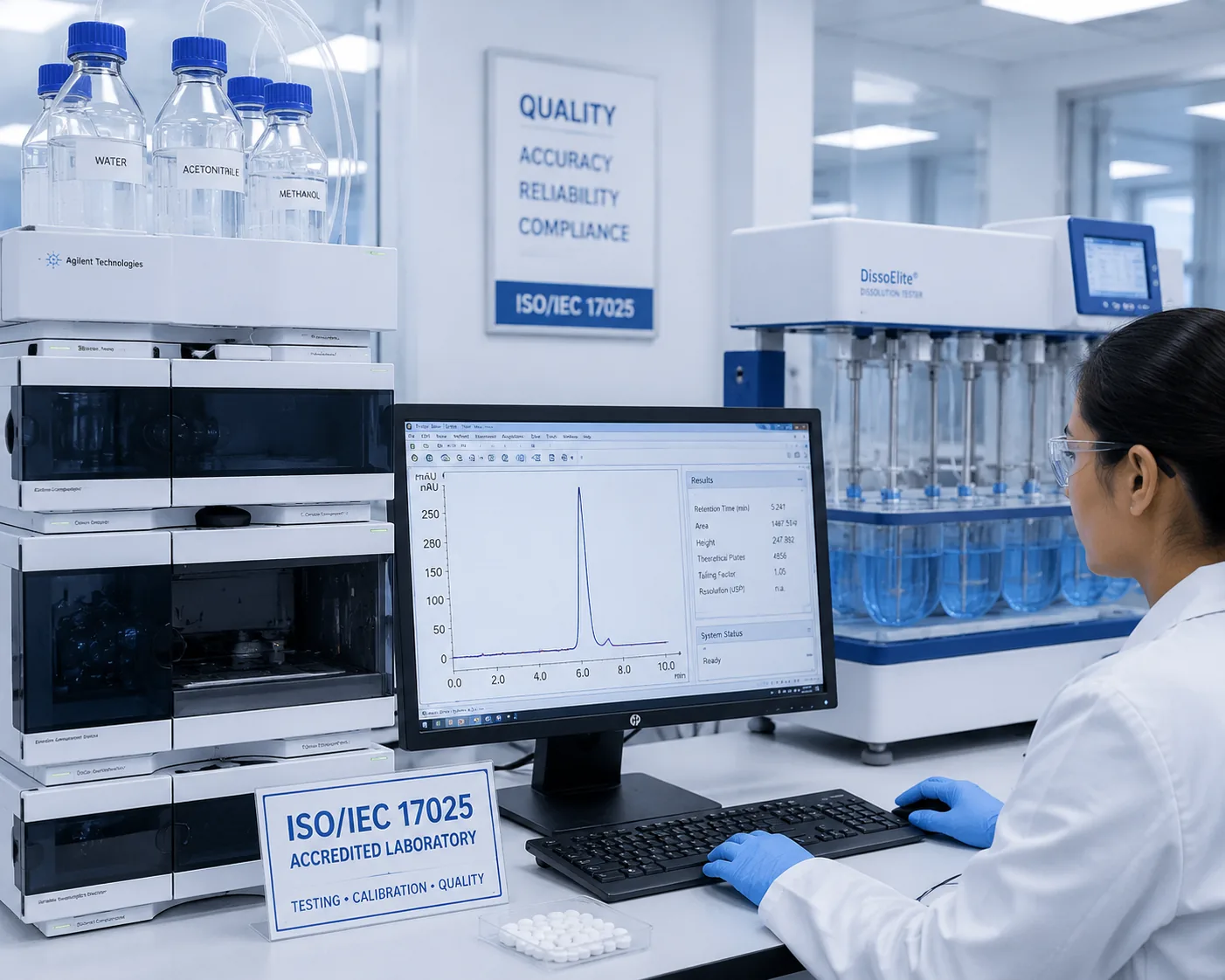
The pharmacopeial stack: USP, EP, DAC, Chinese Pharmacopoeia, GB/T 5009.170
A complete melatonin testing project draws on a stack of pharmacopeial and national standards, the choice of which depends on the product form (API vs tablet vs capsule), the regulatory pathway (dietary supplement vs OTC drug vs health food), and the target market.
| Family | Standard | Scope |
|---|---|---|
| USP Melatonin monograph (USP Dietary Supplements) | Melatonin (API) and Melatonin Tablets | Assay (HPLC-UV), identification (IR/UV/HPLC retention), related compounds (5-MT), loss on drying, residue on ignition, chloride, heavy metals, dissolution for tablets |
| USP <2040> | Disintegration and Dissolution of Dietary Supplements | Dissolution testing for melatonin tablets: water 500 mL, Apparatus 2 (paddles) 50 rpm, 30 min, ≥ 75 % released |
| USP <621> | Chromatography | General chapter governing column, mobile phase, flow rate adjustments to monograph methods |
| USP <6111> | Acceptance criteria for content uniformity / mass uniformity | Applied to melatonin tablet batches |
| EP (European Pharmacopoeia) | No monograph for melatonin as of EP 11.0; historically covered in the German Drug Codex (DAC 2009, M-080) | EU compounding preparations use the DAC method |
| German Drug Codex (DAC 2009, M-080) | Melatonin monograph | HPLC assay with water/acetonitrile 60:40, UV 278 nm; the method used in European hospital-compounded melatonin capsules |
| Chinese Pharmacopoeia (ChP) | No monograph for melatonin API; melatonin tablets addressed under generic tablet monographs | For OTC melatonin drug registration in China |
| GB/T 5009.170-2016 | National food safety Standard — Determination of Melatonin in Health Food | The Chinese national standard method for melatonin assay in health-food capsules and tablets; two methods: HPLC-UV (LOD 0.07 mg/kg) and HPLC-fluorescence (LOD 30 pg) |
| ICH Q2(R2) | Validation of analytical procedures | The validation framework for any melatonin HPLC method |
| ICH Q1A(R2) | Stability testing of new drug substances and products | Long-term (25 °C/60 % RH) and accelerated (40 °C/75 % RH) stability for melatonin shelf-life assignment |
| FDA 21 CFR 111 | Dietary supplement current Good Manufacturing Practice | The US manufacturing/QC framework requiring identity, purity, strength, composition testing of melatonin supplements |
| ISO 17034 / ISO/IEC 17025 | Reference material producer and testing laboratory accreditation | Applies to melatonin Certified Reference Material (CRM) production and to testing laboratories issuing pharmacopeial reports |
The single most consequential fact for a Chinese laboratory is that GB/T 5009.170-2016 is the Chinese national standard for melatonin in health food — the SAMR-mandated method for health-food filing — while the USP monograph is the international reference for dietary-supplement QC. A melatonin product exported to multiple markets must be tested against both, and the two methods are not interchangeable (different mobile phase, different detection wavelength, different LOD).
The USP Melatonin monograph: assay, impurities, dissolution, acceptance criteria
The USP Melatonin monograph (current in USP NF) defines the API and the tablet forms and is the most internationally cited single specification for melatonin QC.
Definition — Melatonin API contains NLT 98.5 % and NMT 101.5 % of melatonin (C₁₃H₁₆N₂O₂), calculated on the dried basis. Melatonin Tablets contain NLT 90.0 % and NMT 110.0 % of the labelled amount of melatonin.
Identification —
- A. Infrared absorption <197K>
- B. Ultraviolet absorption <197U> — analytical wavelength 277 nm; absorbances calculated on the dried basis do not differ by more than 3.0 %
- C. The retention time of the major peak of the sample solution corresponds to that of the Standard solution (for tablets)
Assay (API and Tablets) —
- Buffer: 0.5 g/L monobasic potassium phosphate, pH 3.5 with phosphoric acid
- Mobile phase: Acetonitrile and Buffer (25:75)
- Column: 4.6-mm × 15-cm; 5-µm packing L1 (C18)
- Detector: UV 222 nm
- Flow rate: 1.0 mL/min; Injection: 10 µL
- System suitability: resolution NLT 4.0 between melatonin and melatonin related compound A; RSD NMT 2.0 % for the melatonin peak (Standard solution)
- Acceptance (API): 98.5–101.5 % on the dried basis
- Acceptance (Tablets): 90.0–110.0 % of the labelled amount
Related compounds (impurities) —
- Mobile phase: gradient of Acetonitrile (A) and Buffer (B)
- Relative retention times: melatonin related compound A = 0.4; melatonin = 1.0
- Individual impurities: NMT 0.1 %
- Total impurities: NMT 1.0 %
Other tests (API) —
- Loss on drying <731>: NMT 1.0 % (80 °C vacuum, 3 h)
- Residue on ignition <281>: NMT 0.1 %
- Chloride <221>: NMT 0.02 %
- Heavy metals <231>: NMT 20 µg/g (deleted in modern revisions in favour of ICP-MS)
- Packaging and storage: tight containers, protected from light
Dissolution (Tablets) per USP <2040> —
- Medium: Water, 500 mL
- Apparatus 2 (paddles): 50 rpm
- Time: 30 min
- Acceptance: NLT 75 % (Q) of the labelled amount of melatonin dissolved
The USP monograph also defines the USP Melatonin RS reference standard and USP Melatonin Related Compound A RS (5-methoxytryptamine, C₁₁H₁₄N₂O, MW 190.24), both of which are required for system-suitability testing of every assay run.
GB/T 5009.170-2016: the Chinese national standard and how it differs from USP
GB/T 5009.170-2016 (保健食品中褪黑素的测定) is the Chinese national standard for the determination of melatonin in health-food products. It is the SAMR-mandated method for the melatonin content declaration on a Chinese health-food filing; it was issued by the special-food technical committee (TC466) and replaced the 2003 version. The standard provides two methods, applicable to melatonin in capsule or tablet form:
| Parameter | GB/T 5009.170-2016 Method 1 (HPLC-UV) | GB/T 5009.170-2016 Method 2 (HPLC-FLD) |
|---|---|---|
| Column | C18, 4.6 mm × 150 mm, 5 µm | C18, 4.6 mm × 150 mm, 5 µm |
| Mobile phase | Methanol : 0.1 % trifluoroacetic acid water (35:65) | Methanol : 0.1 % trifluoroacetic acid water (gradient or isocratic) |
| Detector | UV 222 nm | Fluorescence (excitation ~285 nm, emission ~345 nm) |
| LOD | ~0.07 mg/kg | ~30 pg on column |
| LOQ | S/N ≥ 10 | S/N ≥ 10 |
| Linear range | 1–100 µg/mL | From 0.05 µg |
| Precision criterion | Two parallel determinations, error ≤ 10 % of mean | Two parallel determinations, error ≤ 10 % of mean |
| Applicability | Capsule and tablet health food with melatonin as active ingredient | Lower-content samples; trace analysis |
GB/T 5009.170-2016 vs USP monograph — the four method differences that matter:
- Mobile phase acid modifier. GB uses 0.1 % trifluoroacetic acid (TFA); USP uses phosphoric acid at pH 3.5. TFA is an ion-pairing reagent; phosphoric acid is a pH buffer. The two are not interchangeable without re-validation, and TFA is progressively being phased out of LC-MS-compatible methods because of its suppression effect.
- Organic modifier. GB uses methanol; USP uses acetonitrile. Methanol is cheaper and lower-toxicity but gives different selectivity (especially for the 5-MT impurity) and is not equivalent without re-validation.
- Detection. GB Method 2 uses fluorescence detection at 285/345 nm excitation/emission; the USP monograph is UV only at 222 nm. Fluorescence detection offers ~1000× lower LOD (30 pg vs 0.07 mg/kg), which matters for low-dose melatonin formulations (the 0.5 mg pediatric capsules used in the Tse hospital study require the lower LOD).
- Acceptance criteria. GB/T 5009.170 is an analytical method only; it does not set product acceptance limits. The product limits (label claim tolerance, impurity caps) come from the SAMR filing dossier or the Chinese Pharmacopoeia, depending on the regulatory pathway. The USP monograph, by contrast, sets both method and limits.
A laboratory that issues a single report covering both USP and GB/T 5009.170 must run both methods in parallel and report the result against each, with the system-suitability evidence for each. This dual-method capability is the entry barrier for serving melatonin manufacturers who export to both China and the US/EU.
Related compound A (5-methoxytryptamine) and melatonin degradation chemistry
The USP monograph specifies one named related compound — 5-methoxytryptamine (5-MT, C₁₁H₁₄N₂O, MW 190.24) — as melatonin related compound A, with relative retention time 0.4 and a resolution requirement of NLT 4.0 between 5-MT and melatonin. 5-MT is the biosynthetic precursor of melatonin (the immediate product of tryptophan → 5-hydroxytryptophan → serotonin → N-acetylserotonin → melatonin), and in a melatonin drug substance it appears as a synthetic by-product of incomplete N-acetylation.
Beyond 5-MT, melatonin has a documented degradation chemistry that a stability-indicating method must resolve:
| Stress | Primary degradation product(s) | Mechanism |
|---|---|---|
| Acid (e.g. 5 M HCl, 70 °C, 30 min) | N-acetylserotonin, 5-MT, kynuramine derivatives | Amide hydrolysis of the N-acetyl group; indole ring opening at low pH |
| Base (e.g. 2 M NaOH, 70 °C, 30 min) | N-acetylserotonin, 5-MT | Alkaline hydrolysis of the amide; retro-Knoevenagel |
| Oxidation (3 % H₂O₂, 80 °C, 10 min) | 2-hydroxymelatonin, cyclic 3-hydroxymelatonin, N¹-acetyl-N²-formyl-5-methoxykynuramine (AFMK) | Indole-ring oxidation; the AFMK pathway is the photochemical oxidation product in vivo |
| Light (UV 365 nm, 5 h) | AFMK; polymerisation products | Photo-oxidation of the indole ring; melatonin is photosensitive — protected-from-light storage is mandated by every pharmacopeia |
| Thermal | Minor; thermal hydrolysis is dominated by oxidative pathways at > 90 °C | Thermal; alone at 25 °C, melatonin is stable for years |
The AFMK pathway (catalysed by horseradish peroxidase in vitro and by myeloperoxidase and indoleamine 2,3-dioxygenase in vivo) is the dominant oxidative degradation route and the one that produces the most chromatographically complex mixture. A validated stability-indicating method must resolve melatonin from AFMK, 2-hydroxymelatonin, 5-MT, and N-acetylserotonin under the four stress conditions, with peak purity verified by diode-array detection. The Tse et al. study (Journal of Pharmaceutical and Biomedical Analysis) validated exactly such a method for hospital-compounded pediatric melatonin capsules, with method capability (Cp) of 15 — a false-negative rate below 0.01 %.
HPLC method parameters: column, mobile phase, flow, detection, system suitability
For routine QC, the four most-used melatonin HPLC methods (USP, GB/T 5009.170, DAC, modernised USP per Waters) share most of their chromatographic backbone but diverge in the four parameters identified above. The system-suitability criteria are common across them:
| Parameter | USP monograph | GB/T 5009.170 (Method 1) | DAC 2009 (Germany) | Modernised USP (Waters, 2023) |
|---|---|---|---|---|
| Column | C18 L1, 4.6 × 150 mm, 5 µm | C18, 4.6 × 150 mm, 5 µm | C18, 4.6 × 150 mm, 3 µm (Luna) | C18 BEH, 4.6 × 75 mm, 2.5 µm |
| Mobile phase | ACN : KH₂PO₄ buffer pH 3.5 (25:75) | MeOH : 0.1 % TFA (35:65) | Water : ACN (60:40) | ACN : buffer (22:78) |
| Detection | UV 222 nm | UV 222 nm (Method 1) or FLD 285/345 nm (Method 2) | UV 278 nm (diode array) | UV 277 nm (PDA, 190–410 nm collected) |
| Flow rate | 1.0 mL/min | 1.0 mL/min | 1.0 mL/min | 1.0 mL/min |
| Injection | 10 µL | 10 µL | 10 µL | 2 µL |
| Run time | ~10 min (assay) / 25 min (impurities) | ~10 min | < 3 min (melatonin RT) | 5 min (assay) / 13 min (impurities) |
| System suitability: 5-MT RRT | 0.4 | — | — | 0.4 |
| System suitability: resolution | ≥ 4.0 | — | ≥ 10 (melatonin/impurities) | 16 |
| System suitability: RSD | ≤ 2.0 % | ≤ 10 % (between two parallels) | — | 0.11 % |
The Waters modernisation demonstrates that a USP method may be made roughly 2× faster and ~20 % greener (lower AMGS score) by changing from a 5 µm to a 2.5 µm particle column and proportionally shortening the column length — adjustments that are explicitly permitted under USP General Chapter <621>, "Adjustment of Chromatographic Conditions", provided the system-suitability criteria are met. A laboratory that runs a high volume of melatonin assays can cut solvent consumption and turnaround time by half without re-validating the method.
Method validation per ICH Q2(R2)
Any non-pharmacopeial melatonin method (a laboratory-developed method, or a pharmacopeial method applied to a new matrix) must be validated per ICH Q2(R2), which defines the validation characteristics:
| Characteristic | Typical melatonin method criterion |
|---|---|
| Specificity | Melatonin resolved from 5-MT (resolution ≥ 4), from excipients (microcrystalline cellulose, lactose, magnesium stearate), and from all four forced-degradation products |
| Linearity | r ≥ 0.999 over the working range (typically 1–100 µg/mL; the USP assay uses 5–25 µg/mL) |
| Range | 80–120 % of the test concentration for assay; LOQ to 200 % for impurities |
| Accuracy (recovery) | 98–102 % mean recovery at 50, 100, 150 % of test concentration (3 replicates each) |
| Repeatability (intra-day precision) | RSD ≤ 2 % at the test concentration (n ≥ 6) |
| Intermediate precision (inter-day, inter-analyst) | RSD ≤ 3 % |
| LOD | S/N ≥ 3; ~0.07 mg/kg (HPLC-UV) or ~30 pg on column (HPLC-FLD) |
| LOQ | S/N ≥ 10; ~0.2 mg/kg (HPLC-UV) or ~0.1 ng (HPLC-FLD) |
| Robustness | Method performance unaffected by deliberate variation of flow (±10 %), mobile phase composition (±3 %), column temperature (±5 °C) |
| System suitability | Verified at the start of every analytical run |
The Tse et al. pediatric-capsule validation additionally reported a method capability (Cp) of 15, far above the conventional acceptance threshold of 1.33 — meaning the method's confidence interval spanned ~90 σ of the specification tolerance, with a false-negative rate below 0.01 %. Cp is not required by ICH Q2 but is a useful metric for high-stakes QC methods where a false release of an out-of-specification batch is a regulatory event.
Forced degradation: the four stress conditions and stability-indicating methods
A melatonin HPLC method is only "stability-indicating" if it has been demonstrated to separate melatonin from all of its degradation products under the four standard stress conditions:
| Condition | Reagent / exposure | Purpose |
|---|---|---|
| Acid hydrolysis | 5 M HCl at 70 °C for 30 min | Hydrolysis of the N-acetyl amide; produces N-acetylserotonin and 5-MT |
| Base hydrolysis | 2 M NaOH at 70 °C for 30 min | Alkaline hydrolysis of the amide |
| Oxidation | 3 % H₂O₂ at 80 °C for 10 min | Indole-ring oxidation; produces AFMK and 2-hydroxymelatonin |
| Photolysis | UV 365 nm for 5 h | Photo-oxidation; AFMK is the dominant product |
For each condition, peak purity of the melatonin peak (by PDA, with purity angle < purity threshold) and the resolution between melatonin and the nearest degradation product are reported. A method that fails to resolve melatonin from any degradation product is not stability-indicating and cannot be used for shelf-life stability studies.
Dissolution testing of melatonin tablets per USP <2040>
For melatonin tablets, the dissolution test is governed by USP <2040> (Disintegration and Dissolution of Dietary Supplements), which is more demanding than the older USP <711> drug dissolution because dietary supplements are not always formulated for immediate release.
- Medium: Water, 500 mL
- Apparatus 2 (paddles): 50 rpm
- Temperature: 37 ± 2 °C
- Time: 30 min
- Acceptance: NLT 75 % (Q) of the labelled amount of melatonin dissolved
- Sampling: at 30 min; if Q is not met, six additional tablets are tested
- Analysis: HPLC assay of the dissolution medium against a USP Melatonin RS standard
The 75 % Q criterion at 30 min in water is the pass/fail specification; failure indicates either over-compression of the tablet, a poorly-designed disintegrant, or a melatonin form (anhydrate vs hydrate, polymorph) with slow dissolution kinetics. The European Pharmacopoeia uses an equivalent criterion (85 % in 30 min in phosphate buffer pH 6.8) for immediate-release drug tablets.
Stability testing per ICH Q1A(R2)
Melatonin drug substances and drug products are tested under the ICH Q1A(R2) stability conditions for shelf-life assignment:
| Condition | Temperature / humidity | Minimum duration | Purpose |
|---|---|---|---|
| Long-term | 25 ± 2 °C / 60 ± 5 % RH | 12 months (3 batches); extended to 24-36 months for shelf-life claim | Primary shelf-life data |
| Intermediate | 30 ± 2 °C / 65 ± 5 % RH | 6 months (if significant change at 40 °C) | Bridging data |
| Accelerated | 40 ± 2 °C / 75 ± 5 % RH | 6 months | Worst-case stress |
For melatonin capsules, the typical shelf life under long-term conditions (25 °C/60 % RH, protected from light) is 18–24 months, with no significant loss of potency. The Tse et al. study demonstrated 18-month stability at 25 °C/60 % RH with melatonin content at 93.6 ± 4.1 % of theoretical for 0.5 mg capsules and 98.7 ± 6.9 % for 6 mg capsules, both within the pharmacopeial 90–110 % tolerance. Photostability testing per ICH Q1B (Option 2, 1.2 million lux·h visible + 200 W·h/m² near-UV) confirms the protected-from-light storage requirement.
Regulatory status: SAMR filing, FDA dietary supplement cGMP, EU novel-food
The regulatory pathway for a melatonin product depends on the claim and the market:
| Market | Pathway | Requirement |
|---|---|---|
| China — health food (filing) | SAMR filing under the Administrative Measures for Health Food Registration and Filing (CFDA Order 22, 2020) | Melatonin is one of the five grandfathered health-food ingredients; the domestic filing dossier requires the GB/T 5009.170 assay, GB 16740 contaminant and microbiological limits, stability per SAMR guideline, and the "helps improve sleep" function evaluation (animal function test, no human trial required for melatonin) |
| China — OTC drug | NMPA drug registration under the Drug Administration Law | Uses the Chinese Pharmacopoeia method; filed as a drug, not a health food |
| US — dietary supplement | FDA notification under 21 CFR 111 (cGMP) | No pre-market approval; the manufacturer must test identity, purity, strength, composition; label-claim tolerance per USP; FDA may inspect and recall |
| EU — food/dietary supplement | EFSA health claim authorisation + national food law | Melatonin is approved at ≥ 0.5 mg for jetlag and ≥ 1 mg for sleep-onset latency claims; regulated as a food, not a drug |
The Chinese SAMR filing pathway for melatonin is markedly lighter than the FDA cGMP pathway in one respect — no pre-market approval — but heavier in another: the function-claim ("helps improve sleep") evaluation requires the full SAMR animal-function test battery (mouse sleep-electroencephalogram or rat locomotor-activity endpoint). A laboratory serving Chinese melatonin manufacturers therefore needs both the GB/T 5009.170 analytical capability and the function-evaluation animal-test capability, or a partnership with a function-test CRO.
The label-claim accuracy problem and why QC testing matters
The single most-cited recent finding in melatonin testing is the wide discrepancy between label claims and measured melatonin content in commercial supplements:
- A study of melatonin supplements sold in Ontario, Canada reported deviations of −83 % to +478 % from the labelled value
- A US study of 25 melatonin gummy products found actual contents of 74 to 347 % of the label claim
- The US CDC reported a 530 % increase in paediatric melatonin-ingestion calls to poison-control centres between 2012 and 2021
These findings have made melatonin content QC testing a regulatory and reputational priority. A melatonin supplement whose measured content deviates from label by more than ±10 % (the USP tolerance) is misbranded under US FDA regulation; a melatonin health food whose measured content deviates from the declared value by more than the GB/T 5009.170 criterion is non-conforming under SAMR. The third-party laboratory that issues the QC report — and the reference standard (USP Melatonin RS, or a CRM traceable to it under ISO 17034) against which the assay is run — is the technical control point that prevents misbranded melatonin from reaching the market. Recent peer-reviewed work (Cohen et al., JAMA Open Access) has called for routine third-party melatonin content verification, and the cGMP regulatory trend is toward mandatory independent laboratory confirmation of label claim.
FAQ
What is the USP melatonin acceptance criterion for assay?
The USP Melatonin monograph sets the API assay at 98.5–101.5 % (on the dried basis) and the tablet assay at 90.0–110.0 % of the labelled amount. Individual impurities are capped at NMT 0.1 %, total impurities at NMT 1.0 %; the specified related compound A is 5-methoxytryptamine (5-MT).
What is the difference between USP melatonin method and GB/T 5009.170?
USP uses acetonitrile-potassium phosphate buffer (pH 3.5) with UV detection at 222 nm; GB/T 5009.170 uses methanol-0.1 % trifluoroacetic acid with UV (Method 1) or fluorescence (Method 2) detection. GB Method 2 has an LOD of 30 pg, roughly 1000× lower than USP's ~0.07 mg/kg. The two are not interchangeable without re-validation.
What is melatonin related compound A?
5-Methoxytryptamine (5-MT), the immediate biosynthetic precursor of melatonin, present as a synthetic by-product in the API. The USP monograph specifies it with relative retention time 0.4 and a resolution requirement of NLT 4.0 between 5-MT and melatonin.
What are the four forced degradation conditions for melatonin?
Acid (5 M HCl, 70 °C, 30 min), base (2 M NaOH, 70 °C, 30 min), oxidation (3 % H₂O₂, 80 °C, 10 min), and photolysis (UV 365 nm, 5 h). The oxidative and photo-oxidative pathways produce AFMK (N¹-acetyl-N²-formyl-5-methoxykynuramine) and 2-hydroxymelatonin; a stability-indicating method must resolve melatonin from all of these.
Does SAMR require human feeding trials for a melatonin health-food filing?
No. Melatonin is one of the five grandfathered health-food ingredients (alongside coenzyme Q10, fish oil, broken Ganoderma lucidum spore powder, and spirulina) and the "helps improve sleep" function claim requires only the SAMR animal-function test battery (mouse/rat sleep or locomotor endpoint), not a human feeding trial.
Our melatonin testing capabilities
Beijing ZKGX Research (ISO/IEC 17025 accredited, CMA- and CNAS-accredited testing laboratory) provides complete melatonin testing across the international and Chinese standard stack:
- USP Melatonin monograph — API assay (98.5–101.5 % criterion), tablet assay (90–110 %), related compound A (5-MT, RRT 0.4, resolution ≥ 4.0), individual impurities ≤ 0.1 %, total impurities ≤ 1.0 %, identification by IR/UV/HPLC retention, loss on drying, residue on ignition, chloride, heavy metals.
- USP <2040> dissolution — water 500 mL, Apparatus 2 (paddles) 50 rpm, 30 min, ≥ 75 % (Q) criterion.
- GB/T 5009.170-2016 — both Method 1 (HPLC-UV, LOD 0.07 mg/kg) and Method 2 (HPLC-fluorescence, LOD 30 pg on column), against a traceable melatonin reference standard; for SAMR health-food filing.
- Method validation per ICH Q2(R2) — specificity, linearity (r ≥ 0.999), accuracy (98–102 % recovery), repeatability (RSD ≤ 2 %), intermediate precision (RSD ≤ 3 %), LOD, LOQ, robustness, system suitability.
- Stability-indicating method development — forced degradation under the four ICH stress conditions (acid, base, oxidation, photolysis); peak purity by PDA; resolution from AFMK, 2-hydroxymelatonin, N-acetylserotonin, and 5-MT.
- Stability testing per ICH Q1A(R2) — long-term (25 °C/60 % RH), intermediate (30 °C/65 % RH), accelerated (40 °C/75 % RH); photostability per ICH Q1B.
- Modernised HPLC method per USP <621> — 2.5 µm C18 column at proportionally shorter length for 2× throughput and 20 % lower AMGS, with full system-suitability evidence; useful for high-volume QC laboratories.
- Reference standards — USP Melatonin RS, USP Melatonin Related Compound A RS, ISO 17034-certified CRM; full traceability to primary standards.
- SAMR health-food filing support for the "helps improve sleep" function claim — assay, contaminant/microbiological limits per GB 16740, stability, and partnership with a function-test CRO for the animal-function evaluation.
Suitable product forms include: melatonin API powder; immediate-release tablets; capsules (hard gelatin, vegetarian); softgels; gummies; liquids; effervescent tablets; and melatonin-containing combination supplements (with magnesium, L-theanine, valerian, B6). Each project is delivered with a full data report (test protocol, instrument calibration, raw chromatograms, system-suitability evidence, statistical analysis, traceability chain to the reference standard, classification conclusion) in English and/or Chinese, with CMA/CNAS stamping, ready for direct submission to FDA, EU food authorities, or SAMR. Contact Beijing ZKGX Research to scope the melatonin test battery applicable to your product and target market.