Table of Contents
- What Is a Blower Door Test?
- What Equipment Does a Blower Door System Use?
- How Is the Test Performed (Procedure and Setup)?
- What Do CFM50 and ACH50 Mean?
- What ACH50 Threshold Defines a Tight vs Leaky Building?
- Which Standards Govern Blower door testing (ASTM E779, EN ISO 9972, ATTMA)?
- How Are Air Leaks Located During the Test?
- FAQ
- Our Blower Door Testing Capabilities
What Is a Blower Door Test?
A blower door test is a diagnostic procedure that measures how airtight a building is, by mounting a powerful calibrated fan in an exterior doorway and using it to pressurize or depressurize the building so that every leak in the envelope shows up as airflow through the fan. The test answers a question that no visual inspection can: how much air is leaking through the building envelope, and where. Air leakage is the single largest unaccounted energy loss in most buildings — it can account for 25% or more of building heat loss — and it cannot be quantified by guesswork. The blower door turns the invisible into a number.
The device used is called a blower door (sometimes a "door fan"): a variable-speed fan sealed into an adjustable frame fitted in a main exterior door. When the fan runs, it either exhausts indoor air (depressurization, the most common mode) or forces outdoor air in (pressurization), creating a controlled pressure difference between inside and outside. Because the building is at a known pressure difference, the airflow required to hold that pressure is a direct measure of the total hole area in the envelope. The test originated in building-science research in the late 1970s (Sweden 1977, the Saskatchewan Conservation House in Canada 1977, Princeton University) and became commercially available in the US in 1980. Today it is mandatory for new buildings in much of the US, UK, Ireland, and parts of Europe and Australasia.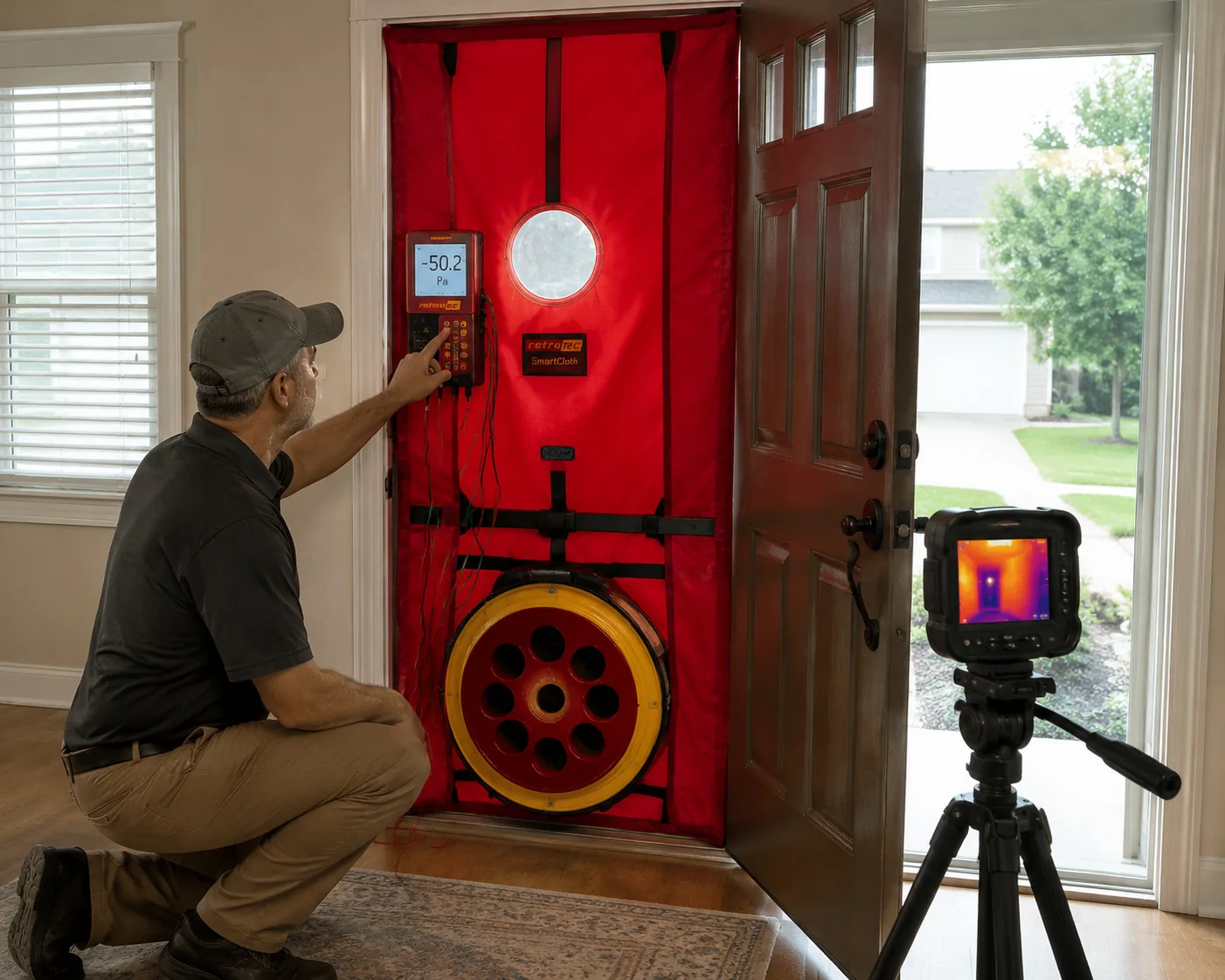
What Equipment Does a Blower Door System Use?
A blower door has three primary components, and the measurement quality depends on the calibration of each:
| Component | Function |
|---|---|
| Calibrated variable-speed fan (blower) | Induces a range of airflows sufficient to pressurize/depressurize buildings of varying size |
| Manometer (differential pressure gauge) | Measures simultaneously the pressure across the fan face and the pressure difference across the building envelope |
| Mounting system (adjustable panel + nylon fabric) | Seals the fan into a building opening (door or window) airtight, so all measured airflow goes through the fan |
The fan is calibrated against a known flow opening in its housing, so the airflow is derived from the pressure measured across that opening — not estimated. The manometer reads in pascals (Pa), the unit of pressure. The whole assembly mounts in an adjustable door panel sealed with airtight nylon fabric, fitted temporarily into an open exterior doorway (the existing door is simply opened, not removed). A system with software and gauges typically costs in the range of USD 1,300–1,800 to purchase, though most building projects subcontract the test rather than own the equipment.
How Is the Test Performed (Procedure and Setup)?
The procedure has two phases: preparing the building, then taking measurements. Proper preparation is what makes the result reproducible.
Before the test:
- Close all exterior openings — windows, doors (except the one holding the blower door), ventilation dampers
- Close doors to unconditioned spaces — attic, garage, crawl space
- Open all interior doors to allow free air circulation throughout the conditioned space
- Shut off atmospheric fossil-fuel appliances (furnaces, water heaters, fireplaces, woodstoves) for safety — depressurization can back-draft combustion gases
- Close fireplace dampers and remove ashes
Measurements:
- The fan starts at low speed for a quick verification sweep, then runs at increasing speeds
- Airflow and pressure readings are taken at multiple pressure differences (a multi-point test), typically across the 10–60 Pa range, with the 40–60 Pa band producing the most accurate results
- Results are standardized to the 50 Pa reference pressure — the industry-standard condition — for consistency and reproducibility
- Readings are corrected for temperature and baseline (wind/stack) pressure using software, then reported as CFM50 and ACH50
A full test takes about 10–15 minutes of fan run time, plus preparation. The multi-point method is preferred for accuracy, but a single-point reading at 50 Pa is often used for a quick estimate. The test should be avoided on extremely windy days, because wind pressure noise degrades the manometer reading.
What Do CFM50 and ACH50 Mean?
Blower door results are expressed in two standardized metrics, both referenced to the 50 Pa test pressure:
| Metric | Definition | Formula |
|---|---|---|
| CFM50 | Cubic feet per minute of airflow required to hold the building at 50 Pa | Measured directly by the calibrated fan |
| ACH50 | Air changes per hour at 50 Pa — how many times the building's air volume is replaced in one hour at the test pressure | ACH50 = CFM50 × 60 ÷ building volume |
CFM50 is the raw airflow; ACH50 normalizes it to building size, which is what allows comparison between buildings of different volumes. ACH50 is the metric used by building codes, green-building certifications, and the Passive House standard. A third derived value, the Estimated Natural Infiltration Rate (ENIR), divides ACH50 by an adjustment factor to estimate the real-world natural air-change rate under typical (not 50 Pa) conditions — useful for estimating actual energy loss and ventilation adequacy:
ACH-natural = ACH50 ÷ ENIR factor
The ENIR factor accounts for the fact that real buildings do not experience a sustained 50 Pa pressure in normal weather, so the natural infiltration is a small fraction of the test value. This distinction matters: a building tested at 5 ACH50 does not actually exchange 5 volumes of air per hour in service — its natural rate is far lower, estimated via the ENIR correction.
What ACH50 Threshold Defines a Tight vs Leaky Building?
The ACH50 number only becomes meaningful against a benchmark. The building-performance industry uses a clear ladder of thresholds, from the ultra-tight Passive House standard down to legacy code minimums:
| Standard / Code | ACH50 Threshold | What It Means |
|---|---|---|
| Passive House (PHI / PHIUS) | ≤ 0.6 ACH50 | Ultra-tight — roughly 5–12× tighter than code minimums; requires mechanical ventilation with heat recovery |
| IECC 2021 (residential, all climate zones) | ≤ 3 ACH50 | Current US code for new homes; blower-door testing now mandatory |
| IECC 2012–2018 | 3–5 ACH50 (varies by climate zone) | Prior code cycles; stricter in cold climates (CZ 3–8) |
| Legacy / older state codes | up to 7 ACH50 | Loose by modern standards; high energy loss |
| "Tight home" industry benchmark | < 3 ACH50 | Generally accepted threshold below which a home is considered well-sealed |
The practical implication is steep: a Passive House building at 0.6 ACH50 is roughly 244× more airtight than a typical UK Building Regulations building and many times tighter than US code. The trade-off at the tight end is that below roughly 3 ACH50, natural infiltration can no longer supply enough fresh air for occupants, so a balanced mechanical ventilation system with heat recovery (HRV/ERV) becomes mandatory — airtightness and controlled ventilation are designed together, not separately. This is why building scientists treat the blower door result as both an energy-efficiency metric and a ventilation-design input.
Which Standards Govern Blower Door Testing (ASTM E779, EN ISO 9972, ATTMA)?
Blower door testing is governed by parallel standard frameworks in the US, Europe, and the UK, each specifying the apparatus, procedure, and reporting:
| Standard | Region | Scope |
|---|---|---|
| ASTM E779 | United States | Standard test method for determining air leakage rate by fan pressurization (single-zone) |
| ASTM E1827 | United States | Orifice blower door method (companion) |
| EN ISO 9972 | Europe / International | Thermal performance of buildings — determination of air permeability by fan pressurization (= DIN EN ISO 9972, BS EN 13829, AS/NZS ISO 9972) |
| ATTMA TSL1 | UK | Air testing standard for residential dwellings (simple buildings) |
| ATTMA TSL2 | UK | Air testing standard for non-simple / non-dwelling buildings |
| ATTMA TSL4 | UK | Standard for Passive House and other low-energy buildings |
The three frameworks are methodologically equivalent — all mount a calibrated fan in an opening, induce a pressure difference, and measure the airflow needed to hold a reference pressure (50 Pa). The differences are in building-class scope and reporting format. ATTMA TSL1/2/4 are layered by building complexity and ambition: a single home uses TSL1, a commercial building uses TSL2, and a Passive House project uses the stricter TSL4. EN ISO 9972 is the harmonized international method adopted across the EU and, as AS/NZS ISO 9972, in Australasia; the UK Building Regulations reference ATTMA standards which are themselves based on BS EN 13829. In the US, ASTM E779 is the primary method and is the basis for IECC code compliance testing. A test report produced to any one of these is methodologically acceptable, but the regulatory authority that requires the test usually specifies which standard to cite.
How Are Air Leaks Located During the Test?
Quantifying total leakage (the ACH50 number) is half the test; locating the leaks is the other half. With the fan running and the building held at the test pressure, the operator walks the interior and uses one of three leak-detection methods:
| Method | How It Works |
|---|---|
| Hand / tactile | Feeling for incoming airflow around window trim, recessed lights, baseboards, electrical outlets |
| Smoke puffer / smoke generator | A non-toxic smoke stream visualizes the leakage path — smoke is drawn in at every leak |
| Infrared thermography | A thermal camera maps temperature differences at leak sites; combined with depressurization it reveals infiltration behind finishes (e.g., at the floor-baseboard interface) |
The principle is conservation of mass: what the fan exhausts must come back in through every gap in the envelope, so under depressurization every leak becomes an inflow that can be felt, smoked, or imaged. Infrared combined with blower-door depressurization is the most diagnostic pairing — it produces graphic evidence of hidden infiltration sites (thermal bypasses, utility chases) that tactile and smoke methods miss. Typical high-yield leak locations: recessed (can) lights, attic hatches, plumbing/electrical penetrations, window/door trim, baseboard interfaces, and duct boots. The leak-location pass is what turns a number into an action list for the air-sealing crew.
FAQ
What pressure is a blower door test run at, and why 50 Pa?
The standard reference pressure is 50 pascals, equivalent to the pressure a building experiences in roughly a 20 mph wind. Testing at 50 Pa (within the 40–60 Pa accurate band) gives consistent, reproducible results because it overwhelms minor wind and stack-pressure noise. Results at 50 Pa are reported as CFM50 and ACH50.
What is a good ACH50 number for a home?
It depends on the target. Under IECC 2021 US code, new homes must achieve ≤ 3 ACH50. A Passive House must achieve ≤ 0.6 ACH50 — roughly 5–12× tighter than code. Older homes often test at 7–10+ ACH50. Below about 3 ACH50, mechanical ventilation (HRV/ERV) is recommended because natural infiltration no longer supplies enough fresh air.
Can a building be too airtight?
Not structurally, but it can be too airtight for occupant health if ventilation is not addressed. Below roughly 3 ACH50, natural air leakage cannot supply adequate fresh air, so a balanced mechanical ventilation system with heat recovery becomes mandatory. The blower door result tells the designer when mechanical ventilation is required. Combustion safety also requires that atmospheric fossil-fuel appliances be assessed (or replaced with sealed-combustion units) in tight buildings.
What is the difference between ASTM E779 and EN ISO 9972?
Both are fan-pressurization methods and are methodologically equivalent. ASTM E779 is the US standard (referenced by IECC code); EN ISO 9972 (formerly BS EN 13829) is the European/international standard. The UK ATTMA TSL standards are based on EN 13829 but are layered by building type (TSL1 residential, TSL2 commercial, TSL4 Passive House). A report to any one is acceptable, but the requiring authority specifies which to cite.
How long does a blower door test take?
The fan-run portion is about 10–15 minutes for a multi-point test. Including building walk-through, setup, preparation (closing openings, shutting off appliances), and leak location, a full diagnostic test takes roughly 30 minutes to over an hour depending on building complexity. Preparation before the auditor arrives (removing ashes, ensuring fires are out) speeds the process.
Does the blower door test find leaks, or just measure total leakage?
Both. The ACH50/CFM50 number quantifies total envelope leakage; then, with the fan still running, the operator locates individual leaks by hand-feel, smoke puffer, or infrared thermography. The combination of a quantified total plus a located leak list is what makes the blower door actionable — it tells you both how bad the problem is and exactly where to fix it.
Our Blower Door Testing Capabilities
Beijing ZKGX Research Institute provides third-party building airtightness testing using calibrated blower door equipment, for residential, commercial, and high-performance building projects. Our testing follows the validated ASTM, EN ISO 9972, and ATTMA methods, and reports results against the relevant code or certification threshold.
Standards / Methods Our Testing Covers
| Test Endpoint | Method Reference |
|---|---|
| Whole-building air leakage (fan pressurization) | ASTM E779 |
| Building air permeability (fan pressurization) | EN ISO 9972 |
| Residential dwelling airtightness | ATTMA TSL1 |
| Commercial / complex building airtightness | ATTMA TSL2 |
| Passive House / low-energy building airtightness | ATTMA TSL4 |
| Orifice blower door method | ASTM E1827 |
What We Can Test
- New residential homes — IECC / building-code compliance testing (ACH50 against code threshold)
- Commercial and multi-family buildings — whole-envelope airtightness per ASTM E779 / EN ISO 9972
- Passive House and high-performance projects — certification-grade testing to the 0.6 ACH50 target
- Retrofit and weatherization projects — before/after testing to quantify air-sealing effectiveness
What a Test Report Includes
Quantified results (CFM50, ACH50, ENIR-estimated natural infiltration), a located leak list by zone, infrared thermography images of major infiltration sites where applicable, and a pass/fail determination against the project's target threshold (code minimum, certification standard, or project spec).
Get a Testing Quote
If you need building airtightness testing for code compliance, green-building certification (Passive House, LEED, Homestar), or a retrofit verification — our team will confirm the applicable standard and provide a quotation. Contact Beijing ZKGX Research Institute to start.