Cardboard testing is the laboratory verification that corrugated cardboard (瓦楞纸板) and the corrugated boxes made from it (瓦楞纸箱) meet the Chinese national standards that govern their mechanical and physical performance for transport packaging. The test scope is defined by a two-layer product standard structure: GB/T 6544 (Corrugated Board) for the board material and GB/T 6543 (Corrugated Boxes for Transport Packaging) for the finished box, each of which references a family of GB/T test-method standards for the specific strength parameters — edge crush (ECT), burst, ply adhesion, flat crush (FCT), and box compression (BCT). The defining trait of the test is that each physical strength property is governed by its own dedicated GB/T method standard, and a complete compliance report maps every measured value to its method.
The Two-Layer Product Standard Structure
The most important framing fact, and one absent from the search results, is that cardboard testing splits into two product layers — the board material and the finished box — each under its own standard:
| Layer | Standard | What it governs |
|---|---|---|
| Corrugated board (the material) | GB/T 6544-2008 — Corrugated Board | Board technical indicators: edge crush, burst, ply adhesion, flat crush, moisture, thickness |
| Corrugated box (the finished package) | GB/T 6543-2008 (2025 edition now published) — Corrugated Boxes for Transport Packaging | Box classification, construction, dimensions, and the acceptance test items |
The board standard (GB/T 6544) sets the technical-indicator requirements for the corrugated board that a box is made from; the box standard (GB/T 6543) sets the requirements for the finished transport box and references GB/T 6544 for the board material. The 2025 revision of GB/T 6543 refined the dimensional-deviation and the 0201-type box expansion dimensions. A current box report cites GB/T 6543 and references GB/T 6544 for the board.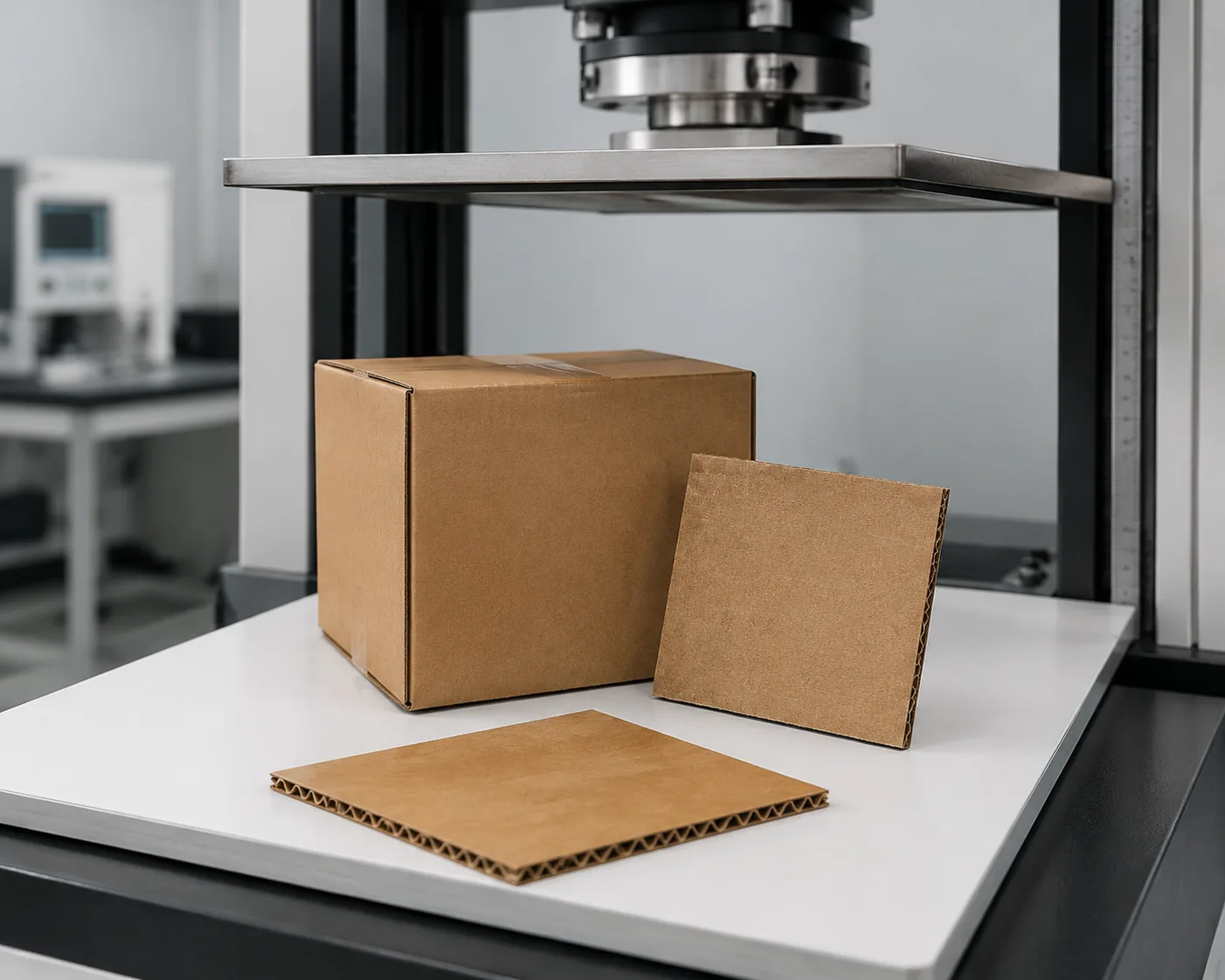
The Five Core Strength Tests and Their Method Standards
Each physical strength property that the product standards require is measured by a dedicated GB/T method standard. This test-to-method mapping is the practical core of cardboard testing:
| Test | Property | Method standard | What it predicts |
|---|---|---|---|
| Edge Crush Test (ECT) | Board edge compressive strength | GB/T 6546 | Stacking strength of the box (top-to-bottom load) |
| Burst test (Mullen) | Board resistance to rupture/puncture | GB/T 6545 | Resistance to impact and sharp-object puncture during rough handling |
| Ply adhesion (delamination) | Bond between the liner and the fluted medium | GB/T 6548 | That the board plies do not separate under stress |
| Flat Crush Test (FCT) | Resistance of the flutes to crushing flat | GB/T 2679.6 | That the flutes cushion and do not flatten under direct pressure |
| Box Compression Test (BCT) | Finished-box top-to-bottom compressive strength | GB/T 4857.4 | How much stacked weight the finished box carries before failure |
A note on the standard numbers, because they are frequently confused: GB/T 6545 is burst (not ECT), GB/T 6546 is ECT (not burst), and GB/T 6548 is ply adhesion. These three adjacent numbers in the 6545–6548 band each govern a different property, and mis-quoting them is a common error in cardboard reports.
ECT vs Burst vs BCT — the Three Distinct Strength Properties
These three tests are the headline cardboard parameters, and they predict different real-world performances:
- ECT (GB/T 6546) measures the board's edge compressive strength — the force the board resists when loaded on its edge. This is the parameter that most directly predicts the stacking strength of the finished box, because a stacked box carries the load of the boxes above it through its vertical board edges. ECT is the dominant parameter for warehouse stacking.
- Burst (GB/T 6545) measures the board's resistance to rupture when a rubber diaphragm presses against it until it bursts. This predicts resistance to impact and sharp-object puncture during rough handling — the hazard that a forklift corner or a neighboring box edge will pierce the wall.
- BCT (GB/T 4857.4) measures the finished box's top-to-bottom compressive strength — the actual weight a complete, assembled, sealed box will carry before it collapses. BCT is the end-product test (on the box, not the board), and it integrates the board's ECT, the box geometry, the flute type, and the manufacturing quality into the real stacking number.
A report that lists only ECT without BCT does not tell the user the actual stacking load the box will carry; a report that lists only burst does not tell the user about stacking at all. The three parameters are complementary, and a complete transport-box report includes all three.
Ply Adhesion and Flat Crush
Two further board parameters complete the core set:
- Ply adhesion (GB/T 6548) verifies the bond between the liner and the fluted medium — that the board does not delaminate under stress. A board with weak ply adhesion separates into its plies when the box is loaded, destroying its structural integrity.
- Flat crush (GB/T 2679.6) verifies that the flutes resist crushing flat under direct pressure — that the cushioning structure of the corrugated board is preserved. A flattened flute loses both its cushioning and its contribution to the board's stiffness.
Moisture and Cobb (Water Absorption)
Cardboard is hygroscopic, and moisture content directly affects strength — a wet board loses a large fraction of its ECT and burst. Two moisture-related parameters are part of the test set:
- Moisture content — measured per the paper-industry method, reported as a percentage; controlled because it directly trades off against strength.
- Water absorption (Cobb test) — the mass of water absorbed per unit area over a defined time, measuring the board's resistance to moisture penetration. This matters for boxes stored or transported in humid or rainy conditions, where a high-Cobb board would lose strength.
How the Test Maps to International Standards
The international tests the search results describe — BCT (ISO 12048), Mullen burst (ASTM), ISTA 1A — map directly onto the GB test set:
| Property | GB/T method | International equivalent |
|---|---|---|
| ECT | GB/T 6546 | TAPPI T811, ISO 3037 |
| Burst | GB/T 6545 | TAPPI T403 (Mullen) |
| Ply adhesion | GB/T 6548 | TAPPI T821 |
| Flat crush | GB/T 2679.6 | ISO 3035 |
| BCT | GB/T 4857.4 | ISO 12048, ASTM D642 |
A Chinese-market report cites the GB/T methods; an international report cites the TAPPI/ISO/ASTM equivalents; the physical test is the same.
Why the Search Results Are Off the Compliance Intent
The search results for "cardboard testing" are dominated by content that describes the tests but does not frame the GB compliance framework:
- Corrugated-box supplier guides (Boxmarket) describe BCT, Mullen burst, Cobb, ECT, adhesion, and vibration competently, citing ISO 12048 / ASTM D642 / ISTA 1A / ISO 18601. Supplier content, ISO/ASTM/ISTA only, zero GB.
- Texture-analyzer vendor pages (Stable Micro Systems) describe crush, tensile, puncture, and flexure for paper and cardboard, citing ASTM D828 / BS ISO 12048. Instrument-vendor content, zero GB.
- General packaging-test explainers describe ISTA procedures and ASTM methods.
None tells a corrugated-board manufacturer, a box maker, or a logistics-quality lab which GB/T product standard and which GB/T method standard govern each test. That compliance mapping is what this article provides.
Our Testing Capabilities
Beijing ZKGX Research conducts corrugated cardboard and box testing across the GB/T framework:
- Board (GB/T 6544-2008): edge crush (GB/T 6546), burst (GB/T 6545), ply adhesion (GB/T 6548), flat crush (GB/T 2679.6), moisture, and thickness.
- Box (GB/T 6543-2008 / 2025): finished-box compression (BCT, GB/T 4857.4), dimensional deviation, construction, and the acceptance test items, with the board material verified per GB/T 6544.
- Moisture and water absorption: moisture content and Cobb water absorption.
- International-equivalent support: reports to TAPPI / ISO / ASTM / ISTA methods for export markets.
- Sample types: single-wall and double-wall corrugated board, transport boxes (0201-type and other constructions), and the liner and fluting raw papers.
- Deliverable: a test report identifying the product (board vs box), the product standard applied, each measured value with its method-standard citation, and pass/fail against the product standard's requirement.
If you have corrugated board or transport boxes requiring performance verification, contact our testing team to scope the product layer (board vs box), the applicable strength tests, and the applicable standard edition.
Frequently Asked Questions
What standard governns corrugated cardboard testing?
It is a two-layer structure: GB/T 6544-2008 (Corrugated Board) for the board material and GB/T 6543-2008 (with the 2025 edition now published) for the finished transport box. Each references a family of GB/T test-method standards: edge crush (GB/T 6546), burst (GB/T 6545), ply adhesion (GB/T 6548), flat crush (GB/T 2679.6), and box compression (GB/T 4857.4).
What is the difference between ECT, burst, and BCT?
ECT (GB/T 6546) measures the board's edge compressive strength and predicts stacking strength. Burst (GB/T 6545, the Mullen test) measures the board's resistance to rupture and predicts puncture resistance in rough handling. BCT (GB/T 4857.4) measures the finished box's top-to-bottom compressive strength and predicts the actual stacking load the complete box carries. The three predict different real-world performances and are complementary.
What is GB/T 6545 — burst or edge crush?
GB/T 6545 is burst strength (the Mullen-type diaphragm test). Edge crush is GB/T 6546. These two adjacent standard numbers are frequently confused; the correct mapping is 6545 = burst, 6546 = ECT, 6548 = ply adhesion.
What replaced GB/T 6543-2008?
GB/T 6543-2008 (Corrugated Boxes for Transport Packaging) is being superseded by the 2025 edition, which refined the dimensional-deviation requirements and the 0201-type box expansion dimensions. A current box report should cite the applicable edition.
Is cardboard testing the same as express-packaging-material testing?
They overlap but differ in scope. Express-packaging-material testing covers the courier/mail packaging stream (mailer bags, tape, labels). Cardboard testing covers corrugated board and transport boxes for logistics — the GB/T 6543/6544 framework described here. The two share some packaging-test principles but are governed by different product standards.