Table of Contents
- What Is Cashmere and Why Does Testing Matter?
- What Are the Consumer Field Tests (and Their Limits)?
- Why Can't the Burn Test Distinguish Cashmere From Wool?
- How Does Laboratory Microscopy Identify Cashmere (ISO 17751)?
- What Diameter and Variability Define Cashmere (CCMI)?
- How Does DNA Testing Verify Species Origin?
- Which Chinese National Standards Apply?
- FAQ
- Our Cashmere Fiber Testing Capabilities
What Is Cashmere and Why Does Testing Matter?
Cashmere is the fine undercoat of the cashmere goat, harvested mainly in Mongolia and China, with a mean fiber diameter that must not exceed 19 microns. That fineness — roughly a third the diameter of a human hair — is what gives cashmere its softness, warmth-to-weight ratio, and premium price. But the same premium that rewards genuine cashmere also rewards fraud: blends sold as "100% cashmere," superfine merino relabeled, and synthetic imitations that mimic the hand-feel.
Testing exists because fraud cannot be stopped by feel alone. A consumer touch test, a burn test, and a label are all useful first screens, but none of them can definitively separate cashmere from superfine sheep's wool — and that distinction is exactly what a fraudster exploits. Laboratory fiber analysis provides the objective, quantified evidence that settles authenticity, supports a label claim, and holds up in a commercial dispute.
What Are the Consumer Field Tests (and Their Limits)?
The field tests circulating in buyer's guides each screen for one signal, and each fails at a specific point:
| Field Test | What It Screens | Where It Fails |
|---|---|---|
| Touch / wrist test | Fineness, prickle | Superfine merino (~18 μm) feels nearly identical to cashmere |
| Stretch / recovery | Elastic resilience | Wool and some synthetics also recover well |
| Pilling | Surface stability | All cashmere pills eventually; pilling alone doesn't prove blend |
| Burn test | Protein vs. synthetic | Cannot separate cashmere from wool — both are keratin, both smell like burnt hair (see next section) |
| Visual / sheen | Fiber alignment, luster | Highly subjective; finishing and dyeing change appearance |
| Water absorption | Wettability | Inconsistent; depends on processing residues |
These tests are useful as a buyer's quick filter, but they share one structural blind spot: none can quantify fiber composition, and none can distinguish cashmere from other animal hairs. When the stakes rise — a label claim, a bulk purchase, a customs or quality dispute — field tests must yield to laboratory methods.
Why Can't the Burn Test Distinguish Cashmere From Wool?
The burn test is the most-recommended consumer test, and it is also the most-overrated for cashmere specifically. Here is why it fails at the one distinction that matters most.
Both cashmere and sheep's wool are keratin proteins with near-identical chemistry. When burned, both:
- Burn slowly with a small flame
- Smell like burnt hair (the protein sulfur signature)
- Leave a soft, crushable ash
- Self-extinguish when removed from the heat
A synthetic fiber (acrylic, polyester) is different — it melts, smells like plastic, and leaves hard beads — so the burn test does separate animal fiber from synthetic. But the fraud that actually costs buyers money is not "cashmere vs. acrylic." It is "cashmere vs. superfine merino wool," where the seller blends in cheaper wool (or substitutes it entirely) and keeps the cashmere label. Because wool burns identically to cashmere, the burn test returns a false "pass" on a wool-misrepresented-as-cashmere sample every time.
This is the single most important limitation a buyer should understand: the burn test certifies "animal fiber," not "cashmere goat undercoat." Only microscopy and DNA analysis can make that species-level distinction.
How Does Laboratory Microscopy Identify Cashmere (ISO 17751)?
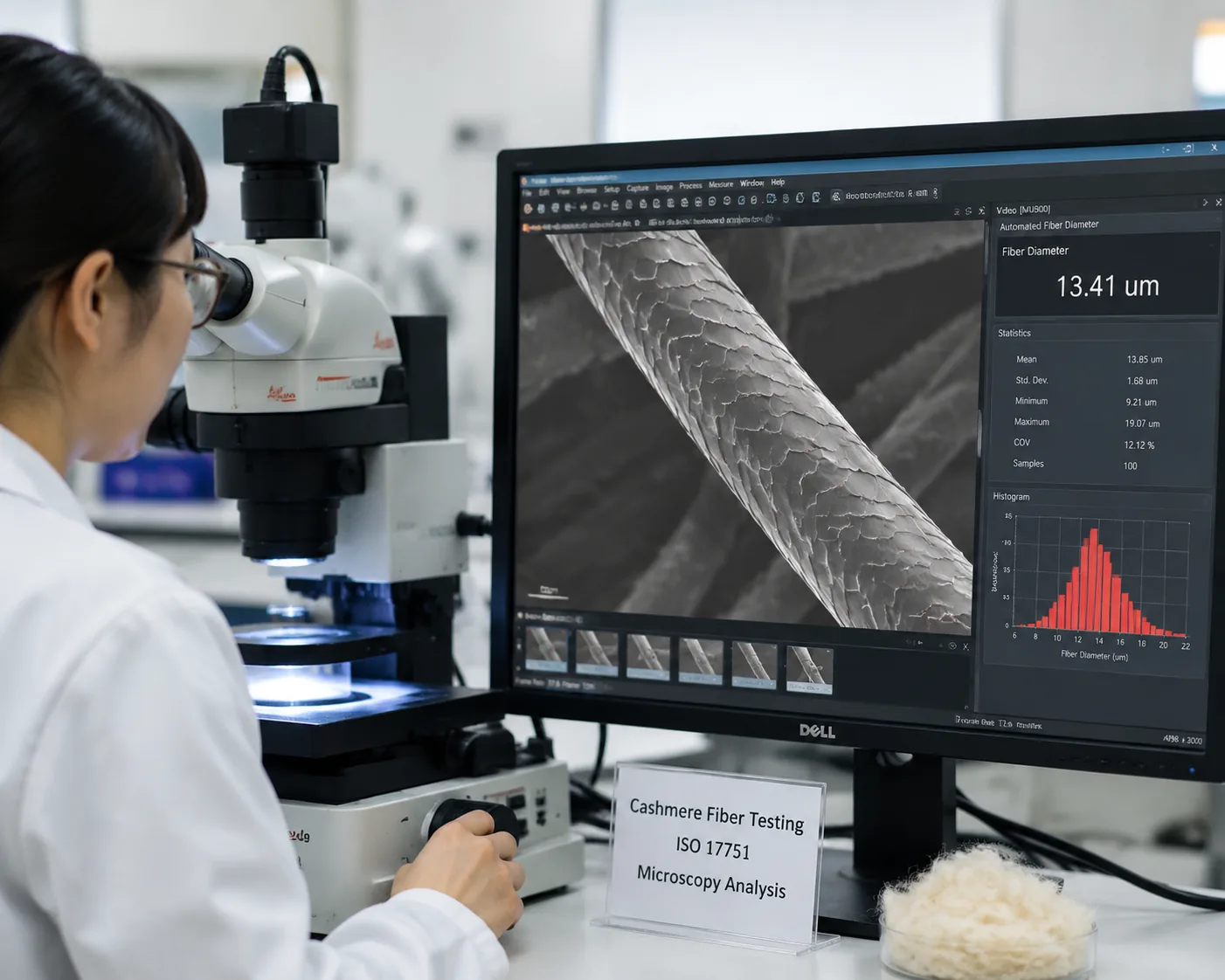
ISO 17751 is the international standard for the qualitative and quantitative analysis of cashmere, wool, and other specialty animal fibers. It has two parts, each using a different magnification to read the cuticle scale morphology — the fingerprint-like surface pattern that differs between species:
| Method | Standard | What It Reads |
|---|---|---|
| Light microscopy (LM) | ISO 17751-1 | Scale margin distance, scale height, fiber diameter |
| Scanning Electron Microscopy (SEM) | ISO 17751-2 | Higher-resolution scale structure, precise diameter, scale edge features |
The principle: every animal fiber is covered in cuticle scales, but the scale height, frequency, and edge pattern differ between cashmere goat and sheep. Cashmere scales are typically fine, closely spaced, and low in height with smooth margins; wool scales are coarser and more prominent. A trained analyst (LM) or high-resolution image (SEM) reads these features fiber by fiber, counts cashmere vs. non-cashmere fibers across a representative sample, and reports the composition by mass.
SEM is the more precise of the two because it resolves scale height that light microscopy can only estimate — useful when the sample is a tight blend or when the dispute is litigated. For a standard quality-control screen, light microscopy (ISO 17751-1) is typically sufficient and faster.
What Diameter and Variability Define Cashmere (CCMI)?
The Cashmere & Camel Hair Manufacturers Institute (CCMI) sets the reference definition that laboratories apply. For a fiber to qualify as cashmere:
| Parameter | Requirement |
|---|---|
| Mean fiber diameter | ≤ 19 μm |
| Fibers exceeding 30 μm | ≤ 3% by weight |
| Coefficient of variation (CV) of diameter | ≤ 24% |
The 19 μm ceiling is the discrete cutoff that separates cashmere from sheep's wool in borderline cases — superfine merino can reach ~18 μm, so diameter alone is not always conclusive, which is why it is paired with scale morphology. The 30 μm / 3% rule screens out contamination with coarser guard hairs, and the CV ≤ 24% requirement ensures the fiber population is uniform rather than a blend of fine and coarse fibers blended to hit a target mean.
These numeric thresholds are what turn a subjective "it feels fine" into a defensible, reportable result: a lab can state "mean diameter 15.2 μm, 0.4% fibers >30 μm, CV 19% — conforms to the CCMI cashmere definition."
How Does DNA Testing Verify Species Origin?
DNA analysis is the emerging complement to microscopy, and it answers the question microscopy cannot: is this fiber from a cashmere goat (caprine) or from a sheep (ovine)? Because microscopy reads morphology — and morphology can be ambiguous in processed or dyed fibers — species-specific DNA testing removes that ambiguity.
The method uses real-time PCR with primers designed to bind species-specific gene sequences. It can:
- Confirm the species of origin — caprine (goat = cashmere) vs. ovine (sheep = wool), and also distinguish yak, camel, alpaca
- Quantify blend ratios in mixtures, by amplifying and comparing species-specific DNA markers
- Work on processed textiles where scale morphology has been damaged by dyeing or finishing
A comprehensive review of these analytical methods — microscopy, DNA, spectroscopy, and image recognition — is published by Zoccola et al. in Fibers (2023). In practice, DNA testing is used when microscopy is inconclusive, when the disputed value is high, or when a buyer requires species-level proof for a label claim.
Which Chinese National Standards Apply?
Chinese national standards mirror the ISO framework, enabling one sample to satisfy both domestic and international submissions:
| International Standard | Chinese Equivalent | Scope |
|---|---|---|
| ISO 17751-1 (LM) | GB/T 10685 | Wool fiber diameter by projection microscope |
| ISO 17751-2 (SEM) | GB/T 16988 | Quantitative analysis of cashmere/wool by SEM |
| — | GB/T 2910 (series) | Quantitative chemical analysis of textile fiber mixtures |
| — | GB 18267 | Cashmere goat raw wool specifications |
A practical note on GB/T 2910: it handles chemical quantitative analysis (dissolving one fiber component to weigh the remainder), but because cashmere and sheep's wool are chemically near-identical, GB/T 2910 cannot separate the two — the microscopy standards (GB/T 10685 / GB/T 16988) are required for that. This is the same chemistry limit that defeats the consumer burn test, now at the laboratory scale.
China's labeling rule also includes a tolerance: 100% cashmere products may contain up to 5% of fibers that appear wool-like due to natural scale variation (not intentional blending), a tolerance tighter in the U.S. market, which permits no non-cashmere fiber in a "100% cashmere" claim.
FAQ
Can the burn test prove a garment is 100% cashmere?
No. The burn test can only confirm the fiber is a protein (animal) fiber vs. a synthetic — both cashmere and sheep's wool burn identically (slow flame, burnt-hair smell, soft ash). To prove cashmere specifically, you need microscopy (ISO 17751) or DNA testing.
What diameter is considered cashmere?
Per the CCMI definition, cashmere has a mean diameter of 19 μm or finer, with no more than 3% by weight of fibers exceeding 30 μm and a coefficient of variation under 24%. Fibers coarser than 19 μm fall into the wool range.
Is light microscopy or SEM better for cashmere identification?
Both are standard (ISO 17751-1 LM, ISO 17751-2 SEM). SEM is more precise because it resolves scale height that light microscopy can only estimate — valuable for tight blends or disputes. For routine quality control, light microscopy is typically sufficient and faster.
Can laboratory testing detect a cashmere-wool blend?
Yes. Microscopy counts cashmere-type vs. wool-type fibers across the sample by their scale morphology and reports a mass percentage. DNA testing (real-time PCR) can quantify the blend by species-specific markers. Both methods work where chemical analysis (GB/T 2910) fails, because cashmere and wool are chemically identical.
Does DNA testing work on dyed or finished cashmere?
Yes. Species-specific PCR targets DNA sequences that survive dyeing and finishing, though heavily processed samples may require more extraction care. DNA testing is especially useful when scale morphology has been damaged by processing.
How much sample is needed for a cashmere fiber test?
Microscopy requires a small representative tuft of fibers (a few milligrams) taken from multiple locations to represent the batch. DNA testing requires a similar small mass but with controlled contamination-free handling. The lab confirms exact sample size per method at quotation.
Our Cashmere Fiber Testing Capabilities
Beijing ZKGX Research Institute provides third-party fiber identification and composition analysis for cashmere textiles. Our testing follows the validated ISO, GB/T, and CCMI reference methods, applied to each sample's form — raw fiber, yarn, or finished garment.
Standards Our Testing Covers
| Test Endpoint | Method Reference |
|---|---|
| Fiber diameter (projection microscope) | ISO 17751-1 / GB/T 10685 |
| Cashmere/wool quantitative analysis (SEM) | ISO 17751-2 / GB/T 16988 |
| Textile fiber quantitative chemical analysis | GB/T 2910 (series) |
| Cashmere goat raw wool specs | GB 18267 |
| Species-origin DNA verification | Species-specific real-time PCR |
| CCMI conformity (diameter ≤19 μm, >30 μm ≤3%, CV ≤24%) | CCMI definition |
What We Can Test
- Raw cashmere fiber and tops — diameter, length, scale morphology, conformity to grade
- Yarns and knitwear — fiber composition, cashmere vs. wool quantification, blend ratio
- Finished garments and textiles — label-claim verification for "100% cashmere" and blend percentages
- Disputed or high-value lots — combined microscopy + DNA analysis for conclusive species-level proof
Sample Types We Accept
Loose fiber, yarn segments, fabric swatches, and whole garments. Microscopy samples are drawn from multiple locations to represent the batch; DNA samples are handled under contamination-controlled protocol.
Get a Testing Quote
If you need to verify a cashmere label claim, resolve a fiber-composition dispute, or qualify a bulk lot, our team will confirm the applicable method, sample requirements, and a quotation. Contact Beijing ZKGX Research Institute to start.