Table of Contents
- What Is Fire-Resistant Cable Tray Testing?
- How Does System-Level Testing Differ From Cable-Level Testing?
- Which Standards Govern System-Level Fire Resistance (DIN 4102-12 and Equivalents)?
- What Do E30, E60, and E90 Classifications Mean?
- How Is the Furnace Test Performed?
- Which Standards Govern Cable-Level Fire Performance?
- What Are the Key Thresholds for Smoke Density and Halogen Gas?
- How Does Circuit Integrity Testing Work (IEC 60331 / GB/T 19216)?
- Which Chinese National Standards Apply?
- FAQ
- Our Fire-Resistant Cable Tray Testing Capabilities
What Is Fire-Resistant Cable Tray Testing?
Fire-resistant cable tray testing verifies that a complete cable management system — cables, supports, trays, fasteners, and accessories assembled together — continues to supply power for a defined period during a fire. The purpose is to keep critical electrical circuits alive: smoke extractors, emergency lighting, fire alarms, sprinkler pressure pumps, and evacuation systems must keep functioning long enough to evacuate occupants and suppress the fire.
This is a system-level test, not a test of the cable alone. A fire-resistant cable that passes its own fire test can still fail when mounted on a tray whose supports collapse or whose fasteners loosen under heat — so the entire assembly must be qualified together. That distinction drives the enTire testing framework described below.
How Does System-Level Testing Differ From Cable-Level Testing?
The single most-confused point in fire-resistant cable tray testing is that two independent standard families govern it, and they answer different questions:
| Question Answered | Standard Family | Scope |
|---|---|---|
| Does the mounted system keep working in a fire? | DIN 4102-12, CSN 730895, STN 920205 | Cables + trays + supports + fasteners as one assembly |
| Is the cable itself flame-retardant / circuit-integrity-capable? | IEC 60332, IEC 60331, EN 61034, EN 60754 | The cable specimen in isolation |
A system can only achieve a DIN 4102-12 classification if both layers are satisfied: the cables must individually meet the relevant IEC/EN performance, and then the complete mounted configuration must survive the furnace test. Treating these as interchangeable is the most common specification error in fire-protection engineering.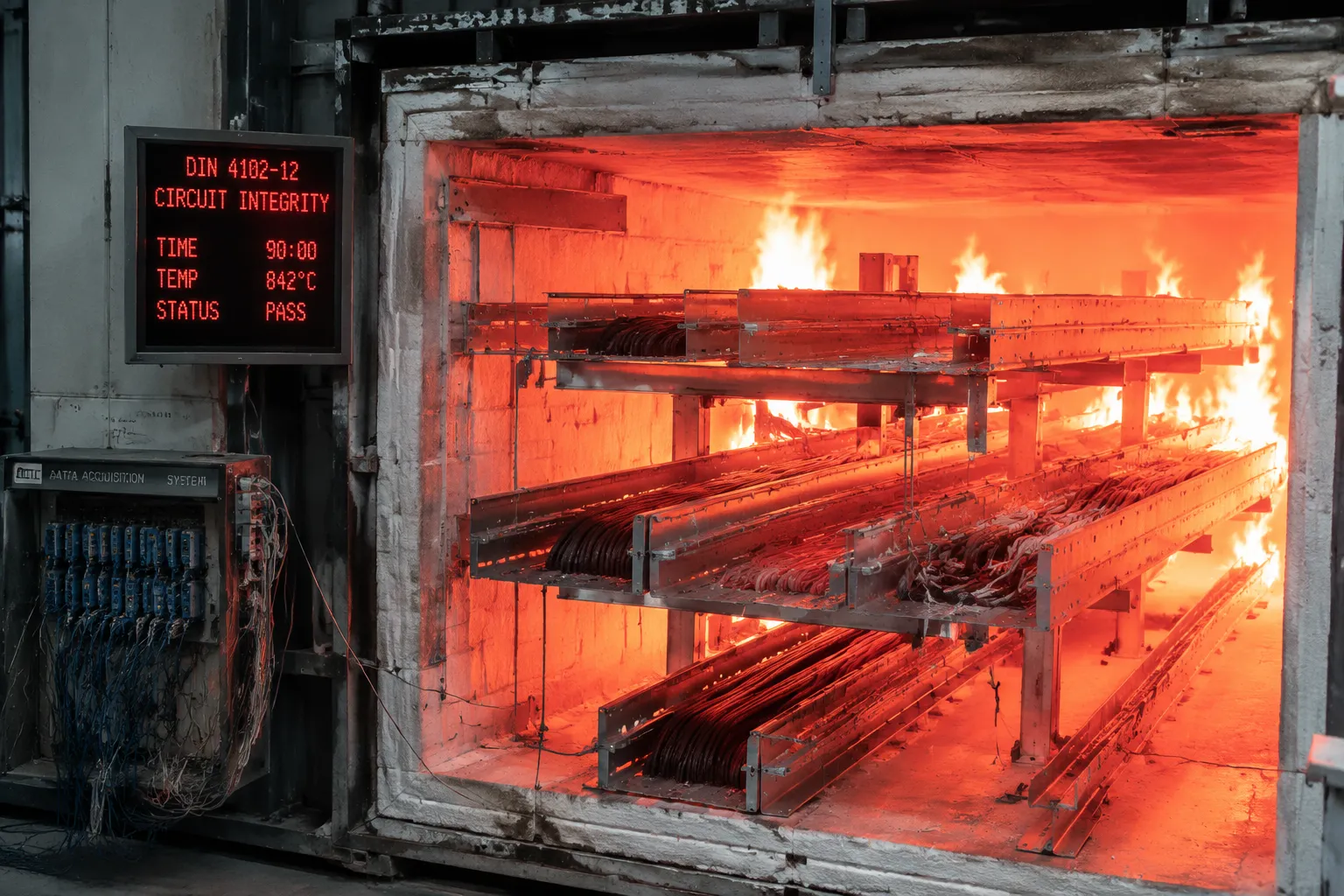
Which Standards Govern System-Level Fire Resistance (DIN 4102-12 and Equivalents)?
In the absence of a single unified European or international regulation for cable-system fire resistance, several national standards fill the gap. Each defines the furnace conditions, the temperature-time curve, and the classification criteria for maintaining circuit integrity:
- DIN 4102-12 (Germany) — "Fire behaviour of building materials and elements — Fire resistance of electric cable systems required to maintain circuit integrity." This is the most widely referenced standard. It evaluates the system under the standard temperature-time curve (Einheitstemperaturkurve, ETK), the German equivalent of the ISO 834 curve.
- CSN 73 0895 (Czech Republic) — "Maintaining the functionality of cable lines under fire conditions." Introduces the Px-R and R-PHX classification scheme.
- STN 92 0205 (Slovakia) — "Circuit integrity maintenance of cable systems," aligned methodologically with the Czech standard.
All three place the live, tensioned cable system (cables mounted on trays and supports) inside a furnace heated along the defined temperature-time curve and verify that power supply is maintained for the target duration.
What Do E30, E60, and E90 Classifications Mean?
The DIN 4102-12 classification marks how many minutes the system maintains circuit integrity under the standard fire curve:
| Classification | Duration of Circuit Integrity | Typical Application |
|---|---|---|
| E30 | ≥ 30 minutes | General emergency circuits, short evacuation buildings |
| E60 | ≥ 60 minutes | Public buildings, hospitals — longer evacuation times |
| E90 | ≥ 90 minutes | High-rise, tunnels, critical infrastructure |
The required class is selected by how long the circuit must survive — which depends on the building's evacuation time and the fire-suppression strategy. Public venues with large occupant loads demand longer integrity because evacuation takes more time.
Important: the E-classification belongs to the specific tested system configuration. Changing the cable type, tray model, support spacing, or fastener invalidates the rating — the classification is not transferable between configurations. Expert-judgement reports can extend a classification to new configurations only under defined conditions.
How Is the Furnace Test Performed?
The furnace test is the core of system-level qualification. The procedure:
- Assembly — The complete system (fire-resistant cables tensioned and mounted on their trays and supports, with all specified accessories and fasteners) is installed inside the test furnace exactly as it would be installed in service.
- Energization — The cables are energized at rated voltage so that circuit integrity can be monitored in real time.
- Fire exposure — The furnace follows the standard temperature-time curve (ETK / ISO 834 equivalent), raising temperature progressively per the defined profile.
- Monitoring — The test checks whether the power supply is maintained: no fuse blows, no circuit breaker trips, and the conductor does not break (indicated by a lamp staying lit) throughout the target duration.
- Classification — If the system holds for 30/60/90 minutes, it earns the corresponding E30/E60/E90 rating.
The result depends heavily on the mounting method — support material, tray geometry, and fastener type all affect how the assembly behaves under heat. This is why the test must run on the actual configuration, not on a generic "tray + cable" assumption.
Which Standards Govern Cable-Level Fire Performance?
Independent of the system test, the cables themselves must meet the relevant IEC/EN flame and smoke standards. These are the key methods and their judgment criteria:
| Standard | Test | Judgment Criterion |
|---|---|---|
| EN IEC 60332-1-2 | Single vertical flame retardant | Flame does not spread to within 50 mm of the upper support; charred region ends > 540 mm from the lower edge of upper support; flame self-extinguishes |
| EN IEC 60332-3 series | Vertical flame spread on bundled cables | Charred portion does not exceed 2.5 m; flame application time 20–40 min depending on category (A F/R / A / B / C / D) |
| IEC 60331-21/-23/-25 | Circuit integrity at 750 °C | Voltage maintained (no fuse blows) and conductor intact (lamp stays lit) — typically 180 minutes |
| EN 50200 | Fire resistance of small cables in emergency safety circuits | Mechanical shock + circuit integrity |
These cable-level results feed into the system-level DIN 4102-12 qualification — a system built from cables that cannot individually survive fire will not pass the system test.
What Are the Key Thresholds for Smoke Density and Halogen Gas?
Beyond flame spread and circuit integrity, fire-safety standards regulate the secondary hazards of burning cables: smoke that blocks evacuation vision and corrosive halogen gases that damage equipment and harm occupants.
| Standard | Hazard Controlled | Threshold |
|---|---|---|
| EN 61034-2 | Smoke density | Light transmittance ≥ 60% (measured in a 27 m³ chamber over max 40 min) |
| EN 60754-1 | Halogen acid gas emission | Halogen acid gas ≤ 5 mg/g (0.5%) |
| EN 60754-2 | Corrosivity / halogen-free | pH > 4.3 AND conductivity < 10 μS/mm |
A cable that meets EN 60754-1/2 and EN 61034-2 is classified halogen-free and low-smoke — the preferred specification for occupied and public spaces, where smoke toxicity and visibility are life-safety concerns.
How Does Circuit Integrity Testing Work (IEC 60331 / GB/T 19216)?
The IEC 60331 family tests whether an energized cable maintains electrical continuity under direct flame. The procedure applies a flame at 750 °C to a horizontal cable while it carries rated voltage, and the result is judged by whether the fuse remains intact and the indicator lamp stays lit for the required duration — typically 180 minutes per the relevant cable standard.
Key points:
- The flame is applied to the cable specimen at a defined point and temperature; the cable is energized so circuit integrity is continuously monitored.
- Some parts of the standard (e.g., IEC 60331-31) add mechanical shock and water spray to simulate real fire-suppression conditions, representing a far more severe scenario than flame alone.
- A cable passing IEC 60331 is a prerequisite for use in a DIN 4102-12 system test — the cable must first prove it can survive fire on its own before the system test adds the tray and supports.
Which Chinese National Standards Apply?
Chinese standards mirror the IEC/EN framework, enabling a single sample to satisfy both domestic and international submissions:
| International / EN Standard | Chinese Equivalent | Scope |
|---|---|---|
| IEC 60331 | GB/T 19216 series | Circuit integrity under flame (e.g., GB/T 19216.21: 750 °C, 90 min) |
| IEC 60332 | GB/T 18380 series | Flame retardant — bundled combustion (classes A/B/C/D) |
| — | GB/T 19666-2019 | General rules for flame-retardant and fire-resistant cables |
| IEC 61537 | GB/T 21762-2008 | Cable management — cable tray and ladder systems |
GB/T 19216.21-2003 — the most-cited circuit-integrity method — applies a 750 °C flame for 90 minutes to an energized 0.6/1 kV cable and judges success by an intact fuse and a lit indicator lamp, matching the IEC 60331-21 methodology.
Note on system vs. cable: GB/T 19216 governs the cable's circuit integrity, while GB/T 21762 covers the cable tray system's mechanical/structural requirements. China has no single national equivalent to the European DIN 4102-12 system-level fire-resistance test — system-level classification in Chinese projects typically references the European standards directly or relies on engineering judgement combining the cable (GB/T 19216) and tray (GB/T 21762) results.
FAQ
Is a fire-resistant cable the same as a flame-retardant cable?
No. A flame-retardant cable (IEC 60332) resists the spread of fire along its length but does not keep working once ignited. A fire-resistant cable (IEC 60331 / GB/T 19216) maintains electrical continuity under direct flame. A fire-resistant cable system (DIN 4102-12) additionally requires the mounted assembly — cables plus trays and supports — to survive together for 30/60/90 minutes.
Can I use a cable's IEC 60331 result to claim an E30/E60/E90 system rating?
No. The E-classification is system-level and belongs only to the specific tested configuration (defined cable + tray + support + fastener). A cable passing IEC 60331 is a prerequisite, not a substitute — the complete assembly must be furnace-tested to DIN 4102-12 to earn the rating.
What temperature does the furnace reach in a DIN 4102-12 test?
The furnace follows the standard temperature-time curve (ETK, equivalent to ISO 834), where temperature rises rapidly from ambient toward approximately 842 °C at 30 minutes and continues increasing per the curve through the test duration. The system must maintain circuit integrity throughout the target E30/E60/E90 period.
What is the difference between CSN 73 0895 Px-R and R-PHX?
Both are classification schemes under the Czech standard. Px-R indicates circuit integrity maintained under fire with mechanical load, while R-PHX represents a different performance tier. They parallel the E30/E60/E90 duration concept but use the Czech classification labels.
Do halogen-free cables automatically meet fire-resistance requirements?
No. Halogen-free (EN 60754) and low-smoke (EN 61034) properties govern gas corrosivity and smoke visibility — they are independent of flame retardancy (IEC 60332) and circuit integrity (IEC 60331). A cable must satisfy each relevant standard separately; halogen-free status alone does not qualify a cable for fire-resistant service.
Which is stricter: IEC 60331 with mechanical shock (Part 31) or standard IEC 60331-21?
Part 31, which adds mechanical shock and water spray, is the more severe test. It simulates real conditions where fire-suppression water jets and falling debris stress the cable simultaneously with flame — relevant for high-risk installations like tunnels and petrochemical plants.
Our Fire-Resistant Cable Tray Testing Capabilities
Beijing ZKGX Research Institute provides third-party fire-performance testing for cable systems and cables. Our testing follows the validated IEC/EN methods and the GB/T national standards, applied to the configuration and hazard profile of each sample.
Standards Our Testing Covers
| Test Endpoint | Method Reference |
|---|---|
| Cable system fire resistance (circuit integrity) | DIN 4102-12 |
| Single vertical flame retardant | EN IEC 60332-1-2 |
| Vertical flame spread on bundled cables | EN IEC 60332-3 series |
| Circuit integrity under flame | IEC 60331 series / GB/T 19216 series |
| Smoke density | EN 61034-2 |
| Halogen acid gas & corrosivity | EN 60754-1 / EN 60754-2 |
| Fire resistance of small emergency-safety cables | EN 50200 |
| General rules for flame-retardant/fire-resistant cables | GB/T 19666-2019 |
| Cable tray & ladder systems | GB/T 21762-2008 |
What We Can Test
- Fire-resistant cable management systems — cable + tray + support + fastener assemblies for DIN 4102-12 E30/E60/E90 qualification
- Power, control, and signal cables — circuit integrity (IEC 60331 / GB/T 19216) and flame retardancy (IEC 60332 / GB/T 18380)
- Halogen-free and low-smoke cables — smoke density and corrosive-gas emission for public-building and occupied-space specifications
- Emergency safety circuit cables — fire resistance with mechanical shock (EN 50200, IEC 60331-31)
Sample Types We Accept
Cable specimens across the standard diameter ranges, complete tray/support/fastener assemblies, and insulation/sheathing polymer samples for gas-emission testing. The test setup accommodates the physical forms typical of installed cable systems.
Get a Testing Quote
If you need fire-resistance classification for a cable system or cable product, our team will confirm the applicable standard, sample requirements, and a quotation. Contact Beijing ZKGX Research Institute to start.