Table of Contents
- What standards govern medical gauze testing?
- How is absorbency tested?
- How are thread count and weight verified?
- What chemical purity tests are required?
- How is sterility assured?
- What is the X-ray detectable component test?
- How do the Chinese YY/T standards align?
- FAQ
- Our medical gauze testing service
What standards govern medical gauze testing?
Medical gauze testing is governed by a pharmacopoeial-and-standards framework that varies fundamentally by market — the USP (United States Pharmacopeia) classifies gauze by application type (Types I through VIII), the BP (British Pharmacopoeia) classifies by construction (Type 12, 13, 14), the EN 14079 European standard sets performance-based criteria, the JP (Japanese Pharmacopoeia) has its own sterile absorbent gauze monograph, and the Chinese YY/T 0331 adopts the EN 14079 for the Chinese market. A medical gauze is simultaneously a pharmacopoeial article and a medical device, and the conformity project must address both frameworks.
The principal reference standards our laboratory works to are:
- USP Absorbent Gauze monograph — the U.S. pharmacopoeial monograph classifying absorbent gauze into Types I through VIII by intended use, with USP Type VII the most widely specified for general wound care and surgical gauze sponges. USP thread count is expressed in threads per inch (not per cm²), the sinking time is ≤ 30 seconds, and the minimum weight is ≥ 18.1 g/m². USP gauze is regulated by the FDA under 21 CFR Part 878 (FDA).
- British Pharmacopoeia (BP), Absorbent Cotton Gauze monograph — the BP monograph classifying gauze by construction type (Type 12, Type 13 Light, Type 14), with thread count in threads per cm², sinking time ≤ 10 seconds, weight 12–16 g/m² for Type 13 Light, and the strict prohibition of fluorescent whitening agents.
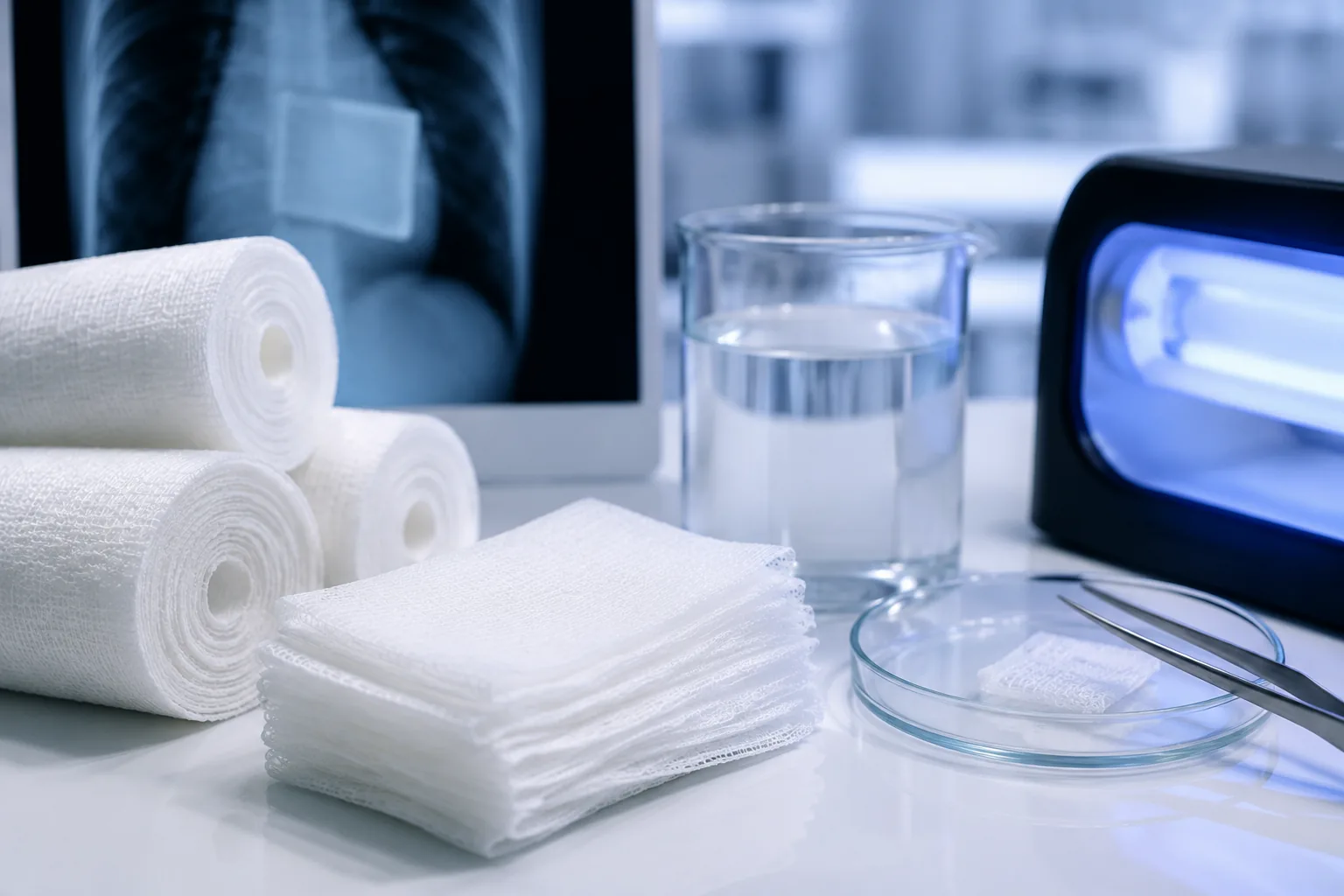
- BS EN 14079:2003, Non-active medical devices — Performance requirements and test methods for absorbent cotton gauze and absorbent cotton and viscose gauze — the harmonised European standard for gauze fabrics, covering the thread count (≥ 19 warp × ≥ 15 weft per cm²), the absorbency (absorption capacity ≥ 23 g per 100 cm²), the sinking time (≤ 10 seconds), the minimum breaking load, the weight per unit area (≥ 17 g/m² after washing), the chemical purity (water-soluble substances, ether-soluble substances, acidity / alkalinity, surface-active substances, starch and dextrin, sulphated ash, fluorescent agents, colouring matter, foreign fibres), and the X-ray detectable component requirements.
- Japanese Pharmacopoeia (JP XIV), Sterile Absorbent Gauze monograph — the JP monograph specifying the thread count per cm, the submersion rate (≤ 8 seconds in water at 24–26 °C), the total ash (≤ 0.25 %), the water-soluble substances, the acid/alkali, the dextrin/starch, the dyes, the fluorescent whitening agents, and the sterility test. The JP monograph classifies gauze by Type (Type 24, Type 20, Type 17) with different thread-count and weight specifications per type.
- YY/T 0331-2024, Performance requirements and test methods for absorbent cotton gauze and absorbent cotton and viscose gauze (std.samr.gov.cn) — the Chinese industry standard adopting EN 14079:2003 for the Chinese market, effective from 1 March 2025, replacing YY/T 0331-2006. YY/T 0331-2024 covers the thread count, the weight per unit area, the minimum breaking load, the absorbency, the water-soluble substances, the acidity/alkalinity (pH 5.0–7.5), the ether-soluble substances, and the fluorescent agents.
- YY/T 0330-2015, Medical absorbent cotton — the Chinese standard for the absorbent cotton used in gauze, covering the purity, the absorbency, and the chemical requirements for the raw cotton material.
- ISO 10993 series, Biological evaluation of medical devices — the biological-evaluation framework for the finished gauze product (Part 5 cytotoxicity, Part 10 sensitisation/irritation).
A point worth stating plainly: USP Type VII and EN 14079 / BP gauze are structurally different products, not interchangeable. The USP Type VII uses an open-weave construction (approximately 19 × 9 threads per inch, ≈ 7.5 × 3.5 per cm²) with heavier yarn (≥ 18.1 g/m²) and a longer sinking time (≤ 30 seconds). The EN 14079 / BP gauze uses a tighter weave (≥ 19 × 15 per cm²) with finer yarn (12–17 g/m²) and a faster sinking time (≤ 10 seconds). A USP Type VII gauze does not meet the EN 14079 thread-count minimum, and an EN 14079 gauze has a different absorbency profile than the USP Type VII. Importing BP/EN 14079 gauze labelled as "USP Type VII equivalent" without verification constitutes a misbranding risk under the FDA regulations. We confirm the target market and the applicable standard before quoting.
How is absorbency tested?
The absorbency — the gauze's ability to take up and retain fluid — is the defining functional property of the medical gauze, because the fluid absorption is the reason the gauze exists. The absorbency is measured by two related but distinct tests: the sinking-time test (the speed of the initial fluid uptake) and the absorption-capacity test (the total fluid the gauze can hold).
The sinking-time test measures the time it takes for the gauze sample to completely submerge when placed on the water surface. The test procedure: a defined sample of the gauze is placed flat on the surface of the water (at the defined temperature — 20 °C for BP, approximately 25 °C for USP, 24–26 °C for JP, and the temperature-controlled water per EN 14079), and the time from the contact to the complete submersion is measured. The acceptance criteria:
- BP Type 13: ≤ 10 seconds
- USP Type VII: ≤ 30 seconds
- EN 14079: ≤ 10 seconds
- JP: ≤ 8 seconds
The difference between the ≤ 10 seconds (BP / EN 14079) and the ≤ 30 seconds (USP) reflects the different weave constructions: the tighter BP / EN 14079 weave absorbs the water faster (the finer yarn and the higher thread density produce the stronger capillary action), while the open USP Type VII weave takes longer to sink initially but holds more total fluid because of the heavier yarn mass.
The absorption-capacity test measures the total fluid the gauze can hold, reported as the grams of water absorbed per 100 cm² of gauze (EN 14079: ≥ 23 g per 100 cm²). The test: the gauze sample is immersed in the water, allowed to saturate, removed, and the absorbed water is quantified by weighing. The absorption capacity is the property that determines how many gauze swabs are needed for a given wound exudate, and it is the parameter the clinical-use planning relies on.
The published clinical research on the surgical gauze absorbency provides the practical data: a 10 × 10 cm gauze absorbs approximately 12 mL of blood (dry) or 9 mL (wetted with saline), a 30 × 30 cm gauze absorbs approximately 100 mL (dry) or 70 mL (wetted), and a 45 × 45 cm gauze absorbs approximately 160 mL (dry) or 140 mL (wetted). The supersaturation (the gauze dripping with blood) increases the capacity by approximately 25 %. These figures illustrate why the absorbency test is the functional test that matters most for the clinical use, and why the wetting with saline before use (the common surgical practice) reduces the effective absorption capacity.
How are thread count and weight verified?
The thread count and the weight per unit area are the construction parameters that determine the gauze's mechanical strength, its lint generation, and its absorbency. These are the fundamental quality parameters that every gauze standard specifies, and they are the parameters that the incoming-quality-control inspection verifies on each batch.
The thread count is the number of threads per unit area in the warp (the lengthways) and the weft (the widthways) directions. The measurement is performed with the calibrated pick glass (the magnifying glass with the defined field of view), counting the threads in the 1 cm × 1 cm frame at multiple positions along the fabric. The acceptance criteria:
| Standard | Warp threads | Weft threads | Unit |
|---|---|---|---|
| EN 14079 | ≥ 19 | ≥ 15 | per cm² |
| BP Type 13 Light | ≥ 19 | ≥ 15 | per cm² |
| USP Type VII | 19 (±1) | 9 (±1) | per inch |
| JP Type 24 | 12 (±1) | 12 (±1) | per cm |
The critical unit-difference caveat: the USP thread count is expressed in threads per inch, while the BP and EN 14079 use threads per cm². Comparing the USP 19 × 9 per inch to the EN 14079 19 × 15 per cm² without the unit conversion is the most common specification error in the gauze procurement. After conversion (÷ 2.54), the USP Type VII ≈ 7.5 × 3.5 per cm² — significantly fewer threads per cm² than the EN 14079 minimum. USP Type VII and EN 14079 are different product categories suited to different clinical contexts.
The weight per unit area (in g/m²) is measured by cutting a defined area (commonly 10 × 10 cm) of the gauze, conditioning it at the defined humidity (the sodium-nitrite-saturated desiccator per JP, or the standard textile-conditioning atmosphere), and weighing it. The acceptance criteria: BP Type 13 Light 12–16 g/m²; USP Type VII ≥ 18.1 g/m²; EN 14079 ≥ 17 g/m² after washing. The weight is the more reliable QC parameter than the thread count when comparing across standards, because it is measured objectively by the mass-per-area and is less subject to the measurement-protocol variation.
What chemical purity tests are required?
The chemical-purity tests verify that the gauze contains nothing harmful that could leach into the patient's wound — the residual processing chemicals, the bleaching agents, the sizing agents, the dyes, and the prohibited additives like the optical brighteners. These tests are the ones that protect the patient from the chemical harm, and they are the tests that the EN 14079 and the BP monographs specify in detail.
The chemical-purity test set, drawn from the EN 14079 and the BP monographs:
- Water-soluble substances — the gauze is boiled in water, the extract is evaporated, and the residue mass must be within the limit. This test catches the residual processing chemicals (the caustic soda, the detergents) that were not fully washed out.
- Ether-soluble substances — the gauze is extracted with ether, and the residue must be within the limit. This test catches the residual waxes, oils, and weaving lubricants that impair the absorbency.
- Acidity or alkalinity — the extract is tested with the phenolphthalein and the methyl orange indicators, and neither indicator must show the colour change. This test catches the residual alkali from the bleaching or the residual acid from the neutralisation.
- Surface-active substances — the extract is tested for the presence of the detergents or the wetting agents, which must be absent. This test catches the deliberate addition of the wetting agents to improve the absorbency — a practice that is dangerous because the wetting agents leach into the wound.
- Starch and dextrin — the extract is tested with the iodine solution, and no blue or red-purple colour must develop. This test catches the residual sizing starch from the weaving process, which could cause the foreign-body reaction in the wound.
- Sulphated ash — the gauze is incinerated with the sulfuric acid, and the ash must be within the limit (JP: ≤ 0.25 %). This test catches the deliberate weight-augmentation (the addition of the inert mineral fillers to increase the gauze weight falsely).
- Fluorescent whitening agents — the gauze is examined under the ultraviolet light, and no fluorescence must be perceptible (except the slight brownish fluorescence of the natural cotton). The optical brighteners are the prohibited additives that provide no functional benefit and are potential carcinogens. The BP monographs make it clear that the gauze treated with the optical brighteners is not acceptable, and the EN 14079 requires the UV test. The USP monograph does not specify the fluorescent-agent test — a gap that the EN 14079 and the BP fill.
- Colouring matter — if the gauze is dyed (green or blue for the surgical use), the dye must be non-toxic and the soluble dye residues must be removed. The ethanol extraction test verifies the dye-fastness.
- Foreign fibres — the microscopic examination confirms the cotton identity (the flattish oval tubes) and detects the foreign fibres (the viscose appearing as the long striated threads) that may dilute the product quality.
How is sterility assured?
For the sterile gauze products (the individually packaged sterile gauze swabs, the sterile laparotomy sponges, the sterile dressing packs), the sterility is the critical safety property that protects the patient from the infection. The sterility is assured by the validated sterilisation process (the ethylene oxide or the gamma irradiation) and verified by the sterility test.
The sterility test (JP Sterile Absorbent Gauze monograph): the sample is taken aseptically from the package, immersed in the fluid thioglycolate medium (for the bacterial detection) and the glucose-peptone medium (for the fungal detection), and incubated for the defined period. The sample number depends on the sterilisation batch size: 4 samples for ≤ 100 units, 10 for 100–500, 20 for ≥ 500. The acceptance criterion: no growth in any of the test media.
The sterility-assurance level (SAL) is the probability of a viable microorganism on a unit after the sterilisation, and for the medical gauze the required SAL is 10⁻⁶ (one in a million). The SAL is not measured directly — it is assured by the validated sterilisation process — but the bioburden before the sterilisation and the sterilisation-cycle validation are the data that demonstrate the SAL achievement. The sterilisation validation (ISO 11137 for the radiation, ISO 11135 for the ethylene oxide) is the framework that qualifies the sterilisation process for the gauze product.
What is the X-ray detectable component test?
The X-ray detectable component is the feature that allows the gauze swab to be detected inside the patient by the X-ray imaging, in the event of the swab being unaccounted for after the surgical closure. The detectable component (the barium-sulphate-impregnated thread, the tin-lead strip, or the woven-in detectable tape) must be securely attached to the gauze, sufficiently X-ray-opaque to be visible on the radiograph, and flexible enough not to cause the patient injury.
The BP monographs require that all X-ray detectable components are securely fixed to the fabric — the detectable thread must be folded into the body of the pad so that, if the fixation fails, the thread remains trapped within the swab. The abdominal swabs may use the strips or patches of the detectable material stitched into one corner.
The detectability test verifies that the detectable component is visible on the X-ray image at the defined exposure settings. The test is the one that qualifies the gauze for the surgical use where the retained-surgical-item risk exists. The published clinical research on the retained surgical items — the gauze left in the body cavity — documents the serious consequences: the reoperation, the infection, the prolonged hospitalisation, and in the worst cases the patient death. The X-ray detectable component is the safety feature that allows the detection of the retained swab without the exploratory reoperation, and its test is the one that qualifies this safety feature.
How do the Chinese YY/T standards align?
The Chinese framework for the medical gauze testing uses the industry standards that adopt the European EN 14079 for the Chinese market:
- YY/T 0331-2024, 脱脂棉纱布、脱脂棉粘胶混纺纱布的性能要求和试验方法 (Performance requirements and test methods for absorbent cotton gauze and absorbent cotton and viscose gauze) (std.samr.gov.cn) — the Chinese industry standard, effective from 1 March 2025, replacing YY/T 0331-2006. YY/T 0331-2024 is the modified adoption of EN 14079:2003, covering the thread count, the weight per unit area, the minimum breaking load, the absorbency, the water-soluble substances, the acidity/alkalinity (pH 5.0–7.5), the ether-soluble substances, and the fluorescent agents.
- YY/T 0330-2015, 医用脱脂棉 (Medical absorbent cotton) — the Chinese standard for the absorbent cotton raw material, covering the purity, the absorbency, and the chemical requirements.
- YY/T 0594, 外科纱布敷料通用要求 (General requirements for surgical gauze dressings) — the Chinese standard for the finished gauze-dressing products, referencing YY/T 0331 for the gauze fabric requirements.
- YY 0854.1, 医用全棉非织造布敷布性能要求 (Performance requirements for medical cotton nonwoven dressings) — for the non-woven gauze products.
The YY/T 0331-2024 is the current edition (March 2025 implementation), and the transition from YY/T 0331-2006 must be confirmed at the project scoping. The pH range 5.0–7.5 is the Chinese-specific acceptance criterion that aligns with the EN 14079.
FAQ
Which standard should my gauze be tested to?
It depends on the target market. USP Type VII for the U.S. market (FDA 21 CFR Part 878). BP Type 13 or EN 14079 for the European market. JP Sterile Absorbent Gauze for the Japanese market. YY/T 0331-2024 for the Chinese market (NMPA). We confirm the target market before quoting. Note that USP Type VII and EN 14079 are structurally different products — the thread count, the weight, and the sinking time all differ — and they are not interchangeable.
What is the sinking-time test?
The sinking-time test measures how quickly the gauze sinks when placed on the water surface. BP and EN 14079 require ≤ 10 seconds; USP requires ≤ 30 seconds; JP requires ≤ 8 seconds. The faster sinking indicates the stronger capillary action from the tighter weave. The slower USP sinking reflects the open-weave construction of Type VII, which holds more total fluid despite the longer initial sinking time.
Why are fluorescent whitening agents prohibited?
Because they provide no functional benefit to the gauze's performance, they are complex chemical compounds some of which are potential carcinogens, and they can cause skin irritation. The BP monographs and EN 14079 explicitly prohibit the fluorescent whitening agents on the gauze. The UV test (no fluorescence under the ultraviolet light) is the screening method. A gauze that shows the bright blue fluorescence has been treated with the optical brightener and is non-compliant.
How is the gauze sterilisation validated?
The sterilisation is validated under ISO 11137 (radiation) or ISO 11135 (ethylene oxide), with the bioburden testing before the sterilisation, the sterilisation-cycle qualification, and the sterility test after the sterilisation. The required SAL is 10⁻⁶. The sterilisation validation is the framework that demonstrates the sterility assurance, and the sterility test is the verification.
Can you test the X-ray detectable component?
Yes. We verify the detectable component's X-ray opacity (the visibility on the radiograph at the defined exposure), the secure attachment to the gauze fabric (the pull test), and the flexibility (the detectable component must not be brittle or sharp). The X-ray detectable component is the safety feature that prevents the retained-surgical-item complication, and its test is the one that qualifies this feature.
Our medical gauze testing service
Our laboratory provides medical gauze testing across the full standard stack — the USP Type VII (U.S.), the BP Type 13 monograph (UK), the BS EN 14079 (Europe), the JP Sterile Absorbent Gauze (Japan), and the YY/T 0331-2024 (China) — covering the absorbency, the thread count, the weight, the chemical purity, the sterility, and the X-ray detectable component. Each project begins with a scoping step that confirms the gauze type (the woven / non-woven, the cotton / cotton-viscose blend, the sterile / non-sterile), the target market, the applicable standard, and the regulatory pathway.
We measure the sinking time and the absorption capacity; the thread count by the pick glass; the weight per unit area by the conditioning and weighing; the chemical purity (water-soluble substances, ether-soluble substances, acidity/alkalinity, surface-active substances, starch and dextrin, sulphated ash, fluorescent agents, colouring matter, foreign fibres); the minimum breaking load; the sterility by the pharmacopoeial method; the X-ray detectable component; and the biocompatibility by the ISO 10993 / GB/T 16886 test set. Reports are issued with the standard, the method, the measured values, the pharmacopoeial limits, and the conformity conclusion explicitly stated, in a format suitable for the FDA submission, the CE marking, the NMPA registration, or the incoming-quality-control inspection.
To start a project, send us the gauze type, the material (100 % cotton or blend), the ply and the mesh, the sterile / non-sterile status, the target market, the applicable standard, and whether the project is the pharmacopoeial conformity, the sterility validation, the incoming QC, or the full registration support. We will return a project scope, sample requirement, schedule and quotation, and begin testing on your confirmation.