Plush toy testing is the laboratory verification that a plush or stuffed toy (毛绒、布制玩具) meets its product-specific standard GB/T 9832 (Plush and Cloth Toys) and the mandatory general-toy-safety standard GB 6675.1-4-2014 (Toy Safety), together with the electric-toy standard GB/T 19865 where the toy has electrical functions. The defining trait of plush-toy testing — and the part that distinguishes it from general toy testing — is that the plush product standard (GB/T 9832) carries requirements general toys do not have: filling-material cleanliness and hygiene, seam/sewing strength, filling uniformity, and now, in the just-published GB/T 9832-2026, the textile-safety parameters formaldehyde, pH, colorfastness, and odor imported from the textile world. A complete plush-toy compliance report draws on both the product layer and the mandatory safety layer.
The Two-Layer Structure
The most important framing fact is that plush-toy testing is built from two layers of standards that must be applied together:
| Layer | Standard | What it governs |
|---|---|---|
| Product (plush-specific) | GB/T 9832 — Plush and Cloth Toys | Filling cleanliness/hygiene, seam/sewing strength, filling uniformity, appearance; 2026 edition adds formaldehyde, pH, colorfastness, odor |
| Mandatory safety (all toys) | GB 6675.1-4-2014 — Toy Safety | General toy safety: .1 basic, .2 mechanical & physical (small parts, edges), .3 flammability, .4 heavy-metal migration |
GB/T 9832 references GB 6675 as the mandatory safety base and layers the plush-specific product requirements on top. A report citing only GB 6675 (the general-toy safety) without GB/T 9832 (the plush product) is incomplete — it misses the filling-cleanliness and seam-strength requirements that define a plush toy's fitness.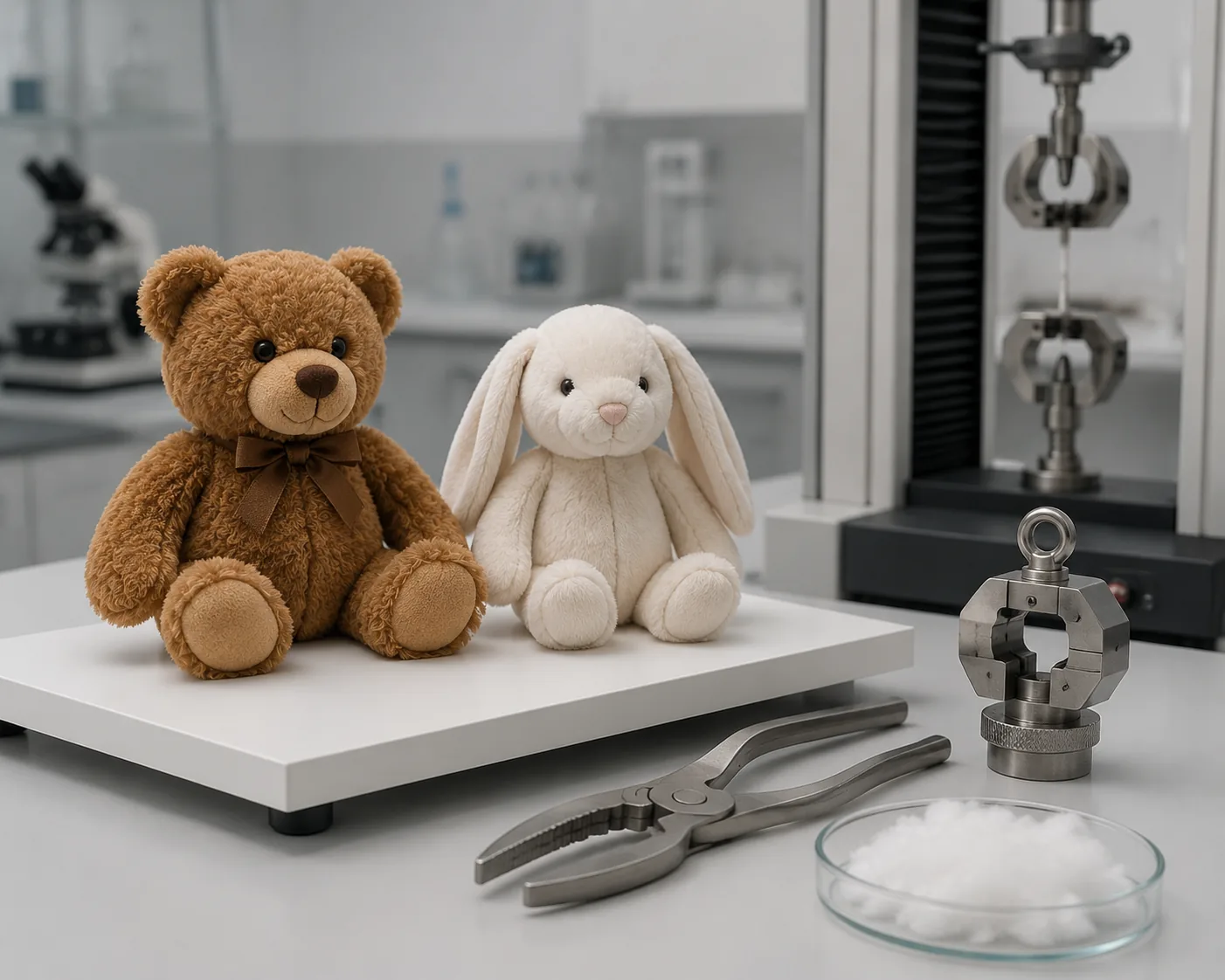
The Product Standard: GB/T 9832 — 2007 and the New 2026 Edition
GB/T 9832 applies to toys whose main outer fabric is plush or cloth and which contain filling material — covering dolls, stuffed animals, plush figures, cushions, and pillow-toys, with or without clothing. The current edition is GB/T 9832-2007, replacing GB 9832-1993 (note the prefix change from mandatory GB to recommended GB/T at the 2007 revision). The product standard covers:
- Filling-material cleanliness and hygiene — the internal filling (PP cotton, polyester fiber, foam, etc.) must be clean, free of foreign matter, and hygienically safe. This is plush-specific: a general plastic toy has no filling to test.
- Seam/sewing strength (缝边牢度) — the seams that keep the filling inside must resist the child pulling at them. A seam that opens releases the filling, creating both a choking hazard and a hygiene failure.
- Filling uniformity and appearance — the filling must be evenly distributed, and the toy's appearance must meet defined quality criteria.
- Cleaning and maintenance — requirements for how the toy tolerates and is labeled for cleaning.
GB/T 9832-2026 — the Brand-New Revision
A major timeliness point: GB/T 9832-2026 is the new revision that fully replaces GB/T 9832-2007. The 2026 edition adds the health-safety parameters inherited from the textile world:
- Formaldehyde — now a required indicator, because the plush fabric is a textile in skin contact.
- pH value — the fabric's pH within a defined range.
- Colorfastness — resistance of the fabric dye to rubbing, washing, and saliva (a child chews the toy).
- Odor — no unusual odor.
These additions align plush-toy safety with the textile-safety framework (GB 18401) that already governs skin-contact textiles, recognizing that a plush toy's fabric is functionally a textile. The 2026 edition also further refined the seam-strength, filling-uniformity, and cleaning requirements. A current plush-toy product report should cite the applicable edition (2007 or 2026) and include the new formaldehyde/pH/colorfastness/odor parameters where the 2026 edition applies.
The Mandatory Safety Base: GB 6675.1-4-2014
The general-toy-safety standard GB 6675-2014 (IDT ISO 8124) is the mandatory base for all toys, including plush. It is published in four parts:
| Part | What it governs | Plush relevance |
|---|---|---|
| GB 6675.1 — Basic规范 | General requirements, age grading, labeling | Applies |
| GB 6675.2 — Mechanical & physical | Small parts, sharp edges, seams/tension, projectile | Critical: small-parts (eyes, noses, attachments) must withstand defined tension; seams must not open under the small-parts tension test |
| GB 6675.3 — Flammability | Fabric/material burning behavior | Critical: plush fabric burns — this is the test the Pennsylvania Stuffed Toy Law checks, but under GB it is GB 6675.3 |
| GB 6675.4 — Specific-element migration | Heavy metals (Sb, As, Ba, Cd, Cr, Pb, Hg, Se) leachable from toy materials | Applies to the fabric, filling, and painted/coated parts |
For plush toys, GB 6675.2 (small parts and seam tension) and GB 6675.3 (flammability) are the two most consequential parts: the small-parts test (a 90 N tension test on attached components like eyes and noses, the same test the Mecmesin competitor describes under EN 71-1) catches detachable parts, and the flammability test catches plush fabrics that burn too readily. GB 6675.4 catches heavy metals in the dyed fabric and filling.
Electric Plush Toys: GB/T 19865
Where the plush toy has electrical functions (battery-operated sound, light, or motion), it must additionally meet GB/T 19865 (Electric Toys — Safety), the electric-toy safety standard that governs the battery compartment, wiring, and heat-generation safety. Electric plush toys are tested under both GB/T 9832 + GB 6675 and GB/T 19865.
What the Search Results Get Wrong
The search results for "plush toy testing" / "stuffed toy testing" are dominated by content that does not frame the GB compliance structure:
- Pennsylvania Stuffed Toy Law (PA Dept of Labor & Industry) — mandatory stuffed-toy registration, the law-label flammability/contents check, and the PA registration number. US state regulation, zero GB.
- Mecmesin tension-test instrument — small-parts tension test on plush per BS EN 71-1 (90 N) and ASTM F963. Instrument-vendor, EN/ASTM only, zero GB.
- Purnaa US stuffed-toy guide — US safety requirements, ASTM F963, CPSIA lead/phthalates. US-market guide, zero GB.
None tells a plush-toy manufacturer, an exporter, or a quality lab which GB/T product standard and which GB 6675 parts apply, what the GB/T 9832-2026 changes mean, or what the filling-cleanliness and seam-strength requirements are. That compliance question is what this article addresses.
Our Testing Capabilities
Beijing ZKGX Research conducts plush and stuffed toy testing across the two-layer structure:
- Product (GB/T 9832-2007 / 2026): filling-material cleanliness and hygiene, seam/sewing strength, filling uniformity, appearance, and cleaning — plus the 2026 edition's new formaldehyde, pH, colorfastness, and odor parameters.
- Mandatory safety (GB 6675.1-4-2014): mechanical & physical (GB 6675.2 — small parts, tension, seam integrity), flammability (GB 6675.3 — plush fabric burning behavior), and specific-element migration (GB 6675.4 — heavy metals in fabric, filling, and coatings).
- Electric plush (GB/T 19865): battery compartment, wiring, and heat-generation safety for battery-operated plush toys.
- Sample types: plush and cloth toys, stuffed animals, dolls, plush figures, cushions, and pillow-toys, with and without electrical functions, for all age grades.
- Deliverable: a test report identifying the product, the applicable product-standard edition (GB/T 9832-2007 or 2026), each measured value with its method citation, and pass/fail against both the product standard and the GB 6675 safety base.
If you have a plush or stuffed toy product requiring compliance verification, contact our testing team to scope the applicable product-standard edition, the GB 6675 safety parts, and whether the electric-toy standard (GB/T 19865) applies.
Frequently Asked Questions
What standard governns plush toy testing?
It is a two-layer structure: GB/T 9832 (Plush and Cloth Toys, the product standard — filling cleanliness, seam strength, filling uniformity; 2026 edition adds formaldehyde/pH/colorfastness/odor) and GB 6675.1-4-2014 (Toy Safety, the mandatory base — mechanical/small parts, flammability, heavy metals). Electric plush toys also meet GB/T 19865.
What changed in GB/T 9832-2026?
The 2026 edition, replacing GB/T 9832-2007, adds the textile-safety parameters formaldehyde, pH, colorfastness, and odor — recognizing that the plush fabric is a skin-contact textile. It also further refined the seam-strength, filling-uniformity, and cleaning requirements. A current plush product report should cite the applicable edition and include the new parameters where 2026 applies.
Is plush toy testing the same as general toy testing?
No. Plush toys carry requirements general toys do not have: filling-material cleanliness and hygiene (no general toy has filling), seam/sewing strength (keeps the filling in), and the 2026 edition's textile-safety parameters. A plush toy is tested under the general GB 6675 safety base plus the plush-specific GB/T 9832 product standard.
What are the flammability requirements for a plush toy?
Under GB 6675.3-2014 (the flammability part of the mandatory toy-safety standard), plush fabrics must not burn too readily — the fabric's burning behavior is tested and graded. This is the test the Pennsylvania Stuffed Toy Law checks at the US-state level; under GB it is GB 6675.3, and it is one of the two most consequential plush-toy safety tests (the other being the GB 6675.2 small-parts/seam tension test).
Do plush toys need the small-parts tension test?
Yes. Under GB 6675.2-2014, attached components on a plush toy — eyes, noses, buttons, ribbons — must withstand a defined tension force (commonly 90 N, the same as EN 71-1) without detaching, because a detached small part is a choking hazard. The seam that holds the filling must also resist the child pulling at it; a seam that opens releases the filling, which is both a choking and a hygiene failure.