Table of Contents
- Why Is Polyolefin Testing Necessary?
- How Does DSC Characterize Polyolefin Thermal Behavior?
- Why Does Polyolefin DSC Precision Lag Behind Metal Standards?
- How Is Molecular Weight Measured (HT-GPC)?
- How Are Comonomer Content and Long-Chain Branching Measured (NMR)?
- What Are Melt Flow Rate and Density Tests?
- Which Standards Govern Polyolefin Testing (ISO, GB/T, ASTM)?
- FAQ
- Our Polyolefin material testing Capabilities
Why Is Polyolefin Testing Necessary?
Polyolefins — polyethylene (HDPE, LDPE, LLDPE) and polypropylene (PP) — are the world's highest-volume plastics, and their end-use performance is governed by molecular and thermal properties that cannot be inferred from chemistry alone, only measured. A polyolefin's grade, processability, mechanical strength, and optical behavior are set by four interlocking parameters: molecular weight distribution, comonomer content, crystallinity (and its thermal signature), and melt flow behavior. Two resins with identical nominal chemistry can process completely differently and yield different final-product properties because their molecular-weight distribution or comonomer incorporation differs. Testing is how a producer proves a lot meets its grade, how a converter selects the right resin for an application, and how a recycler qualifies a recycled polyolefin for food-contact reuse.
The testing volume reflects the material's ubiquity. Between 2000 and 2025, more than 7,500 global patent applications cited DSC (differential scanning calorimetry) data as a property specification — a footprint that makes DSC the most widely referenced single test method in the polyolefin industry. The reason is direct: polyolefins are semi-crystalline, and their crystallization and melting behavior (Tm, Tc, ΔHm) correlates tightly with density, stiffness, and barrier performance. A polyolefin lot that has not been characterized by DSC, GPC, and melt-flow testing is a lot whose processing behavior and end-use properties are unverified.
How Does DSC Characterize Polyolefin Thermal Behavior?
Differential scanning calorimetry (DSC) measures the heat flow difference between a sample and an inert reference as both are heated and cooled at a controlled rate, revealing the thermal transitions that define a polyolefin's crystalline structure. The method subjects a milligram-scale sample to a defined temperature program — heat to erase thermal history, cool to crystallize, reheat to melt — and the resulting thermogram yields the parameters that grade the resin:
| Parameter | What It Reveals |
|---|---|
| Tm (melting temperature) | Crystallite perfection and thickness; correlated with density |
| Tc (crystallization temperature) | Nucleation and crystallization kinetics during cooling |
| ΔHm (enthalpy of fusion) | Total crystallinity — the area under the melting peak |
| Xc (relative crystallinity) | Calculated from ΔHm / ΔH⁰m, where ΔH⁰m for 100% crystalline PE = 293 J/g |
From these, downstream properties are derived. Relative crystallinity (Xc) is calculated by dividing the measured ΔHm by the theoretical enthalpy of fusion for 100% crystalline polyethylene (293 J/g), and that crystallinity value correlates directly with the resin's density. For copolymers such as EVA (ethylene-vinyl acetate), Tm and ΔHm fall monotonically as vinyl-acetate content rises — so precisely that high-precision DSC data can predict comonomer content along a calibrated curve. This is why DSC is the workhorse polyolefin characterization method: one measurement yields thermal, structural, and compositional information simultaneously.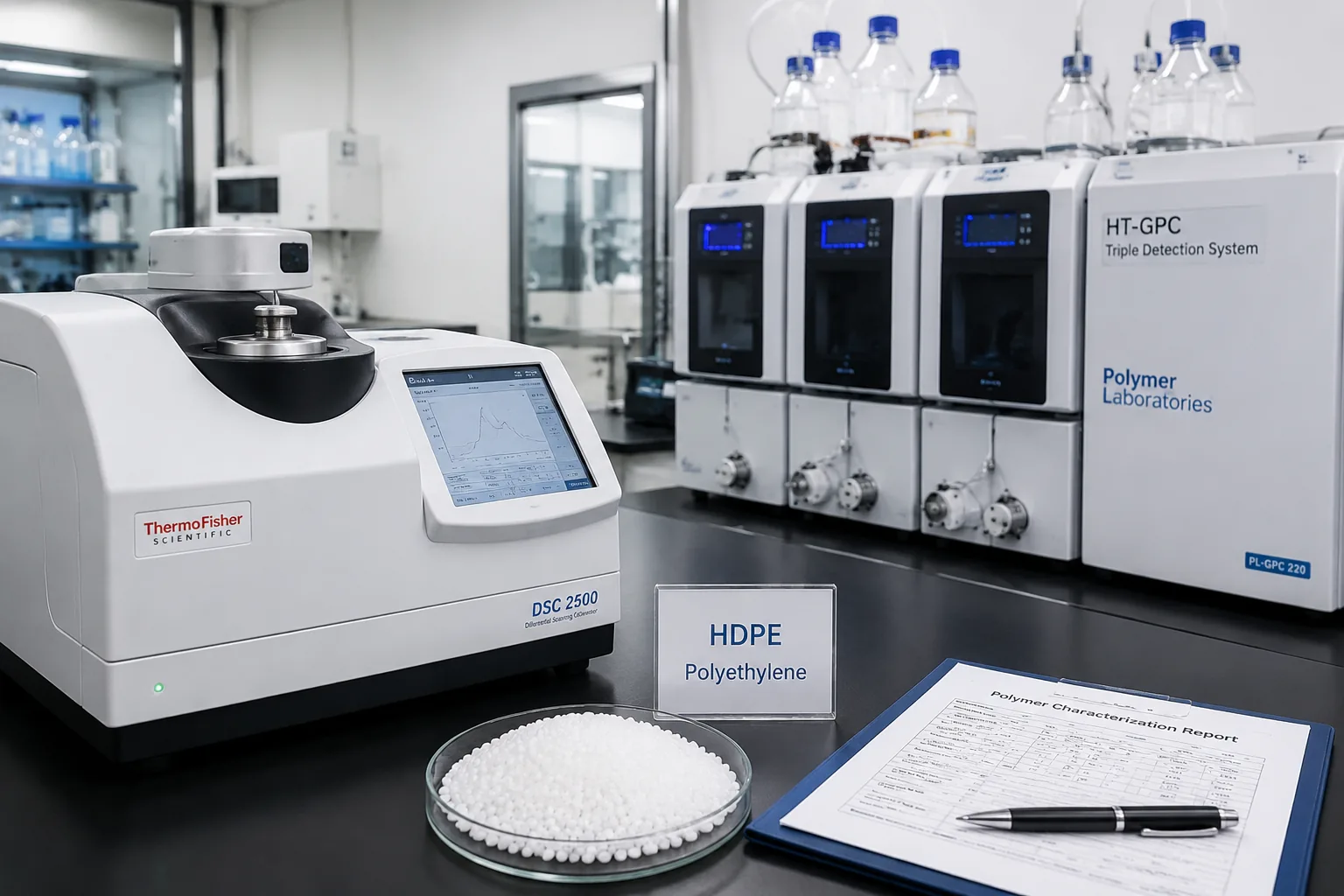
Why Does Polyolefin DSC Precision Lag Behind Metal Standards?
A widely-recognized but under-discussed issue in polyolefin testing is that DSC precision on polyolefins is much poorer than the precision the same instrument achieves on metal calibration standards. The gap is large enough to cause real commercial consequences, and the data quantify it precisely.
DSC instruments are calibrated with high-purity metals (indium, tin, zinc) that have sharp, well-defined melting transitions. On indium, a typical DSC achieves a melting-onset standard deviation of σ = 0.03 °C — exceptional reproducibility. But when the same instrument, under standardized protocols (ASTM E967/E968, ISO 11357), tests a medical-grade HDPE reference material, the Tm standard deviation degrades to σ = 0.48 °C — a 16-fold precision loss. That variability is not an instrument defect; it reflects the physics of semi-crystalline polymers.
The root cause is the broad, asymmetrical melting transition of polyolefins, which originates from the polydispersity of crystallite sizes and defective long-range ordering within the lamellar microstructure — fundamentally different from a metal's discrete lattice-to-liquid transition. The Chinese national standard GB/T 19466.3-2004 documents the resulting precision limits explicitly: for HDPE tested across 14 laboratories, melting-point repeatability r = 1 °C and reproducibility R = 6 °C; for PP, r = 2 °C and R = 5 °C.
Precision can be recovered, but only through protocol optimization. A recent study demonstrated that optimizing three variables — extending thermal-history-elimination time (to 8 minutes), using compression-molded plaque samples (500 μm thick, uniform geometry), and tightening sample-mass control (to 5–5.5 mg) — reduced the HDPE Tm standard deviation from 0.48 °C to 0.11 °C, a 4.4-fold improvement that brings polyolefin DSC close to the practical precision ceiling for the material. The practical stake: a 2.9 °C Tm span (the ±3σ range at σ = 0.48 °C) corresponds to a density shift large enough to misclassify a resin's grade — which is why precision optimization is not academic, it is a commercial-grade-control necessity.
How Is Molecular Weight Measured (HT-GPC)?
High-temperature gel permeation chromatography (HT-GPC) is the primary method for measuring the molecular-weight distribution (MWD) of polyolefins, which sets the resin's processability and mechanical strength. Polyolefins require high-temperature GPC (typically 140–160 °C, with the polymer dissolved in a high-boiling solvent such as 1,2,4-trichlorobenzene) because they are crystalline and insoluble at room temperature.
A modern HT-GPC system uses a triple-detector configuration — infrared (IR) concentration detector, four-bridge viscometer, and multi-angle light scattering (LS) — to measure not only the conventional molecular-weight averages but also the absolute molecular weight, intrinsic viscosity, and branching:
| Output | What It Tells the Producer |
|---|---|
| Mw (weight-average molecular weight) | Overall chain length; drives melt strength and toughness |
| MWD (molecular-weight distribution) | Breadth of chain lengths; narrow MWD = uniform processing, broad MWD = easier extrusion |
| Intrinsic viscosity (IV) | Hydrodynamic volume; correlates with Mw for linear chains |
| Bulk Mw by LS | Absolute molecular weight, sensitive to long-chain branching |
Pellet-to-pellet homogeneity — measured by running 40+ individual pellets on HT-GPC and checking the standard deviation of Mw and MWD — is the quality benchmark for a reference material or a production lot. For a well-controlled HDPE, Mw σ across 40 pellets is around 3%, and MWD σ around 3.25% — low enough to confirm the lot is uniform for downstream DSC and process qualification.
How Are Comonomer Content and Long-Chain Branching Measured (NMR)?
13C nuclear magnetic resonance (NMR) spectroscopy is the definitive method for quantifying comonomer content (the fraction of non-ethylene units incorporated into the chain) and long-chain branching (LCB) in polyolefins — two microstructural features that DSC and GPC can only infer indirectly.
Comonomer content (e.g., octene in LLDPE, vinyl acetate in EVA) determines density, crystallinity, and flexibility. 13C NMR quantifies it by counting the characteristic carbon resonances of the comonomer versus the ethylene backbone. The conventional inverse-gated 13C NMR experiment, however, requires roughly 15 hours of acquisition on a 400 MHz instrument to reach adequate signal-to-noise for low-comonomer polyethylenes. Sensitivity-enhanced pulse sequences (RINEPT and its adiabatic variants) cut that to roughly 12 minutes — a better-than-76-fold reduction — while preserving quantitative accuracy, making routine comonomer measurement practical for QC.
Long-chain branching (LCB) is structurally subtler and commercially important: even trace LCB (below 0.01 branch per 1000 carbons) measurably affects melt rheology and processability. 13C NMR with a sensitivity-enhanced sequence reaches a level of detection of 0.01 branch/1000C for T-shaped LCB — a detection limit that would require over 5,000 hours of acquisition by the conventional method. HT-GPC with a light-scattering detector corroborates LCB independently by flagging chains whose absolute Mw (by LS) exceeds their conventional Mw. Together, NMR and triple-detector HT-GPC provide the complete microstructural picture: comonomer content and branch frequency, quantified to trace levels.
What Are Melt Flow Rate and Density Tests?
Two simpler, high-volume QC tests round out the polyolefin characterization suite and are typically run on every lot:
| Test | What It Measures | Standard Conditions |
|---|---|---|
| Melt flow rate (MFR / MVR) | Mass (or volume) of polymer extruded through a standard die in 10 minutes under a set load — a proxy for molecular weight and processability | 190 °C, 2.16 kg load (for PE); 230 °C, 2.16 kg (for PP) |
| Density (ρ) | Mass per unit volume — the primary grade descriptor for polyethylene (HDPE ~0.960, LLDPE ~0.920, LDPE ~0.920 g/cm³) | Gradient column or displacement method |
MFR (g/10 min) is the single most-cited processing parameter on a polyolefin data sheet because it predicts how the resin will flow in injection molding or extrusion. Density determines the resin family (HDPE / LLDPE / LDPE) and correlates with stiffness, barrier performance, and melting temperature. These two tests, plus DSC, form the minimum characterization set that defines a polyolefin grade; GPC and NMR are added when the application requires molecular or microstructural detail beyond what flow and density provide.
Which Standards Govern Polyolefin Testing (ISO, GB/T, ASTM)?
Polyolefin testing methods are harmonized across three parallel standard frameworks that specify the apparatus, procedure, and reporting:
| Measurement | ISO | GB/T (China) | ASTM |
|---|---|---|---|
| DSC (general principles) | ISO 11357-1:2016 (8-part series) | GB/T 19466 (series) | E967 (temperature calibration), E968 (heat-flow calibration) |
| Melt flow rate (MFR/MVR) | ISO 1133-1:2011 | GB/T 3682.1-2018 | D1238 |
| DSC melting/crystallization (Part 3) | ISO 11357-3 | GB/T 19466.3-2004 | — |
The three frameworks are methodologically equivalent for the measurements they cover — a DSC run to ISO 11357-3 and GB/T 19466.3 follows the same heating/cooling protocol and reports the same parameters (Tm, Tc, ΔHm). The GB/T standards are modified-adopted from the ISO originals, so a Chinese-lab test report is acceptable against the ISO method and vice versa. A complete polyolefin characterization report cites the standard for each measurement (DSC, MFR, density, and where applicable GPC and NMR), so a lot qualified for one market can be cross-read against another's requirements.
FAQ
Why is DSC the most widely used single test in polyolefin characterization?
Because polyolefins are semi-crystalline, and DSC measures the melting and crystallization behavior that directly sets crystallinity, density, and stiffness — three properties that define a resin's grade and end-use performance. Over 7,500 patents filed between 2000 and 2025 cite DSC data, reflecting its industry footprint. One DSC measurement yields thermal, structural, and (via calibration) compositional information simultaneously.
What precision can DSC achieve on polyolefins?
With standard protocols (ASTM E967/E968, ISO 11357), the melting-temperature standard deviation for a well-controlled HDPE is about 0.48 °C — roughly 16× worse than the 0.03 °C achievable on indium calibration standards. With an optimized protocol (8-minute thermal-history elimination, compression-molded 500 μm plaque, 5–5.5 mg sample mass), the σ can be reduced to about 0.11 °C, a 4.4-fold improvement.
How is comonomer content measured in LLDPE or EVA?
The definitive method is 13C NMR, which counts the characteristic carbon resonances of the comonomer versus the ethylene backbone. Conventional inverse-gated 13C NMR requires ~15 hours per acquisition; sensitivity-enhanced RINEPT pulse sequences cut that to ~12 minutes while preserving quantitative accuracy. For EVA, high-precision DSC can also predict vinyl-acetate content along a calibrated Tm/ΔHm curve.
What is the difference between MFR and Mw?
MFR (melt flow rate) is a flow-based proxy for molecular weight — it measures how much polymer extrudes through a die in 10 minutes under set load (g/10 min). Mw (weight-average molecular weight) is the direct measure from HT-GPC, in g/mol. MFR is fast, cheap, and used on every lot for QC; Mw requires HT-GPC and is used when the application needs the full molecular-weight distribution, not just a flow index.
Can polyolefin testing qualify recycled material for food contact?
Yes, but it requires a dedicated challenge test — a process-specific decontamination test that deliberately contaminates the plastic with surrogate chemicals and measures how well the recycling process removes them. The EU framework is Regulation 2022/1616; FDA guidance (largely unchanged since 2006) is built around PET and does not address polyolefin behavior specifically. A validated, reproducible challenge-test protocol for HDPE and PP has recently been developed (WRAP / Innovate UK, seven-phase), giving recyclers the evidence base for food-grade polyolefin submission.
Which DSC standard applies in China?
GB/T 19466 (the series, corresponding to ISO 11357) governs DSC methods for plastics in China. GB/T 19466.3-2004 specifically covers melting and crystallization temperatures and enthalpy. It is modified-adopted from ISO 11357-3, so the procedure and reported parameters are equivalent. The standard also documents the precision limits (HDPE: r = 1 °C, R = 6 °C; PP: r = 2 °C, R = 5 °C) that characterize inter-laboratory reproducibility.
Our Polyolefin Material Testing Capabilities
Beijing ZKGX Research Institute provides third-party analytical testing for polyolefin resins — HDPE, LDPE, LLDPE, PP, and polyolefin copolymers (EVA, POE). Our testing follows the validated ISO, GB/T, and ASTM frameworks, applied to each lot's grade, application, and regulatory target.
Standards / Methods Our Testing Covers
| Test Endpoint | Method Reference |
|---|---|
| DSC — thermal analysis (Tm, Tc, ΔHm, Xc) | ISO 11357 / GB/T 19466 / ASTM E967, E968 |
| Melt flow rate (MFR / MVR) | ISO 1133-1 / GB/T 3682.1-2018 / ASTM D1238 |
| Density (ρ) | Gradient column / displacement method |
| Molecular weight & distribution (HT-GPC) | Triple-detector HT-GPC (IR + viscometer + LS) |
| Comonomer content & long-chain branching (NMR) | Quantitative 13C NMR (conventional and sensitivity-enhanced) |
| Recycled polyolefin food-contact challenge test | EU 2022/1616 / FDA guidance / WRAP 7-phase protocol |
What We Can Test
- Virgin polyolefin resins (HDPE / LDPE / LLDPE / PP) — full grade characterization (DSC, MFR, density, GPC)
- Polyolefin copolymers (EVA, POE, EMA) — comonomer content by NMR, thermal behavior by DSC
- Recycled polyolefins (rHDPE, rPP) — decontamination challenge testing for food-contact qualification
- Production-lot QC — DSC, MFR, density on lot samples for consistency verification
Sample Types We Accept
Pellet, powder, and compression-molded plaque samples. DSC uses milligram-scale specimens (typically 5–10 mg) cut from pellets or molded plaques; HT-GPC uses individual pellets dissolved in high-boiling solvent; NMR uses solution samples in deuterated solvent at elevated temperature.
Get a Testing Quote
If you need to characterize a polyolefin resin for grade qualification, qualify a recycled polyolefin for food-contact reuse, or verify production-lot consistency — our team will confirm the applicable method, sample requirements, and a quotation. Contact Beijing ZKGX Research Institute to start.